I will not judge michele bachmann on her personal relationship with Jesus Christ, that is up to Jesus to do. I do not recognize her attitudes and policies of lying and misleading people, using hate, deception, fear mongering and propaganda for political gain in Christian teaching. I do not recognize her dismissal of, her disdain for those struggling in poverty, the poor, the unemployed, the sick, those in need, the least among us in the teachings of Jesus Christ and the Apostles, was never taught her attitudes in the Christian church I was raised in and do not find them in the core beliefs of the universal Catholic (Christian) church I believe in. It is obvious she can't find her attitudes and beliefs in Scripture either, because while she speaks in religious generalities she seldom references actual Scripture except for references to Old Testament prophets, not the teachings of the Jesus Christ she "radically abandoned " herself to. From HuffPost...
LYNCHBURG, Va. — Michele Bachmann on Wednesday told Christian students at Liberty University in Virginia "don't settle" for easy personal and political choices in life.
During a half-hour address to some 10,000 students at Liberty's weekly campus-wide convocation, she briefly tied a message mostly about personal values and responsibility to an appeal to reject President Barack Obama's agenda, including his health care reforms.
She made no mention of her GOP primary rivals in a talk laced with Scripture that took on the tone of a sermon.
Badly trailing front-runners Rick Perry and Mitt Romney and struggling in national polls, Bachmann sought a breakout moment with her base of support – Christian conservatives.
Liberty's chancellor, Jerry Falwell Jr., said Bachmann won a recent student straw poll over the GOP field, largely because of her evangelical roots.
Bachmann evoked a few standing ovations and an occasional amen in speaking of her conversion to Christianity and how she would set her alarm for 5 a.m. as a teen so she could wake and read the Bible.
"Even though I hadn't been a drinker, even though I never did drugs, ... even though I hadn't been chasing around, it didn't matter. I was a sinner," she said. "I radically abandoned myself to Jesus Christ."
She called the issue of abortion "the watershed issue of our time," noting that she had five children of her own and that she and her husband, Marcus, who joined her onstage had taken in 23 foster children. She used it to pivot into a broadside against Obama's health care reforms.
"Obamacare is the first time in the history of our nation that we have taxpayer-subsidized abortions," she said. "When it comes to Obamacare – and I have been involved in this fight for some time now – I will tell you, unless we repeal (it) in 2012, we will have socialized medicine for the United States' future."
And the applause lines kept coming.
The leader of the House's Tea Party Caucus said conservatives have to stand against federal takeovers of U.S. industries, including the automotive, banking and insurance industries the government bailed out during the recession.
"And we can't settle when it comes to America standing up for our greatest ally in the world, Israel," Bachmann said.
The conservative congresswoman also signaled that she plans to be "the comeback kid" in the race for the Republican presidential nomination.
Former president Bill Clinton earned the same label after making a comeback in the wake of controversy to finish in second place in the 1992 New Hampshire primary.
The "don't settle" theme has become the dominant message of Bachmann's campaign in recent days. She hit it hard in appearances in Iowa on Monday.

BUCKNACKT'S SORDID TAWDRY BLOG We should not be a journey to the grave with the intention of arriving safely in an attractive & well preserved body, but rather to skid in sideways, chocolate, bier or wein in hand, body thoroughly used up, totally worn out and screaming "WHOO-HOO, WHAT A RIDE!!!!!!"
29 September 2011

24 September 2011

God and Class Warfare 22SEP11
Nothing to add to this, Jim Wallis says it all, eloquently. From SOJO....
The hot phrase in Washington, D.C., this week is "class warfare."
Paul Ryan, John Boehner, Mitch McConnell, and a host of Republican presidential candidates have attacked President Barack Obama as a class warrior because he has suggested that the wealthiest individuals in the country, along with the largest corporations, should pay what he calls their "fair share" of the costs of both deficit reduction and putting Americans back to work.
Well, let's be clear: There really is a class war going on, and the upper class is winning.
As former President Bill Clinton also pointed out this week, 90 percent of income gains in the last decade went to the top 10 percent, and 40 percent of the increased wealth went to the top 1 percent. The middle class has lost ground in the same period. And we can now say that the only growth in this economy seems to be the skyrocketing poverty figures that the Census Bureau released last week. Almost 50 million Americans are now in poverty -- the highest rate in 50 years, including 22 percent of all our children -- in this the richest country in the world.
Let's put it another way: The only people doing well in this economy are the people at the very top, some of whose selfish behavior caused this recession in the first place. Only they have "recovered" from the crisis they helped create. The rest of us are still trying to recover. That's a war being waged by Wall Street against Main Street. And Wall Street is winning that war.
But when anybody talks about fairness or equity or morality in economics, or when anyone even begins to challenge the greatest inequality since the 1920s, they are quickly accused of engaging in "class warfare." So why is it when the top 1 percent of the country controls 42 percent of the nation's financial wealth -- more than 90 percent of the rest of us -- and the ratio of CEO pay to average workers salaries is 400 to 1, it is NOT class warfare? Yet simply calling for a return of the highest-end tax rates to the 1990s levels IS?
Imagine a bomber pilot cruising high above the clouds, utterly destroying a city below him. After much devastation, a kid with a sling shot hurls a stone at the airplane that is leveling his city and community. The stone pings on the fuselage and the pilot becomes indignant. "These people are engaged in warfare," he exclaims. "Who do they think they are? This kind of behavior will divide people and is just irresponsible!"
Wall Street has been devastating Main Street for some time. And when the politicians -- most of them bought by Wall Street -- say nothing, it's called "responsible economics." But when somebody, anybody, complains about people suffering and that the political deck in official Washington has been stacked in favor of Wall Street, the accusation of class warfare quickly emerges. "Just who do these people think they are," they ask. The truth is that the people screaming about class warfare this week aren't really concerned about the warfare. They're just concerned that their class -- or the class that has bought and paid for their political careers -- continues to win the war.
So where is God in all of this? Is God into class warfare? No, of course not. God really does love us all, sinners and saints alike, rich and poor, mansion dwellers and ghetto residents. But the God of the Bible has a special concern for the poor and is openly suspicious of the rich. And if that is not clear in the Bible, nothing is.
You might say when it comes to economics, God has a bias toward the poor. God's prophets say that nations will be judged by how they treat the poor and vulnerable -- not by how much they lower tax rates for the wealthy. Listen to what the prophets Amos, Micah, Isaiah, and Jeremiah say about the rich and the poor, about fairness and justice, about inequality and equity. Is there any doubt that if the biblical prophets were saying such things in the House of Representatives or on Fox News today that they, too, would all be accused of class warfare?
What about Jesus? Mary, the mother of Jesus, spoke clearly about his coming and his meaning in history when she prophesied about his mission in her famous prayer/song known as the Magnificat. She predicts how the child in her womb will reverse the status quo, saying, "He has brought down rulers from their thrones but has lifted up the humble. He has filled the hungry with good things and sent the rich away empty." These are not the words of a humble and charitable service provider, but the language of a social revolutionary who would certainly be charged with class warfare today on conservative talk radio.
Jesus fulfilled his mother's prophesy in his own Nazareth Manifesto -- his first words, in Luke 4 -- by saying, "The Spirit of the Lord is upon me, because he has anointed me to bring good news to the poor." He clearly should have been more sensitive to the rich who, after all, are job creators, right? How did all the prophets and Jesus miss that essential economic point?
In 2008, the wealthiest 400 Americans on average paid only 18 percent of their income in taxes. But they (and their political representatives) continue to angrily push back against the so-called "Buffett Rule," which would require wealthy people to at least pay taxes at rates closer to what their secretaries and other employees do.
"Class warfare might make for good politics, but it makes for rotten economics," Rep. Paul Ryan said on "Fox News Sunday" earlier this week.
But, according to a new report by the International Monetary Fund, Ryan is just wrong. The IMF report says the widening income gap is bad for economic recovery. Growing income inequality actually hinders economic growth, and reducing economic inequality actually helps spur the economy, the report found.
The IMF study concluded that a 10 percent decrease in inequality actually increased the expected economic growth by 50 percent. "Sustainable economic reform," the authors write, "is possible only when its benefits are widely shared."
So the call for economic fairness -- what Paul Ryan decries as "class warfare" -- may not be "rotten economics" at all but, in fact, rather good economics, as well as good morality.
Maybe God has a point.
Jim Wallis is the author of Rediscovering Values: A Guide for Economic and Moral Recovery, and CEO of Sojourners. He blogs at www.godspolitics.com. Follow Jim on Twitter @JimWallis.
KILLED BY A DRUNK DRIVER (UPDATED WITH STEVE'S OBITUARY 29SEP11)
MY friend Pam just called me, her brother-in-law Steve was killed last night by a drunk driver in Chicago. He was crossing a street and was struck and killed. The driver is in custody. What a waste of life. He and Carol, Pam's sister, just celebrated their 25th wedding anniversary. They have 4 children. He was only 50 years old. Just like that he is gone, because of a drunk driver. A DRUNK DRIVER. THINK ABOUT IT.
Stephen F. Dapogny
CHICAGO, ILL – Stephen Francis Dapogny, 50, of 17705 NE 29th St., Redmond, Wash., died Saturday, September 24, 2011, in Chicago.
Born November 10, 1960 in San Jose, Calif., he was the son of Capt. Robert John Dapogny, USN, Retd., and Barbara Schmid Dapogny of Pinehurst, N.C.
Steve received a BS degree in engineering from the University of Virginia, and an MS in management from Troy State University. He was a lieutenant in the U. S. Navy, having served for 9 years and 9 months as a Naval Flight Officer, attached to fixed wing squadron VA196, operating off of the U.S.S. Constellation, Training Command VT86 and Training and Reserve Squadron VA205. Steve was a volunteer with Evergreen Hospice, an activity he undertook after experiencing the compassion and support the program provided his family during his father’s illness. He was a member of cascadebrewers Club and at the time of his death was enrolled in the International Diploma in Brewing Technology program at the Siebel Institute in Chicago, IL.
He is survived by his wife Carol Anne Harvey Dapogny; three children, Alexander James Dapogny, Cynthia Louise Dapogny, and Margaret Jane Dapogny, all of Redmond; his mother; three brothers, Robert Dapogny of Secunda, South Africa, John Dapogny of Vienna, Va., and Thomas Dapogny of Roswell, Ga.; and two sisters, Jeannie Antos (Curt) of Aptos, Calif. and Denise Tolley (Gary) of Durham, N.C.; and many nieces and nephews. He was preceded in death by his father and a sister, Mary Scarcliff and nephew Robert Scarcliff.
A beloved husband and father, Steve spent countless hours coaching and playing soccer in Vienna, Va and Gerrards Cross, England. He was known for his dry wit, compelling writing and patient listening, critical qualities for an at-home dad.
A memorial service will be held 1pm Friday, September 30th at the Memorial Chapel at Ft. Myer in Arlington, Va . A memorial service will be held at 2pm Saturday, October 1st in the chapel of Bear Funeral Home in Churchville, Virginia, with burial in Green Hill Cemetery, Churchville.
Memorials may be directed to the Hospice Foundation of America at http://www.hospicefoundation.
23 September 2011
We Are All Eyewitnesses 21SEP11
DESPITE all the evidence and calls for clemency by over 800000 people from around the world, most in the U.S., Troy Davis was murdered by the state of Georgia last night. Another man, who didn't receive as much attention from the world, although he deserved it too, was murdered in Texas yesterday. The world mourns the government murder of Troy Davis. I am guilty for not being as concerned as I should have been about the execution of Lawrence Russell Brewer in Texas. He, along with Troy Davis, never deserved the death penalty. I believe the person convicted of murder should receive a life sentence without parole, and the ultimate punishment for their crime should be left to that day when they meet God face to face. Their relationship with Him will determine their fate. A Christian nation should be able to accept that. Read the article( http://www
From HuffPost.....
As I write this, Troy Davis is just a few hours away from his death.
By the time you read this, he may well be gone. In just a few weeks, I fear his case, the profound problems with it and the wrong-headed rush to his execution will be fast-fading memories, as well.
At least that's the way it always happens here in Texas, where citizens like me -- like it or not -- live with death on a regular basis.
In fact, we are killing someone tonight. We often are.
About the same time Troy Davis dies in Georgia, Lawrence Russell Brewer will be led to the Texas death chamber, home of the world's busiest gurney -- prayed over, poisoned and poured into a body bag.
There is no outcry about the Brewer execution, unlike the Troy Davis case, even from people who traditionally oppose the death penalty. Governor Rick Perry received no pleas for mercy on Brewer's behalf.
Jimmy Carter hasn't said a word.
There hasn't been a peep from the Pope.
The silence seems richly deserved. Brewer was convicted in a horrifying case, the 1999 racist dragging death of James Byrd in Jasper, Texas. I covered the trial and the unremittingly cruel details of the crime were beyond imagining. Byrd was killed by three yahoos simply for the fun of it, simply because he was black, simply because they were drunk, simply because.
Now Brewer, who is unapologetic, unsympathetic, unblinkingly stupid, hateful and vile will be put to death for the same reason -- simply because.
There is no way to equate these two cases and these two men, except in the most obvious way.
Us.
We all, in the form of our flawed and illogical legal system, have chosen to kill both of them.
And as long as we insist on killing the Brewers of the world, we will keep screwing up and killing the Troy Davises, the Gary Grahams, the Karla Faye Tuckers, the Cameron Todd Willinghams and every other condemned inmate who suffered at the hands of bad science, bad police or prosecutors, bad eyewitness testimony, bad attorneys or bad luck.
Our system, too often, is as fundamentally unfair as we are -- as cruel as any one person can be, as riddled with hypocrisy, confusion and mistakes as any other human endeavor.
Tonight, as all eyes are on Georgia, as prayers are delivered and hopes are dashed, we should resolve to finally, finally do something about our addiction to execution.
If we believe in civil rights, we should abolish the death penalty because it invariably takes the lives of a disproportionate number of minorities.
If we believe in helping the poor, we should abolish the death penalty because there never have been and never will be rich folks on death row.
If we believe in human rights, we should stop dripping toxins into living human beings and carefully recording what happens next.
If we care about people with crippling personal issues, we should stop killing people who are schizophrenics, drug addicts, alcoholics or mentally disabled.
I was once interviewing the overworked chaplain at Texas's death row when a naive out of state reporter asked what the chaplain would do if "they led someone into the death chamber and inmate was clearly mentally disabled or mentally ill." He answered bluntly, "Well, dear, that happens all the time."
We are once again at a new moment in the death penalty debate when the lines are drawn so clearly that even Blind Justice can see them.
A recent GOP debate audience cheered the number of executions that Rick Perry, Texas governor and preening presidential candidate, has personally overseen. Though it should be noted, he has never bothered to witness one. He has always had better things to do, I guess, than actually watch the disturbing details of his version of justice carried out.
The Tea Party audience that whooped at Perry's world-class execution scorecard (234 that night, 236 after tonight) never asked any questions about the cases or the crimes -- the process or the police work, the makeup of the jury or the system of justice that led to those convictions.
They don't care why or how the executions happened, only that these killings made them feel better, stronger, braver.
They were just hooting and hollering exultantly over the body count.
Which, of course, makes no sense. This is the same crowd that doesn't trust government involvement in anything from HPV vaccines to safe hamburgers. Killing people? That's apparently another story.
Tonight, when two bodies are carried out of two death rows, when the hearses drive past the two crowds in Georgia and Texas -- one mourning, the other probably celebrating -- we should remember that justice is just that.
Just us.
Once again, we have all been eyewitnesses to a questionable execution.
Isn't it time we did something about it?
Mitt Romney repeats claim that Obama went around the world apologizing for the United States 22SEP11
HOW does Mitt Romney justify rampant lying with his faith? How is he to be trusted if he is willing to repeat lies to manipulate voters into supporting him? What sort of political policy has to depend on lies for people to accept it? And how can the leaders of his faith remain silent when on one hand he is promoting his faith as the guiding force in his life and on the other hand he is using lies, distortion, deception and manipulation to persuade people to support his campaign?


"How much more important it is to refrain from evil speech, remembering what such sins bring down on us in punishment. In fact so important is it to cultivate silence. After all, it is written in scripture that one who never stops talking cannot avoid falling into sin. Another text in the same book reminds us that the tongue holds the key to death and life."
- Saint Benedict of Nursia
This from PolitiFact....- Saint Benedict of Nursia
The Truth-O-Meter Says:
President Obama "went around the world and apologized for America."
Mitt Romney on Thursday, September 22nd, 2011 in a debate in Orlando, Fla.Mitt Romney repeats claim that Obama went around the world apologizing for the United States
Share this story:
In a debate in Orlando on Sept. 22, 2011, Mitt Romney charged that President Obama has gone around the world apologizing for America.
President Obama "went around the world and apologized for America," Romney said, in response to a question about Israel and the Middle East.
Romney, the former governor of Massachusetts, has made this charge several times. The first time we checked it was when he made the charge is his own book, No Apology: The Case for American Greatness.
Here’s the claim from Romney’s book that we checked back then:
"Never before in American history has its president gone before so many foreign audiences to apologize for so many American misdeeds, both real and imagined," Romney wrote. "It is his way of signaling to foreign countries and foreign leaders that their dislike for America is something he understands and that is, at least in part, understandable. There are anti-American fires burning all across the globe; President Obama's words are like kindling to them."
In the book, Romney specifically named the speeches he was referring to:
"In his first nine months in office, President Obama has issued apologies and criticisms of America in speeches in France, England, Turkey, and Cairo; at the CIA headquarters in Langley, Virginia, the National Archives in Washington, D.C., and the United Nations in New York City. He has apologized for what he deems to be American arrogance, dismissiveness and derision; for dictating solutions, for acting unilaterally, and for acting without regard for others; for treating other countries as mere proxies, for unjustly interfering in the internal affairs of other nations and for feeding anti-Muslim sentiments; for committing torture, for dragging our feet on global warming and for selectively promoting democracy."
At the time, we rated the claim False.
Romney made a similar claim in June 2011 during a campaign appearance when he said, "A few months into office, (President Barack Obama) traveled around the globe to apologize for America." We rated that one Pants on Fire, because he implied the trips were intended to offer the president a forum to apologize to other countries. That was hardly the case.
Let’s recap our specific findings.
What Obama said
For starters, as we looked over Obama's remarks, we noticed that he never used the word that is the universal hallmark of apologies: "sorry." Merriam-Webster defines an apology as "an admission of error or discourtesy accompanied by an expression of regret."
We read the seven Obama speeches cited in Romney’s book and selected the passages that seemed the most critical, apologetic or conciliatory, and then ran them by several experts with different points of view. Because of their length, we've compiled those passages into a separate document with links to the full remarks, and we encourage you to click over and read those remarks now.
At times, Obama uses an on-the-one-hand, on-the-other-hand formulation that he tends to employ right before he asks the two sides to come together.
At a town hall meeting in France, for example, Obama encouraged Europe to work with the United States, and admitted that the United States "has shown arrogance and been dismissive, even derisive." But he immediately said that Europe has been guilty of a "casual" and "insidious" anti-Americanism. "On both sides of the Atlantic, these attitudes have become all too common. They are not wise. They do not represent the truth. They threaten to widen the divide across the Atlantic and leave us both more isolated," Obama concluded. And at a major address to the United Nations, Obama said, "I took office at a time when many around the world had come to view America with skepticism and distrust. Part of this was due to misperceptions and misinformation about my country. Part of this was due to opposition to specific policies and a belief that on certain critical issues, America has acted unilaterally, without regard for the interests of others. And this has fed an almost reflexive anti-Americanism, which too often has served as an excuse for collective inaction."
At other times, Obama doesn't seem so much to be criticizing the United States as he is criticizing the foreign policy stances of the Bush administration. In England, a reporter said that during the 2008 campaign, Obama had said that the power and authority of the United States had diminished in recent years. Obama was quick to turn the question toward the Bush team. "Well, first of all, during the campaign I did not say that some of that loss of authority was inevitable," Obama said. "I said it was traced to very specific decisions that the previous administration had made that I believed had lowered our standing in the world.... I would like to think that with my election and the early decisions that we've made, that you're starting to see some restoration of America's standing in the world."
At a speech in Cairo on relations between the United States and the Islamic world, Obama got very close to regretting decades-old U.S. actions in Iran. But then he immediately countered with criticism of Iran. He did not make a formal expression of regret, but suggested both countries simply "move forward." Here are his exact remarks: "In the middle of the Cold War, the United States played a role in the overthrow of a democratically elected Iranian government. Since the Islamic Revolution, Iran has played a role in acts of hostage-taking and violence against U.S. troops and civilians. This history is well known. Rather than remain trapped in the past, I've made it clear to Iran's leaders and people that my country is prepared to move forward."
Looking at all the remarks Romney cited, we noticed that Obama is most conciliatory when discussing torture and detention at the U.S. military installation at Guantanamo Bay, Cuba. Obama mentioned this in four separate instances that Romney cited in his book. Typically, Obama would say that the United States must always stay true to its ideals, and that's why Obama "unequivocally prohibited the use of torture by the United States, and I have ordered the prison at Guantanamo Bay closed by early next year." (He has not been successful with his order of closing Guantanamo; we’ve rated it a Promise Broken.)
Obama's most pointed remarks on Guantanamo were at the National Archives, in a major speech on fighting terrorism. Obama said that after 9/11, "our government made a series of hasty decisions. I believe that many of these decisions were motivated by a sincere desire to protect the American people. But I also believe that all too often our government made decisions based on fear rather than foresight; that all too often our government trimmed facts and evidence to fit ideological predispositions." He also said that the Guantanamo prison "likely created more terrorists around the world than it ever detained. So the record is clear: Rather than keeping us safer, the prison at Guantanamo has weakened American national security. It is a rallying cry for our enemies."
Did Obama apologize?
Back in 2010, we sent Obama's remarks to several different experts on foreign policy and apologies, to see if they thought Obama was apologizing.
• Nile Gardiner, a foreign policy analyst with the the conservative Heritage Foundation, said Obama is definitely apologizing, and it's not good. He co-wrote the Heritage analysis, "Barack Obama's Top 10 Apologies: How the President Has Humiliated a Superpower."
"Apologizing for your own country projects an image of weakness before both allies and enemies," Gardiner said. "It sends a very clear signal that the U.S. is to blame for some major developments on the world stage. This can be used to the advantage of those who wish to undermine American global leadership."
He noted that Obama tends to be most apologetic about how the United States has fought terrorism and its approach to the Iraq war. "There is a very strong partisan element to his apologies, but the biggest driving factor is Obama's personal belief that the U.S. is not an exceptional, uniquely great nation," he said.
• John Murphy, a communications professor at the University of Illinois at Urbana-Champaign, studies presidential rhetoric and political language. He said Obama is using conciliatory language for diplomatic purposes, not apologizing.
"It's much more a sense of establishing of reciprocity," Murphy said. "Each side says, okay, we haven't done great, but we have a new president and we're going to make a fresh start and move forward. I don't think that's an apology. ... In rhetorical history, an apology is generally considered an account of some kind of bad behavior in which you are going to take responsibility and express regret."
Romney's criticisms of Obama are part of a conservative tradition that emphasizes steadfastness in foreign policy, particularly in the wake of the Vietnam War. "There's long been a strain of conservative rhetoric that argues that what matters most for the United States in the world is our will," Murphy said. "The difficulty with that was shown in the second Bush administration, when will power is not quite enough. In Iraq, for example, you have to have a battle plan that makes sense and understand the situation you're going into'' and have enough resources to do that.
• Lauren Bloom, an attorney and business consultant, wrote the book, The Art of the Apology, advising businesses and individuals on when to apologize and how to do it.
She said Obama's words fall short of an apology, mostly because he didn't use the words "sorry" or "regret." "I think to make an effective apology, the words 'I'm sorry' or 'we're sorry' always have to be there," Bloom said.
Obama's remarks are really non-apologies, and they're not good in business or personal relationships, Bloom said. The one area where they can be useful: international diplomacy.
"Gov. Romney is trying to appeal to the inner John Wayne of his readers, and that has a certain emotional appeal," Bloom said. "For the rest of us, a level assessment of less-than-perfect human behavior is perfectly reasonable."
• Rhoda E. Howard-Hassmann, a professor who studies international human rights, maintains the Web site Political Apologies and Reparations, a database of documents on apologies. Many of the apologies in the database relate to genocide or slavery.
"To say the United States will not torture is not an apology, it is a statement of intent," Howard-Hassman said. "A complete apology has to acknowledge something was wrong, accept responsibility, express sorrow or regret and promise not to repeat it."
Obama's Cairo address in particular was a means of reaching out to the Islamic world, not an acknowledgement of wrongdoing, she said.
"Whether he's apologizing or not, he's saying 'I respect your society, and I respect your customs.' Maybe that's what Romney considers an apology, that gesture of respect," she said. "But a gesture of respect is not an apology."
Other presidential apologies
Short of conducting a full review of all American presidents to see if any others had ever apologized, we decided to narrow our focus and look at Obama's two immediate predecessors, George W. Bush and Bill Clinton.
Several sources we reviewed discussed Clinton's remarks about the 1994 genocide in Rwanda, and described them as an apology. But Clinton did not explicitly apologize, and he assigned responsibility to the international community, not just the United States. "The international community, together with nations in Africa, must bear its share of responsibility for this tragedy as well," Clinton said in Rwanda in 1998. "We did not act quickly enough after the killing began. We should not have allowed the refugee camps to become safe haven for the killers. We did not immediately call these crimes by their rightful name: genocide. We cannot change the past. But we can and must do everything in our power to help you build a future without fear, and full of hope."
Clinton did apologize, forcefully, to the survivors and families of the experiments conducted in Tuskegee, Ala., in which government doctors left sick men untreated as part of a research study on syphilis. "The United States government did something that was wrong -- deeply, profoundly, morally wrong," Clinton said at a formal ceremony in 1997. "To the survivors, to the wives and family members, the children and the grandchildren, I say what you know: No power on Earth can give you back the lives lost, the pain suffered, the years of internal torment and anguish. What was done cannot be undone. But we can end the silence. We can stop turning our heads away. We can look at you in the eye and finally say on behalf of the American people, what the United States government did was shameful, and I am sorry."
Bush made remarks in 2002 about American slavery, which some people construed as an apology, at Goree Island, Senegal. But Bush did not formally apologize or express regret, instead opting to praise the Americans in history who worked to end slavery. "My nation's journey toward justice has not been easy, and it is not over," he said. "The racial bigotry fed by slavery did not end with slavery or with segregation. And many of the issues that still trouble America have roots in the bitter experience of other times. But however long the journey, our destination is set: liberty and justice for all."
Bush did, however, specifically apologize to King Abdullah of Jordan for the abuse of prisoners at the Abu Ghraib prison in Iraq. The 2004 apology took place privately, but Bush and Abdullah spoke soon after at a Rose Garden press conference. "We also talked about what has been on the TV screens recently, not only in our own country, but overseas -- the images of cruelty and humiliation. I told His Majesty as plainly as I could that the wrongdoers will be brought to justice, and that the actions of those folks in Iraq do not represent the values of the United States of America," Bush said. "I told him I was sorry for the humiliation suffered by the Iraqi prisoners, and the humiliation suffered by their families. I told him I was equally sorry that people who have been seeing those pictures didn't understand the true nature and heart of America."
Obama's praise and motivations
While Obama has admitted mistakes, he has also praised America. Romney acknowledged as much when he wrote that Obama, "always the skillful politician, will throw in compliments about America here and there."
In Cairo, Obama called the United States "one of the greatest sources of progress that the world has ever known. ... We were founded upon the ideal that all are created equal, and we have shed blood and struggled for centuries to give meaning to those words -- within our borders, and around the world." At the Langley speech, Obama told the CIA staff, "What makes the United States special, and what makes you special, is precisely the fact that we are willing to uphold our values and our ideals even when it's hard, not just when it's easy; even when we are afraid and under threat, not just when it's expedient to do so. That's what makes us different. So, yes, you've got a harder job. And so do I. And that's okay, because that's why we can take such extraordinary pride in being Americans. And over the long term, that is why I believe we will defeat our enemies, because we're on the better side of history."
And at his speech accepting the Nobel Prize, Obama said: "Whatever mistakes we have made, the plain fact is this: The United States of America has helped underwrite global security for more than six decades with the blood of our citizens and the strength of our arms. The service and sacrifice of our men and women in uniform has promoted peace and prosperity from Germany to Korea, and enabled democracy to take hold in places like the Balkans. We have borne this burden not because we seek to impose our will. We have done so out of enlightened self-interest -- because we seek a better future for our children and grandchildren, and we believe that their lives will be better if others' children and grandchildren can live in freedom and prosperity."
What’s new from the debate
What Romney said at the debate in Orlando -- "He went around the world and apologized for America" -- is very similar to what he said at his campaign stop in June -- "A few months into office, he traveled around the globe to apologize for America."
At the debate, Romney added this comment: "He addressed the United Nations in his inaugural address and chastised our friend, Israel, for building settlements and said nothing about Hamas launching thousands of rockets into Israel."
We looked again at Obama's first speech at the United Nations. It's true that he does not specifically mention Hamas. But it's certainly not a one-sided chastisement of Israel. Obama repeatedly calls on Palestinians to understand and respect Israel's security needs. And he specifically mentions the fear Israeli civilians have of rocket attacks.
"We must remember that the greatest price of this conflict is not paid by us. It's not paid by politicians," Obama said. "It's paid by the Israeli girl in Sderot who closes her eyes in fear that a rocket will take her life in the middle of the night. It's paid for by the Palestinian boy in Gaza who has no clean water and no country to call his own."
Our ruling
Some of the Obama speeches that Romney cited in his book certainly laid out Obama’s foreign policy ideas, and it seems fair to say that a less confrontational approach was among Obama’s goals. Obama had made no secret during the campaign that he intended to set a different course on foreign policy than Bush -- a committed unilateralist -- had pursued.
Still, we think it’s incorrect for Romney to portray these early speeches as part of a global apology tour. Using Romney’s standard, you could argue that any change in foreign policy that’s undertaken after a presidential transition and announced to the world would constitute an "apology" for the previous policy.
On the substance of Romney’s charge, we believe that what we wrote in March 2010 still stands. While Obama's speeches contained some criticisms of past U.S. actions, those passages were typically leavened by praise for the United States and its ideals, and he frequently mentioned how other countries have erred as well. We found not a single, full-throated apology in the bunch. And on the new angle Romney has added -- that the trips were intended to offer the president a forum to apologize to other countries -- we think it’s a ridiculous charge. There’s a clear difference between changing policies and apologizing, and Obama didn’t do the latter. So we rate Romney’s statement Pants on Fire.
HERE are the speech excerpts referenced above
France
Obama took questions at a town hall meeting in Strasbourg, France, on April 9, 2009. He opened the meeting with remarks on the U.S.-Europe relationship and said that the U.S. and Europe need to work together.
"Not more than a generation ago, it would have been difficult to imagine that the inability of somebody to pay for a house in Florida could contribute to the failure of the banking system in Iceland. Today, what's difficult to imagine is that we did not act sooner to shape our future. Now, there's plenty of blame to go around for what has happened, and the United States certainly shares blame for what has happened. But every nation bears responsibility for what lies ahead, especially now, for whether it's the recession or climate change, or terrorism, or drug trafficking, poverty, or the proliferation of nuclear weapons, we have learned that without a doubt there's no quarter of the globe that can wall itself off from the threats of the 21st century."
At another point, Obama addressed transatlantic attitudes:
"In recent years we've allowed our Alliance to drift. I know that there have been honest disagreements over policy, but we also know that there's something more that has crept into our relationship. In America, there's a failure to appreciate Europe's leading role in the world. Instead of celebrating your dynamic union and seeking to partner with you to meet common challenges, there have been times where America has shown arrogance and been dismissive, even derisive. But in Europe, there is an anti-Americanism that is at once casual but can also be insidious. Instead of recognizing the good that America so often does in the world, there have been times where Europeans choose to blame America for much of what's bad. On both sides of the Atlantic, these attitudes have become all too common. They are not wise. They do not represent the truth. They threaten to widen the divide across the Atlantic and leave us both more isolated."
England
During a visit to London in April 2009, Obama answered questions at a press conference. A reporter asked Obama which country was to blame for the financial crisis:
"I would say that if you look at the sources of this crisis, the United States certainly has some accounting to do with respect to a regulatory system that was inadequate to the massive changes that had taken place in the global financial system."
At another press conference, a reporter said Obama during the campaign had spoken of the "diminished power and authority of the United States over the last decade" and asked if Obama was seeing evidence of that.
"Well, first of all, during the campaign I did not say that some of that loss of authority was inevitable," Obama said. "I said it was traced to very specific decisions that the previous administration had made that I believed had lowered our standing in the world. And that wasn't simply my opinion; that was, it turns out, the opinion of many people around the world. I would like to think that with my election and the early decisions that we've made, that you're starting to see some restoration of America's standing in the world. And although, as you know, I always mistrust polls, international polls seem to indicate that you're seeing people more hopeful about America's leadership."
Turkey
Obama gave a major address to the Turkish parliament in April that seemed to be largely a diplomatic outreach to an Islamic ally and to the Islamic world at large.
"I know there have been difficulties these last few years. I know that the trust that binds the United States and Turkey has been strained, and I know that strain is shared in many places where the Muslim faith is practiced. So let me say this as clearly as I can: The United States is not, and will never be, at war with Islam."
He also said this:
"Every challenge that we face is more easily met if we tend to our own democratic foundation. This work is never over. That's why, in the United States, we recently ordered the prison at Guantanamo Bay closed. That's why we prohibited -- without exception or equivocation -- the use of torture. All of us have to change. And sometimes change is hard. Another issue that confronts all democracies as they move to the future is how we deal with the past. The United States is still working through some of our own darker periods in our history. Facing the Washington Monument that I spoke of is a memorial of Abraham Lincoln, the man who freed those who were enslaved even after Washington led our Revolution. Our country still struggles with the legacies of slavery and segregation, the past treatment of Native Americans. Human endeavor is by its nature imperfect. History is often tragic, but unresolved, it can be a heavy weight. Each country must work through its past."
Cairo
The Obama administration billed a speech in Cairo on June 4, 2009, as a major diplomatic outreach to the Islamic world.
"Nine-eleven was an enormous trauma to our country. The fear and anger that it provoked was understandable, but in some cases, it led us to act contrary to our traditions and our ideals. We are taking concrete actions to change course. I have unequivocally prohibited the use of torture by the United States, and I have ordered the prison at Guantanamo Bay closed by early next year. ...
"In the middle of the Cold War, the United States played a role in the overthrow of a democratically elected Iranian government. Since the Islamic Revolution, Iran has played a role in acts of hostage-taking and violence against U.S. troops and civilians. This history is well known. Rather than remain trapped in the past, I've made it clear to Iran's leaders and people that my country is prepared to move forward."
CIA headquarters in Langley, Va.
On April 20, 2009, Obama visited the headquarters of the Central Intelligence Agency in Langley, Va. Much of his brief remarks were thanking the CIA officers for their work. But he visited them not long after his administration released records on brutal interrogation tactics. Whether those methods met the legal definition of torture is one thing; they certainly met the common usage definition, "to cause intense suffering." Obama's visit was seen as a move to reassure the agency's staff.
"Don't be discouraged that we have to acknowledge potentially we've made some mistakes. That's how we learn. But the fact that we are willing to acknowledge them and then move forward, that is precisely why I am proud to be President of the United States, and that's why you should be proud to be members of the CIA."
The National Archives in Washington, D.C.
Obama used the setting of the National Archives to discuss his thoughts on fighting terrorism, particularly about how terror suspects should be tried. During the speech, Obama said he intended to keep some prisoners in indefinite detention.
"After 9/11, we knew that we had entered a new era -- that enemies who did not abide by any law of war would present new challenges to our application of the law; that our government would need new tools to protect the American people, and that these tools would have to allow us to prevent attacks instead of simply prosecuting those who try to carry them out.
"Unfortunately, faced with an uncertain threat, our government made a series of hasty decisions. I believe that many of these decisions were motivated by a sincere desire to protect the American people. But I also believe that all too often our government made decisions based on fear rather than foresight; that all too often our government trimmed facts and evidence to fit ideological predispositions. Instead of strategically applying our power and our principles, too often we set those principles aside as luxuries that we could no longer afford. And during this season of fear, too many of us -- Democrats and Republicans, politicians, journalists, and citizens -- fell silent.
"In other words, we went off course. And this is not my assessment alone. It was an assessment that was shared by the American people who nominated candidates for President from both major parties who, despite our many differences, called for a new approach -- one that rejected torture and one that recognized the imperative of closing the prison at Guantanamo Bay. ...
"There is also no question that Guantanamo set back the moral authority that is America's strongest currency in the world. Instead of building a durable framework for the struggle against al Qaeda that drew upon our deeply held values and traditions, our government was defending positions that undermined the rule of law. In fact, part of the rationale for establishing Guantanamo in the first place was the misplaced notion that a prison there would be beyond the law--a proposition that the Supreme Court soundly rejected. Meanwhile, instead of serving as a tool to counter terrorism, Guantanamo became a symbol that helped al Qaeda recruit terrorists to its cause. Indeed, the existence of Guantanamo likely created more terrorists around the world than it ever detained.
"So the record is clear: Rather than keeping us safer, the prison at Guantanamo has weakened American national security. It is a rallying cry for our enemies."
United Nations General Assembly
Obama addressed the United Nations General Assembly on Sept. 23, 2009, in New York City. Obama urged countries to work together under the auspices of the UN to address issues such as terrorism, nuclear proliferation, climate change and economic development. Obama also used the speech to discuss his actions since taking office only nine months before.
"I took office at a time when many around the world had come to view America with skepticism and distrust. Part of this was due to misperceptions and misinformation about my country. Part of this was due to opposition to specific policies, and a belief that on certain critical issues, America has acted unilaterally, without regard for the interests of others. And this has fed an almost reflexive anti-Americanism, which too often has served as an excuse for collective inaction. ...
" For those who question the character and cause of my nation, I ask you to look at the concrete actions we have taken in just nine months.
On my first day in office, I prohibited -- without exception or equivocation -- the use of torture by the United States of America. I ordered the prison at Guantanamo Bay closed, and we are doing the hard work of forging a framework to combat extremism within the rule of law. Every nation must know: America will live its values, and we will lead by example. ..."
"Democracy cannot be imposed on any nation from the outside. Each society must search for its own path, and no path is perfect. Each country will pursue a path rooted in the culture of its people and in its past traditions. And I admit that America has too often been selective in its promotion of democracy. But that does not weaken our commitment; it only reinforces it."
Subjects: Foreign Policy
Sources:
Fox News/Google debate transcript, accessed via CQ Transcriptswire, Sept. 22, 2011
Mitt Romney, presidential announcementspeechin Stratham, N.H., June 2, 2011
Mitt Romney, No Apology: The Case for American Greatness, 2010
PolitiFact, "Obama's remarks never a true 'apology,'" Mar. 15, 2010
The Heritage Foundation, Barack Obama's Top 10 Apologies: How the President Has Humiliated a Superpower, June 2, 2009
The American Spectator, Conservatve (sic) Leaders Speak Out Against Obama's Apology Tour, Sept. 25, 2010
Rush Limbaugh, Obama Attacks America Again Ahead of Muslim Apology Tour, June 2, 2009
The White House, Remarks by the President at a town hall in Strasbourg, France, April 3, 2009
The White House, Remarks by the President at joint press availability in London, April 1, 2009
The White House, Remarks by the President at a news conference in London, April 2, 2009
The White House, Remarks by the President in Cairo, Egypt, June 4, 2009
The White House, Remarks by the President on national security at the National Archives, May 21, 2009
The White House, Remarks by the President to CIA employees, Langley, Va., April 20, 2009
The White House, Remarks by the President to the United Nations General Assembly, Sept. 23, 2009
Interview with Nile Gardiner of the Heritage Foundation
Interview with John Murphy of the University of Illinois at Urbana-Champaign
Interview with Lauren Bloom, author of The Art of the Apology
Interview with Rhoda E. Howard-Hassmann of Wilfrid Laurier University
Wilfrid Laurier University, Political Apologies andReparationsdatabase
The National Archives, speech of President Bill Clinton in Rwanda, March 25, 1998
The National Archives, remarks of President Bill Clinton "in apology for study done in Tuskegee,"May 16, 1997
The National Archives, speech of President George W. Bush at Goree Island, Senegal, July 8, 2003
The National Archives, remarks of President George W. Bush with King Abdullah of Jordan, May 6, 2004
Fox News, Bush apologizes for prisoner abuse, May 7, 2004
The White House, Remarks by the President at the Acceptance of the Nobel Peace Prize, Dec. 10, 2009
Foreign Affairs, The Carter Syndrome, by Walter Russell Mead, January 2010
Written by: Angie Drobnic Holan
Researched by: Angie Drobnic Holan, Louis Jacobson
Edited by: Martha Hamilton
President Obama "went around the world and apologized for America," Romney said, in response to a question about Israel and the Middle East.
Romney, the former governor of Massachusetts, has made this charge several times. The first time we checked it was when he made the charge is his own book, No Apology: The Case for American Greatness.
Here’s the claim from Romney’s book that we checked back then:
"Never before in American history has its president gone before so many foreign audiences to apologize for so many American misdeeds, both real and imagined," Romney wrote. "It is his way of signaling to foreign countries and foreign leaders that their dislike for America is something he understands and that is, at least in part, understandable. There are anti-American fires burning all across the globe; President Obama's words are like kindling to them."
In the book, Romney specifically named the speeches he was referring to:
"In his first nine months in office, President Obama has issued apologies and criticisms of America in speeches in France, England, Turkey, and Cairo; at the CIA headquarters in Langley, Virginia, the National Archives in Washington, D.C., and the United Nations in New York City. He has apologized for what he deems to be American arrogance, dismissiveness and derision; for dictating solutions, for acting unilaterally, and for acting without regard for others; for treating other countries as mere proxies, for unjustly interfering in the internal affairs of other nations and for feeding anti-Muslim sentiments; for committing torture, for dragging our feet on global warming and for selectively promoting democracy."
At the time, we rated the claim False.
Romney made a similar claim in June 2011 during a campaign appearance when he said, "A few months into office, (President Barack Obama) traveled around the globe to apologize for America." We rated that one Pants on Fire, because he implied the trips were intended to offer the president a forum to apologize to other countries. That was hardly the case.
Let’s recap our specific findings.
What Obama said
For starters, as we looked over Obama's remarks, we noticed that he never used the word that is the universal hallmark of apologies: "sorry." Merriam-Webster defines an apology as "an admission of error or discourtesy accompanied by an expression of regret."
We read the seven Obama speeches cited in Romney’s book and selected the passages that seemed the most critical, apologetic or conciliatory, and then ran them by several experts with different points of view. Because of their length, we've compiled those passages into a separate document with links to the full remarks, and we encourage you to click over and read those remarks now.
At times, Obama uses an on-the-one-hand, on-the-other-hand formulation that he tends to employ right before he asks the two sides to come together.
At a town hall meeting in France, for example, Obama encouraged Europe to work with the United States, and admitted that the United States "has shown arrogance and been dismissive, even derisive." But he immediately said that Europe has been guilty of a "casual" and "insidious" anti-Americanism. "On both sides of the Atlantic, these attitudes have become all too common. They are not wise. They do not represent the truth. They threaten to widen the divide across the Atlantic and leave us both more isolated," Obama concluded. And at a major address to the United Nations, Obama said, "I took office at a time when many around the world had come to view America with skepticism and distrust. Part of this was due to misperceptions and misinformation about my country. Part of this was due to opposition to specific policies and a belief that on certain critical issues, America has acted unilaterally, without regard for the interests of others. And this has fed an almost reflexive anti-Americanism, which too often has served as an excuse for collective inaction."
At other times, Obama doesn't seem so much to be criticizing the United States as he is criticizing the foreign policy stances of the Bush administration. In England, a reporter said that during the 2008 campaign, Obama had said that the power and authority of the United States had diminished in recent years. Obama was quick to turn the question toward the Bush team. "Well, first of all, during the campaign I did not say that some of that loss of authority was inevitable," Obama said. "I said it was traced to very specific decisions that the previous administration had made that I believed had lowered our standing in the world.... I would like to think that with my election and the early decisions that we've made, that you're starting to see some restoration of America's standing in the world."
At a speech in Cairo on relations between the United States and the Islamic world, Obama got very close to regretting decades-old U.S. actions in Iran. But then he immediately countered with criticism of Iran. He did not make a formal expression of regret, but suggested both countries simply "move forward." Here are his exact remarks: "In the middle of the Cold War, the United States played a role in the overthrow of a democratically elected Iranian government. Since the Islamic Revolution, Iran has played a role in acts of hostage-taking and violence against U.S. troops and civilians. This history is well known. Rather than remain trapped in the past, I've made it clear to Iran's leaders and people that my country is prepared to move forward."
Looking at all the remarks Romney cited, we noticed that Obama is most conciliatory when discussing torture and detention at the U.S. military installation at Guantanamo Bay, Cuba. Obama mentioned this in four separate instances that Romney cited in his book. Typically, Obama would say that the United States must always stay true to its ideals, and that's why Obama "unequivocally prohibited the use of torture by the United States, and I have ordered the prison at Guantanamo Bay closed by early next year." (He has not been successful with his order of closing Guantanamo; we’ve rated it a Promise Broken.)
Obama's most pointed remarks on Guantanamo were at the National Archives, in a major speech on fighting terrorism. Obama said that after 9/11, "our government made a series of hasty decisions. I believe that many of these decisions were motivated by a sincere desire to protect the American people. But I also believe that all too often our government made decisions based on fear rather than foresight; that all too often our government trimmed facts and evidence to fit ideological predispositions." He also said that the Guantanamo prison "likely created more terrorists around the world than it ever detained. So the record is clear: Rather than keeping us safer, the prison at Guantanamo has weakened American national security. It is a rallying cry for our enemies."
Did Obama apologize?
Back in 2010, we sent Obama's remarks to several different experts on foreign policy and apologies, to see if they thought Obama was apologizing.
• Nile Gardiner, a foreign policy analyst with the the conservative Heritage Foundation, said Obama is definitely apologizing, and it's not good. He co-wrote the Heritage analysis, "Barack Obama's Top 10 Apologies: How the President Has Humiliated a Superpower."
"Apologizing for your own country projects an image of weakness before both allies and enemies," Gardiner said. "It sends a very clear signal that the U.S. is to blame for some major developments on the world stage. This can be used to the advantage of those who wish to undermine American global leadership."
He noted that Obama tends to be most apologetic about how the United States has fought terrorism and its approach to the Iraq war. "There is a very strong partisan element to his apologies, but the biggest driving factor is Obama's personal belief that the U.S. is not an exceptional, uniquely great nation," he said.
• John Murphy, a communications professor at the University of Illinois at Urbana-Champaign, studies presidential rhetoric and political language. He said Obama is using conciliatory language for diplomatic purposes, not apologizing.
"It's much more a sense of establishing of reciprocity," Murphy said. "Each side says, okay, we haven't done great, but we have a new president and we're going to make a fresh start and move forward. I don't think that's an apology. ... In rhetorical history, an apology is generally considered an account of some kind of bad behavior in which you are going to take responsibility and express regret."
Romney's criticisms of Obama are part of a conservative tradition that emphasizes steadfastness in foreign policy, particularly in the wake of the Vietnam War. "There's long been a strain of conservative rhetoric that argues that what matters most for the United States in the world is our will," Murphy said. "The difficulty with that was shown in the second Bush administration, when will power is not quite enough. In Iraq, for example, you have to have a battle plan that makes sense and understand the situation you're going into'' and have enough resources to do that.
• Lauren Bloom, an attorney and business consultant, wrote the book, The Art of the Apology, advising businesses and individuals on when to apologize and how to do it.
She said Obama's words fall short of an apology, mostly because he didn't use the words "sorry" or "regret." "I think to make an effective apology, the words 'I'm sorry' or 'we're sorry' always have to be there," Bloom said.
Obama's remarks are really non-apologies, and they're not good in business or personal relationships, Bloom said. The one area where they can be useful: international diplomacy.
"Gov. Romney is trying to appeal to the inner John Wayne of his readers, and that has a certain emotional appeal," Bloom said. "For the rest of us, a level assessment of less-than-perfect human behavior is perfectly reasonable."
• Rhoda E. Howard-Hassmann, a professor who studies international human rights, maintains the Web site Political Apologies and Reparations, a database of documents on apologies. Many of the apologies in the database relate to genocide or slavery.
"To say the United States will not torture is not an apology, it is a statement of intent," Howard-Hassman said. "A complete apology has to acknowledge something was wrong, accept responsibility, express sorrow or regret and promise not to repeat it."
Obama's Cairo address in particular was a means of reaching out to the Islamic world, not an acknowledgement of wrongdoing, she said.
"Whether he's apologizing or not, he's saying 'I respect your society, and I respect your customs.' Maybe that's what Romney considers an apology, that gesture of respect," she said. "But a gesture of respect is not an apology."
Other presidential apologies
Short of conducting a full review of all American presidents to see if any others had ever apologized, we decided to narrow our focus and look at Obama's two immediate predecessors, George W. Bush and Bill Clinton.
Several sources we reviewed discussed Clinton's remarks about the 1994 genocide in Rwanda, and described them as an apology. But Clinton did not explicitly apologize, and he assigned responsibility to the international community, not just the United States. "The international community, together with nations in Africa, must bear its share of responsibility for this tragedy as well," Clinton said in Rwanda in 1998. "We did not act quickly enough after the killing began. We should not have allowed the refugee camps to become safe haven for the killers. We did not immediately call these crimes by their rightful name: genocide. We cannot change the past. But we can and must do everything in our power to help you build a future without fear, and full of hope."
Clinton did apologize, forcefully, to the survivors and families of the experiments conducted in Tuskegee, Ala., in which government doctors left sick men untreated as part of a research study on syphilis. "The United States government did something that was wrong -- deeply, profoundly, morally wrong," Clinton said at a formal ceremony in 1997. "To the survivors, to the wives and family members, the children and the grandchildren, I say what you know: No power on Earth can give you back the lives lost, the pain suffered, the years of internal torment and anguish. What was done cannot be undone. But we can end the silence. We can stop turning our heads away. We can look at you in the eye and finally say on behalf of the American people, what the United States government did was shameful, and I am sorry."
Bush made remarks in 2002 about American slavery, which some people construed as an apology, at Goree Island, Senegal. But Bush did not formally apologize or express regret, instead opting to praise the Americans in history who worked to end slavery. "My nation's journey toward justice has not been easy, and it is not over," he said. "The racial bigotry fed by slavery did not end with slavery or with segregation. And many of the issues that still trouble America have roots in the bitter experience of other times. But however long the journey, our destination is set: liberty and justice for all."
Bush did, however, specifically apologize to King Abdullah of Jordan for the abuse of prisoners at the Abu Ghraib prison in Iraq. The 2004 apology took place privately, but Bush and Abdullah spoke soon after at a Rose Garden press conference. "We also talked about what has been on the TV screens recently, not only in our own country, but overseas -- the images of cruelty and humiliation. I told His Majesty as plainly as I could that the wrongdoers will be brought to justice, and that the actions of those folks in Iraq do not represent the values of the United States of America," Bush said. "I told him I was sorry for the humiliation suffered by the Iraqi prisoners, and the humiliation suffered by their families. I told him I was equally sorry that people who have been seeing those pictures didn't understand the true nature and heart of America."
Obama's praise and motivations
While Obama has admitted mistakes, he has also praised America. Romney acknowledged as much when he wrote that Obama, "always the skillful politician, will throw in compliments about America here and there."
In Cairo, Obama called the United States "one of the greatest sources of progress that the world has ever known. ... We were founded upon the ideal that all are created equal, and we have shed blood and struggled for centuries to give meaning to those words -- within our borders, and around the world." At the Langley speech, Obama told the CIA staff, "What makes the United States special, and what makes you special, is precisely the fact that we are willing to uphold our values and our ideals even when it's hard, not just when it's easy; even when we are afraid and under threat, not just when it's expedient to do so. That's what makes us different. So, yes, you've got a harder job. And so do I. And that's okay, because that's why we can take such extraordinary pride in being Americans. And over the long term, that is why I believe we will defeat our enemies, because we're on the better side of history."
And at his speech accepting the Nobel Prize, Obama said: "Whatever mistakes we have made, the plain fact is this: The United States of America has helped underwrite global security for more than six decades with the blood of our citizens and the strength of our arms. The service and sacrifice of our men and women in uniform has promoted peace and prosperity from Germany to Korea, and enabled democracy to take hold in places like the Balkans. We have borne this burden not because we seek to impose our will. We have done so out of enlightened self-interest -- because we seek a better future for our children and grandchildren, and we believe that their lives will be better if others' children and grandchildren can live in freedom and prosperity."
What’s new from the debate
What Romney said at the debate in Orlando -- "He went around the world and apologized for America" -- is very similar to what he said at his campaign stop in June -- "A few months into office, he traveled around the globe to apologize for America."
At the debate, Romney added this comment: "He addressed the United Nations in his inaugural address and chastised our friend, Israel, for building settlements and said nothing about Hamas launching thousands of rockets into Israel."
We looked again at Obama's first speech at the United Nations. It's true that he does not specifically mention Hamas. But it's certainly not a one-sided chastisement of Israel. Obama repeatedly calls on Palestinians to understand and respect Israel's security needs. And he specifically mentions the fear Israeli civilians have of rocket attacks.
"We must remember that the greatest price of this conflict is not paid by us. It's not paid by politicians," Obama said. "It's paid by the Israeli girl in Sderot who closes her eyes in fear that a rocket will take her life in the middle of the night. It's paid for by the Palestinian boy in Gaza who has no clean water and no country to call his own."
Our ruling
Some of the Obama speeches that Romney cited in his book certainly laid out Obama’s foreign policy ideas, and it seems fair to say that a less confrontational approach was among Obama’s goals. Obama had made no secret during the campaign that he intended to set a different course on foreign policy than Bush -- a committed unilateralist -- had pursued.
Still, we think it’s incorrect for Romney to portray these early speeches as part of a global apology tour. Using Romney’s standard, you could argue that any change in foreign policy that’s undertaken after a presidential transition and announced to the world would constitute an "apology" for the previous policy.
On the substance of Romney’s charge, we believe that what we wrote in March 2010 still stands. While Obama's speeches contained some criticisms of past U.S. actions, those passages were typically leavened by praise for the United States and its ideals, and he frequently mentioned how other countries have erred as well. We found not a single, full-throated apology in the bunch. And on the new angle Romney has added -- that the trips were intended to offer the president a forum to apologize to other countries -- we think it’s a ridiculous charge. There’s a clear difference between changing policies and apologizing, and Obama didn’t do the latter. So we rate Romney’s statement Pants on Fire.
HERE are the speech excerpts referenced above
Obama's Apologies?
The following selections are quotes from President Barack Obama's speeches. Mitt Romney argued in his book No Apology: The Case for American Greatness, that the remarks constitute apologies. Our analysis, however, concluded they did not fit the formal definition of apologies; read our full report.France
Obama took questions at a town hall meeting in Strasbourg, France, on April 9, 2009. He opened the meeting with remarks on the U.S.-Europe relationship and said that the U.S. and Europe need to work together.
"Not more than a generation ago, it would have been difficult to imagine that the inability of somebody to pay for a house in Florida could contribute to the failure of the banking system in Iceland. Today, what's difficult to imagine is that we did not act sooner to shape our future. Now, there's plenty of blame to go around for what has happened, and the United States certainly shares blame for what has happened. But every nation bears responsibility for what lies ahead, especially now, for whether it's the recession or climate change, or terrorism, or drug trafficking, poverty, or the proliferation of nuclear weapons, we have learned that without a doubt there's no quarter of the globe that can wall itself off from the threats of the 21st century."
At another point, Obama addressed transatlantic attitudes:
"In recent years we've allowed our Alliance to drift. I know that there have been honest disagreements over policy, but we also know that there's something more that has crept into our relationship. In America, there's a failure to appreciate Europe's leading role in the world. Instead of celebrating your dynamic union and seeking to partner with you to meet common challenges, there have been times where America has shown arrogance and been dismissive, even derisive. But in Europe, there is an anti-Americanism that is at once casual but can also be insidious. Instead of recognizing the good that America so often does in the world, there have been times where Europeans choose to blame America for much of what's bad. On both sides of the Atlantic, these attitudes have become all too common. They are not wise. They do not represent the truth. They threaten to widen the divide across the Atlantic and leave us both more isolated."
England
During a visit to London in April 2009, Obama answered questions at a press conference. A reporter asked Obama which country was to blame for the financial crisis:
"I would say that if you look at the sources of this crisis, the United States certainly has some accounting to do with respect to a regulatory system that was inadequate to the massive changes that had taken place in the global financial system."
At another press conference, a reporter said Obama during the campaign had spoken of the "diminished power and authority of the United States over the last decade" and asked if Obama was seeing evidence of that.
"Well, first of all, during the campaign I did not say that some of that loss of authority was inevitable," Obama said. "I said it was traced to very specific decisions that the previous administration had made that I believed had lowered our standing in the world. And that wasn't simply my opinion; that was, it turns out, the opinion of many people around the world. I would like to think that with my election and the early decisions that we've made, that you're starting to see some restoration of America's standing in the world. And although, as you know, I always mistrust polls, international polls seem to indicate that you're seeing people more hopeful about America's leadership."
Turkey
Obama gave a major address to the Turkish parliament in April that seemed to be largely a diplomatic outreach to an Islamic ally and to the Islamic world at large.
"I know there have been difficulties these last few years. I know that the trust that binds the United States and Turkey has been strained, and I know that strain is shared in many places where the Muslim faith is practiced. So let me say this as clearly as I can: The United States is not, and will never be, at war with Islam."
He also said this:
"Every challenge that we face is more easily met if we tend to our own democratic foundation. This work is never over. That's why, in the United States, we recently ordered the prison at Guantanamo Bay closed. That's why we prohibited -- without exception or equivocation -- the use of torture. All of us have to change. And sometimes change is hard. Another issue that confronts all democracies as they move to the future is how we deal with the past. The United States is still working through some of our own darker periods in our history. Facing the Washington Monument that I spoke of is a memorial of Abraham Lincoln, the man who freed those who were enslaved even after Washington led our Revolution. Our country still struggles with the legacies of slavery and segregation, the past treatment of Native Americans. Human endeavor is by its nature imperfect. History is often tragic, but unresolved, it can be a heavy weight. Each country must work through its past."
Cairo
The Obama administration billed a speech in Cairo on June 4, 2009, as a major diplomatic outreach to the Islamic world.
"Nine-eleven was an enormous trauma to our country. The fear and anger that it provoked was understandable, but in some cases, it led us to act contrary to our traditions and our ideals. We are taking concrete actions to change course. I have unequivocally prohibited the use of torture by the United States, and I have ordered the prison at Guantanamo Bay closed by early next year. ...
"In the middle of the Cold War, the United States played a role in the overthrow of a democratically elected Iranian government. Since the Islamic Revolution, Iran has played a role in acts of hostage-taking and violence against U.S. troops and civilians. This history is well known. Rather than remain trapped in the past, I've made it clear to Iran's leaders and people that my country is prepared to move forward."
CIA headquarters in Langley, Va.
On April 20, 2009, Obama visited the headquarters of the Central Intelligence Agency in Langley, Va. Much of his brief remarks were thanking the CIA officers for their work. But he visited them not long after his administration released records on brutal interrogation tactics. Whether those methods met the legal definition of torture is one thing; they certainly met the common usage definition, "to cause intense suffering." Obama's visit was seen as a move to reassure the agency's staff.
"Don't be discouraged that we have to acknowledge potentially we've made some mistakes. That's how we learn. But the fact that we are willing to acknowledge them and then move forward, that is precisely why I am proud to be President of the United States, and that's why you should be proud to be members of the CIA."
The National Archives in Washington, D.C.
Obama used the setting of the National Archives to discuss his thoughts on fighting terrorism, particularly about how terror suspects should be tried. During the speech, Obama said he intended to keep some prisoners in indefinite detention.
"After 9/11, we knew that we had entered a new era -- that enemies who did not abide by any law of war would present new challenges to our application of the law; that our government would need new tools to protect the American people, and that these tools would have to allow us to prevent attacks instead of simply prosecuting those who try to carry them out.
"Unfortunately, faced with an uncertain threat, our government made a series of hasty decisions. I believe that many of these decisions were motivated by a sincere desire to protect the American people. But I also believe that all too often our government made decisions based on fear rather than foresight; that all too often our government trimmed facts and evidence to fit ideological predispositions. Instead of strategically applying our power and our principles, too often we set those principles aside as luxuries that we could no longer afford. And during this season of fear, too many of us -- Democrats and Republicans, politicians, journalists, and citizens -- fell silent.
"In other words, we went off course. And this is not my assessment alone. It was an assessment that was shared by the American people who nominated candidates for President from both major parties who, despite our many differences, called for a new approach -- one that rejected torture and one that recognized the imperative of closing the prison at Guantanamo Bay. ...
"There is also no question that Guantanamo set back the moral authority that is America's strongest currency in the world. Instead of building a durable framework for the struggle against al Qaeda that drew upon our deeply held values and traditions, our government was defending positions that undermined the rule of law. In fact, part of the rationale for establishing Guantanamo in the first place was the misplaced notion that a prison there would be beyond the law--a proposition that the Supreme Court soundly rejected. Meanwhile, instead of serving as a tool to counter terrorism, Guantanamo became a symbol that helped al Qaeda recruit terrorists to its cause. Indeed, the existence of Guantanamo likely created more terrorists around the world than it ever detained.
"So the record is clear: Rather than keeping us safer, the prison at Guantanamo has weakened American national security. It is a rallying cry for our enemies."
United Nations General Assembly
Obama addressed the United Nations General Assembly on Sept. 23, 2009, in New York City. Obama urged countries to work together under the auspices of the UN to address issues such as terrorism, nuclear proliferation, climate change and economic development. Obama also used the speech to discuss his actions since taking office only nine months before.
"I took office at a time when many around the world had come to view America with skepticism and distrust. Part of this was due to misperceptions and misinformation about my country. Part of this was due to opposition to specific policies, and a belief that on certain critical issues, America has acted unilaterally, without regard for the interests of others. And this has fed an almost reflexive anti-Americanism, which too often has served as an excuse for collective inaction. ...
" For those who question the character and cause of my nation, I ask you to look at the concrete actions we have taken in just nine months.
On my first day in office, I prohibited -- without exception or equivocation -- the use of torture by the United States of America. I ordered the prison at Guantanamo Bay closed, and we are doing the hard work of forging a framework to combat extremism within the rule of law. Every nation must know: America will live its values, and we will lead by example. ..."
"Democracy cannot be imposed on any nation from the outside. Each society must search for its own path, and no path is perfect. Each country will pursue a path rooted in the culture of its people and in its past traditions. And I admit that America has too often been selective in its promotion of democracy. But that does not weaken our commitment; it only reinforces it."
About this statement:
Published: Thursday, September 22nd, 2011 at 11:01 p.m.Subjects: Foreign Policy
Sources:
Fox News/Google debate transcript, accessed via CQ Transcriptswire, Sept. 22, 2011
Mitt Romney, presidential announcementspeechin Stratham, N.H., June 2, 2011
Mitt Romney, No Apology: The Case for American Greatness, 2010
PolitiFact, "Obama's remarks never a true 'apology,'" Mar. 15, 2010
The Heritage Foundation, Barack Obama's Top 10 Apologies: How the President Has Humiliated a Superpower, June 2, 2009
The American Spectator, Conservatve (sic) Leaders Speak Out Against Obama's Apology Tour, Sept. 25, 2010
Rush Limbaugh, Obama Attacks America Again Ahead of Muslim Apology Tour, June 2, 2009
The White House, Remarks by the President at a town hall in Strasbourg, France, April 3, 2009
The White House, Remarks by the President at joint press availability in London, April 1, 2009
The White House, Remarks by the President at a news conference in London, April 2, 2009
The White House, Remarks by the President in Cairo, Egypt, June 4, 2009
The White House, Remarks by the President on national security at the National Archives, May 21, 2009
The White House, Remarks by the President to CIA employees, Langley, Va., April 20, 2009
The White House, Remarks by the President to the United Nations General Assembly, Sept. 23, 2009
Interview with Nile Gardiner of the Heritage Foundation
Interview with John Murphy of the University of Illinois at Urbana-Champaign
Interview with Lauren Bloom, author of The Art of the Apology
Interview with Rhoda E. Howard-Hassmann of Wilfrid Laurier University
Wilfrid Laurier University, Political Apologies andReparationsdatabase
The National Archives, speech of President Bill Clinton in Rwanda, March 25, 1998
The National Archives, remarks of President Bill Clinton "in apology for study done in Tuskegee,"May 16, 1997
The National Archives, speech of President George W. Bush at Goree Island, Senegal, July 8, 2003
The National Archives, remarks of President George W. Bush with King Abdullah of Jordan, May 6, 2004
Fox News, Bush apologizes for prisoner abuse, May 7, 2004
The White House, Remarks by the President at the Acceptance of the Nobel Peace Prize, Dec. 10, 2009
Foreign Affairs, The Carter Syndrome, by Walter Russell Mead, January 2010
Written by: Angie Drobnic Holan
Researched by: Angie Drobnic Holan, Louis Jacobson
Edited by: Martha Hamilton
Senate rejects House spending bill, leaving open possibility of government shutdown 23SEP11
Dysfunctional government brought to us by the greed of the gop / tea-bagger House. Hey all you right wing anti federal government voters, hows that extreme tea-bagger thingy working out for you now???? From the Washington Post.....
It remained unclear Friday afternoon how leaders in both chambers would resolve the stalemate.
Shortly after Friday’s vote, Senate Majority Leader Harry Reid (D-Nev.) announced that the chamber would return Monday afternoon to vote on its own funding measure, a move that cuts into an already-scheduled week-long recess.
The House is also scheduled to recess next week, and House Republican leaders declined to say Friday morning whether they would call lawmakers back into session to continue work on the funding dispute.
The Federal Emergency Management Agency could run out of funding as early as Monday, and the resolution currently keeping the federal government open is set to expire on Sept. 30.
At a Capitol news conference ahead of the Friday morning vote, House Republican leaders urged the Senate to take up the House-passed measure.
“With FEMA expected to run out of disaster funding as soon as Monday, the only path to getting assistance into the hands of American families immediately is for the Senate to approve the House bill,” House Speaker John Boehner (R-Ohio) said.
Hours earlier, the House had approved its version of the legislation by a 219-203 vote in an after-midnight roll call. But Democrats in both chambers have balked at the inclusion of more than $1 billion in cuts elsewhere in the budget in order to offset the additional disaster relief funding.
The vote in the upper chamber came after a midnight roll call, when House Republican leaders persuaded conservatives early Friday morning to support a stop-gap measure nearly identical to one they had rejected just 30 hours earlier. By a narrow margin, 213 Republicans supported the plan, along with six Democrats; 179 Democrats opposed it, joined by 24 Republicans.
Without a resolution, FEMA’s disaster relief fund will run out of money early next week and the rest of the government would be forced to shutdown Oct. 1.
FEMA said its Disaster Relief Fund had just $175 million as of Friday morning and would go broke by early next week, likely on Tuesday.
An unprecedented depletion of the fund would trigger federal laws governing how agencies are supposed to operate in the absence of funds, and the agency said it is consulting with Obama administration lawyers to determine how to proceed.
“The administration is committed to doing all it can under current legal authorities to continue vital operations, including assistance to individuals,” FEMA spokeswoman Rachel Racusen said in an e-mail. “ But there is no question this is a critical situation and one we are watching closely.”
House leaders contend that the Senate is responsible for blocking desperately needed disaster dollars from flowing to FEMA.
“You saw the House act,” said House Majority Leader Eric Cantor (R-Va.) as he left the Capitol early Friday morning. “We are intending that the money gets to FEMA and to disaster victims as they need it.”
“I think Harry Reid’s political ploy is not going to work,” Cantor continued. “I guess Harry Reid will have to bear the burden of denying disaster victims the money they need.”
Friday’s House vote marked a reversal of fortunes for Boehner, who after losing the initial Wednesday vote on the House spending resolution found himself roaming the contours of a familiar dilemma — capitulate to fiscal hawks in his own party who want to spend less, or compromise with Democrats who want to spend more.
Instead, Boehner found another route: He huddled all day and night Thursday with his rank-and-file, warning them he would give them one more chance to approve the bill or he would be forced to agree to drop the offsetting cut, as Democrats had demanded.
In addition, after a 90-minute meeting with the House GOP Conference on Thursday afternoon, the leadership agreed to an additional, largely symbolic cut by striking $100 million from a loan program that funded the bankrupt solar panel manufacturer Solyndra. That company, which received the loan guarantees through the Obama administration’s 2009 stimulus legislation, has become a favorite target for Republicans in their critique of the White House’s handling of the economy.
As for the swipe at the program that had funded Solyndra, Rep. David Dreier (R-Calif.) told colleagues on the House floor late Thursday that the goal was to “ensure that hard-earned dollars of the American people are not wasted in the way that we have seen” with the company.
Rep. Louise M. Slaughter (D-N.Y.) countered that the measure had hardly changed after a day of wrangling and still made “unacceptable cuts to an essential manufacturing jobs program to pay for equally essential disaster relief.”
The blow-up over what Boehner had once hoped would be a routine matter — a bill to merely keep government operating until Nov. 18 — illustrated what has become a central reality for the Republican speaker: He controls the House majority only on paper.
On any given vote, he must contend with a sizable bloc of his own members willing to buck his leadership in the name of shrinking government.
This leaves him in the uncomfortable position of having to consider alliances with Democrats — and facing negotiating those alliances from a position of weakness.
Despite the embarrassing loss on Wednesday’s vote, Republicans defended the decision to hold the vote even though they realized it was likely to fail. The GOP leadership wanted to demonstrate to the recalcitrant conservatives that their actions had real consequences. One senior Republican adviser called the process “an educational experience.”
“I’ve always believed in allowing the House to work its will. I understood what the risk was yesterday. But why not put the bill on the floor and let the members speak? And they did,” Boehner said Thursday morning at his weekly press briefing.
According to GOP lawmakers and aides, House Majority Whip Kevin McCarthy (R-Calif.) had reported to Boehner and Cantor that a few dozen Republicans would oppose the legislation, mostly because they thought its spending levels were too far above those they voted for in the spring when they approved the 2012 budget originally proposed by House Budget Committee Chairman Paul Ryan (R-Wis.).
Boehner’s leadership team knew that it would need Democratic votes to approve the plan, but only by Wednesday afternoon did they fully understand that House Minority Leader Nancy Pelosi (D-Calif.) and House Minority Whip Steny H. Hoyer (D-Md.) were whipping their caucus to oppose the measure and make Boehner deliver nearly all Republican votes for passage. Rather than pulling the bill from the floor, Boehner told his deputies to hold the vote.
The extraordinary effort required to pass such a basic bill suggests even bigger battles later in the fall on potential blockbuster deficit-reduction plans.
The stopgap spending bill is necessary because the House and Senate have stalemated over how to fund government through the whole year. Without a stopgap in place to buy time for further negotiations, the government will shut down at month’s end.
House leaders had hoped to pass the short-term funding bill without the strife that had characterized recent debates, which they knew would erode financial markets’ confidence and spark further disgust among voters. They would do it by agreeing to set spending in the bill at a rate of $1.043 trillion for the year, the amount set in the rancorous August deal to raise the nation’s debt ceiling.
But that plan ran headlong into the political realities of their divided chamber — as well as a congressional calendar that provides for a week-long recess starting Friday so that Jewish lawmakers can observe their holidays next week.
Democrats, stung by accusations that they had made too many concessions in the debt fight during the summer, stood unified against the measure over a Republican decision to pair $3.65 billion in funding for disaster relief with a $1.5 billion spending cut to the the Advanced Technology Vehicle Manufacturing program, which offers loans to car companies to encourage the production of energy-efficient cars. That particular cut was anathema to many Democrats, who argued that the loan program has generated tens of thousands of jobs.
Democrats relished the prospect that their unified opposition forced Boehner to publicly struggle.
“In the House, the majority controls all the mechanisms,” said Rep. Anna G. Eshoo (D-Calif.). “You’d better be able to produce the votes. You just cant go willy-nilly to the floor and then say, ‘Well, oopsy.’ ”
By Felicia Sonmez, Rosalind S. Helderman and Paul Kane
The Senate on Friday, 59 to 36, defeated a GOP-authored short-term funding measure designed to keep the government running through mid-November, ratcheting up the pressure on party leaders to resolve an impasse on federal disaster relief funds ahead of a deadline at the end of next week.It remained unclear Friday afternoon how leaders in both chambers would resolve the stalemate.
Shortly after Friday’s vote, Senate Majority Leader Harry Reid (D-Nev.) announced that the chamber would return Monday afternoon to vote on its own funding measure, a move that cuts into an already-scheduled week-long recess.
The House is also scheduled to recess next week, and House Republican leaders declined to say Friday morning whether they would call lawmakers back into session to continue work on the funding dispute.
The Federal Emergency Management Agency could run out of funding as early as Monday, and the resolution currently keeping the federal government open is set to expire on Sept. 30.
At a Capitol news conference ahead of the Friday morning vote, House Republican leaders urged the Senate to take up the House-passed measure.
“With FEMA expected to run out of disaster funding as soon as Monday, the only path to getting assistance into the hands of American families immediately is for the Senate to approve the House bill,” House Speaker John Boehner (R-Ohio) said.
Hours earlier, the House had approved its version of the legislation by a 219-203 vote in an after-midnight roll call. But Democrats in both chambers have balked at the inclusion of more than $1 billion in cuts elsewhere in the budget in order to offset the additional disaster relief funding.
The vote in the upper chamber came after a midnight roll call, when House Republican leaders persuaded conservatives early Friday morning to support a stop-gap measure nearly identical to one they had rejected just 30 hours earlier. By a narrow margin, 213 Republicans supported the plan, along with six Democrats; 179 Democrats opposed it, joined by 24 Republicans.
Without a resolution, FEMA’s disaster relief fund will run out of money early next week and the rest of the government would be forced to shutdown Oct. 1.
FEMA said its Disaster Relief Fund had just $175 million as of Friday morning and would go broke by early next week, likely on Tuesday.
An unprecedented depletion of the fund would trigger federal laws governing how agencies are supposed to operate in the absence of funds, and the agency said it is consulting with Obama administration lawyers to determine how to proceed.
“The administration is committed to doing all it can under current legal authorities to continue vital operations, including assistance to individuals,” FEMA spokeswoman Rachel Racusen said in an e-mail. “ But there is no question this is a critical situation and one we are watching closely.”
House leaders contend that the Senate is responsible for blocking desperately needed disaster dollars from flowing to FEMA.
“You saw the House act,” said House Majority Leader Eric Cantor (R-Va.) as he left the Capitol early Friday morning. “We are intending that the money gets to FEMA and to disaster victims as they need it.”
“I think Harry Reid’s political ploy is not going to work,” Cantor continued. “I guess Harry Reid will have to bear the burden of denying disaster victims the money they need.”
Friday’s House vote marked a reversal of fortunes for Boehner, who after losing the initial Wednesday vote on the House spending resolution found himself roaming the contours of a familiar dilemma — capitulate to fiscal hawks in his own party who want to spend less, or compromise with Democrats who want to spend more.
Instead, Boehner found another route: He huddled all day and night Thursday with his rank-and-file, warning them he would give them one more chance to approve the bill or he would be forced to agree to drop the offsetting cut, as Democrats had demanded.
In addition, after a 90-minute meeting with the House GOP Conference on Thursday afternoon, the leadership agreed to an additional, largely symbolic cut by striking $100 million from a loan program that funded the bankrupt solar panel manufacturer Solyndra. That company, which received the loan guarantees through the Obama administration’s 2009 stimulus legislation, has become a favorite target for Republicans in their critique of the White House’s handling of the economy.
As for the swipe at the program that had funded Solyndra, Rep. David Dreier (R-Calif.) told colleagues on the House floor late Thursday that the goal was to “ensure that hard-earned dollars of the American people are not wasted in the way that we have seen” with the company.
Rep. Louise M. Slaughter (D-N.Y.) countered that the measure had hardly changed after a day of wrangling and still made “unacceptable cuts to an essential manufacturing jobs program to pay for equally essential disaster relief.”
The blow-up over what Boehner had once hoped would be a routine matter — a bill to merely keep government operating until Nov. 18 — illustrated what has become a central reality for the Republican speaker: He controls the House majority only on paper.
On any given vote, he must contend with a sizable bloc of his own members willing to buck his leadership in the name of shrinking government.
This leaves him in the uncomfortable position of having to consider alliances with Democrats — and facing negotiating those alliances from a position of weakness.
Despite the embarrassing loss on Wednesday’s vote, Republicans defended the decision to hold the vote even though they realized it was likely to fail. The GOP leadership wanted to demonstrate to the recalcitrant conservatives that their actions had real consequences. One senior Republican adviser called the process “an educational experience.”
“I’ve always believed in allowing the House to work its will. I understood what the risk was yesterday. But why not put the bill on the floor and let the members speak? And they did,” Boehner said Thursday morning at his weekly press briefing.
According to GOP lawmakers and aides, House Majority Whip Kevin McCarthy (R-Calif.) had reported to Boehner and Cantor that a few dozen Republicans would oppose the legislation, mostly because they thought its spending levels were too far above those they voted for in the spring when they approved the 2012 budget originally proposed by House Budget Committee Chairman Paul Ryan (R-Wis.).
Boehner’s leadership team knew that it would need Democratic votes to approve the plan, but only by Wednesday afternoon did they fully understand that House Minority Leader Nancy Pelosi (D-Calif.) and House Minority Whip Steny H. Hoyer (D-Md.) were whipping their caucus to oppose the measure and make Boehner deliver nearly all Republican votes for passage. Rather than pulling the bill from the floor, Boehner told his deputies to hold the vote.
The extraordinary effort required to pass such a basic bill suggests even bigger battles later in the fall on potential blockbuster deficit-reduction plans.
The stopgap spending bill is necessary because the House and Senate have stalemated over how to fund government through the whole year. Without a stopgap in place to buy time for further negotiations, the government will shut down at month’s end.
House leaders had hoped to pass the short-term funding bill without the strife that had characterized recent debates, which they knew would erode financial markets’ confidence and spark further disgust among voters. They would do it by agreeing to set spending in the bill at a rate of $1.043 trillion for the year, the amount set in the rancorous August deal to raise the nation’s debt ceiling.
But that plan ran headlong into the political realities of their divided chamber — as well as a congressional calendar that provides for a week-long recess starting Friday so that Jewish lawmakers can observe their holidays next week.
Democrats, stung by accusations that they had made too many concessions in the debt fight during the summer, stood unified against the measure over a Republican decision to pair $3.65 billion in funding for disaster relief with a $1.5 billion spending cut to the the Advanced Technology Vehicle Manufacturing program, which offers loans to car companies to encourage the production of energy-efficient cars. That particular cut was anathema to many Democrats, who argued that the loan program has generated tens of thousands of jobs.
Democrats relished the prospect that their unified opposition forced Boehner to publicly struggle.
“In the House, the majority controls all the mechanisms,” said Rep. Anna G. Eshoo (D-Calif.). “You’d better be able to produce the votes. You just cant go willy-nilly to the floor and then say, ‘Well, oopsy.’ ”
One In Four Young U.S. Children Living In Poverty, Study Finds 22SEP11 & Most States Experience Significant Rise In Levels Of 'Deep Poverty' 23SEP11
25% of young American children are living in poverty. Just over 15% of all Americans are living in poverty, the highest rate since the great depression and the highest rate among industrial nations. As a nation we should be outraged, disgusted and ashamed, but we aren't. This should be one of the main policy issues of the presidential candidates, but among the gop / tea-bagger candidates, it isn't. THEY are concerned about the perception of class warfare during this double dip recession, worried the electorate will realize that all their propaganda and manipulation and deception is to fulfill their obligations to the rich, to corporate America, to the military-industrial complex, those who own them through their campaign contributions and the promise of high dollar jobs after their political careers are over. They are waging class warfare on 98% of America, and we have to start fighting back before it is too late.
Twenty-five percent of very young children in America are living in poverty, according to an analysis of Census data released Thursday.
The number of children under six living in poverty rose to 5.9 million in 2010 from 5.7 million in 2009, researchers from the Carsey Institute at the University of New Hampshire found. The ranks of American children in poverty have swelled by 2.6 million since the recession began.
The dismal poverty rate among young children mirrors that of adults, who have been pushed into poverty in larger numbers by high joblessness and slow income growth. The Census Bureau announced last week that 46.2 million Americans were in poverty in 2010, the most since the agency started tracking poverty in the 1950s.
And as American parents struggle to land jobs amid a 9.1 percent unemployment rate, the jobs crisis has had an outsized effect on their children, according to the Economic Policy Institute. More than 18 percent of American children had at least one unemployed or underemployed parent, the organization found, compared with 9.1 percent in 2007, before the start of the recession.
Child poverty has been growing across the country over the last decade, the Annie E. Casey Foundation reported last month. Child poverty rate jumped in 38 states during the last 10 years, and about 43 percent of children live economically unstable households, according to the organization’s findings.
Children in the south have been hit the hardest by the economic downturn, according to the University of New Hampshire researchers. The South has the highest rate of child poverty at 24.2 percent. Mississippi had the highest rate of child poverty of all the states at 32.5 percent, the study found.
Very young children who grow up in poverty are likely to be affected later in life, according to the University of New Hampshire researchers.
"It is important to understand young child poverty specifically, as children who are poor before age 6 have been shown to experience educational deficits, and health problems, with effects that span the life course," the researchers said.
Elevated rates of child poverty could also have dire consequences for the country down the line. Child poverty is a “leading indicator” of the country’s future Patrick McCarthy, President and CEO of the Casey Foundation told The Huffington Post last month.
"Nearly all of the social problems that we worry about in this country are heavily correlated with child poverty," he said at the time.
The closer one looks at the Census data on American poverty, the more discouraging it becomes.
It was already known that the national poverty rate climbed to 15.1 percent last year, the greatest percentage since 1993, and that the actual number of Americans living in poverty had hit 46.2 million, the highest number since the Census Bureau began measuring poverty in 1959.
It was known that the median household income fell more than 2 percent in 2010. And it was known that a million more children fell into poverty in 2010, bringing the total to about 15.7 million -- and that of all the children in America age six or younger, one in four now live in poverty.
The latest analysis of Census data, from the Center on Budget and Policy Priorities, further illustrates how widespread the problem of want in America has become. According to the CBPP, 39 states, plus the District of Columbia, have experienced significant rises in their levels of "deep poverty" in the past four years -- that is, people living on incomes that are less than half the poverty line.
No states saw a decline in their deep poverty rates.
The findings make clear how far-reaching the effects of the recession have been, and align with other studies that have shown deep poverty increasing in the U.S. over the past two decades. Nationwide, some 6.7 percent of Americans were living in deep poverty in 2010 -- the highest rate since the government started tracking this number in 1975. Nearly one in 10 children are counted in this category.
As the CBPP noted in an earlier blog post, one reason for the rise in deep poverty in recent years is that low-income families have access to fewer public resources than they used to. Skyrocketing unemployment and falling wages have also played a role.
The below graphic is by the Center for Budget and Policy Priorities:

Twenty-five percent of very young children in America are living in poverty, according to an analysis of Census data released Thursday.
The number of children under six living in poverty rose to 5.9 million in 2010 from 5.7 million in 2009, researchers from the Carsey Institute at the University of New Hampshire found. The ranks of American children in poverty have swelled by 2.6 million since the recession began.
The dismal poverty rate among young children mirrors that of adults, who have been pushed into poverty in larger numbers by high joblessness and slow income growth. The Census Bureau announced last week that 46.2 million Americans were in poverty in 2010, the most since the agency started tracking poverty in the 1950s.
And as American parents struggle to land jobs amid a 9.1 percent unemployment rate, the jobs crisis has had an outsized effect on their children, according to the Economic Policy Institute. More than 18 percent of American children had at least one unemployed or underemployed parent, the organization found, compared with 9.1 percent in 2007, before the start of the recession.
Child poverty has been growing across the country over the last decade, the Annie E. Casey Foundation reported last month. Child poverty rate jumped in 38 states during the last 10 years, and about 43 percent of children live economically unstable households, according to the organization’s findings.
Children in the south have been hit the hardest by the economic downturn, according to the University of New Hampshire researchers. The South has the highest rate of child poverty at 24.2 percent. Mississippi had the highest rate of child poverty of all the states at 32.5 percent, the study found.
Very young children who grow up in poverty are likely to be affected later in life, according to the University of New Hampshire researchers.
"It is important to understand young child poverty specifically, as children who are poor before age 6 have been shown to experience educational deficits, and health problems, with effects that span the life course," the researchers said.
Elevated rates of child poverty could also have dire consequences for the country down the line. Child poverty is a “leading indicator” of the country’s future Patrick McCarthy, President and CEO of the Casey Foundation told The Huffington Post last month.
"Nearly all of the social problems that we worry about in this country are heavily correlated with child poverty," he said at the time.
Most States Experience Significant Rise In Levels Of 'Deep Poverty'
http://www.huffingtonpost.com/2011/09/23/deep-poverty_n_977749.htmlThe closer one looks at the Census data on American poverty, the more discouraging it becomes.
It was already known that the national poverty rate climbed to 15.1 percent last year, the greatest percentage since 1993, and that the actual number of Americans living in poverty had hit 46.2 million, the highest number since the Census Bureau began measuring poverty in 1959.
It was known that the median household income fell more than 2 percent in 2010. And it was known that a million more children fell into poverty in 2010, bringing the total to about 15.7 million -- and that of all the children in America age six or younger, one in four now live in poverty.
The latest analysis of Census data, from the Center on Budget and Policy Priorities, further illustrates how widespread the problem of want in America has become. According to the CBPP, 39 states, plus the District of Columbia, have experienced significant rises in their levels of "deep poverty" in the past four years -- that is, people living on incomes that are less than half the poverty line.
No states saw a decline in their deep poverty rates.
The findings make clear how far-reaching the effects of the recession have been, and align with other studies that have shown deep poverty increasing in the U.S. over the past two decades. Nationwide, some 6.7 percent of Americans were living in deep poverty in 2010 -- the highest rate since the government started tracking this number in 1975. Nearly one in 10 children are counted in this category.
As the CBPP noted in an earlier blog post, one reason for the rise in deep poverty in recent years is that low-income families have access to fewer public resources than they used to. Skyrocketing unemployment and falling wages have also played a role.
The below graphic is by the Center for Budget and Policy Priorities:
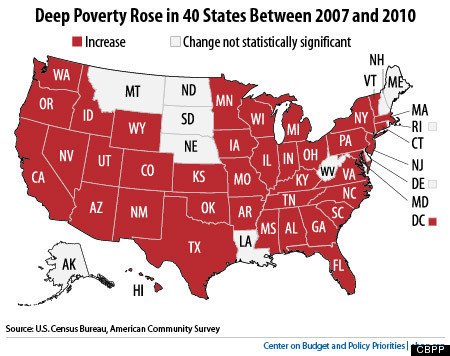
Elizabeth Warren Blasts GOP 'Class Warfare' Charge, Tax Cuts For The Rich (VIDEO) 22SEP11
POLITICAL correctness may require candidates to say the Democrats aren't waging class warfare. The truth is the repiglicans and tea-baggers started this round of class warfare right after the election of President Obama, and they have been waging it against the poor, the retired, the working class and the middle class in America. This is class warfare, it is a battle to stop our Republic turning into a plutocracy, to stop the nations descent to Third World status. It is class warfare against the gross economic inequality in this country, the shameful increase in the number of Americans, especially children, in poverty. It is class warfare against the gop / tea-baggers plans to destroy the social safety net and Social Security and the insatiable greed and lust for power of corporate America. So this is class warfare, and the repiglicans and tea-baggers are on the wrong side.
Elizabeth Warren, Democratic Senate candidate in Massachusetts and former White House financial reform adviser, blasted Republicans at an appearance In Andover last month for accusing Democrats of engaging in "class warfare."
"I hear all this, you know, 'Well, this is class warfare, this is whatever,'" Warren said. "No. There is nobody in this country who got rich on his own -- nobody."
Republican lawmakers have criticized President Barack Obama in recent weeks for engaging in "class warfare." House Majority Leader Eric Cantor (R-Va.) argued in an op-ed last month that the president was “anti-business, hyper-regulatory [and] pro-tax” and “fueled by efforts to incite class warfare."
House Speaker John Boehner (R-Ohio) had a similar criticism after Obama unveiled his new deficit reduction plan this month, which features a proposed tax on millionaires, saying “Class warfare isn’t leadership.”
In Andover, Warren went on to discuss the "social contract" and how it benefits everyone:
Obama disputed the claim during a speech on Monday, saying his newest plan "is not class warfare. It’s math."
Warren -- who formally entered the Senate race less than two weeks ago -- currently has a slight edge over her competitor, Republican Scott Brown, according to a recent poll by the Democratic-affiliated firm Public Policy Polling.
Her comments were captured on video and posted to YouTube by an individual who claims not to be involved with Warren's campaign, according to Talking Points Memo.
Elizabeth Warren, Democratic Senate candidate in Massachusetts and former White House financial reform adviser, blasted Republicans at an appearance In Andover last month for accusing Democrats of engaging in "class warfare."
"I hear all this, you know, 'Well, this is class warfare, this is whatever,'" Warren said. "No. There is nobody in this country who got rich on his own -- nobody."
Republican lawmakers have criticized President Barack Obama in recent weeks for engaging in "class warfare." House Majority Leader Eric Cantor (R-Va.) argued in an op-ed last month that the president was “anti-business, hyper-regulatory [and] pro-tax” and “fueled by efforts to incite class warfare."
House Speaker John Boehner (R-Ohio) had a similar criticism after Obama unveiled his new deficit reduction plan this month, which features a proposed tax on millionaires, saying “Class warfare isn’t leadership.”
In Andover, Warren went on to discuss the "social contract" and how it benefits everyone:
“You built a factory out there? Good for you. But I want to be clear: you moved your goods to market on the roads the rest of us paid for; you hired workers the rest of us paid to educate; you were safe in your factory because of police forces and fire forces that the rest of us paid for. You didn’t have to worry that marauding bands would come and seize everything at your factory, and hire someone to protect against this, because of the work the rest of us did. “Now look, you built a factory and it turned into something terrific, or a great idea? God bless. Keep a big hunk of it. But part of the underlying social contract is you take a hunk of that and pay forward for the next kid who comes along.”Democrats have fought back against the "class warfare" charges by drawing attention to the dramatic cuts that Republicans have proposed to programs benefiting low- and middle-income Americans.
Obama disputed the claim during a speech on Monday, saying his newest plan "is not class warfare. It’s math."
Warren -- who formally entered the Senate race less than two weeks ago -- currently has a slight edge over her competitor, Republican Scott Brown, according to a recent poll by the Democratic-affiliated firm Public Policy Polling.
Her comments were captured on video and posted to YouTube by an individual who claims not to be involved with Warren's campaign, according to Talking Points Memo.
This One Matters, TIM KAINE FOR SENATE from VIRGINIA
VIRGINIA, and the nation, can't afford to have george allen elected to the U.S. Senate. If you can please donate to Tim Kaine's campaign (I did) by clicking the link below, and if you can share this with others....
At this moment, when nothing is sacred in American politics, we need leaders with real values.

Just think about those options. And decide to make a choice. This race could come right down to the wire, and your help today could make the difference.
Click here to make a contribution. We only need $92,864 more for the Kaine campaign to reach its fundraising goal before the September 30th FEC reporting deadline.
For Tim, this campaign is not abstract. It is about every kid he has met around Virginia having access to good teachers and higher education. It is about seniors struggling with medical and electric bills having the dignity of a secure retirement. It is about every American being protected from the forces of hatred and division that aim to make some feel like they do not belong. For Tim, it is about manufacturing workers who have been laid off having a shot at the energy jobs of tomorrow. Where do you think a Sen. Allen would come down on these things? What would a Senate that’s run by the tea party do?
Tim and his family were supposed to be done with the campaign trail. They sacrificed a great deal because they knew how high the stakes were. I hope that you will be able to match that with a small sacrifice today. The polls are dead even, and shadowy groups -- like Karl Rove’s organization that accepts limitless, anonymous contributions -- are lined up on the other side. Tim stood by me when few would, and I ask you to return the favor and make a contribution today.
Please contribute today, before the September 30th fundraising deadline, so Tim has the resources to get his message out.
Thanks so much for your support
Tom Perriello
PO Box 306
Ivy, VA 22945 ![]()
At this moment, when nothing is sacred in American politics, we need leaders with real values.
When I was thinking about an uphill bid for Congress, almost everyone laughed me out of the room. One guy didn’t. He understood
that leaders with convictions not only win elections. They change the debate. He too had felt called by faith to a career in community service, and those experiences led him to public service. That person was Tim Kaine, and even as the Governor he took time to help a long-shot who was willing to fight for the working and middle class.
That man could become our next Senator, a solid champion for social security, economic fairness, and sustainability. Or that seat could be reclaimed by George Allen, and quite possibly delivering the Senate and the legislative branch to special interest groups and tea party.Just think about those options. And decide to make a choice. This race could come right down to the wire, and your help today could make the difference.
Click here to make a contribution. We only need $92,864 more for the Kaine campaign to reach its fundraising goal before the September 30th FEC reporting deadline.
For Tim, this campaign is not abstract. It is about every kid he has met around Virginia having access to good teachers and higher education. It is about seniors struggling with medical and electric bills having the dignity of a secure retirement. It is about every American being protected from the forces of hatred and division that aim to make some feel like they do not belong. For Tim, it is about manufacturing workers who have been laid off having a shot at the energy jobs of tomorrow. Where do you think a Sen. Allen would come down on these things? What would a Senate that’s run by the tea party do?
Tim and his family were supposed to be done with the campaign trail. They sacrificed a great deal because they knew how high the stakes were. I hope that you will be able to match that with a small sacrifice today. The polls are dead even, and shadowy groups -- like Karl Rove’s organization that accepts limitless, anonymous contributions -- are lined up on the other side. Tim stood by me when few would, and I ask you to return the favor and make a contribution today.
Please contribute today, before the September 30th fundraising deadline, so Tim has the resources to get his message out.
Thanks so much for your support
Tom Perriello
| Paid for and authorized by Perriello for Congress |
Ivy, VA 22945
Subscribe to:
Posts (Atom)