BUCKNACKT'S SORDID TAWDRY BLOG
We should not be a journey to the grave with the intention of arriving safely in an attractive & well preserved body, but rather to skid in sideways, chocolate, bier or wein in hand, body thoroughly used up, totally worn out and screaming "WHOO-HOO, WHAT A RIDE!!!!!!"
A Christian nation shouldn't tolerate this kind of economic inequality and insecurity....
“My daughters have to choose between money they need for food and rent and the needs of their children.”
That’s just one of hundreds of stories that UltraViolet members have shared about living with economic insecurity. And it’s one millions of Americans can also relate to. Someone working full-time on minimum wage only makes $14,500 a year--just think about trying to pay rent, buy groceries, and afford health care on that.1
Last week, we asked UltraViolet members what a 21st century pro-family economic agenda looked like. Over 11,000 of you responded, and you were clear: we need child care, equal pay, paid family leave, and a higher minimum wage. Of those of you who told us about the benefits available to you, only 30% reported making a livable wage, 40% had paid sick leave, and only 8% reported having access to child care at work.
We created this infographic to spread the word about these issues and to connect your personal stories with facts and figures showing the immense scope of these problems. Will you share it with your friends? The more people who see it, the more energy we’ll create to make minimum wage a livable wage, to pass family friendly policies, to make child care affordable, and to ensure men and women are paid equally for the same work.
IMMIGRATION REFORM, real reform, is working it's way through the Senate. There are 300 some amendments to the legislation being processed. Some are offered as poison pills, in the hopes that the Judiciary Committee will include them and give legislators a reason for voting against this bill. We can only hope and pray the Senate will remember whatever bill they pass must be a moral and just law. Here is an update from CCIR. It is followed by a video from Cuentame / Brave New Foundation on the heritage foundation's decision to hire an anti-immigration lobbyist to produce a study on immigration. Sad that as a Christian organization they choose to ignore the teachings of Jesus Christ on foreigners. Donate to Cuentame's media campaign if you can (I did) to fight against the hate, fear mongering and racism being spread by right wing extremist. We must pass immigration reform this year!
After months of negotiations, the Border Security, Economic Opportunity, and Immigration Modernization Act (S744) has finally been introduced by a bipartisan group of senators known as the “Gang of 8.” This is an encouraging sign that both parties are serious about passing immigration reform this year.
The legislation includes an earned path towards citizenship, creates a new “W” visa for hiring foreign workers, increases the number of available high-skilled visas, and features several measures focused on border security.
As expected, the legislation is not perfect.It abolishes the Diversity Visa Lottery—a valuable program that has ensured diversity within our U.S. immigration system—over an 18-month period, eliminating the visas available for U.S. citizens who are trying to bring their siblings or adult children above age 31 to the U.S.Senators will likely seek to address these and other issues during a process known as “mark-up,” where the Judiciary Committee votes on specific amendments to the legislation and then votes on whether to send the final bill to the full Senate for consideration.
As this process unfolds, senators will be seeking input from constituents. While others will frame this as a legal, political, or economic issue, people of faith must remind their senators that this is fundamentally a moral issue, and urge them to support amendments that create an immigration system embodying our shared values of fairness, compassion, and accountability. We must also keep our elected officials and our immigrant brothers and sisters in our prayers as this process unfolds.
In faith, The Sojourners Immigration Team (VIDEO) Evangelicals Take Immigration Reform to Hill: Say Amnesty v. Deportation a 'False Choice' This coalition is notable as demographics and changing social sentiments continue to diversify the evangelical community. Dr. Richard Land, president of the Ethics and Religious Liberty Commission of the Southern Baptist Convention, agreed, noting there are 5,000 Southern Baptists and nine million Latino evangelicals—suggesting a significant demographic shift in the "lived experience" of immigration in evangelical churches. ‘Nuns on the Bus’ Will Hit the Road for Immigration Reform The “Nuns on the Bus” are revving up their engines for another national campaign, only this time the Catholic sisters are taking their mobile platform for social justice along the country’s southern border to push Congress to pass immigration reform. Sierra Club Endorses Immigration Reform Undoubtedly, the growing momentum for immigration reform will invite a backlash from those struggling against the tidal wave of support. Before those voices can take over the debate, let’s show our appreciation to groups willing to publicly endorse immigration reform... The Sierra Club’s announcement is an important reminder of the many ways that public policy issues relate. We can’t forget we’re all in this together. 'Si, Se Puede!' Tens of Thousands Gather on National Mall for Immigration Reform The diverse crowd, many of whom had bussed in from across the country, stood through the unusually sweltering April heat to raise chants, noisemakers, and cheers in a show of unified solidarity for immigration reform. Flags dotted the Capitol lawn, with American flags mixing with the flags of Peru, Guatemala, Honduras, Brazil, and other countries to form a visual tapestry of American diversity. Broad Outlines of Senate Immigration Agreement Emerge A bipartisan group of senators has largely agreed on a broad immigration bill that would require tough border measures to be in place before [undocumented] immigrants could take the first steps to become American citizens, according to several people familiar with drafts of the legislation. Tougher Border Security Language Added to Immigration Bill In a direct appeal to Republicans, the Senate Judiciary Committee made the first major change to the bipartisan immigration bill, agreeing Thursday to require the government to achieve “effective control” of the entire Southern border, not just high-risk areas. Five ways immigration reform will help low-wage workers But the evidence for those low-wage losses is mixed, and a lot of it relies on excessively narrow models of the economy. The right question is whether low-wage workers are better off under a world in which we’ve passed immigration reform or under the status quo. On this, I think the answer is clear for at least five reasons. Marco Rubio: Immigration Reform Compromise Isn't 'Amnesty,' Will Be More Onerous Than Current Law Sen. Marco Rubio (R-Fla.) suggested Sunday that the bipartisan immigration reform currently being negotiated by eight senators would not constitute "amnesty" because the path to legal status it proposes would be more onerous than the standards under current law.
While the discussions about changing immigration policy often seem complex, people of faith must do all they can to educate others about what’s at stake in this debate. Here are the latest resources to help you talk with others about the need for comprehensive immigration reform:
http://youtu.be/yFCtuNtykP0
Thank you for being a donor. Yesterday we ran a blog post exposing how the Heritage Foundation's anti-immigration study - the one conservatives are citing to denounce reform as "too expensive" - was authored by Jason Richwine; a man who also wrote that Latino immigrants "have a lower IQ" and who has ties to white supremacy, eugenics and nativist ideology. This is how fear, racism and hate take hold the immigration debate.
We see a daily barrage of images, words, actions and comments that portray immigrants as “criminals, leeches, invaders and dangerously different” to just name a few.
As a token of appreciation, we will send you our commemorative Deport Hate sticker pictured below, so that you too can spread the message to promote love and deport hate!
Brave New Foundation · 10510 Culver Blvd, Culver City, CA 90232, United States You can also keep up with Axel Caballero on Twitter. For donation questions, please contact donations@bravenewfoundation.org.
WORDS of wisdom from Paul Krugman on the CLASS WARFARE being waged in America. The gop and tea-baggers and their plutocrat owners will wail how wrong it is to promote the concept of class warfare in our country, describing it as deceptive, manipulative, based on fear and so very uncivil and the perfect example of what is wrong with America and why any agreement hasn't been achieved on avoiding going over the fiscal cliff. THE fact is these are the people who have been waging this war on the majority of Americans for at least the past generation. They are shameless liars and use deception, manipulation, fear, misrepresentation and racism to take more and more from the majority of Americans to feed their immoral, wanton greed for more wealth and power. They expected this years presidential election to provide a major step to establishing the Plutocratic States of America. We, the people, defeated them on 6NOV12, but the battle is far from over and we can not, in the words of Paul Krugman, allow them to snatch victory from the jaws of defeat.
On Election Day, The Boston Globe reported, Logan International Airport
in Boston was running short of parking spaces. Not for cars — for
private jets. Big donors were flooding into the city to attend Mitt
Romney’s victory party.
Fred R. Conrad/The New York Times
Paul Krugman
They were, it turned out, misinformed about political reality. But the
disappointed plutocrats weren’t wrong about who was on their side. This
was very much an election pitting the interests of the very rich against
those of the middle class and the poor.
And the Obama campaign won largely by disregarding the warnings of
squeamish “centrists” and embracing that reality, stressing the
class-war aspect of the confrontation. This ensured not only that
President Obama won by huge margins among lower-income voters, but that
those voters turned out in large numbers, sealing his victory.
The important thing to understand now is that while the election is
over, the class war isn’t. The same people who bet big on Mr. Romney,
and lost, are now trying to win by stealth — in the name of fiscal
responsibility — the ground they failed to gain in an open election.
Before I get there, a word about the actual vote. Obviously, narrow
economic self-interest doesn’t explain everything about how individuals,
or even broad demographic groups, cast their ballots. Asian-Americans
are a relatively affluent group, yet they went for President Obama by 3
to 1. Whites in Mississippi, on the other hand, aren’t especially well
off, yet Mr. Obama received only 10 percent of their votes.
These anomalies, however, weren’t enough to change the overall pattern.
Meanwhile, Democrats seem to have neutralized the traditional G.O.P.
advantage on social issues, so that the election really was a referendum
on economic policy. And what voters said, clearly, was no to tax cuts
for the rich, no to benefit cuts for the middle class and the poor. So
what’s a top-down class warrior to do?
The answer, as I have already suggested, is to rely on stealth — to
smuggle in plutocrat-friendly policies under the pretense that they’re
just sensible responses to the budget deficit.
Consider, as a prime example, the push to raise the retirement age, the
age of eligibility for Medicare, or both. This is only reasonable, we’re
told — after all, life expectancy has risen, so shouldn’t we all retire
later? In reality, however, it would be a hugely regressive policy
change, imposing severe burdens on lower- and middle-income Americans
while barely affecting the wealthy. Why? First of all, the increase in
life expectancy is concentrated among the affluent; why should janitors
have to retire later because lawyers are living longer? Second, both
Social Security and Medicare are much more important, relative to
income, to less-affluent Americans, so delaying their availability would
be a far more severe hit to ordinary families than to the top 1
percent.
Or take a subtler example, the insistence that any revenue increases
should come from limiting deductions rather than from higher tax rates.
The key thing to realize here is that the math just doesn’t work; there
is, in fact, no way limits on deductions can raise as much revenue from
the wealthy as you can get simply by letting the relevant parts of the
Bush-era tax cuts expire. So any proposal to avoid a rate increase is,
whatever its proponents may say, a proposal that we let the 1 percent
off the hook and shift the burden, one way or another, to the middle
class or the poor.
The point is that the class war is still on, this time with an added
dose of deception. And this, in turn, means that you need to look very
closely at any proposals coming from the usual suspects, even — or
rather especially — if the proposal is being represented as a
bipartisan, common-sense solution. In particular, whenever some
deficit-scold group talks about “shared sacrifice,” you need to ask,
sacrifice relative to what?
As regular readers may know, I’m not a fan of the Bowles-Simpson report
on deficit reduction that laid out a poorly designed plan that for some
reason has achieved near-sacred status among the Beltway elite. Still,
at least you can say this for Bowles-Simpson: When it talked about
shared sacrifice, it started from a “baseline” that already assumed the
end of the high-end Bush tax cuts. At this point, however, just about
all the deficit scolds seem to want us to count the expiration of those
cuts — which were sold on false pretenses, and were never affordable —
as some kind of big giveback by the rich. It isn’t.
So keep your eyes open as the fiscal game of chicken continues. It’s an
uncomfortable but real truth that we are not all in this together;
America’s top-down class warriors lost big in the election, but now
they’re trying to use the pretense of concern about the deficit to
snatch victory from the jaws of defeat. Let’s not let them pull it off.
The Line documents
the stories of people across the country living at or below the poverty
line. They have goals. They have children. They work hard. They are
people like you and me.
From Chicago's suburbs and west side to
the Gulf Coast to North Carolina, millions of Americans are struggling
every day to make it above The Line.
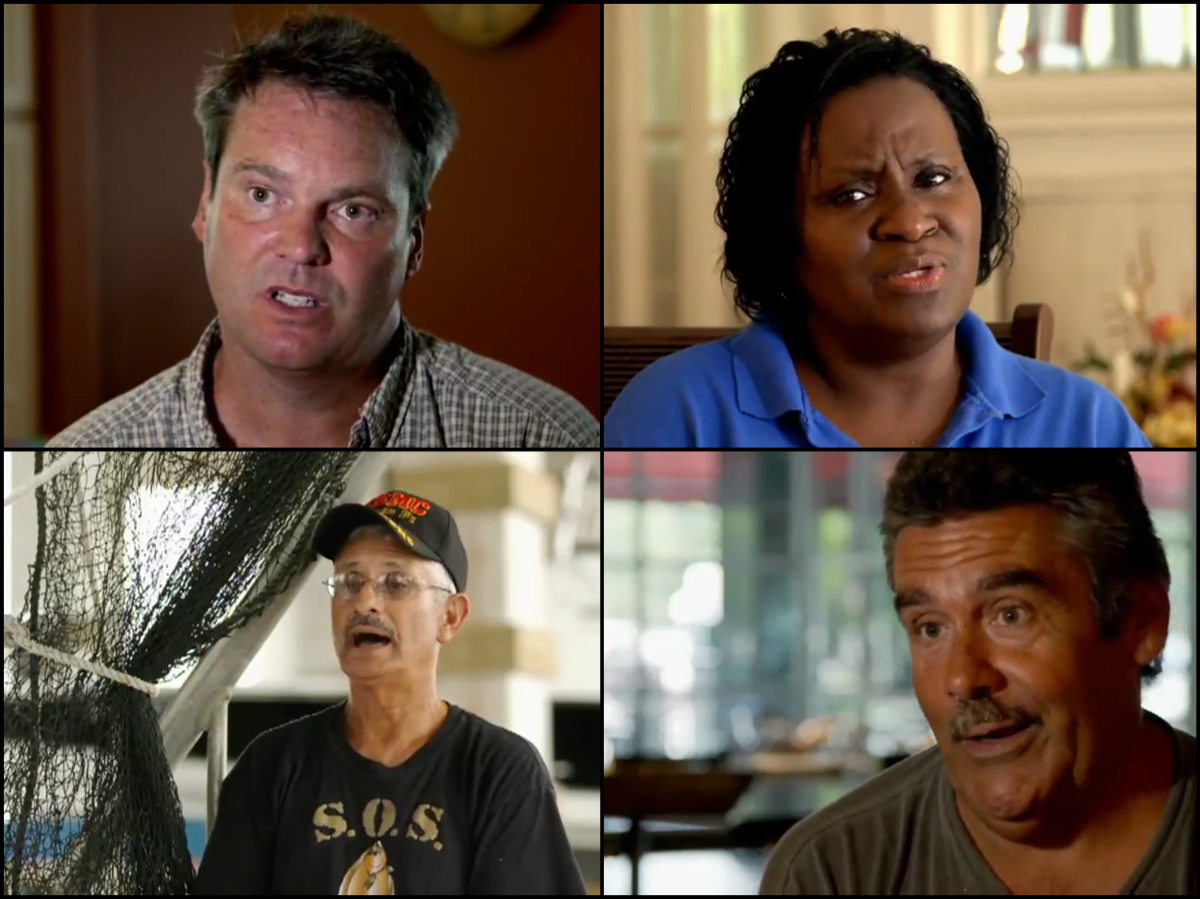
(L-R, top-bottom) John, Sheila, Ronnie, and James from "The Line."
Many people in America are poor, due to no fault of their own—and their numbers are growing.
If
you really know any poor people, you know that to be true. If you
don’t, the first sentence of this post runs against the grain of many
cultural assumptions in America that tend to blame people for being
poor.
On the eve of the first Presidential debate, Sojourners premiered The Line
— a film about the new faces of poverty in America. In this powerful
documentary from award-winning filmmaker Linda Midgett, those popular
judgmental assumptions against poor people clearly and convincingly are
debunked.
The Line, which I am asking everyone who reads this column to watch,
deftly dismantles many stereotypes about poverty and why a growing
number of Americans find themselves falling into it. The film does so by
telling the personal stories of people who have fallen beneath “the
line.”
My 14-year-old son Luke, watched the story of John: a
banker from a failed bank who once made a six figure salary, but who now
finds himself a substitute teacher making $12,000 a year and trying to
raise his three kids. John painfully talked about what it feels like to
have to go to a food bank because he has no other viable choice.
His story caused Luke to ask his mom after the film, “John said he got straight A’s in school, so could that happen to me?”
My
nine year old, Jack, was most impressed with James, a fellow who lost a
blue-collar job after 23 years, and now — in his 50s — was working
hard to be a successful busboy.
My Mississippi-born friend Burns
Strider said he identified most with Ronnie — a self-employed fisherman
in coastal Louisiana whose family has been in the shrimping business for
generations who faces an uncertain future now that the shrimp have
disappeared in the wake of Hurricane Katrina and the BP Oil spill that
have devastated the ecosystem and the economy.
And many in the hundreds-strong crowd that packed the DC theater where The Line premiered
earlier this week were drawn to Sheila, a mother of three who, after
lifting herself out of poverty and a poor, violent neighborhood in
Chicago, tripped and fell down the steps of an “L” train stop and has
fought against disabilities and health care costs ever since.
Sheila
was attended the DC premiere and was a part of the panel discussion,
along with the director, Linda Midgett, Adam Taylor from Bread for the
World, and me, that followed the screening.
What also was true of
each of the people profiled in the film is that falling into poverty
made them feel alone. The line that most struck me was from Ronnie who,
when speaking about himself and his wife, said, “We have no confidence
in the future…and we worry about our kids.”
After the presidential debate last night, I doubt if the growing numbers of poor people in America feel less alone.
The
political discussion today is only about who won the debate. But
millions of people who are struggling financially (and otherwise) in
America are not likely to feel that they did.
Presidential
candidates could make it clear to those who are experiencing very hard
times that they will not be left alone. But that didn’t come across last
night, in the first presidential debate focused on domestic policy.
The
competing narratives between Obama and Romney about tax policies,
health care, the role of government, their focus on the middle class,
and their differing arguments for economic growth now are being polled
and debated as pundits and wonks try to determine to which candidate had
the best performance and how it might affect the electoral numbers.
But
one thing is certain about last night: there was no clarifying
discussion about what the policies Obama and Romney debated will mean
for the Americans who are struggling the most.
After watching The Line,
what so many of us felt was a desire to reach out to the people who,
with great candor and courage, swallowed their pride (and their privacy)
and told their stories, revealing how hard their lives have become.
Conservative,
liberal, neither or both —I believe many Americans would want to reach
out to the people whose stories were told in The Line.
Clearly
it is the mission of the church to tell and to show the millions of
people who have fallen below the poverty line that they are not alone.
Jesus clearly says, in the Matthew 25 that how we treat them is how we
treat him.
I think we also want to live in a society that makes
sure that people who are struggling with poverty are not left alone.
That is the responsibility of all of us, and it is also part of the role
of government.
The presidential candidates could make those who
are hurting the most feel like they are not alone anymore. But that
didn’t happen last night.
Journalists tell us at Sojourners that
poverty is not a “sexy” issue in America — especially not at election
time. Some told us that again on the day The Line premiered.
We had hoped for perhaps 100 screenings of The Line around
the country. By the time the film began rolling Tuesday night, we had
more than 1,600 screenings of the film scheduled across the country and
around the globe — including nearly every state and continent, even as
far away as Japan, New Zealand and Australia.
The tremendous
response we are getting to this extraordinary film tells me that while
the issue poverty in America may not be a top issue for our journalists
and our politicians, it most assuredly is for a growing number of people
of all faith traditions and none, across denominational, political, and
cultural lines.
The stories in The Line explain why.
See
the film, share it, talk about it, and help make this poverty — a
fundamental moral issue that respects the health (and wealth) of the
soul of our nation — a priority during this election season and beyond.
DEBATE analysis from Mother Jones of the first debate between Pres Obama and mitt robme romney offering an answer to the questions of why didn't the President raise romney's 47% comments and why was romney allowed to dominate the issues? And from God's Politics Blog, commentary of the plight of the poor completely absent from the debate. Other debate commentary available in my earlier postThe First Presidential Debate & Five Takeaways From The First Presidential Debate 4OKT12 ...
After the first presidential debate in Denver—which an on-the-attack Mitt Romney seemed to exploit better than a noncombative President Barack Obama—at least one question loomed: Why had the president not once referred to the 47 percent video
that showed Romney denigrating half of Americans as moochers and
victims who don't assume responsibility for their lives? After all, this
video seemed to have sent the Romney campaign reeling, and focus groups
conducted by both campaigns have found it had a serious impact on voter
perceptions of Romney.
The morning after the debate, I contacted several Democratic
strategists. They each said they were puzzled by Obama's silence on this
topic and by his decision not to say a word about Romney's days at Bain
Capital. "This is the stuff that has been working for us," one
remarked. "Bain, 47 percent, Romney not empathizing with the middle
class. Why not mention it?"
The Obama campaign does have an explanation. When I asked a top
campaign official why Obama had made no mention of Romney's 47 percent
remark, he said,
Not that we won't talk about it again. We will. But [what's] most
compelling [is] hearing it from Romney himself. We've got that on the
air at a heavy dollar amount in key states. And it's sunk in. Ultimately
the president's goal last night was to speak past the pundits and
directly to the undecided voter tuning in for the first time about the
economic choice and his plans to restore economic security.
It's clear, one Democratic strategist said, that Obama's inner circle
concluded it was best not to turn the debate into a slugfest and hit
Romney personally. That might come across as not presidential. It could
distract from his aim of persuading those few remaining undecideds that
they should see this election as a choice between two starkly different
visions for the future and select his. Besides, there are weeks of ads
to come, and if the 47 percent theme continues to resonate, the campaign
certainly can keep producing ads that use the video as ammo.
Despite the pundit reviews noting that Romney performed better than
Obama, is it possible that Obama's low-impact strategy worked—or didn't
fail? Priorities USA Action, a pro-Obama super-PAC, has released a memo
based on a "dial group session" pollster Geoff Garin held in Aurora,
Colorado, during the debate; the participants were "weak Democrats and
independents who voted for Obama in 2008 but who remain open to
switching in the upcoming election." The results were mixed:
Compared with the beginning of the session, there was a doubling in
the number of respondents who said that Obama has good ideas for
improving the economy. While Romney also improved on this dimension, 63%
of respondents said at the end that Obama expressed good ideas for
improving the economy, compared with 27% who said the same about Romney
in the debate…
Romney did gain ground on the President on the issue of taxes, and he
largely negated the advantage Obama had on the issue when respondents
first walked into the room.
In the moment-to-moment dialing, President Obama’s high points were
when he talked about outsourcing and tax breaks for shipping jobs
overseas, the need for a balanced approach to dealing with the deficit,
and clean energy. Romney’s high points were fewer, but he scored best
whenever he spoke about making jobs the number-one priority.
Respondents who came into the room open to Romney as an alternative
to Obama felt disappointed in Romney’s lack of specifics. But Romney did
benefit from low expectations among this group, and several said that
Romney did not seem as bad as they thought he might be. For these key
swing voters, whom Obama must hold and Romney must win, the first debate
did not change much, but it also did not settle much. Obama continues
to have the advantage with them, but the deal still is not sealed.
Not settle much. That's often the case with presidential
debates. But perhaps the most worrisome of these findings for the Obama
camp is that these voters ended up believing Romney's not such a bad
guy. That suggests his debate performance has the potential to undo some
of the damage he suffered from the Bain blasts and the revelation of
his 47 percent tirade. Yet, as the Obama campaign official suggests,
there's plenty of time—and plenty of opportunity—for the campaign to
resume its Bain-bashing and reprise its 47 percent assault. UPDATE:On
a conference call with reporters, a defensive David Axelrod, Obama's
chief strategist, noted that the president's supporters would have liked
to see Obama slam Romney on Bain, tax returns, and the 47 percent
video. But, he added, "a lot of these issues are well known to the
public," and Obama's "choice was to talk about the main things people
are worried about in their lives." Obama, Axelrod said, had wanted to
avoid an insult-fest and instead use the debate to discuss the future.
He did note that following the debate the campaign would "make some
adjustments."
(L-R, top-bottom) John, Sheila, Ronnie, and James from "The Line."
Many people in America are poor, due to no fault of their own—and their numbers are growing.
If
you really know any poor people, you know that to be true. If you
don’t, the first sentence of this post runs against the grain of many
cultural assumptions in America that tend to blame people for being
poor.
On the eve of the first Presidential debate, Sojourners premiered The Line
— a film about the new faces of poverty in America. In this powerful
documentary from award-winning filmmaker Linda Midgett, those popular
judgmental assumptions against poor people clearly and convincingly are
debunked.
The Line, which I am asking everyone who reads this column to watch,
deftly dismantles many stereotypes about poverty and why a growing
number of Americans find themselves falling into it. The film does so by
telling the personal stories of people who have fallen beneath “the
line.”
My 14-year-old son Luke, watched the story of John: a
banker from a failed bank who once made a six figure salary, but who now
finds himself a substitute teacher making $12,000 a year and trying to
raise his three kids. John painfully talked about what it feels like to
have to go to a food bank because he has no other viable choice.
His story caused Luke to ask his mom after the film, “John said he got straight A’s in school, so could that happen to me?”
My
nine year old, Jack, was most impressed with James, a fellow who lost a
blue-collar job after 23 years, and now — in his 50s — was working
hard to be a successful busboy.
My Mississippi-born friend Burns
Strider said he identified most with Ronnie — a self-employed fisherman
in coastal Louisiana whose family has been in the shrimping business for
generations who faces an uncertain future now that the shrimp have
disappeared in the wake of Hurricane Katrina and the BP Oil spill that
have devastated the ecosystem and the economy.
And many in the hundreds-strong crowd that packed the DC theater where The Line premiered
earlier this week were drawn to Sheila, a mother of three who, after
lifting herself out of poverty and a poor, violent neighborhood in
Chicago, tripped and fell down the steps of an “L” train stop and has
fought against disabilities and health care costs ever since.
Sheila
was attended the DC premiere and was a part of the panel discussion,
along with the director, Linda Midgett, Adam Taylor from Bread for the
World, and me, that followed the screening.
What also was true of
each of the people profiled in the film is that falling into poverty
made them feel alone. The line that most struck me was from Ronnie who,
when speaking about himself and his wife, said, “We have no confidence
in the future…and we worry about our kids.”
After the presidential debate last night, I doubt if the growing numbers of poor people in America feel less alone.
The
political discussion today is only about who won the debate. But
millions of people who are struggling financially (and otherwise) in
America are not likely to feel that they did.
Presidential
candidates could make it clear to those who are experiencing very hard
times that they will not be left alone. But that didn’t come across last
night, in the first presidential debate focused on domestic policy.
The
competing narratives between Obama and Romney about tax policies,
health care, the role of government, their focus on the middle class,
and their differing arguments for economic growth now are being polled
and debated as pundits and wonks try to determine to which candidate had
the best performance and how it might affect the electoral numbers.
But
one thing is certain about last night: there was no clarifying
discussion about what the policies Obama and Romney debated will mean
for the Americans who are struggling the most.
After watching The Line,
what so many of us felt was a desire to reach out to the people who,
with great candor and courage, swallowed their pride (and their privacy)
and told their stories, revealing how hard their lives have become.
Conservative,
liberal, neither or both —I believe many Americans would want to reach
out to the people whose stories were told in The Line.
Clearly
it is the mission of the church to tell and to show the millions of
people who have fallen below the poverty line that they are not alone.
Jesus clearly says, in the Matthew 25 that how we treat them is how we
treat him.
I think we also want to live in a society that makes
sure that people who are struggling with poverty are not left alone.
That is the responsibility of all of us, and it is also part of the role
of government.
The presidential candidates could make those who
are hurting the most feel like they are not alone anymore. But that
didn’t happen last night.
Journalists tell us at Sojourners that
poverty is not a “sexy” issue in America — especially not at election
time. Some told us that again on the day The Line premiered.
We had hoped for perhaps 100 screenings of The Line around
the country. By the time the film began rolling Tuesday night, we had
more than 1,600 screenings of the film scheduled across the country and
around the globe — including nearly every state and continent, even as
far away as Japan, New Zealand and Australia.
The tremendous
response we are getting to this extraordinary film tells me that while
the issue poverty in America may not be a top issue for our journalists
and our politicians, it most assuredly is for a growing number of people
of all faith traditions and none, across denominational, political, and
cultural lines.
The stories in The Line explain why.
See
the film, share it, talk about it, and help make this poverty — a
fundamental moral issue that respects the health (and wealth) of the
soul of our nation — a priority during this election season and beyond.
IF you are one of those apple fans that doesn't give a damn about the abuse and exploitation of foxconn employees (they make the iphone and other apple products) in the prc don't ready any further. If you have a conscience read on... Apple says it makes its products ethically. It
says that even the new iPhone that will be unveiled today will meet it's
commitment to the "highest standards of social responsibility".
But then how does Apple explain this report we got just last month from a worker in a factory in its Chinese supply chain? Share this image on Facebook so everyone knows the truth about the new iPhone:
Today there's going to be a lot of buzz about Apple's shiny new
gadget. But if we can create a different kind of buzz -- about the
terrible working conditions faced by factory workers in Apple's Chinese
factories -- then Apple will feel the pressure to finally keep its
pledge to treat its workers ethically and pay them fairly. So today we need your help to get the word out about the real cost of the newly announced iPhone 5.
Back in January, in response to reports of repeated worker suicides,
toxic working conditions and rampant illegal overtime, SumOfUs.org
launched a campaign to push Apple to address reports of horrendous
working conditions in its Chinese supply chain. Over 200,000 of us
raised our voices to demand that Apple make the iPhone 5 ethically. That
phone is being released today. In a few weeks, it will be on the
shelves. But the iPhone 5 is not an ethical iPhone -- not even close.
In response to the massive public outcry, Apple promised to improveworking conditions,
raise wages, and put an end to involuntary labor. The Fair Labor
Association -- which is paid by Apple to investigate Apple -- quickly
announced that there was rapid progress at Apple’s suppliers. But independent reports from as recently as last month tell a very different story.
Apple claims that it’s ending forced illegal overtime, but workers
are simply required to meet the same quotas within a regular shift --
meaning many have to work extra hours without any pay at all. “Apple
claims wages are rising, but deductions for room and board have also
increased, as has unpaid overtime, so take-home pay has actually
declined.” Meanwhile bosses are still abusive, unions are still
overwhelmingly populated by management, students are still forced to
work in factories as part of phony “internship” programs, and workers
still lack any collective bargaining rights.
Suppliers like Foxconn abuse their workers because Apple demands that
iPhones and other gadgets be produced as cheaply as possible. But Apple makes huge profits, and it can easily afford to treat its workers ethically. And as the world’s largest company, Apple has the cash, the centralized supply chain, and organizational heft to drive improvements throughout the Chinese manufacturing sector by raising its own standards.
Together, SumOfUs.org members have already driven Apple to respond to
reports on working conditions in its supply chains. Apple clearly wants
to look like an ethical company, even though it isn’t acting like one
yet. So we need to keep up the pressureuntil Apple finally follows through on its promises.
PRESIDENT Obama and mitt romney have responded to our calls for them to address the issue of American poverty in their presidential election campaigns. Below are their video responses and the transcripts of their statements. We need to keep up the pressure, so after listening to each candidate check out my earlier post THE LINE (THIS IS WHAT POVERTY LOOKS
LIKE IN AMERICA) & HAVING OUR SAY (AMERICAN POVERTY AND THE
PRESIDENTIAL DEBATES) 8&7SEP12
http://bucknacktssordidtawdryblog.blogspot.com/2012/09/the-line-this-is-what-poverty-looks.html and tweet both candidates and the presidential and vp debate moderators to make sure American poverty is an issue they must address on the campaign trail, during the debates and in their policy platforms. From Sojourners and The Circle of Protection.... Today Sojourners
released 2 amazing videos, and we wanted you to be the first to see them.
As part of our ongoing work against poverty, Sojourners and our
coalition partners with the Circle of Protection asked the presidential candidates what they were going to do about
poverty – the most important issue of our time. The presidential
candidates just responded to us. We still have a long road ahead of us this election season
to make poverty a top issue, but for today, let’s celebrate this huge moment
together.
FROM THE CIRCLE OF PROTECTION
What About Hungry and Poor People? Barack Obama's and Mitt Romney's Views
Why We Sought Their Views
On July 6, 2012, Circle of Protection leaders invited the
presidential candidates — President Barack Obama and Governor Mitt
Romney — to submit short video statements.
"We believe that this presidential campaign should include a clear
focus on what each candidate proposes to do to provide help and
opportunity for hungry and poor people in the United States and around
the world," they wrote.
The leaders emphasized that God holds nations accountable for how
those Jesus called "the least of these" (Matthew 25:45) are treated.
The Circle of Protection is composed of more than 65 heads of
denominations, relief and development agencies, and other Christian
organizations representing a wide array of churches in the U.S.A.
The Circle of Protection does not support, oppose or in any way endorse either of these presidential candidates. Learn more about the Circle of Protection »
Watch the videos below:
President Barack Obama: Last year, I had the privilege of meeting with the Circle of Protection at the White House. There I reflected on my own Christian faith and how it’s shaped my walk in life, how I believe it’s made me a better husband, a better father, and I hope, a better president. My faith teaches me that poverty is a moral issue. The Bible calls on us to be our brother’s keeper and our sister’s keeper, and I believe that as a public servant, I must do my part to answer that call. When I hear the story of a single mom struggling to put food on the table, or a child born into poverty, or a dad who’s gone months without a paycheck, I cannot sit idly by, not as a person and certainly not as a president. That’s why I’ve fought to keep this a country where everyone who works hard has a basic sense of dignity and a chance to get ahead. That means things like good jobs and good wages, healthcare that’s there for you when you get sick, a secure retirement even if you’re not rich, a chance to buy a home to call your own, and an education that gives our young people every chance in life. I believe that even as we work hard to get ahead, we also have the obligation to reach back and help others get ahead, too. That’s why my Office of Faith-based and Neighborhood Partnerships has expanded its work with groups around the country to help those in need. And it’s why last year, in the midst a heated budget debate in Washington, I promised to protect vital assistance for the least of these. I’ve kept that promise. We can pay down our debt in a balanced and responsible way, but we cannot balance the budget on the backs of the most vulnerable. And certainly can’t ask the poor, the sick, or those with disabilities to sacrifice even more, or ask the middle-class to pay more, just so we can offer massive new tax cuts to those who’ve been blessed with the most. It’s not just bad economics, it’s morally wrong. It’s not in line with our values, and it’s not who we are as a people. I know you share my belief that government can’t solve every problem and it shouldn’t try. I learned from my mother that no education policy can take the place of a parent’s love and attention. As a young man I worked with a group of Catholic churches who taught me that no government program can take the place of a caring neighbor. Not every tax dollar is spent wisely. Not everyone can be helped who refuses to help themselves. But that’s not an excuse to tell our fellow Americans that they’re on their own. We are all in this together as one people, one American family, one nation under God. That’s how we’ll create a true circle of protection. And if we each do our part, we can build an economy that works for all of us, and leaves something better for our children. There have been many times over the past for four years when I have fallen on my knees asking God for guidance, not just in my personal life and my Christian walk, but in the life of this nation. I want you to know I have been so grateful for your prayers. And I pray His richest blessings on each of you. Thank you. God bless you and may God bless the United States of America.
Governor Mitt Romney: Hello, I’m Mitt Romney. And I appreciate the opportunity to share my plan to protect the poor and vulnerable among us. And I want to start by thanking all who’ve already answered the call to care for those in need. Both here at home and around the world, good people of faith have dedicated themselves to improving the lives of the less fortunate, providing aid and comfort in places that were once without hope. These kind acts reveal the good heart of America. Coming to the aid of those in need is a critical mission. And it’s more important now than at any other time in recent memory. As I speak with you today, there are 23 million Americans struggling to find work. A record 46.7 million people are on food stamps. Nearly one in every six people in America is in poverty. When our economy is weak, lives are shattered, hearts ache, parents wonder how they’ll make ends meet, and how they’ll provide better lives for their children. I’m running for president because I believe we can and must do better. If we’re going to help lift our brothers and sisters out of poverty we must restore our economy and reduce the debt. When our economy is healthy and growing, we have the resources to take care of those who still find themselves in need. That’s why we must deliver the recovery we have all been waiting for, and the jobs too many Americans are still looking for. My vision for recovery starts with jobs, a lot of jobs, and I have a five-part economic plan that will help create 12 million new jobs by the end of my first term in office. More jobs will mean more opportunities. It’ll mean good wages that pay the bills and put food on the table. It will mean fewer people on the welfare rolls and more people on the payroll. A strong economy will reduce our budget deficits, and it will reduce poverty as well. But at this point, budget cuts are also going to be necessary and I intend to make them. Here you have my word: I’ll proceed carefully. I understand this is a delicate task. Our government rightfully provides a safety net for the hungry and the homeless, the sick and the elderly, and we have a responsibility to keep it intact for future generations. I’ve laid out a sensible plan to save and strengthen our nations’ entitlement programs, which now account for more than half of federal spending. Here again, I’m committed to protecting those in or near poverty. For example, I support means testing, where more money goes to those in need, and a little less goes to those who are able to support themselves. And I recognize that the assistance provided by your organizations can mean the difference between life and death for someone who’s sick or starving. That’s why my administration will stand with faith-based organizations, instead of standing in their way. If I’m elected president, I will seek the counsel of faith-based community leaders on matters large and small. And I’ll support your work. Together we’ll ensure that those who need our help remain within the circle of protection. http://www.circleofprotection.us/index.html
THIS is the trailer for The Line, a nonpartisan film about what happens to ordinary American families when they cross the poverty line. Click the link to watch the trailer and you will also have the opportunity to tweet Pres Obama and mitt romney and ask them what they are going to do about poverty in America. The film opens 2OCT12. I want to make sure you got a chance to see this.
We just launched the trailer for Sojourners' new upcoming film The Line,
and it’s already taking off across the web and across the country! It’s
written and directed by Emmy Award-winning producer Linda Midgett, and
chronicles the very real stories of four real people struggling with real poverty in America today. http://www.youtube.com/watch?feature=player_embedded&v=RGkqh5x6scw You’ll meet a banker in the suburban Midwest who used to earn
six-figures a year and now, after the economic collapse, must go to a
food bank to feed his three kids; a fisherman on the Gulf Coast of
Louisiana who has watched his livelihood and his culture wash away in
the wake of Hurricane Katrina and a devastating off-shore oil spill; a
blue collar guy in North Carolina who worked hard his whole life but
lost his job, became homeless, and started over as a restaurant busboy;
and a single mom in Chicago who battles daily to ensure that her son is
safe, healthy, and has the opportunity to go to college. You can watch — and share — the official trailer for The Line, which debuts next month, right HERE.
Thanks,
Jim Wallis http://thelinemovie.com/
Watch 'The Line': The Most Important Film You'll See This Year
Last
week, millions tuned in to watch the Republican National Convention. It
was a party for a political party funded by wealthy interests seeking
to appeal to middle-class voters in an election year.
This week, millions are tuning in to watch the Democratic National
Convention. It is a party for a political party funded by wealthy
interests seeking to appeal to middle-class voters in an election year.
Today, I want to introduce you to a film that just might be the most
important thing you watch this week — or this year, for that matter.
Significant things, no doubt, have and will be said about our country
during the political conventions. Competing visions for our future will
be presented at both events. And there will be a lot of grandstanding,
empty promises, half-truths, and deceptions (as their always seem to be
in politics).
The media already is obsessing about how many times the word “God” is
used in each party’s platform as a measure of faith or religiosity, as
if crying “Lord, Lord” and vain repetition has replaced obedience to
God’s command to love our neighbors. And yet, it's the actions of each
party during the last four years that gives us true insight into who and
what is important to them, much more than what gets written down on a
party platform or said in speeches during these three-day
self-congratulatory celebrations.
Yes, a strong middle class is important for a nation. But I also
believe many more people need to be lifted up into economic security.
Matthew 25 doesn’t say, “As you have done to the middle class, you have done to me."
What it records Jesus saying is, “As you have done to the least of these, you have done to me.” Chances are that will never be the central message of political conventions during election years.
But every four years for the last 40 years (even before we were called Sojourners!),
our community has done what we can to lift up the issue of poverty
during presidential elections. While political party platforms have
changed, our commitment to the least of these has not.
So it is with that spirit, this election year, that I am proud to present a new short film called The Line.
Written and directed by Emmy award-winning producer Linda Midgett, it chronicles the very real stories of four real people struggling with real poverty in America today.
You’ll meet a former banker in the suburban Midwest who used to earn
six figures a year and now, after the economic collapse, must go to a
food bank to feed his three kids; a fisherman on the Gulf Coast of
Louisiana who has watched his livelihood and his culture wash away in
the wake of Hurricane Katrina and the devastating BP oil spill; a blue
collar guy in North Carolina who worked hard his whole life but lost his
job, became homeless, and started over as a restaurant bus boy; and a
single mom in Chicago who battles daily to ensure that her son is safe,
healthy, and has the opportunity to go to college.
You can watch — and share — the official trailer for The Line, which debuts next month, right HERE.
The idea of the film is simple: People living in and struggling with
poverty telling their own stories. They are beautiful, inspiring,
challenging, and full of grace.
In a word, their stories are powerful. The kind you never forget. The
kind that make you not only feel something, but compel you to do something.
My Sojourners colleagues and I want to share The Line's stories and message with as many people as we can. That's where you come in. We need your help.
The first thing you can do is watch the trailer. As soon as you've
seen it, I'm sure you’re going to want to share it with everyone you
know.
Next, I invite you to join us. The Line premieres at 8 p.m. (EST) Oct. 2 — the night before the first presidential debate.
With your help, I believe we can make sure both candidates understand
that they will need to address the issue of poverty during that debate.
But, before we can get there, I need you to help us spread the word.
So please, take just a couple of minutes today to watch the trailer and
share with everyone you think needs to hear these stories.
And it’s with a lot of gratitude that I get to thank our partner —
World Vision — as well as the generous support from Oxfam America,
Bread for the World, and the Christian Community Development Association
that made The Line possible.
If you'd like to host a screening of The Line in your town (at your house of worship, a local theater, school, or anywhere else) or find a screening near you, click HERE. Jim Wallis is the author of Rediscovering Values: A Guide for Economic and Moral Recovery, and CEO of Sojourners. Follow Jim on Twitter @JimWallis.
HAVING OUR SAY (AMERICAN POVERTY AND THE PRESIDENTIAL DEBATES) 7SEP12
"The great enemy of freedom is the alignment of political power with
wealth. This alignment destroys the commonwealth - that is, the natural
wealth of localities and the local economies of household, neighborhood,
and community - and so destroys democracy,
of which the commonwealth is the foundation and practical means.” - Wendell Berry
from The Art of the Commonplace
TAVIS Smiley has long been an advocate for social justice and a moral
budget and moral economy. Here he offers a way to make sure our
concerns about the number of Americans living in poverty or facing the
prospect of falling into poverty are brought up and addressed at the
presidential and vice presidential debates. Twitter, if you tweet, the
debate moderators and insist they include the plight of America's poor
in the debates. From HuffPost....
Now that the conventions are over, time to prepare for the
presidential debates. The candidates have homework to do, but so do we.
There are roughly 300 million American citizens. Each one with an
equal right to be heard. But four Americans have been given special
status. Jim Lehrer, Bob Schieffer, Candy Crowley and Martha Raddatz:
the four journalists selected by the Commission on Presidential Debates
to moderate the upcoming presidential and vice-presidential debates.
I have the utmost respect for my distinguished broadcast colleagues;
they have each earned their way onto the debate stage. That said, I
reiterate my deep disappointment with the obvious lack of diversity in
this group; a group that could have been and should have been more
representative of the most multi-cultural, multi-racial and multi-ethnic
America ever. But I have an even greater concern at the moment.
As we move closer to the first debate, October 3, in Denver,
Colorado, how do issues that should matter actually get raised in the
debate? Case in point: four years ago in the three debates between
Senator Barack Obama and Senator John McCain, the word "poor" or
"poverty" did not come up one time. Obama didn't raise it, McCain didn't
raise it, the moderators never asked about it. By the way, two of those
moderators are back on stage this year.
This year, both Governor Romney and President Obama at least
mentioned the "P" word in their convention speeches, but neither pledged
to make the alleviation of poverty in America a priority. Both
continued to address the "middle class" when everybody knows that the
new poor are the former middle class. Candidates for high office love
sharing personal narratives of overcoming poverty, but can't seem to
fully commit themselves to lead in creating a bi-partisan plan that
could significantly reduce and eventually eradicate poverty in the
richest nation in the world.
So, how do we get the impolite topic of poverty on the agenda for the
debates? It's hard to ignore that 1 in 2 Americans is either living in
or near poverty. Hard to ignore the 16 million children now living in
poverty. Hard to ignore that more Americans are experiencing long-term
unemployment than at any time in recorded history. Hard to ignore the
growing lines at food pantries. Hard to ignore all the FORECLOSURE yard
signs. Hard to ignore all the recent -- and not so recent -- college
graduates who can't find work. Hard to ignore the millions of Americans
falling through the cracks as government inexplicably draws up the
social safety net, diminishing Medicaid, food stamps and other vital
social service programs. Hard to ignore the direct link between poverty
and joblessness. Hard to ignore.
Yet, I fear that's exactly what may happen if we don't remind the
candidates and the moderators that poverty in America ought to be
abnormal, not the new normal. So, what to do? I say let the moderators
hear from you. I don't know too many of my colleagues who outright
refuse to review their mail. It matters to most. And since they're
representing US, why not hear from US?
Greg Kaufmann of The Nation magazine has been doing his
homework, chronicling potential questions about poverty in America for
President Obama and Governor Romney. Sample questions: What is the
appropriate role of government in improving the likelihood that an
honest day's work earns a living wage? What do you think is most
important in securing economic mobility for all children, regardless of
the incomes or educational attainment of their parents, and how will you
accomplish this? As president, what would you do about America's
growing hunger crisis?
So here's your assignment: I'm sure you have a question for Obama and
Romney about how to tackle poverty, and you ought to share that with
the debate moderators. Here's how: JIM LEHRER - PBS twitter.com/NewsHour newshour@pbs.org BOB SCHIEFFER - CBS twitter.com/bobSchieffer facethenation@cbsnews.com CANDY CROWLEY - CNN twitter.com/crowleyCNN MARTHA RADDATZ - ABC twitter.com/martharaddatz
Poor people cannot be rendered invisible in this campaign. This time
around, let's do our homework and make sure that ALL voices are heard. http://www.huffingtonpost.com/tavis-smiley/debate-questions_b_1864091.html?utm_hp_ref=daily-brief?utm_source=DailyBrief&utm_campaign=090712&utm_medium=email&utm_content=BlogEntry&utm_term=Daily%20Brief