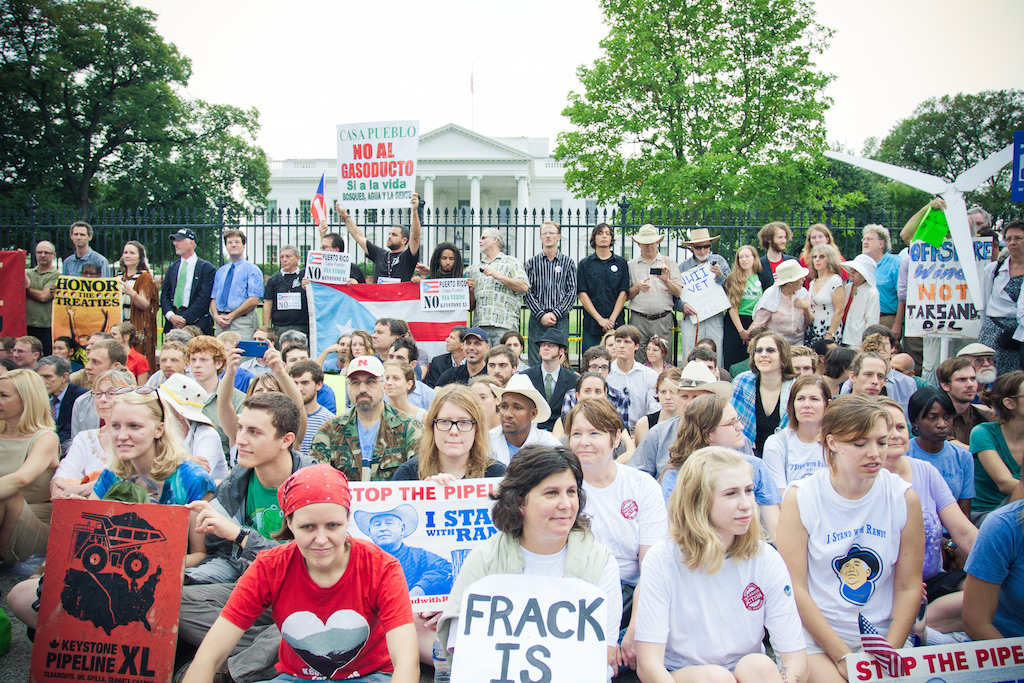
This moratorium will keep enormous amounts of carbon in the ground
and move the U.S. closer toward hitting our climate goals set in Paris.
And if our next President makes the moratorium permanent, this could end
up being the single biggest step toward keeping fossil fuels in the
ground that the U.S. has ever taken. We’re talking about 212 gigatons of
carbon left safely underground! (To put that in perspective, the
Canadian tar sands represent about 240 gigatons of carbon.)
This is a real movement-driven victory too: from marching in the
streets across the country (and around the world) this past December, to
winning big fights like the Keystone XL rejection and Arctic drilling
-- today’s announcement is possible because of the momentum that you’ve
had a hand in creating. The climate movement is really changing the
political game.
The administration’s plan is to stop federal coal sales and do a
complete review of the federal coal leasing program, which has
essentially been giving away our public lands to the fossil fuel
industry to extract coal (and oil and gas) since 1920.
The industry
already has five times more coal, oil and gas reserves than we can
safely burn. Keeping climate change below 2°C, which the Obama
administration has pledged to do -- let alone the 1.5°C it said in Paris
that we should be aiming for -- means a radical shift toward keeping
fossil fuels in the ground across the board.
Here’s what the head of the National Mining Association said about
this decision: “It appears that they’re going after the federal coal
leasing program with the intention of keeping coal in the ground.” Yes!
Fossil fuels have no place in a 21st century energy plan, and our
government has no business selling them. President Obama could keep half
of all U.S. fossil fuels underground forever by banning government
sales of all fossil fuels.
Fossil fuel companies already have way more fossil fuels than we can
burn -- we can’t afford to sell them any more. This win is great news,
but this fight is nowhere near done.
is building a global climate movement.
The federal government will stop issuing new coal leases on
some 570 million acres of federal land, under a new plan being released
Friday. In this photo from 2013, coal is loaded onto a truck at a mine
built on federally controlled land in Montana.
Matthew Brown/AP
Citing concerns over pricing and pollution, the Obama
administration on Friday unveiled a moratorium on new coal leases on
federal lands. The change won't affect existing leases, which generated
nearly $1.3 billion for the government last year.
The
Department of the Interior says it wants to make sure the money it's
charging for coal leases takes into account both market prices and
what's often called the "social costs" of coal — its impact on climate
change and public health.
The agency says federal lands account for roughly 40 percent of all U.S. coal production.
NPR's Jeff Brady reports:
"The
moratorium will remain in place while the agency reviews whether fees
charged to mining companies provides a fair return and considers coal's
effect on the environment. Leases already awarded are not affected."
Update at 10:50 a.m. ET: Two Reactions
As you would expect, there are vastly different reactions to the announcement. We'll excerpt two here.
First, from Rhea Suh, president of the Natural Resources Defense Council:
"The
president is right to stop this handout to big coal companies, which
has cost American taxpayers more than $30 billion over the past three
decades."
And from Rep. Rob Bishop, R-Utah, Chairman of the House Committee on Natural Resources:
"This
unprecedented action will completely shut down coal leasing on Federal
lands and will disproportionately harm the poorest among us."
Our original post continues:
The
review process is expected to take about three years. Secretary of the
Interior Sally Jewell announced the change in a conference call Friday
morning. Before that call, an administration official confirmed details
of the plan to Jeff.
During what her agency is calling a
"pause" in issuing leases, Jewell said Friday, "we'll make
accommodations in the event of emergency circumstances to ensure this
pause will have no material impact on the nation's ability to meet its
power generation needs."
In addition to analyzing the return American taxpayers are earning on the use of natural resources,
the Interior Department says it'll also review coal's public health impacts.
The
federal Bureau of Land Management handles coal leasing on the
approximately 570 million acres of land. In 2014, 475 million of those
acres were covered by leases, along with one sale.
The federal
shift on coal leases comes weeks after the BLM announced that in 2015,
its coal program had taken in about $1.29 billion in royalties, rents
and bonuses. That's
from a release in which the agency celebrated "major gains in 2015 ensuring safe and responsible energy development on public lands."
Last
spring, Jewell called for a new discussion of the federal coal program,
focusing on the fairness of prices charged for coal leases and other
concerns at five public meetings.
The U.S. government shares
coal-lease revenue with the states where the land is located. In recent
years, that has meant hundreds of millions of dollars for Wyoming, which
accounts for the most acreage and leases in the federal system and is
the nation's leading coal producer.
In 2014, the most recent
year with complete data, Wyoming received more than $555 million in
royalties and revenues, with more than 200,000 acres covered by 102
federal leases. Colorado and Utah are the next-largest participants,
with more than 80,000 acres.