NORTON META TAG

Showing posts with label First Nation. Show all posts

24 January 2014

'Fort McMurray is a wasteland': Neil Young slams oil patch, Keystone plans 10SEP13

(THIS may be a late post to this blog, the the battle over tar sand oil production and the keystone xl pipeline is still being waged in Canada and America. Until Pres Obama agrees to say NO to the proposed tar sands oil pipeline it is important to remind people to be vigilant. Search for keystone xl on this blog for more information)
CANADIAN rock legend Neil Young recently went to Alberta, Canada to see the devastation of the tar sands production fields.
View image on Twitter 
 
Canadian Tar Sands Oil Field
Near Fort McMurray, Alberta, Canada

 
Hiroshima, Japan 1945
Want to see the actual destruction from tar sands mining? 
https://www.google.com/search?q=Canadian+Tar+Sands+Oil+Field&um=1&ie=UTF-8&hl=en&tbm=isch&source=og&sa=N&tab=wi&ei=EncvUoGoLrK14APry4DIDw&biw=1366&bih=643&sei=F3cvUpm6BbDC4APx2oHYDw#hl=en&q=Canadian+Tar+Sands&safe=off&tbm=isch&um=1 
 
He has created a lot of controversy with his comments on the environmental damage done by tar sands oil production and the environmental threat of the keystone xl pipeline, the health problems the people of Alberta, especially First Nation people, are dealing with, the greed of Canadian oil and gas companies and the complicity of the government of PM stephen harper, who recently had Canadian government officials in D.C. pressuring Pres Obama to approve keystone xl. From The Globe and Mail and Neil Young.....

Neil Young arrives for the film "Neil Young Journeys" at the Toronto International Film Festival in Toronto on Sept. 12, 2011. (Nathan Denette/THE CANADIAN PRESS)

'Fort McMurray is a wasteland': Neil Young slams oil patch, Keystone plans


Canadian rocker Neil Young has waded into the bitter debate over Alberta’s vast oil sands and the controversial Keystone XL pipeline planned to funnel one million barrels a day of Canadian crude to huge refineries in Texas and Louisiana.
Mr. Young said in a news conference on Monday that oil sands extraction was killing native peoples, igniting a new firestorm in the ongoing battle between proponents who want the massive reserves extracted and an array of opponents who argue that burning the carbon-heavy crude will seriously exacerbate global warming that threatens the planet.

More Related to this Story

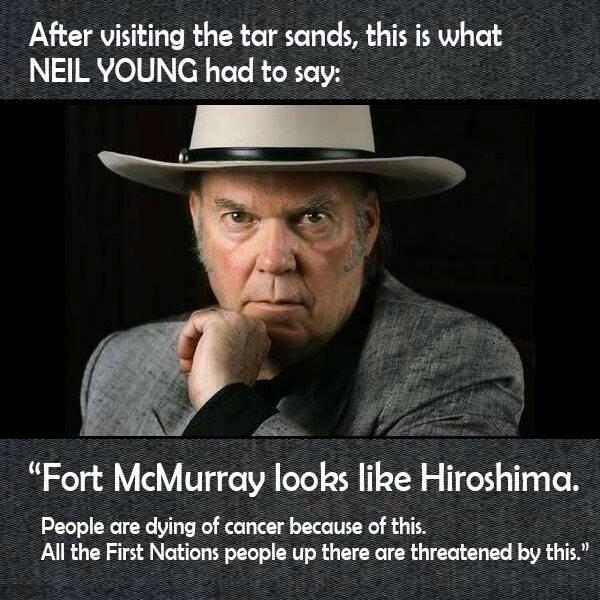
“The fact is, Fort McMurray looks like Hiroshima,” Mr. Young said in Washington. “Fort McMurray is a wasteland. The Indians up there and the native peoples are dying.”
Keystone opponents were quick to cheer Mr. Young’s blunt intervention.
Sierra Club spokesman Eddie Scher said: “Neil Young has been expressing and exposing hard truths his whole career,” adding: “Looks like he’s at it again.”
Natural Resources Minister Joe Oliver – who was in Washington himself on the same day for a meeting with U.S. Energy Secretary Ernest Moniz, took a different view.
“I am a big fan of Neil Young’s music,” Mr. Oliver told the Globe. “But on this matter we disagree because Keystone XL will displace heavy oil from Venezuela which has the same or higher greenhouse gas emissions, with a stable and secure source of Canadian oil.”
The singer is among a growing number of well-known activists speaking out against Keystone XL “Neil Young is speaking for all of us fighting to stop the Keystone XL,” said Jane Kleeb, Executive Director of Bold Nebraska, a coalition of landowners and others opposed to the $5.3-billion Keystone XL pipeline. “When you see the pollution already caused by the reckless expansion of tar sands, you only have one choice and that is to act.”
Mr. Young, one of Canada’s best-known singer-songwriters since the 1960s, told a conference in Washington Monday that he recently traveled to Alberta, where “much of the oil comes from, much of the oil that we’re using here, which they call ethical oil because it’s not from Saudi Arabia or some country that may be at war with us.”
As for Keystone, Mr. Young lampooned claims that it would create lots of jobs.
“Yeah it’s going to put a lot of people to work, I’ve heard that, and I’ve seen a lot of people that would dig a hole that’s so deep that they couldn’t get out of it, and that’s a job too, and I think that’s the jobs that we are talking about there with the Keystone pipeline,” he said.
He spoke at the U.S. National Farmers Union conference in Washington, intended to support alternative fuels, such as ethanol, which he did at length, slamming Big Oil and talking about his own LincVolt, an old Continental that runs on ethanol and electricity.
Young said he drove the 1959 Lincoln, which runs on ethanol and electricity, to Fort McMurray while traversing the continent from his California home to Washington over the last two and half weeks.
At the same time, Canada’s Natural Resources Minister Joe Oliver was making the latest in a long series of lobbying visits by ministers and premiers intended to sway President Barack Obama to approve the long-delayed pipeline.
Ms. Kleeb wasn’t impressed. “Prime Minister Harper can write all the memos he wants, Joe Oliver can say anything but the reality is people are dying and the alliance between cowboys and Indians is stronger than any K Street lobbyists Canada hires.”
All Risk, No Rewards, another group opposed to Keystone XL also echoed Mr. Young’s comments.
“Canada’s First Nations know all too well the risks of Keystone XL and the risks of expanding the tar sands,” said Rachel Wolf, a spokeswoman for the group. Ranchers in Nebraska and First Nations peoples in Canada have more in common than one might think: they’re ‘Ordinary People’ who share a common goal to protect their land and protect their water, and they both know that these tar sands expansion projects are all risk and no reward.”
Mr. Young described his recent visit graphically. “The fuel’s all over – the fumes everywhere – you can smell it when you get to town. The closest place to Fort McMurray that is doing the tar sands work is 25 or 30 miles out of town and you can taste it when you get to Fort McMurray. People are sick. People are dying of cancer because of this. All the First Nations people up there are threatened by this.”
Mr. Young's comments don't sit well with Fort McMurray's mayor, who called them "blatantly false."
Melissa Blake, mayor of the Regional Municipality of Wood Buffalo, which includes Fort McMurray, said she has no problem with people having environmental interests at heart.
But she said Fort McMurray is totally different from Mr. Young's characterization. With his power in the music industry, she's disappointed "there wasn't more rationality to it."
"When people say it's a wasteland, it really and truly isn't," Ms. Blake said. "When it comes to the community of Fort McMurray, you're overwhelmed frankly by the beauty of it. You've got an incredible boreal environment that's all around you. You proceed further north into the oil sands and inevitably, there's mining operations that will draw your attention because they take up large chunks of land."
The mayor said she always invites outsiders to the region to see the landscape, and to see oil sands companies' reclamation efforts.
Danielle Droitsch, director of the National Resources Defense Council, said “Seeing tar sands development up close is shocking" adding "these are massive operations and industry hopes to triple its production over the next 20 years.”
Blocking Keystone XL will thwart expansion of oil sands production, according to the NRDC, but Mr. Oliver says Canada will just export its reserves elsewhere.
With files from Steven Chase and The Canadian Press


NO FREEDOM IN CANADA

September 3, 2013 On my recent trip to Fort Mac in Alberta, I drove Lincvolt about 1800 miles from San Francisco running on Cellulosic Ethanol fuel. I have chosen to use Ethanol, a much cleaner fuel created from plants nourished by the sun and rain and grown by farmers rather than run on gasoline, which has a carbon footprint of 19.5 LBS (pump to tailpipe) per gallon or 28 LBS CO2 per gallon (earth to tailpipe) according to the Mass Institute of Technology.


Although E 85 is hard to find in some parts of the USA, it is much cleaner than gasoline and since I am a believer in Climate Chaos as a result of Global Warming, I have chosen this greener fuel. On the trip back from Fort Mac, I ran out of fuel in Red Deer Alberta after searching in vain for an E 85 or pure ethanol fuel source in CANADA. In Red Deer Alberta we were told by Husky Oil reps that they had “never heard of E 85”. Lincvolt does not run on gasoline by design.
In Canada, where the dirtiest oil on the planet is extracted from the Alberta Tar sands at an immeasurable human cost to the First Nations people, and disease statistics reflect 30% increase in some fatal diseases, there is no freedom to choose an alternative to gasoline at the pump. This is un-Canadian.
As a proud Canadian, I cannot let this go by without a fight. Canadians deserve Freedom to Choose the Fuel they use. Canadians should have a fuel choice at the pump that considers Future Generations. Canadians should have the freedom to express themselves through the choices they make, not have those choices made for them by a government that is too close to industry and over concerned with money and petro dollar value. We do not have to be spoon fed by the Big Oil Companies. Stand with me for Future Generations and Bring Light to the conditions In Canada as we move forward on this mission.
As time passes, you will see what we are up to. If you believe in Freedom of Choice for Canadians, you will have a voice in this with us. It will be your chance to stand up.
BRING LIGHT-FUTURE GENERATIONS
--Neil Young

http://www.lincvolt.com/lincvolt_lincvoltgazette 

Stephen Harper and The Great Darkness 24JAN14

OUR neighbors in the great white north (that would be Canada) are suffering through the administration of stephen harper, who would be considered a tea-bagger here in the U.S. Who would have thought Canadians were as gullible to the deception and manipulation of the right wing as Americans are? Yet harper has managed to cling to power in Ottawa, enriching corporate Canada, while the rest of Canada, especially the First Nation people, have seen the quality of their lives decline. Thursday, 23JAN14 marked the 8th anniversary of the Great Darkness of the harper administration. From Montreal Simon...

Stephen Harper and The Great Darkness


Not many people noticed, but last night was the eighth anniversary of the election victory that made Stephen Harper Prime Minister.

The night the lights starting going out all over Canada.

The beginning of what historians will one day call The Great Darkness.

When Canada was abandoned to the beasts, and raped and mutilated beyond recognition.

And on this fatal anniversary Chris Hall writes that although Great Leader has been badly mauled by scandal, and his polls are tanking, we shouldn't count him out. 

The Senate scandal isn't over. Critics are getting more air time to push their view that Harper is too doctrinaire, too bloody-minded, hell, just too plain mean to last much longer.

And yet those who have worked closely with Harper, who have followed his time in office, insist he isn't going anywhere because being prime minister of Canada is the only job to which he has ever aspired.

And Paul Wells agrees: 

"The main point is to endure. Not to last for the sake of lasting… [but] to implement a Conservative change in the political culture of the country," Wells says. "And if that means doing something Liberal today so that he can do more Conservative things tomorrow, it is fine with him.''

But I don't.

While I do think Harper will try to hang on as long as he can, if only so he can try to join MacDonald and Laurier as the only Prime Ministers to win four consecutive terms. 

And as you know, clinging to power is in his genes...


Ever since the first Harper in Canada had to be forcibly removed from office after unleashing a reign of terror on his enemies.

But I really wonder whether the darkness is now so great, that even those who make their living covering politics can't see the forest for the trees. Or the spider webs.

Because while it's true the Cons are buffing Great Ugly Leader up, with OUR money, as you can see in this latest propaganda video. 

Which does indeed include a nod to the Liberals...


The whole thing reeks of desperation, and nothing can change Harper's dire situation. 

His polls are down to as low as 28% and showing no signs of rebounding. Even some in his base are abandoning him. Never have so few Canadians thought he was leading them in the right direction. Or the mood been so sour. 

The Senate scandal and the robocall trial will maul him further, and wipe the mascara off his face. The economy is showing signs of growing weakness, and cannot be guaranteed to lift him anymore.

And all that even before we get to his greatest liability, the one that can't be measured. The one that will finish him off.

The depth of the hatred so many Canadians have for him and his foul regime. And the widespread feeling that he has been around for too long, and his time is OVER.

Because once that sets in it's almost impossible to recover from ANYTHING. 

Which explains why neither Harper, nor the Con Ministry of Propaganda and Disinformation, mentioned today's anniversary, after having trumpeted it in previous years.

Because they don't want to remind Canadians how long he has been in office. 

Lest he scare them further...


But Chris Hall is right about this:

He will stay as long as he can win. He will leave if, and only if, it's clear he can't. Harper's grip might be slipping. But he'll never make the mistake of letting go.

Which is where we come in eh?

Because he only has about a year to decide whether to stay or go. Jason Kenney will make sure of that.

And if we attack him harder than we ever have before, he will NEVER recover in time.

He will wither in the returning light.

His mummy will crumble.

And The Great Darkness will finally end.... 


http://montrealsimon.blogspot.com/2014/01/stephen-harper-and-great-darkness.html

15 November 2013

WHICH OF THE 11 AMERICAN NATIONS DO YOU LIVE IN? (Check out the map) 15NOV13

I love maps, and this map (click on it to enlarge) and the article that comes with it is fascinating. I was born and raised in Yankeedom but now live in Tidewater. From Tufts Universities Tufts Magazine.....

Up in Arms


THE BATTLE LINES OF TODAY’S DEBATES OVER GUN CONTROL, STAND-YOUR-GROUND LAWS, AND OTHER VIOLENCE-RELATED ISSUES WERE DRAWN CENTURIES AGO BY AMERICA’S EARLY SETTLERS


Last December, when Adam Lanza stormed into the Sandy Hook Elementary School in Newtown, Connecticut, with a rifle and killed twenty children and six adult staff members, the United States found itself immersed in debates about gun control. Another flash point occurred this July, when George Zimmerman, who saw himself as a guardian of his community, was exonerated in the killing of an unarmed black teenager, Trayvon Martin, in Florida. That time, talk turned to stand-your-ground laws and the proper use of deadly force. The gun debate was refreshed in September by the shooting deaths of twelve people at the Washington Navy Yard, apparently at the hands of an IT contractor who was mentally ill.
Such episodes remind Americans that our country as a whole is marked by staggering levels of deadly violence. Our death rate from assault is many times higher than that of highly urbanized countries like the Netherlands or Germany, sparsely populated nations with plenty of forests and game hunters like Canada, Sweden, Finland, or New Zealand, and large, populous ones like the United Kingdom, Germany, and Japan. State-sponsored violence, too—in the form of capital punishment—sets our country apart. Last year we executed more than ten times as many prisoners as other advanced industrialized nations combined—not surprising given that Japan is the only other such country that allows the practice. Our violent streak has become almost a part of our national identity.
What’s less well appreciated is how much the incidence of violence, like so many salient issues in American life, varies by region. Beyond a vague awareness that supporters of violent retaliation and easy access to guns are concentrated in the states of the former Confederacy and, to a lesser extent, the western interior, most people cannot tell you much about regional differences on such matters. Our conventional way of defining regions—dividing the country along state boundaries into a Northeast, Midwest, Southeast, Southwest, and Northwest—masks the cultural lines along which attitudes toward violence fall. These lines don’t respect state boundaries. To understand violence or practically any other divisive issue, you need to understand historical settlement patterns and the lasting cultural fissures they established.
The original North American colonies were settled by people from distinct regions of the British Isles—and from France, the Netherlands, and Spain—each with its own religious, political, and ethnographic traits. For generations, these Euro-American cultures developed in isolation from one another, consolidating their cherished religious and political principles and fundamental values, and expanding across the eastern half of the continent in nearly exclusive settlement bands. Throughout the colonial period and the Early Republic, they saw themselves as competitors—for land, capital, and other settlers—and even as enemies, taking opposing sides in the American Revolution, the War of 1812, and the Civil War.
There’s never been an America, but rather several Americas—each a distinct nation. There are eleven nations today. Each looks at violence, as well as everything else, in its own way.
The precise delineation of the eleven nations—which I have explored at length in my latest book, American Nations—is original to me, but I’m certainly not the first person to observe that such national divisions exist. Kevin Phillips, a Republican Party campaign strategist, recognized the boundaries and values of several of these nations in 1969 and used them to correctly prophesy two decades of American political development in his politico cult classic The Emerging Republican Majority. Joel Garreau, a Washington Post editor, argued that our continent was divided into rival power blocs in The Nine Nations of North America, though his ahistorical approach undermined the identification of the nations. The Pulitzer Prize–winning historian David Hackett Fischer detailed the origins and early evolution of four of these nations in his magisterial Albion’s Seed and later added New France. Russell Shorto described the salient characteristics of New Netherland in The Island at the Center of the World. And the list goes on.
The borders of my eleven American nations are reflected in many different types of maps—including maps showing the distribution of linguistic dialects, the spread of cultural artifacts, the prevalence of different religious denominations, and the county-by-county breakdown of voting in virtually every hotly contested presidential race in our history. Our continent’s famed mobility has been reinforcing, not dissolving, regional differences, as people increasingly sort themselves into like-minded communities, a phenomenon analyzed by Bill Bishop and Robert Cushing in The Big Sort (2008). Even waves of immigrants did not fundamentally alter these nations, because the children and grandchildren of immigrants assimilated into whichever culture surrounded them.
Before I describe the nations, I should underscore that my observations refer to the dominant culture, not the individual inhabitants, of each region. In every town, city, and state you’ll likely find a full range of political opinions and social preferences. Even in the reddest of red counties and bluest of blue ones, twenty to forty percent of voters cast ballots for the “wrong” team. It isn’t that residents of one or another nation all think the same, but rather that they are all embedded within a cultural framework of deep-seated preferences and attitudes—each of which a person may like or hate, but has to deal with nonetheless. Because of slavery, the African American experience has been different from that of other settlers and immigrants, but it too has varied by nation, as black people confronted the dominant cultural and institutional norms of each.
The nations are constituted as follows:
YANKEEDOM. Founded on the shores of Massachusetts Bay by radical Calvinists as a new Zion, Yankeedom has, since the outset, put great emphasis on perfecting earthly civilization through social engineering, denial of self for the common good, and assimilation of outsiders. It has prized education, intellectual achievement, communal empowerment, and broad citizen participation in politics and government, the latter seen as the public’s shield against the machinations of grasping aristocrats and other would-be tyrants. Since the early Puritans, it has been more comfortable with government regulation and public-sector social projects than many of the other nations, who regard the Yankee utopian streak with trepidation.
NEW NETHERLAND. Established by the Dutch at a time when the Netherlands was the most sophisticated society in the Western world, New Netherland has always been a global commercial culture—materialistic, with a profound tolerance for ethnic and religious diversity and an unflinching commitment to the freedom of inquiry and conscience. Like seventeenth-century Amsterdam, it emerged as a center of publishing, trade, and finance, a magnet for immigrants, and a refuge for those persecuted by other regional cultures, from Sephardim in the seventeenth century to gays, feminists, and bohemians in the early twentieth. Unconcerned with great moral questions, it nonetheless has found itself in alliance with Yankeedom to defend public institutions and reject evangelical prescriptions for individual behavior.
THE MIDLANDS. America’s great swing region was founded by English Quakers, who believed in humans’ inherent goodness and welcomed people of many nations and creeds to their utopian colonies like Pennsylvania on the shores of Delaware Bay. Pluralistic and organized around the middle class, the Midlands spawned the culture of Middle America and the Heartland, where ethnic and ideological purity have never been a priority, government has been seen as an unwelcome intrusion, and political opinion has been moderate. An ethnic mosaic from the start—it had a German, rather than British, majority at the time of the Revolution—it shares the Yankee belief that society should be organized to benefit ordinary people, though it rejects top-down government intervention.
TIDEWATER. Built by the younger sons of southern English gentry in the Chesapeake country and neighboring sections of Delaware and North Carolina, Tidewater was meant to reproduce the semifeudal society of the countryside they’d left behind. Standing in for the peasantry were indentured servants and, later, slaves. Tidewater places a high value on respect for authority and tradition, and very little on equality or public participation in politics. It was the most powerful of the American nations in the eighteenth century, but today it is in decline, partly because it was cut off from westward expansion by its boisterous Appalachian neighbors and, more recently, because it has been eaten away by the expanding federal halos around D.C. and Norfolk.
GREATER APPALACHIA. Founded in the early eighteenth century by wave upon wave of settlers from the war-ravaged borderlands of Northern Ireland, northern England, and the Scottish lowlands, Appalachia has been lampooned by writers and screenwriters as the home of hillbillies and rednecks. It transplanted a culture formed in a state of near constant danger and upheaval, characterized by a warrior ethic and a commitment to personal sovereignty and individual liberty. Intensely suspicious of lowland aristocrats and Yankee social engineers alike, Greater Appalachia has shifted alliances depending on who appeared to be the greatest threat to their freedom. It was with the Union in the Civil War. Since Reconstruction, and especially since the upheavals of the 1960s, it has joined with Deep South to counter federal overrides of local preference.
DEEP SOUTH. Established by English slave lords from Barbados, Deep South was meant as a West Indies–style slave society. This nation offered a version of classical Republicanism modeled on the slave states of the ancient world, where democracy was the privilege of the few and enslavement the natural lot of the many. Its caste systems smashed by outside intervention, it continues to fight against expanded federal powers, taxes on capital and the wealthy, and environmental, labor, and consumer regulations.
EL NORTE. The oldest of the American nations, El Norte consists of the borderlands of the Spanish American empire, which were so far from the seats of power in Mexico City and Madrid that they evolved their own characteristics. Most Americans are aware of El Norte as a place apart, where Hispanic language, culture, and societal norms dominate. But few realize that among Mexicans, norteños have a reputation for being exceptionally independent, self-sufficient, adaptable, and focused on work. Long a hotbed of democratic reform and revolutionary settlement, the region encompasses parts of Mexico that have tried to secede in order to form independent buffer states between their mother country and the United States.
THE LEFT COAST. A Chile-shaped nation wedged between the Pacific Ocean and the Cascade and Coast mountains, the Left Coast was originally colonized by two groups: New Englanders (merchants, missionaries, and woodsmen who arrived by sea and dominated the towns) and Appalachian midwesterners (farmers, prospectors, and fur traders who generally arrived by wagon and controlled the countryside). Yankee missionaries tried to make it a “New England on the Pacific,” but were only partially successful. Left Coast culture is a hybrid of Yankee utopianism and Appalachian self-expression and exploration—traits recognizable in its cultural production, from the Summer of Love to the iPad. The staunchest ally of Yankeedom, it clashes with Far Western sections in the interior of its home states.
THE FAR WEST. The other “second-generation” nation, the Far West occupies the one part of the continent shaped more by environmental factors than ethnographic ones. High, dry, and remote, the Far West stopped migrating easterners in their tracks, and most of it could be made habitable only with the deployment of vast industrial resources: railroads, heavy mining equipment, ore smelters, dams, and irrigation systems. As a result, settlement was largely directed by corporations headquartered in distant New York, Boston, Chicago, or San Francisco, or by the federal government, which controlled much of the land. The Far West’s people are often resentful of their dependent status, feeling that they have been exploited as an internal colony for the benefit of the seaboard nations. Their senators led the fight against trusts in the mid-twentieth century. Of late, Far Westerners have focused their anger on the federal government, rather than their corporate masters.
NEW FRANCE. Occupying the New Orleans area and southeastern Canada, New France blends the folkways of ancien régime northern French peasantry with the traditions and values of the aboriginal people they encountered in northeastern North America. After a long history of imperial oppression, its people have emerged as down-to-earth, egalitarian, and consensus driven, among the most liberal on the continent, with unusually tolerant attitudes toward gays and people of all races and a ready acceptance of government involvement in the economy. The New French influence is manifest in Canada, where multiculturalism and negotiated consensus are treasured.
FIRST NATION. First Nation is populated by native American groups that generally never gave up their land by treaty and have largely retained cultural practices and knowledge that allow them to survive in this hostile region on their own terms. The nation is now reclaiming its sovereignty, having won considerable autonomy in Alaska and Nunavut and a self-governing nation state in Greenland that stands on the threshold of full independence. Its territory is huge—far larger than the continental United States—but its population is less than 300,000, most of whom live in Canada.
If you understand the United States as a patchwork of separate nations, each with its own origins and prevailing values, you would hardly expect attitudes toward violence to be uniformly distributed. You would instead be prepared to discover that some parts of the country experience more violence, have a greater tolerance for violent solutions to conflict, and are more protective of the instruments of violence than other parts of the country. That is exactly what the data on violence reveal about the modern United States.
Most scholarly research on violence has collected data at the state level, rather than the county level (where the boundaries of the eleven nations are delineated). Still, the trends are clear. The same handful of nations show up again and again at the top and the bottom of state-level figures on deadly violence, capital punishment, and promotion of gun ownership.
Consider assault deaths. Kieran Healy, a Duke University sociologist, broke down the per capita, age-adjusted deadly assault rate for 2010. In the northeastern states—almost entirely dominated by Yankeedom, New Netherland, and the Midlands—just over 4 people per 100,000 died in assaults. By contrast, southern states—largely monopolized by Deep South, Tidewater, and Greater Appalachia—had a rate of more than 7 per 100,000. The three deadliest states—Louisiana, Mississippi, and Alabama, where the rate of killings topped 10 per 100,000—were all in Deep South territory. Meanwhile, the three safest states—New Hampshire, Maine, and Minnesota, with rates of about 2 killings per 100,000—were all part of Yankeedom.
Not surprisingly, black Americans have it worse than whites. Countrywide, according to Healy, blacks die from assaults at the bewildering rate of about 20 per 100,000, while the rate for whites is less than 6. But does that mean racial differences might be skewing the homicide data for nations with larger African-American populations? Apparently not. A classic 1993 study by the social psychologist Richard Nisbett, of the University of Michigan, found that homicide rates in small predominantly white cities were three times higher in the South than in New England. Nisbett and a colleague, Andrew Reaves, went on to show that southern rural counties had white homicide rates more than four times those of counties in New England, Middle Atlantic, and Midwestern states.
Stand-your-ground laws are another dividing line between American nations. Such laws waive a citizen’s duty to try and retreat from a threatening individual before killing the person. Of the twenty-three states to pass stand-your-ground laws, only one, New Hampshire, is part of Yankeedom, and only one, Illinois, is in the Midlands. By contrast, each of the six Deep South–dominated states has passed such a law, and almost all the other states with similar laws are in the Far West or Greater Appalachia.
Comparable schisms show up in the gun control debate. In 2011, after the mass shooting of U.S. Representative Gabrielle Giffords and eighteen others in Tucson, the Pew Research Center asked Americans what was more important, protecting gun ownership or controlling it. The Yankee states of New England went for gun control by a margin of sixty-one to thirty-six, while those in the poll’s “southeast central” region—the Deep South states of Alabama and Mississippi and the Appalachian states of Tennessee and Kentucky—supported gun rights by exactly the same margin. Far Western states backed gun rights by a proportion of fifty-nine to thirty-eight.
Another revealing moment came this past April, in the wake of the Newtown school massacre, when the U.S. Senate failed to pass a bill to close loopholes in federal background checks for would-be gun owners. In the six states dominated by Deep South, the vote was twelve to two against the measure, and most of the Far West and Appalachia followed suit. But Yankee New England voted eleven to one in favor, and the dissenting vote, from Kelly Ayotte of New Hampshire, was so unpopular in her home state that it caused an immediate dip in her approval rating.
The pattern for capital punishment laws is equally stark. The states dominated by Deep South, Greater Appalachia, Tidewater, and the Far West have had a virtual monopoly on capital punishment. They account for more than ninety-five percent of the 1,343 executions in the United States since 1976. In the same period, the twelve states definitively controlled by Yankeedom and New Netherland—states that account for almost a quarter of the U.S. population—have executed just one person.
Why is violence—state-sponsored and otherwise—so much more prevalent in some American nations than in others? It all goes back to who settled those regions and where they came from. Nisbett, the social psychologist, noted that regions initially “settled by sober Puritans, Quakers, and Dutch farmer-artisans”—that is, Yankeedom, the Midlands, and New Netherland—were organized around a yeoman agricultural economy that rewarded “quiet, cooperative citizenship, with each individual being capable of uniting for the common good.” The South—and by this he meant the nations I call Tidewater and Deep South—was settled by “swashbuckling Cavaliers of noble or landed gentry status, who took their values . . . from the knightly, medieval standards of manly honor and virtue.”
Continuing to treat the South as a single entity, Nisbett argued that the violent streak in the culture the Cavaliers established was intensified by the “major subsequent wave of immigration . . . from the borderlands of Scotland and Ireland.” These immigrants, who populated what I call Greater Appalachia, came from “an economy based on herding,” which, as anthropologists have shown, predisposes people to belligerent stances because the animals on which their wealth depends are so vulnerable to theft. Drawing on the work of the historian David Hackett Fisher, Nisbett maintained that “southern” violence stems partly from a “culture-of-honor tradition,” in which males are raised to create reputations for ferocity—as a deterrent to rustling—rather than relying on official legal intervention.
More recently, researchers have begun to probe beyond state boundaries to distinguish among different cultural streams. Robert Baller of the University of Iowa and two colleagues looked at late-twentieth-century white male “argument-related” homicide rates, comparing those in counties that, in 1850, were dominated by Scots-Irish settlers with those in other parts of the “Old South.” In other words, they teased out the rates at which white men killed each other in feuds and compared those for Greater Appalachia with those for Deep South and Tidewater. The result: Appalachian areas had significantly higher homicide rates than their lowland neighbors—“findings [that] are supportive of theoretical claims about the role of herding as the ecological underpinning of a code of honor.”
Another researcher, Pauline Grosjean, an economist at Australia’s University of New South Wales, found strong statistical relationships between the presence of Scots-Irish settlers in the 1790 census and contemporary homicide rates, but only in “southern” areas “where the institutional environment was weak”—which is the case in almost the entirety of Greater Appalachia. She further noted that in areas where Scots-Irish were dominant, settlers of other ethnic origins—Dutch, French, and German—were also more violent, suggesting that they had acculturated to Appalachian norms.
But it’s not just herding that promoted a culture of violence. Scholars have long recognized that cultures organized around slavery rely on violence to control, punish, and terrorize—which no doubt helps explain the erstwhile prevalence of lynching deaths in Deep South and Tidewater. But it is also significant that both these nations, along with Greater Appalachia, follow religious traditions that sanction eye-for-an-eye justice, and adhere to secular codes that emphasize personal honor and shun governmental authority. As a result, their members have fewer qualms about rushing to lethal judgments.
The code of Yankeedom could not have been more different. Its founders promoted self-doubt and self-restraint, and their Unitarian and Congregational spiritual descendants believed vengeance would not receive the approval of an all-knowing God. This nation was the center of the nineteenth-century death penalty reform movement, which began eliminating capital punishment for burglary, robbery, sodomy, and other nonlethal crimes. None of the states controlled by Yankeedom or New Netherland retain the death penalty today, with the exception of New Hampshire, where the penalty is rarely imposed (the last execution took place in 1939).
With such sharp regional differences, the idea that the United States would ever reach consensus on any issue having to do with violence seems far-fetched. The cultural gulf between Appalachia and Yankeedom, Deep South and New Netherland is simply too large. But it’s conceivable that some new alliance could form to tip the balance.
Among the eleven regional cultures, there are two superpowers, nations with the identity, mission, and numbers to shape continental debate: Yankeedom and Deep South. For more than two hundred years, they’ve fought for control of the federal government and, in a sense, the nation’s soul. Over the decades, Deep South has become strongly allied with Greater Appalachia and Tidewater, and more tenuously with the Far West. Their combined agenda—to slash taxes, regulations, social services, and federal powers—is opposed by a Yankee-led bloc that includes New Netherland and the Left Coast. Other nations, especially the Midlands and El Norte, often hold the swing vote, whether in a presidential election or a congressional battle over health care reform. Those swing nations stand to play a decisive role on violence-related issues as well.
For now, the country will remain split on how best to make its citizens safer, with Deep South and its allies bent on deterrence through armament and the threat of capital punishment, and Yankeedom and its allies determined to bring peace through constraints such as gun control. The deadlock will persist until one of these camps modifies its message and policy platform to draw in the swing nations. Only then can that camp seize full control over the levers of federal power—the White House, the House, and a filibuster-proof Senate majority—to force its will on the opposing nations. Until then, expect continuing frustration and division.
Colin Woodard, A91, is the author of American Nations: A History of the Eleven Rival Regional Cultures of North America. An earlier book, The Republic of Pirates, is the basis of the forthcoming NBC drama Crossbones. He is currently state and national affairs writer at the Portland Press Herald and Maine Sunday Telegram, where he won a George Polk Award this year for his investigative reporting.
http://www.tufts.edu/alumni/magazine/fall2013/features/up-in-arms.html