BUCKNACKT'S SORDID TAWDRY BLOG
We should not be a journey to the grave with the intention of arriving safely in an attractive & well preserved body, but rather to skid in sideways, chocolate, bier or wein in hand, body thoroughly used up, totally worn out and screaming "WHOO-HOO, WHAT A RIDE!!!!!!"
(THIS may be a late post to this blog, the the battle over tar sand oil production and the keystone xl pipeline is still being waged in Canada and America. Until Pres Obama agrees to say NO to the proposed tar sands oil pipeline it is important to remind people to be vigilant. Search for keystone xl on this blog for more information) CANADIAN rock legend Neil Young recently went to Alberta, Canada to see the devastation of the tar sands production fields. Canadian Tar Sands Oil Field
Near Fort McMurray, Alberta, Canada Hiroshima, Japan 1945 Want to see the actual destruction from tar sands mining? https://www.google.com/search?q=Canadian+Tar+Sands+Oil+Field&um=1&ie=UTF-8&hl=en&tbm=isch&source=og&sa=N&tab=wi&ei=EncvUoGoLrK14APry4DIDw&biw=1366&bih=643&sei=F3cvUpm6BbDC4APx2oHYDw#hl=en&q=Canadian+Tar+Sands&safe=off&tbm=isch&um=1 He has created a lot of controversy with his comments on the environmental damage done by tar sands oil production and the environmental threat of the keystone xl pipeline, the health problems the people of Alberta, especially First Nation people, are dealing with, the greed of Canadian oil and gas companies and the complicity of the government of PM stephen harper, who recently had Canadian government officials in D.C. pressuring Pres Obama to approve keystone xl. From The Globe and Mail and Neil Young.....
'Fort McMurray is a wasteland': Neil Young slams oil patch, Keystone plans
PAUL KORING And KELLY CRYDERMAN
WASHINGTON/CALGARY — The Globe and Mail
Published
Last updated
Canadian rocker Neil Young has waded into the bitter debate over
Alberta’s vast oil sands and the controversial Keystone XL pipeline
planned to funnel one million barrels a day of Canadian crude to huge
refineries in Texas and Louisiana.
Mr. Young said in a news
conference on Monday that oil sands extraction was killing native
peoples, igniting a new firestorm in the ongoing battle between
proponents who want the massive reserves extracted and an array of
opponents who argue that burning the carbon-heavy crude will seriously
exacerbate global warming that threatens the planet.
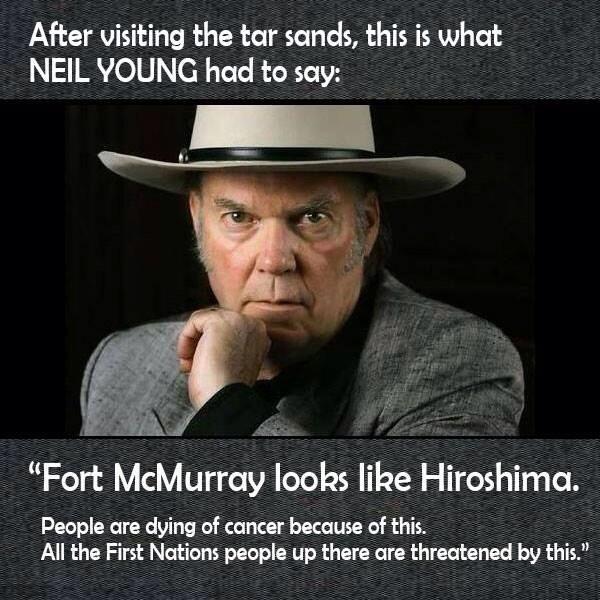
“The fact is, Fort McMurray looks like Hiroshima,” Mr. Young said in
Washington. “Fort McMurray is a wasteland. The Indians up there and the
native peoples are dying.”
Keystone opponents were quick to cheer Mr. Young’s blunt intervention.
Sierra
Club spokesman Eddie Scher said: “Neil Young has been expressing and
exposing hard truths his whole career,” adding: “Looks like he’s at it
again.”
Natural Resources Minister Joe Oliver – who was in
Washington himself on the same day for a meeting with U.S. Energy
Secretary Ernest Moniz, took a different view.
“I am a big fan of
Neil Young’s music,” Mr. Oliver told the Globe. “But on this matter we
disagree because Keystone XL will displace heavy oil from Venezuela
which has the same or higher greenhouse gas emissions, with a stable and
secure source of Canadian oil.”
The singer is among a growing
number of well-known activists speaking out against Keystone XL “Neil
Young is speaking for all of us fighting to stop the Keystone XL,” said
Jane Kleeb, Executive Director of Bold Nebraska, a coalition of
landowners and others opposed to the $5.3-billion Keystone XL pipeline.
“When you see the pollution already caused by the reckless expansion of
tar sands, you only have one choice and that is to act.”
Mr.
Young, one of Canada’s best-known singer-songwriters since the 1960s,
told a conference in Washington Monday that he recently traveled to
Alberta, where “much of the oil comes from, much of the oil that we’re
using here, which they call ethical oil because it’s not from Saudi
Arabia or some country that may be at war with us.”
As for Keystone, Mr. Young lampooned claims that it would create lots of jobs.
“Yeah
it’s going to put a lot of people to work, I’ve heard that, and I’ve
seen a lot of people that would dig a hole that’s so deep that they
couldn’t get out of it, and that’s a job too, and I think that’s the
jobs that we are talking about there with the Keystone pipeline,” he
said.
He spoke at the U.S. National Farmers Union conference in
Washington, intended to support alternative fuels, such as ethanol,
which he did at length, slamming Big Oil and talking about his own
LincVolt, an old Continental that runs on ethanol and electricity.
Young
said he drove the 1959 Lincoln, which runs on ethanol and electricity,
to Fort McMurray while traversing the continent from his California home
to Washington over the last two and half weeks.
At the same time,
Canada’s Natural Resources Minister Joe Oliver was making the latest in
a long series of lobbying visits by ministers and premiers intended to
sway President Barack Obama to approve the long-delayed pipeline.
Ms.
Kleeb wasn’t impressed. “Prime Minister Harper can write all the memos
he wants, Joe Oliver can say anything but the reality is people are
dying and the alliance between cowboys and Indians is stronger than any K
Street lobbyists Canada hires.”
All Risk, No Rewards, another group opposed to Keystone XL also echoed Mr. Young’s comments.
“Canada’s
First Nations know all too well the risks of Keystone XL and the risks
of expanding the tar sands,” said Rachel Wolf, a spokeswoman for the
group. Ranchers in Nebraska and First Nations peoples in Canada have
more in common than one might think: they’re ‘Ordinary People’ who share
a common goal to protect their land and protect their water, and they
both know that these tar sands expansion projects are all risk and no
reward.”
Mr. Young described his recent visit graphically. “The
fuel’s all over – the fumes everywhere – you can smell it when you get
to town. The closest place to Fort McMurray that is doing the tar sands
work is 25 or 30 miles out of town and you can taste it when you get to
Fort McMurray. People are sick. People are dying of cancer because of
this. All the First Nations people up there are threatened by this.”
Mr. Young's comments don't sit well with Fort McMurray's mayor, who called them "blatantly false."
Melissa
Blake, mayor of the Regional Municipality of Wood Buffalo, which
includes Fort McMurray, said she has no problem with people having
environmental interests at heart.
But she said Fort McMurray is
totally different from Mr. Young's characterization. With his power in
the music industry, she's disappointed "there wasn't more rationality to
it."
"When people say it's a wasteland, it really and truly
isn't," Ms. Blake said. "When it comes to the community of Fort
McMurray, you're overwhelmed frankly by the beauty of it. You've got an
incredible boreal environment that's all around you. You proceed further
north into the oil sands and inevitably, there's mining operations that
will draw your attention because they take up large chunks of land."
The
mayor said she always invites outsiders to the region to see the
landscape, and to see oil sands companies' reclamation efforts.
Danielle
Droitsch, director of the National Resources Defense Council, said
“Seeing tar sands development up close is shocking" adding "these are
massive operations and industry hopes to triple its production over the
next 20 years.”
Blocking Keystone XL will thwart expansion of oil
sands production, according to the NRDC, but Mr. Oliver says Canada will
just export its reserves elsewhere. With files from Steven Chase and The Canadian Press
September 3, 2013
On my recent trip to Fort Mac in Alberta, I drove Lincvolt
about 1800 miles from San Francisco running on Cellulosic Ethanol fuel. I
have chosen to use Ethanol, a much cleaner fuel created from plants
nourished by the sun and rain and grown by farmers rather than run on
gasoline, which has a carbon footprint of 19.5 LBS (pump to tailpipe)
per gallon or 28 LBS CO2 per gallon (earth to tailpipe) according to the
Mass Institute of Technology.
Although E 85 is hard to find in some parts of the USA, it is
much cleaner than gasoline and since I am a believer in Climate Chaos as
a result of Global Warming, I have chosen this greener fuel. On the
trip back from Fort Mac, I ran out of fuel in Red Deer Alberta after
searching in vain for an E 85 or pure ethanol fuel source in CANADA. In
Red Deer Alberta we were told by Husky Oil reps that they had “never
heard of E 85”. Lincvolt does not run on gasoline by design.
In Canada, where the dirtiest oil on the planet is extracted from
the Alberta Tar sands at an immeasurable human cost to the First
Nations people, and disease statistics reflect 30% increase in some
fatal diseases, there is no freedom to choose an alternative to gasoline
at the pump. This is un-Canadian.
As a proud Canadian, I cannot let this go by without a fight.
Canadians deserve Freedom to Choose the Fuel they use. Canadians should
have a fuel choice at the pump that considers Future Generations.
Canadians should have the freedom to express themselves through the
choices they make, not have those choices made for them by a government
that is too close to industry and over concerned with money and petro
dollar value. We do not have to be spoon fed by the Big Oil Companies.
Stand with me for Future Generations and Bring Light to the conditions
In Canada as we move forward on this mission.
As time passes, you will see what we are up to. If you believe in
Freedom of Choice for Canadians, you will have a voice in this with us.
It will be your chance to stand up.
BRING LIGHT-FUTURE GENERATIONS
--Neil Young http://www.lincvolt.com/lincvolt_lincvoltgazette
There has long been a scholarly debate about whether it was necessary for the United States to use atomic weapons to bring World War II to an end. Traditionalists say yes: If not for Fat Man and Little Boy, Japan would have fought to the last man. But revisionists argue that by August of 1945: (a) Japan's situation was catastrophically hopeless; (b) they knew it and were ready to surrender; and (c) thanks to decoded Japanese diplomatic messages, Harry Truman and other American leaders knew they were ready. A Japanese surrender could have been negotiated in fairly short order with or without the destruction of Hiroshima and Nagasaki.
For various reasons I've always found the revisionist view unsatisfactory. After all, even after the Hiroshima bomb was dropped, we know there was still considerable debate within the Japanese war cabinet over their next step. Surely if Japan had already been close to unconditional surrender in early August—and for better or worse, unconditional surrender was an American requirement—the atomic demonstration of August 6 would have been more than enough to tip them over the edge. But it didn't. It was only after the second bomb was dropped that Japan ultimately agreed to surrender.
But although the revisionist view has never persuaded me, a new revisionist view has been swirling around the academic community for several years—and this one seems much more interesting. Tsuyoshi Hasegawa, a trilingual English/Russian/Japanese historian, reminds us that the actual timeline of Japanese surrender went like this:
August 6: Hiroshima bomb dropped. August 8: Soviet Union declares war on Japan and invades Manchuria. August 9: Nagasaki bomb dropped. August 10: Emperor Hirohito breaks the cabinet deadlock and decides that Japan must surrender.
So what really caused the Japanese to finally give up? Was it America's atomic bombs, or was it the Soviet Union's entrance into the Pacific war? Hasegawa, based on meticulous research into primary sources, argues that it was probably the latter. Gareth Cook summarizes Hasegawa's argument in the Boston Globe:
According to his close examination of the evidence, Japan was not poised to surrender before Hiroshima, as the revisionists argued, nor was it ready to give in immediately after the atomic bomb, as traditionalists have always seen it.…Americans, then and today, have tended to assume that Japan's leaders were simply blinded by their own fanaticism, forcing a catastrophic showdown for no reason other than their refusal to acknowledge defeat.…But Hasegawa and other historians have shown that Japan's leaders were in fact quite savvy, well aware of their difficult position, and holding out for strategic reasons.
Their concern was not so much whether to end the conflict, but how to end it while holding onto territory, avoiding war crimes trials, and preserving the imperial system. The Japanese could still inflict heavy casualties on any invader, and they hoped to convince the Soviet Union, still neutral in the Asian theater, to mediate a settlement with the Americans. Stalin, they calculated, might negotiate more favorable terms in exchange for territory in Asia. It was a long shot, but it made strategic sense.
On Aug. 6, the American bomber Enola Gay dropped its payload on Hiroshima.…As Hasegawa writes in his book "Racing the Enemy," the Japanese leadership reacted with concern, but not panic.…Very late the next night, however, something happened that did change the plan. The Soviet Union declared war and launched a broad surprise attack on Japanese forces in Manchuria. In that instant, Japan's strategy was ruined. Stalin would not be extracting concessions from the Americans. And the approaching Red Army brought new concerns: The military position was more dire, and it was hard to imagine occupying communists allowing Japan's traditional imperial system to continue. Better to surrender to Washington than to Moscow.
In some sense, the real answer here is probably unknowable. Two events happened at nearly the same time, and they were closely followed by a third. Figuring out conclusively what caused what may simply not be possible. Probably they both played a role. Still, aside from the documentary evidence that Hasegawa amasses, his theory accounts for other aspects of the war. Like the dog that didn't bark in the night, Japan didn't give up after the fire bombing of Tokyo. Nor did Germany surrender after the fire bombing of Dresden. And although it's undeniably true that atomic bombs are a more dramatic way of destroying a city than conventional weaponry, it's also undeniably true that simply destroying a city was never enough to produce a surrender. So why would destroying a city with an atomic bomb be that much different?
This is fascinating stuff. At the same time, I think that Cook takes a step too far when he suggests that Hasegawa's research, if true, should fundamentally change our view of atomic weapons. "If the atomic bomb alone could not compel the Japanese to submit," he writes, "then perhaps the nuclear deterrent is not as strong as it seems." But that hardly follows. America in 1945 had an air force capable of leveling cities with conventional weaponry. We still do—though barely—but no other country in the world comes close. With an atomic bomb and a delivery vehicle, North Korea can threaten to destroy Seoul. Without it, they can't. And larger atomic states, like the US, India, Pakistan, and Russia, have the capacity to do more than just level a city or two. They can level entire countries.
So, no: Hasegawa's research is fascinating for what it tells us about a key event in history. But should it change our view of atomic weaponry or atomic deterrence? I doubt it. It's not 1945 anymore.
Sixty-five years after the atomic attacks on Hiroshima and Nagasaki, the bomb is still very much with us, and controversy continues to swirl over the decision to obliterate the two Japanese cities -- sparked this time by President Obama's decision to send a U.S. envoy to Hiroshima, for the first time, for the official ceremony today.
Already some on the right are charging that this amounts to an "apology" for using the bomb against Japan. Warren Kozak, in an op-ed for the Wall Street Journal, has attacked the Obama move, equating it with President Reagan going to Bitburg and laying a wreath at graves belonging to SS members. In contrast, the overwhelming majority of the 130,000 killed in Hiroshima were civilians, mainly women and children.
Secretary of State Hillary Clinton has said U.S. Ambassador John Roos is merely honoring all of the dead of World War II and expressing the president's endorsement of severe cutbacks in the global nuclear arsenals. No U.S. president has visited Hiroshima while in office.
Hiroshima, in any case, remains a vital lesson for us all, not only for the first use of a nuclear weapon there, but because of the "first use" nuclear policy the U.S. maintains today.
It's a subject practically off-limits in the media and in American policy circles. Even the current, fine antinuclear documentary Countdown to Zero, which outlines many serious nuclear dangers (from an accidental launch to a terror attack on America), fails to even mention the possibility that the U.S. might choose to use nuclear weapons again. Resisting a no-first-use policy, in fact, has been a cornerstone of U.S. nuclear policy for decades.
Yet despite some positive signs from Obama, I fear that moving very far in the direction of no-first-use is still a long way off in America.
Perhaps the strongest reason is this: Most Americans, our media and our leaders (including every president), have endorsed our "first-use" of the bomb against Japan. This remains true today, despite new evidence and analysis that has emerged for so many years. I've been probing this for almost thirty years -- in articles, a film, in a book -- with little shift in the polls or change in heart among our policymakers and elected officials.
There has also been little change abroad -- where the use of the bomb in 1945 has been roundly condemned from the beginning. Indeed, U.S. support, even pride, in our use of the weapon has given us little moral standing in arguing that other countries should not develop nuclear weapons and consider using them, possibly as a first, not a last, resort (that's our policy, remember).
So it all goes back to Hiroshima and Nagasaki.
While I respect the views of a range of historians on this matter, and the opinions of the men who fought in the Pacific, I happen to believe the bombs should not have been used against Japan -- directly over massive cities -- at that time. The war would likely have ended very shortly without it (or a bloody American invasion planned for months later), largely because of the Soviets finally declaring war on Japan -- an event long-dreaded by Japanese leaders.
Yes, there was a day when conservatives like John Foster Dulles, columnist David Lawrence, Admiral William Leahy and General Dwight D. Eisenhower -- "We shouldn't have hit them with that awful thing," Ike declared -- clearly condemned the use of the bombs. They knew that the argument of "saving tens of thousands of American lives" only counted if an invasion actually was necessary. We had demanded "unconditional surrender," dropped the bombs -- then accepted the main Japanese demand, keeping their emperor as figurehead.
But the key point for today is this: How the "Hiroshima narrative" has been handed down to generations of Americans -- and overwhelmingly endorsed by officials and the media, even if many historians disagree -- matters greatly. (And see my piece earlier this week here on Truman editing the first Hollywood movie on the bombing, and an earlier piece on suppression of footage shot in Hiroshima by U.S. military film crews.)
Over and over, top policymakers and commentators say, "We must never use nuclear weapons," yet they endorse the two times the weapons have been used against cities in a first strike. To make any exceptions, even in the past and in a horrid situation, means exceptions can be made in the future. Indeed, we have already made two exceptions, with more than 200,000 civilians killed. The line against using nuclear weapons has been drawn... in the sand.
To cite just one example: Before our attack on Iraqi forces in Kuwait in 1990, then-Pentagon chief Dick Cheney said on TV that we would consider using nuclear weapons against Iraq but would hold off "at this point" -- then specifically cited President Truman's use of the bomb as morally correct. Some polls at the time showed strong support from the American public for using nukes if our military so advised. And who can forget Hillary Clinton's claim, during her run for president, that we might have to "obliterate" Iran.
And, as I noted, the fact that the United States first developed, and then used -- twice -- the WMD to end all WMDs has severely compromised our arguments against others building the weapon ever since. Hiroshima was our original sin, and we are still paying for it, even if most Americans do not recognize this.
That is why I always urge everyone to study the history surrounding the decision to use the bomb and how the full story was covered up for decades. There is certainly, in the minds of the media and the American public, no taboo on using nuclear weapons, and it all started, but did not end, with Hiroshima and Nagasaki. This is what nuclear abolitionists -- or even those who (like Obama) simply want a partial easing of our first-use policy -- are up against.
WHITE HOUSE COVER-UP: How Truman Edited Hollywood's First Movie About the Atomic Bomb
This Friday marks the 65th anniversary of the first use of the atomic bomb against a large city. Since that day, creative artists of every variety have made incisive, satiric or powerful statements about nuclear threat. They have offered cautionary works that depict the horror of the bomb or its meaning in our society. What these artistic statements share, however, with rare exceptions, is an avoidance of the specific subject of Hiroshima.
Since August 1945, hundreds of "nuclear" movies have appeared. At least one American "nuclear" film was a work of genius (Dr. Strangelove), and several others explored the issue thoughtfully (Fail-Safe, The War Game, Testament and Desert Bloom come to mind). But more often the fear of nuclear war in Hollywood spawned survivalist fantasies, irradiated-monster films and post-apocalypse thrillers.
What is striking is that few of these films say anything directly about Hiroshima. Almost all of them are works of pure fiction, imagining nuclear attacks in the near or distant future while ignoring the two instances when atomic weapons have already been used: Nagasaki and Hiroshima.
Only three Hollywood movies have emerged about the making or use of the first atomic bombs: The Beginning or the End, Above and Beyond, and Fat Man and Little Boy (the only such film since the 1950s).
Ambivalence or guilt is certain to be evoked by any cinematic treatment of Hiroshima. Perhaps that is why the films all grapple with the notion of American decency. The three Hollywood films have much in common: Each was highly touted and directed by a talented film maker but was an artistic failure. Each was subject to political pressure or scrutiny. Here's a close-up look at the "coverup"--led by the Truman White House--of the first "Hiroshima movie," some of it based on material we were first to discover at the Truman Library in Missouri. The Beginning or the End
This controversial MGM film emerged, after many revisions -- some demanded by the White House -- as a Hollywood version of the official Hiroshima narrative: the bomb was absolutely necessary to end the war and save American lives.
About a month after the Hiroshima attack, Sam Marx, a producer at MGM, received a call from agent Tony Owen, who said his wife, actress Donna Reed, had received some fascinating letters from her high school chemistry teacher, Dr. Edward Tomkins--who was not at Oak Ridge. Tomkins expressed surpise that Hollywood did not already have an atomic bomb feature in the works, and wondered if the film industry wanted to warn the people of the world about the coming dangers of a nuclear arms race.
Soon, MGM boss Louis B. Mayer gave the film a go, calling it "the most important story" he would ever film. Marx and others from MGM met with the atomic scientists at Oak Ridge and elsewhere.
Early scripts raised doubts about the Hiroshima decision and portrayed the effects of the atomic bombing in a way that would have shocked many viewers, with Hiroshima pictured as ghostlike ruins and a baby with a burned face. The overall political message was alarmist and aligned with pro-disarmament scientists: It would have been better to lose half a million American lives "than release atomic energy in the world." Then something happened, and the sensibility of The Beginning or the End shifted radically. The decision to use the bomb, in revised scripts, was viewed as justifiable, even admirable. Now, after the bombings, no victims appeared -- just a burning landscape observed from the air. Amazingly, Gen. Leslie Groves, the director of the Manhattan Project, had secured the right of script approval -- along with a hefty $10,000 fee -- and played a vital part in reshaping the film.
MGM hired Norman Taurog to direct the film and Hume Cronyn to star as Robert Oppenheimer. Everyone from famed columnist Bob Considine to author Ayn Rand were involved with early scripts. Nearly all of the scientists impersonated in the film signed releases, even Albert Einstein, but unlike Groves and President Truman, were not given script approval. Oppenheimer visited the set after being assured that his character, the film's narrator, would display "humility" and "a love of mankind." The Hollywoodization of the bomb had begun.
Even in minor details, the revised script now justified the bombing. General Groves made light of nuclear fallout. The B-29's flying over Hiroshima were pelted with heavy flak, a fabrication that makes the attack more courageous. The name of one of those planes was changed from Bock's Car to Necessary Evil. Nagasaki was not mentioned at all. One scene depicting a fictional German scientists visiting a (fabricated) Japanese nuclear facility in--Hiroshima.
Yet it was in the script's central melodrama that the true message of the film was conveyed. Matt Cochran, a young scientist arming the bomb, prevents a chain reaction from blowing up 40,000 people on a Pacific island -- and thereby exposes himself to a fatal dose of radiation. But just before he dies, Matt concludes that "God has not shown us a new way to destroy ourselves. Atomic energy is the hand he has extended to lift us from the ruins of war and lighten the burdens of peace."
After screening the finished, watered-down, film, famed columnist Walter Lippmann said he still found one scene "shocking." President Truman felt uncomfortable with it as well. It pictured Truman making the decision to use the bomb, and the president and his aides objected to his deciding, after only a brief reflection, that the United States would use the weapon against Japan because "I think more of our American boys than I do of all our enemies." This was actually true, of course.
After protests from the White House, the MGM screenwriter James K. McGuinness deleted the offending scene and wrote a new one in which Truman explained that in his many discussions on the matter the "consensus of opinion is that the bomb will shorten the war by approximately a year." In the revised scene, Truman revealed that the United States would drop leaflets warning the populace of "what is coming" as a means to "save lives." He said there was a "consensus" that dropping the bomb by a year (there was no such thing) and he predicted that a "year less of war will mean life for . . . from 300,000 to half a million of America's finest youth" (a highly inflated figure).
And he advised that the targets had been picked for their prime military value, rather than the truth: They were picked because they had not been bombed previously and so would demonstrate the pure power of this new weapon. In any case, the aiming points for release of the bombs would be the center of the cities, not over any military bases. The new scene had Truman claiming he had spent "sleepless nights" making the decision. But in real life he proudly insisted he had never lost any sleep over it.
Still, the White House demanded further changes; among them, deleting a reference to morally concerned scientists who favored demonstrating the bomb for Japanese leaders in a remote area before dropping it on a city.
Truman even wrote a letter objecting to the actor who had portrayed him in the original scene, and the actor, Roman Bohnen was replaced. Bohnen would write a sarcastic letter to Truman, informing him that people would be debating the decision to drop the bomb for 100 years "and posterity is quite apt to be a little rough." Truman, who normally ignored critical letters, took the trouble to reply and defend the decision, revealing, "I have no qualms about it whatever." The Beginning or the End, which billed itself as "basically a true story," opened across the country in March 1947 to mixed reviews (see video below). Time laughed at the film's "cheery imbecility," but Variety praised its "aura of authenticity and special historical significance."
Harrison Brown, who had worked on the bomb, exposed some of the film's factual errors in The Bulletin of Atomic Scientists: he called the showering of warning leaflets over Hiroshima the "most horrible falsification of history." But in the far more influential New York Times, Bosley Crowther called the picture a fair and "creditable" reenactment and observed that MGM had "taken no obvious sides in the current atomic contentions."
The MGM movie was seen by hundreds of thousands of Americans. Because of its quasi-documentary form, its depiction of history was probably accepted by most viewers. (See MGM preview below.) But famed physicist Leo Szilard, after attending a screening, summed it up this way: "If our sin as scientists was to make and use the bomb, then our punishment was to watch The Beginning or the End." Greg Mitchell and Robert Jay Lifton first wrote about Hiroshima films in their book "Hiroshima in America."
Early this week, President Obama -- perhaps under new pressure as a Nobel Peace Prize winner -- said he would like to visit Hiroshima and Nagasaki during his presidency. If he does, he will become the first sitting U.S. president to make that trip.
Yesterday, Veterans Day arrived, so here I'd liked to pay tribute to two of the most remarkable veterans I've ever encountered.
In the weeks following the atomic attacks on Japan 64 years ago, and then for decades afterward, the United States engaged in airtight suppression of all film shot in Hiroshima and Nagasaki after the bombings. This included footage shot by U.S. military crews and Japanese newsreel teams. In addition, for many years, many newspaper photographs were seized or prohibited.
The general public did not see any of the newsreel footage for 25 years, and the U.S. military film remained hidden for nearly four decades. I first probed the coverup back in 1983, and developed it further in later articles and in my 1995 book with Robert Jay Lifton, Hiroshima in America and in a 2005 documentary Original Child Bomb. To see some of the footage, go to my blog.
As editor of Nuclear Times in the early 1980s, I met Herbert Sussan, one of the members of the U.S. military film crew. The color U.S. military footage would remain hidden until the early 1980s, and has never been fully aired. It rests today at the National Archives in College Park, Md., in the form of 90,000 feet of raw footage labeled #342 USAF. I have a VHS copy of all of it today.
When that footage finally emerged, I spoke with and corresponded with the man at the center of this drama: Lt. Col. Daniel A. McGovern, who directed the U.S. military film-makers in 1945-1946, managed the Japanese footage, and then kept watch on all of the top-secret material for decades.
"I always had the sense," McGovern told me, "that people in the Atomic Energy Commission were sorry we had dropped the bomb. The Air Force -- it was also sorry. I was told by people in the Pentagon that they didn't want those [film] images out because they showed effects on man, woman and child....They didn't want the general public to know what their weapons had done -- at a time they were planning on more bomb tests. We didn't want the material out because...we were sorry for our sins."
Sussan, meanwhile, struggled for years to get some of the American footage aired on national TV, taking his request as high as President Truman, Robert F. Kennedy and Edward R. Murrow, to no avail.
More recently, McGovern declared that Americans should have seen the damage wrought by the bomb. "The main reason it was classified was...because of the horror, the devastation," he said. Because the footage shot in Hiroshima and Nagasaki was hidden for so long, the atomic bombings quickly sank, unconfronted and unresolved, into the deeper recesses of American awareness, as a costly nuclear arms race, and nuclear proliferation, accelerated.
In 2005, Editor & Publisher (where I am editor) broke the news that articles written by famed Chicago Daily News war correspondent George Weller about the effects of the atomic bomb dropped on Nagasaki were finally published, in Japan, almost six decades after they had been spiked by U.S. officials. But suppressing film footage shot in Hiroshima and Nagasaki was even more significant, as this country rushed into the nuclear age with its citizens having neither a true understanding of the effects of the bomb on human beings, nor why the atomic attacks drew condemnation around the world. The common view abroad, and among many U.S. historians, is that Russia's entry into the war (long scheduled and carried out on August 8) would have forced a Japanese surrender long before any U.S. invasion took place. Gen. Dwight D. Eisenhower himself later said it was not necessary to hit Japan "with that awful thing."
The atomic cover-up also reveals what can happen in any country that carries out deadly attacks on civilians in any war (such as Japan's policy in China in World War II) and then keeps images of what occurred from its own people.
The Japanese Newsreel Footage
On August 6, 1945, the United States dropped an atomic bomb over the center of Hiroshima, killing at least 70,000 civilians instantly and perhaps 50,000 more in the days and months to follow. Three days later, it exploded another atomic bomb over Nagasaki, slightly off target, killing 40,000 immediately and dooming tens of thousands of others. Within days, Japan had surrendered, and the U.S. readied plans for occupying the defeated country -- and documenting the first atomic catastrophe.
But the Japanese also wanted to study it. Within days of the second atomic attack, officials at the Tokyo-based newsreel company Nippon Eigasha discussed shooting film in the two stricken cities. In early September, just after the Japanese surrender, and as the American occupation began, director Sueo Ito set off for Nagasaki. There his crew filmed the utter destruction near ground zero and scenes in hospitals of the badly burned and those suffering from the lingering effects of radiation.
On Sept. 15, another crew headed for Hiroshima. When the first rushes came back to Toyko, Akira Iwasaki, the chief producer, felt "every frame burned into my brain," he later said.
At this point, the American public knew little about conditions in the atomic cities beyond Japanese assertions that a mysterious affliction was attacking many of those who survived the initial blasts (claims that were largely taken to be propaganda). Newspaper photographs of victims were non-existent, or censored. Life magazine would later observe that for years "the world...knew only the physical facts of atomic destruction."
Tens of thousands of American GIs occupied the two cities. Because of the alleged absence of residual radiation, no one was urged to take precautions. This remains perhaps the last little-told story of World War II.
Then, on October 24, 1945, a Japanese cameraman in Nagasaki was ordered to stop shooting by an American military policeman. His film, and then the rest of the 26,000 feet of Nippon Eisasha footage, was confiscated by the U.S. General Headquarters (GHQ). An order soon arrived banning all further filming. It was at this point that Lt. Daniel McGovern took charge.
Shooting the U.S. Military Footage
In early September, 1945, less than a month after the two bombs fell, Lt. McGovern -- who as a member of Hollywood's famed First Motion Picture Unit shot some of the footage for William Wyler's "Memphis Belle" -- had become one of the first Americans to arrive in Hiroshima and Nagasaki. He was a director with the U.S. Strategic Bombing Survey, organized by the Army the previous November to study the effects of the air campaign against Germany, and now Japan.
As he made plans to shoot the official American record, McGovern learned about the seizure of the Japanese footage. He felt it would be a waste to not take advantage of the newsreel footage, noting in a letter to his superiors that "the conditions under which it was taken will not be duplicated, until another atomic bomb is released under combat conditions."
McGovern proposed hiring some of the Japanese crew to edit and "caption" the material, so it would have "scientific value." He took charge of this effort in early January 1946, even as the Japanese feared that, when they were done, they would never see even a scrap of their film again.
At the same time, McGovern was ordered by General Douglas MacArthur on January 1, 1946 to document the results of the U.S. air campaign in more than 20 Japanese cities. His crew would shoot exclusively on color film, Kodachrome and Technicolor, rarely used at the time even in Hollywood. McGovern assembled a crew of eleven, including two civilians. Third in command was a young lieutenant from New York named Herbert Sussan.
The unit left Tokyo in a specially outfitted train, and made it to Nagasaki. "Nothing and no one had prepared me for the devastation I met there," Sussan later told me. "We were the only people with adequate ability and equipment to make a record of this holocaust...I felt that if we did not capture this horror on film, no one would ever really understand the dimensions of what had happened. At that time people back home had not seen anything but black and white pictures of blasted buildings or a mushroom cloud."
Along with the rest of McGovern's crew, Sussan documented the physical effects of the bomb, including the ghostly shadows of vaporized civilians burned into walls; and, most chillingly, dozens of people in hospitals who had survived (at least momentarily) and were asked to display their burns, scars, and other lingering effects for the camera as a warning to the world.
At the Red Cross Hospital in Hiroshima, a Japanese physician traced the hideous, bright red scars that covered several of the patients -- and then took off his white doctor's shirt and displayed his own burns and cuts.
After sticking a camera on a rail car and building their own tracks through the ruins, the Americans filmed hair-raising tracking shots that could have been lifted right from a Hollywood movie. Their chief cameramen was a Japanese man, Harry Mimura, who in 1943 had shot Sanshiro Sugata, the first feature film by a then-unknown Japanese director named Akira Kurosawa.
The Suppression Begins
While all this was going on, the Japanese newsreel team was completing its work of editing and labeling all their black and white footage into a rough cut of just under three hours. At this point, several members of Japanese team took the courageous step of ordering from the lab a duplicate of the footage they had shot before the Americans took over the project.
Director Ito later said: "The four of us agreed to be ready for 10 years of hard labor in the case of being discovered." One incomplete, silent print would reside in a ceiling until the Occupation ended.
The negative of the finished Japanese film, nearly 15,000 feet of footage on 19 reels, was sent off to the U.S. in early May 1946. The Japanese were also ordered to include in this shipment all photographs and related material. The footage would be labeled SECRET and not emerge from the shadows for more than 20 years.
The following month, McGovern was abruptly ordered to return to the U.S. He hauled the 90,000 feet of color footage, on dozens of reels in huge footlockers, to the Pentagon and turned it over to General Orvil Anderson. Locked up and declared top secret, it did not see the light of day for more than 30 years.
McGovern would be charged with watching over it. Sussan would become obsessed with finding it and getting it aired.
Fearful that his film might get "buried," McGovern stayed on at the Pentagon as an aide to Gen. Anderson, who was fascinated by the footage and had no qualms about showing it to the American people. "He was that kind of man, he didn't give a damn what people thought," McGovern told me. "He just wanted the story told."
In an article in his hometown Buffalo Evening News, McGovern said that he hoped that "this epic will be made available to the American public." He planned to call the edited movie Japan in Defeat.
Once they eyeballed the footage, however, most of the top brass didn't want it widely shown and the Atomic Energy Commission (AEC) was also opposed, according to McGovern. It nixed a Warner Brothers feature film project based on the footage that Anderson had negotiated, while paying another studio about $80,000 to help make four training films.
In a March 3, 1947 memo, Francis E. Rundell, a major in the Air Corps, explained that the film would be classified "secret." This was determined "after study of subject material, especially concerning footage taken at Hiroshima and Nagasaki. It is believed that the information contained in the films should be safeguarded until cleared by the Atomic Energy Commission." After the training films were completed, the status would be raised to "Top Secret" pending final classification by the AEC.
The color footage was shipped to the Wright-Patterson base in Ohio. McGovern went along after being told to put an I.D. number on the film "and not let anyone touch it -- and that's the way it stayed," as he put it. After cataloging it, he placed it in a vault in the top secret area.
"Dan McGovern stayed with the film all the time," Sussan later said. "He told me they could not release the film [because] what it showed was too horrible."
Sussan wrote a letter to President Truman, suggesting that a film based on the footage "would vividly and clearly reveal the implications and effects of the weapons that confront us at this serious moment in our history." A reply from a Truman aide threw cold water on that idea, saying such a film would lack "wide public appeal."
McGovern, meanwhile, continued to "babysit" the film, now at Norton Air Force base in California. "It was never out of my control," he said later, but he couldn't make a film out of it any more than Sussan could (but unlike Herb, he at least knew where it was). The Japanese Footage Emerges
At the same time, McGovern was looking after the Japanese footage. Fearful that it might get lost forever in the military/government bureaucracy, he secretly made a 16 mm print and deposited it in the U.S. Air Force Central Film Depository at Wright-Patterson. There it remained out of sight, and generally out of mind. (The original negative and production materials remain missing, according to Abe Mark Nornes, who teaches at the University of Michigan and has researched the Japanese footage more than anyone.)
The Japanese government repeatedly asked the U.S. for the full footage of what was known in that country as "the film of illusion," to no avail. A rare article about what it called this "sensitive" dispute appeared in the New York Times on May 18, 1967, declaring right in its headline that the film had been "Suppressed by U.S. for 22 Years." Surprisingly, it revealed that while some of the footage was already in Japan (likely a reference to the film hidden in the ceiling), the U.S. had put a "hold" on the Japanese using it -- even though the American control of that country had ceased many years earlier.
Despite rising nuclear fears in the 1960s, before and after the Cuban Missile Crisis, few in the U.S. challenged the consensus view that dropping the bomb on two Japanese cities was necessary. The United States maintained its "first-use" nuclear policy: Under certain circumstances it would strike first with the bomb and ask questions later. In other words, there was no real taboo against using the bomb. This notion of acceptability had started with Hiroshima. A firm line against using nuclear weapons had been drawn -- in the sand. The U.S., in fact, had threatened to use nuclear weapons during the Cuban Missile Crisis and on other occasions.
On Sept. 12, 1967, the Air Force transferred the Japanese footage to the National Archives Audio Visual Branch in Washington, with the film "not to be released without approval of DOD (Department of Defense)."
Then, one morning in the summer of 1968, Erik Barnouw, author of landmark histories of film and broadcasting, opened his mail to discover a clipping from a Tokyo newspaper sent by a friend. It indicated that the U.S. had finally shipped to Japan a copy of black and white newsreel footage shot in Hiroshima and Nagasaki. The Japanese had negotiated with the State Department for its return.
From the Pentagon, Barnouw learned in 1968 that the original nitrate film had been quietly turned over to the National Archives, so he went to take a look. Soon Barnouw realized that, despite its marginal film quality, "enough of the footage was unforgettable in its implications, and historic in its importance, to warrant duplicating all of it," he later wrote.
Attempting to create a subtle, quiet, even poetic, black and white film, he and his associates cut it from 160 to 16 minutes, with a montage of human effects clustered near the end for impact. Barnouw arranged a screening at the Museum of Modern Art in New York, and invited the press. A throng turned out and sat in respectful silence at its finish. (One can only imagine what impact the color footage with many more human effects would have had.) "Hiroshima-Nagasaki 1945" proved to be a sketchy but quite moving document of the aftermath of the bombing, captured in grainy but often startling black and white images: shadows of objects or people burned into walls, ruins of schools, miles of razed landscape viewed from the roof of a building.
In the weeks ahead, however, none of the (then) three TV networks expressed interest in airing it. "Only NBC thought it might use the film," Barnouw later wrote, "if it could find a 'news hook.' We dared not speculate what kind of event this might call for." But then an article appeared in Parade magazine, and an editorial in the Boston Globe blasted the networks, saying that everyone in the country should see this film: "Television has brought the sight of war into America's sitting rooms from Vietnam. Surely it can find 16 minutes of prime time to show Americans what the first A-bombs, puny by today's weapons, did to people and property 25 years ago."
This at last pushed public television into the void. What was then called National Educational Television (NET) agreed to show the documentary on August 3, 1970, to coincide with the 25th anniversary of dropping the bomb.
"I feel that classifying all of this filmed material was a misuse of the secrecy system since none of it had any military or national security aspect at all," Barnouw told me. "The reason must have been -- that if the public had seen it and Congressmen had seen it -- it would have been much harder to appropriate money for more bombs." The American Footage Comes Out
About a decade later, by pure chance, Herb Sussan would spark the emergence of the American footage, ending its decades in the dark.
In the mid-1970s, Japanese antinuclear activists, led by a Tokyo teacher named Tsutomu Iwakura, discovered that few pictures of the aftermath of the atomic bombings existed in their country. Many had been seized by the U.S. military after the war, they learned, and taken out of Japan. The Japanese had as little visual exposure to the true effects of the bomb as most Americans. Activists managed to track down hundreds of pictures in archives and private collections and published them in a popular book. In 1979 they mounted an exhibit at the United Nations in New York.
There, by chance, Iwakura met Sussan, who told him about the U.S. military footage.
Iwakura made a few calls and found that the color footage, recently declassified, might be at the National Archives. A trip to Washington, D.C. verified this. He found eighty reels of film, labeled #342 USAF, with the reels numbered 11000 to 11079. About one-fifth of the footage covered the atomic cities. According to a shot list, reel #11010 included, for example: "School, deaf and dumb, blast effect, damaged Commercial school demolished School, engineering, demolished.School, Shirayama elementary, demolished, blast effect Tenements, demolished."
The film had been quietly declassified a few years earlier, but no one in the outside world knew it. An archivist there told me at the time, "If no one knows about the film to ask for it, it's as closed as when it was classified."
Eventually 200,000 Japanese citizens contributed half a million dollars and Iwakura was able to buy the film. He then traveled around Japan filming survivors who had posed for Sussan and McGovern in 1946. Iwakura quickly completed a documentary called Prophecy and in late spring 1982 arranged for a New York premiere.
That fall a small part of the McGovern/Sussan footage turned up for the first time in an American film, one of the sensations of the New York Film Festival, called Dark Circle. It's co-director, Chris Beaver, told me, "No wonder the government didn't want us to see it. I think they didn't want Americans to see themselves in that picture. It's one thing to know about that and another thing to see it."
Despite this exposure, not a single story had yet appeared in an American newspaper about the shooting of the footage, its suppression or release. And Sussan was now ill with a form of lymphoma doctors had found in soldiers exposed to radiation in atomic tests during the 1950s -- or in Hiroshima and Nagasaki.
In late 1982, I met Sussan and Erik Barnouw -- and talked on several occasions with Daniel McGovern, out in Northridge, California. "It would make a fine documentary even today," McGovern said of the color footage. "Wouldn't it be wonderful to have a movie of the burning of Atlanta?"
After he hauled the footage back to the Pentagon, McGovern said, he was told that under no circumstances would the footage be released for outside use. "They were fearful of it being circulated," McGovern said. He confirmed that the color footage, like the black and white, had been declassified over time, taking it from top secret to "for public release" (but only if the public knew about it and asked for it).
Still, the question of precisely why the footage remained secret for so long lingered. Here McGovern added his considerable voice. "The main reason it was classified was because of the horror, the devastation," he said. "The medical effects were pretty gory. The attitude was: do not show any medical effects. Don't make people sick."
But who was behind this? "I always had the sense," McGovern answered, "that people in the AEC were sorry they had dropped the bomb. The Air Force -- it was also sorry. I was told by people in the Pentagon that they didn't want those images out because they showed effects on man, woman and child. But the AEC, they were the ones that stopped it from coming out. They had power of God over everybody," he declared. "If it had anything to do with nukes, they had to see it. They were the ones who destroyed a lot of film and pictures of the first U.S. nuclear tests after the war."
Even so, McGovern believed, his footage might have surfaced "if someone had grabbed the ball and run with it but the AEC did not want it released."
As Dark Circle director Chris Beaver had said, "With the government trying to sell the public on a new civil defense program and Reagan arguing that a nuclear war is survivable, this footage could be awfully bad publicity."
Today
In the summer of 1984, I made my own pilgrimage to the atomic cities, to walk in the footsteps of Dan McGovern and Herb Sussan, and meet some of the people they filmed in 1946. (The month-long grant was arranged by the current mayor of Hiroshima, Tad Akiba.) By then, the McGovern/ Sussan footage had turned up in several new documentaries. On September 2, 1985, however, Herb Sussan passed away. His final request to his children: Would they scatter his ashes at ground zero in Hiroshima?
In the mid-1990s, researching Hiroshima in America, a book I would write with Robert Jay Lifton, I discovered the deeper context for suppression of the U.S. Army film: it was part of a broad effort to suppress a wide range of material related to the atomic bombings, including photographs, newspaper reports on radiation effects, information about the decision to drop the bomb, even a Hollywood movie.
The 50th anniversary of the bombing drew extensive print and television coverage -- and wide use of excerpts from the McGovern/Sussan footage -- but no strong shift in American attitudes on the use of the bomb.
Then, in 2003, as adviser to a documentary film, Original Child Bomb, I urged director Carey Schonegevel to draw on the atomic footage as much as possible. She not only did so but also obtained from McGovern's son copies of home movies he had shot in Japan while shooting the official film.
Original Child Bomb went on to debut at the 2004 Tribeca Film Festival, win a major documentary award, and debut on the Sundance cable channel. After 60 years at least a small portion of that footage reached part of the American public in the unflinching and powerful form its creators intended. Americans who saw were finally able to fully judge for themselves what McGovern and Sussan were trying to accomplish in shooting the film, why the authorities felt they had to suppress it, and what impact their footage, if widely aired, might have had on the nuclear arms race -- and the nuclear proliferation that plagues, and endangers, us today.
(To see some of the footage, go to my blog here.)
Today marks the 65th anniversary of America's atomic bombing of Hiroshima, Japan during World War II. And for the first time ever, a U.S. representative participated in the annual commemoration.
Some details about the memorial, via the AP:
The site of the world's first A-bomb attack echoed with the choirs of schoolchildren and the solemn ringing of bells Friday as Hiroshima marked its biggest memorial yet. At 8:15 a.m. -- the time the bomb dropped, incinerating most of the city -- a moment of silence was observed.
Hiroshima's mayor welcomed Washington's decision to send U.S. Ambassador John Roos to Friday's commemoration, which began with an offering of water to the 140,000 who died in the first of two nuclear bombings that prompted Japan's surrender in World War II.
On August 9, 1945, three days after Hiroshima, the U.S. bombed Nagasaki, killing around 80,000 people. Japan surrendered a week later, on August 15, thereby ending WWII.
To commemorate the anniversary, LIFE.com has released some stunning never before seen photographs of those cities in the wake of the bombs being dropped. You can preview a small sample of the photos below. And be sure to check out the amazing full gallery from LIFE.com here.
Photos and captions courtesy of LIFE.com
Nagasaki, photographed by Alfred Eisensatedt.
Nagasaki, 1945, a few months after the bombing, photographed by Alfred Eisenstaedt.
That's the case for survivor Masashiro Kunishige, who was picking wheat alongside a group of his classmates when the bomb hit. Though seriously injured, he miraculously survived, but in 65 years, he has never spoken publicly about his experience. "I used to be filled with bitterness and wanted retribution," he says. "Then I realized the best way is to rid the world of nuclear weapons." He cites President Obama's pledge to clear the world of its atomic stockpile as a "turning point" for him and other survivors.



 Since August 1945, hundreds of "nuclear" movies have appeared. At least one American "nuclear" film was a work of genius (Dr. Strangelove), and several others explored the issue thoughtfully (Fail-Safe, The War Game, Testament and Desert Bloom come to mind). But more often the fear of nuclear war in Hollywood spawned survivalist fantasies, irradiated-monster films and post-apocalypse thrillers.
 Then something happened, and the sensibility of The Beginning or the End shifted radically. The decision to use the bomb, in revised scripts, was viewed as justifiable, even admirable. Now, after the bombings, no victims appeared -- just a burning landscape observed from the air. Amazingly, Gen. Leslie Groves, the director of the Manhattan Project, had secured the right of script approval -- along with a hefty $10,000 fee -- and played a vital part in reshaping the film.


