LYNCHBURG, Va. —
Democratic presidential hopeful Bernie Sanders sought Monday to reach
out to a conservative Christian audience, arguing that however stark
their differences on social issues, they should agree there is “massive
injustice” in the country’s economy.
“It
would be hard for anyone in this room to make the case that the United
States of America . . . is a just society or anything resembling a just
society today,” Sanders, the self-described democratic socialist senator
from Vermont, told a crowd of nearly 12,000 students and visitors at
Liberty University. “There is no justice when so few have so much and so
many have so little.”
After his appearance
at a convocation at the school founded by the late evangelist Jerry
Falwell, Sanders addressed a rally that drew an estimated 8,000 people
and snarled traffic around the Prince William County Fairgrounds. The
county is a rapidly diversifying jurisdiction that is home to a large
population of black and Latino voters.
Both
stops in Virginia on Monday pointed to segments of the electorate that
Sanders has yet to excite in large numbers when he is surging in Iowa
and New Hampshire polls based largely on his appeal to white liberals.
The crowd at the Manassas area rally was largely white, although more
diverse than at most of Sanders’s rallies.
The
Virginia stops also underscored the importance of the swing state,
which could play a role in Sanders’s fight for the Democratic nomination
against front-runner Hillary Rodham Clinton. Virginia is among about a
dozen states with Super Tuesday primaries, and so far, most prominent
Democrats, including Virginia Gov. Terry McAuliffe, have lined up behind
Clinton.
While
speaking at Liberty University, Sanders said that although incredible
strides have been made, institutional racism still exists and “cries out
for reform.” (Liberty University)
Sanders’s
advisers think he has the potential to appeal to minority voters as he
becomes better known in those communities; they also argue that he will
be able to attract some culturally conservative working-class voters,
including in Virginia, on the basis of his economic message.
His
remarks at the Liberty convocation echoed what he has been saying on
the campaign trail. He sprinkled in more talk about morality as well as
references to a few Bible verses and quotes from Pope Francis to
underscore his arguments.
“There is no justice when, in
recent years, we have seen a proliferation of millionaires and
billionaires while, at the same time, the United States has the highest
rate of childhood poverty of any major country on Earth,” Sanders said.
“How can we talk about morality, about justice, when we turn our backs
on the children of our country?”
Sanders
acknowledged that he and many in his audience are on opposite sides of
issues such as abortion and same-sex marriage, but he said that “maybe,
just maybe” they could find common ground elsewhere.
“I
came here today because I believe that it is important for those with
different views in our country to engage in civil discourse,” Sanders
said, speaking in the same venue where Sen. Ted Cruz (Tex.) kicked off
his bid for the Republican presidential nomination.
“There
is too much shouting at each other, too much making fun of each other,”
Sanders said, prompting an “Amen” from a young woman in the venue,
which doubles as Liberty’s basketball arena.
The
reaction from students here was largely polite. Some said they found
Sanders’s remarks thought-provoking, but few seemed ready to support him
politically.
“It’s a great reminder for me
that I need to be praying for our country and its leaders,” said Kaylee
Breunig, a senior majoring in kinesiology.
Breunig,
21, said she heard “some stuff I agree with and some I don’t.” She
liked, for example, Sanders’s concern for hungry children, but she said
his views on abortion don’t align with hers.
“I cannot overlook the murder of the babies in the womb,” said Breunig, who came to Liberty from New Jersey.
Ryan
Hiepler, a freshman from Southern California who is studying economics
and plays on the basketball team, said he shares some of Sanders’s
concerns about income inequality. But Hiepler said he thinks some of
Sanders’s solutions would hurt the business climate.
“I
don’t think he attracted many people in the auditorium, but I think it
was still smart for his campaign, because it shows he’s willing to reach
out,” said Hiepler, 18.
Students
typically attend morning convocations at Liberty three times a week,
and attendance is strongly encouraged. The university attempts to book
an array of speakers, including the occasional politician. Officials
said they have had Democrats speak before but never one seeking the
presidential nomination.
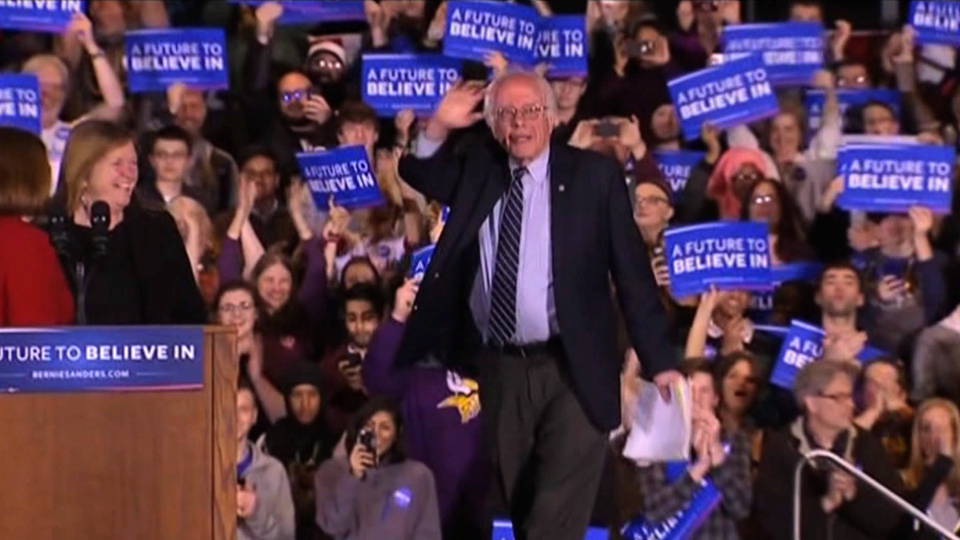
Sanders’s rally in
the Manassas area — where his speech was interrupted by frequent
applause and boisterous chants of “Bernie! Bernie! Bernie!” — signals
the importance of that Washington suburb for the eventual winner of the
Democratic nomination.
Prince William
County has become Virginia’s true bellwether in general elections. The
county has deeply red, wealthy enclaves to the west, an exploding Latino
population around Manassas and to the east, and a densely concentrated
corridor of black residents along Interstate 95 to the east.
To
succeed, a Democratic candidate will have to excite minority voters and
boost turnout — something President Obama did as a candidate in 2008
and 2012.
That is a task that Sanders, who
represents a state that is 95 percent white, has acknowledged is one of
the hurdles facing his campaign.
McAuliffe
also managed to drive turnout in Prince William in his 2013 election as
governor, and he undoubtedly is working to help Clinton do just that in
2016.
McAuliffe is a close friend of the
former secretary of state and her husband, former president Bill
Clinton. McAuliffe has also been a record-breaking fundraiser for both
and was chairman of Hillary Clinton’s 2008 campaign.
His staff has been officially mum on Sanders’s visit.
Laura Vozzella contributed to this report.
John Wagner is a political reporter covering the race for the 2016 Democratic presidential nomination.
Bernie Sanders, as far as the media is concerned, is the
Rodney Dangerfield of presidential candidates -- "he don't get no
respect." Of the 23 candidates running for president in the two major
parties, precisely four of them have ever shown even 20 percent support
(in their polling averages from their base voters). Actually, to be
completely accurate, five people have hit the 20 percent support level
since the race began this year, but Joe Biden is not actually a
candidate yet. The other four are Donald Trump, Ben Carson, Hillary
Clinton, and Bernie Sanders.
Andrew Tyndall, who monitors broadcast news from ABC, NBC, and CBS, has some numbers which
starkly show
Bernie's Rodney Dangerfield problem. Tyndall tracked the total time
the three networks have devoted to the presidential race this year: 504
minutes. This is more than their coverage (to this point on the
calendar) in 2011 (277 minutes) and 2007 (462 minutes), so it's not like
they're shying away from covering the race or anything. Out of that
total, 338 minutes this year has been aired about the Republican race,
while only 128 minutes was centered on the Democratic race. Granted,
the Republicans have more candidates, which might explain some of the
lopsided nature of those numbers.
Even so, the numbers get even
more jaw-droppingly uneven when you look at individual candidates.
Donald Trump (of course) leads the pack in coverage of his campaign,
clocking in at an impressive 145 minutes. Hillary Clinton has gotten 82
minutes of campaign coverage, and an additional 83 minutes devoted to
the email scandal. Jeb Bush, who is currently polling in fifth place in
the Republican race with less than 10 percent in the polls, has
received 43 minutes of coverage. The Bernie Sanders campaign has
received a grand total of
eight minutes of coverage --
one-fifth of Bush's time, or one-tenth of Clinton's time (one-twentieth,
if you count the scandal coverage). Bernie got roughly the same amount
of time as Chris Christie (polling below four percent, far back in the
Republican pack). Bernie got the same amount of time that
Mitt Romney got, when he was teasing a bid earlier this year.
That
is pathetic. Bernie Sanders is one of the four frontrunners for the
entire presidential race, and has been closing the polling gap with
Hillary Clinton on the Democratic side. One recent poll put Bernie only
seven points behind Clinton nationally among Democrats, but you
probably didn't hear that on the evening news. Bernie now leads Hillary
in the polling in both of the first states to vote, Iowa and New
Hampshire. But of the total time the networks have devoted to the race,
they've only used a little over
1.5 percent of it to cover
Bernie's campaign. Rodney Dangerfield would have had a few choice
things to say about this lack of respect, one imagines.
Bernie Sanders routinely draws crowds that
dwarf other candidates' rallies. He just
made some news today because his campaign has now received
one million individual donations -- a number far superior to anything
any
other candidate can claim. In fact, it is even superior to the
champion online fundraiser of all time, Barack Obama. Obama didn't hit
1,000,000 online donations until February of 2008, or October of 2011
during his re-election campaign. No other candidate in the 2016 race --
Democratic or Republican -- is even
close to this number. And yet the near-blackout on the evening news continues.
I
don't know what Bernie Sanders's chance of success in the nomination
race will be. But I do know it'd be a lot better if the news actually
informed the American public about how successful his campaign is doing.
This whole disgraceful lack of respect really puts the lie to those on
the right who complain about "the liberal media," in fact. The most
liberal candidate in the race is being covered at the same rate as Chris
Christie, after all. Doesn't sound like any sort of liberal cabal to
me. It sounds instead like proof of what some on the left insist, that
the media does indeed have a bias -- but a
corporate bias.
Because
of this obvious anti-Bernie bias, I'll go so far as to make a bold
prediction. The first Democratic debate is going to happen in a few
weeks. This will be the first time many Democratic voters will be
exposed to Bernie's unfiltered message. My prediction is that the
post-debate polling will show a big bump for Bernie's support, after
weighing Bernie's solutions to the nation's problems next to Hillary's.
I
still don't know what Bernie's chances for success truly are. Joe
Biden's announcement (either way) will shake up the Democratic race, and
this announcement is probably going to happen before the debates do.
If Bernie does well in the first debate, though, and if his numbers do
get a healthy bump, then the broadcast news is going to have to start
talking about Sanders. At that point, the lack of coverage will become
painfully obvious to all if it continues. At first (no doubt) this
coverage will likely be mocking and dismissive, with plenty of jokes
thrown in. But sooner or later the media is going to have to cope with
the fact that Bernie Sanders's campaign is no laughing matter to those
who have gotten on board the "Feel The Bern" train. Sooner or later
they're going to have to address the real reason he's seen such a
monstrous outpouring of support so far -- his issues and his agenda.
Sooner or later, they're going to have to show Bernie a little more
respect. With over a quarter of Democratic voters already supporting
him and with over a million donations, Bernie Sanders has already earned
this respect. A lot more respect than eight minutes out of 504, that's
for sure.
Chris Weigant blogs at:




 2000 and has never reached 65 percent ever in history, will rise to 65 percent in a mere ten years.

