NORTON META TAG

Showing posts with label marriage. Show all posts

03 September 2025

Miss Manners: All the single ladies...are sick of this question 2SEP25


 Hey Miss Manners, all single men are too. I love your answer!!! 

Miss Manners: All the single ladies...are sick of this question


Single woman is tired of being asked about her plans for marriage.


Column by 
, 
 and 

Dear Miss Manners: I’m a single woman who is frequently asked about my plans for marriage. The individuals making these inquiries have no business asking this question, let alone hearing the answer.

I typically smile and change the subject without answering their question. A few times, when particularly startled, I have responded with, “I beg your pardon.”

Is there a more polite way to handle this highly impertinent question?

“If this is a proposal, I am sorry to have to disappoint you.”

16 August 2022

HAPPY 70TH ANNIVERSARY MOM AND DAD!!!!!

 MY parents married on 16 AUG 1952, today is their 70th anniversary! Dad died in 2017, mom has vascular dementia and is now in a home in Gatesville, TX, but as Christians they are still married and will be reunited as husband and wife in heaven. LOVE YOU BOTH MOM AND DAD!

08 April 2016

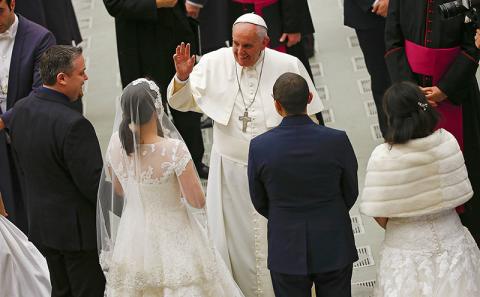
On Divorce, Contraception, Pope Calls For More Grace, Less Dogma & Applause, Dismay, Confusion Over Pope's Words 8APR16

Pope Francis at his weekly general audience in St. Peter's Square on Wednesday. On Friday he released a post-synodal apostolic exhortation called "Amoris Laetitia," or "The Joy of Love."
THOSE with a problem with the Catholic Church and religion in general will criticize Pope Francis' pronouncement on these issues. They look for anything to justify their hatred of religion, especially Christianity in this country, how sad for them. I see this as an acknowledgement of the teachings and life examples of Jesus Christ as so eloquently expressed by Pope Francis And he notes that Jesus set forth a demanding ideal for his followers — but "never failed to show compassion and closeness to the frailty of individuals.".  This is not the Pope giving Christians license to ignore the doctrines of Christianity. It is the Pope's recognition that the 'thou shalls' and 'thou shall nots' are mandatory goals for all believers to strive for, and recognizing that we are all human, and if we are really trying to live the Christian life, but at times fail, the Catholic Church leadership and all Christians should try to respond as Christ would, " to show compassion and closeness to the frailty of individuals.". The Pope is calling for more Christianity, less dogma. This from +NPR and +Sojourners .....

On Divorce, Contraception, Pope Calls For More Grace, Less Dogma

In a major document released Friday, Pope Francis addressed divisive elements of Catholic doctrine — including how to treat couples who remarry after a divorce that wasn't annulled by the church, and the church's stance on contraception.
Without issuing any new top-down doctrine, Francis said that priests should focus on providing pastoral care for Catholic couples, rather than sitting in judgment of them, and that individual conscience should be emphasized, rather than dogmatic rules.
The document — a post-synodal apostolic exhortation called "Amoris Laetitia," or "The Joy of Love" — is more than 250 pages long.
In it, the pope emphasizes that life is more complicated than religious law. In the opening pages, he invokes the values of "generosity, commitment, fidelity and patience," but also says he wishes to "encourage everyone to be a sign of mercy and closeness wherever family life remains imperfect or lacks peace and joy."
Copies of the post-synodal apostolic exhortation "Amoris Laetitia" (The Joy of Love) are on display at a press conference at the Vatican on Friday. In it, Pope Francis writes that individual conscience should be the guiding principle for Catholics negotiating the complexities of sex, marriage and family life.i
Copies of the post-synodal apostolic exhortation "Amoris Laetitia" (The Joy of Love) are on display at a press conference at the Vatican on Friday. In it, Pope Francis writes that individual conscience should be the guiding principle for Catholics negotiating the complexities of sex, marriage and family life.
Andrew Medichini/AP
He explains that in Amoris Laetitia, in addition to considering scripture, he will "examine the actual situation of families, in order to keep firmly grounded in reality." And he notes that Jesus set forth a demanding ideal for his followers — but "never failed to show compassion and closeness to the frailty of individuals."
Joshua McElwee of the National Catholic Reporter told NPR's Morning Edition that the exhortation has a very different tone than previous church pronouncements on these subjects.
The focus on "conscience" as a determining factor is key, McElwee says. He explains what that means in this context:
"That's something that the church talked about 50 years ago, but the last couple of popes did not expand upon. And what Pope Francis is saying is that conscience means that people can be hearing something from God, kind of in the depths of their heart, that may even be not quite in accord with what the church teaches generally, as a general norm, but can still be true and can still be discerned to be God's will in their life. So he's allowing for a little bit of discord between individual cases and the general church teaching."
On Divorce
When it comes to divorce and remarriage, McElwee says, the pope doesn't directly change church law — which holds that couples who divorce and remarry without getting a Catholic annulment are committing adultery and cannot receive communion.
"But he kind of pivots the church stance, asking clergy to be much more pastoral and not always apply one general norm to all cases — but instead help people discern what God is doing in their lives, even if they might be living in a situation the church in past years might have called irregular," McElwee says.
No longer can the church simply say everyone in such an "irregular situation" is living in mortal sin, McElwee explains. Instead, each individual situation will need to be looked at separately.
"So, it's a very different stance, and it's allowing clergy to let people discern God's will, even in situations where that might be what, what he says, 'morally confusing,' " McElwee says.
Some in the Catholic Church wanted the pope to say it's OK for remarried people to take communion; others wanted "a very strong no," McElwee says.
"And what the pope has done really is seemed to embrace the middle path, looking for ambiguity, for individual situations."
On Contraception
Francis didn't describe any methods of contraception as "unlawful," as previous Catholic encyclicals have, The Associated Press notes.
Instead of characterizing contraception as a sin, Francis says the church must emphasize to young couples the joy of having children — while respecting the need for each couple to decide their family size on their own.
He cites the Relatio Finalis, written by bishops last year:
"In accord with the personal and fully human character of conjugal love, family planning fittingly takes place as the result a consensual dialogue between the spouses, respect for times and consideration of the dignity of the partner. ... Decisions involving responsible parenthood presupposes the formation of conscience."
As well as the Second Vatican Council:
"Let them thoughtfully take into account both their own welfare and that of their children, those already born and those which the future may bring. ... They should consult the interests of the family group, of temporal society and of the Church herself. The parents themselves and no one else should ultimately make this judgment in the sight of God."
"Francis made a single reference to the church-sanctioned family planning method of abstaining from sex during a woman's fertile time," the AP writes. "He said only that such practices are to be 'promoted' — not that other methods are forbidden — and he insisted on the need for children to receive sex education, albeit without focusing on 'safe sex.' "
On Sex, Homosexuality And Gender
Francis rejected the idea that sexual desire is a thing to be "eliminated" or looked down upon.
"God himself created sexuality, which is a marvelous gift to his creatures," he wrote.
He writes that sex and eroticism can be distorted — including when people instruct women to submit to their husbands, or sex becomes either selfish or purely self-sacrificing. But reciprocal and respectful sex, within the context of marriage, is a passion that reveals "the marvels of which the human heart is capable," Francis writes.
The pope also said that a "great variety" of family situations can offer stability, while emphasizing that same-sex marriage or unmarried committed relationships are not equal to marriage in the eyes of the Church.
The document references transgender people, saying that while there are "at times understandable aspirations" to ideologies that allow for a separation of gender and biological sex, they are attempting to "sunder what are inseparable aspects of reality."
The pope calls for women's rights to be advanced around the world and rejected the idea that feminism has hurt family structures. "The equal dignity of men and women makes us rejoice to see old forms of discrimination disappear," he wrote.
On Marriage, The Church And The World
On marriage in general, the Pope writes that the Catholic Church needs "a healthy dose of self-criticism" for the way it has described and presented marriage to the public.
"[W]e often present marriage in such a way that its unitive meaning, its call to grow in love and its ideal of mutual assistance are overshadowed by an almost exclusive insistence on the duty of procreation ... At times we have also proposed a far too abstract and almost artificial theological ideal of marriage, far removed from the concrete situations and practical possibilities of real families. ...
"[W]e have often been on the defensive, wasting pastoral energy on denouncing a decadent world without being proactive in proposing ways of finding true happiness."
The pope also addressed a wide range of challenges that affect families, including poverty; migration; children with special needs; elderly relatives who need care; drug use and alcoholism; domestic violence; and a lack of affordable housing, as well as social pressures and the difficulty of addressing marital problems.
"The Synod's reflections show us that there is no stereotype of the ideal family," he writes, "but rather a challenging mosaic made up of many different realities, with all their joys, hopes and problems. "

Amoris-Laetitia


Applause, Dismay, Confusion Over Pope's Words

Image via REUTERS/Tony Gentile/RNS
Pope Francis’ “Joy of Love,” a massive document released April 8 that wraps unchanged doctrine on marriage, divorce, and LGBT life in gentle terms, is getting a mixed reaction from U.S. Catholics.
It brought joy to conservative Christians who feared Francis would tamper with dogma, but less love from liberals who had hoped for a change in practices, not simply in tone. Statements flooded out from both directions. A sampling:
  • Archbishop of Kentucky Joseph Kurtz, president of the U.S. Conference of Catholic Bishops, extolled it as “love letter to married couples and families” to realize more and more her mission to live and love as a family. “The pope traces through the Bible all the beauty of marriage and that “no obstacle is to big for Christ to overcome.”
  • The Human Rights Campaign was “disappointed” that the document, issued in the pope’s Year of Mercy, did not translate into fuller inclusion for LGBT Catholics, said Mary Beth Maxwell, an HRC senior vice president. She found consolation in knowing that “in a growing number of Catholic families and parishes all across this country we are welcomed for who we are, not judged or excluded because of doctrine.”
  • Conservative Catholic writer George Weigel, in the National Review, saw a thread throughout that church teachings can offer a structure for both holiness and happiness. He wrote that it says “many important things about love, marriage, the family, and the current cultural crisis of a world in which the imperial autonomous Self is running roughshod over just about everything, leaving a lot of human unhappiness in its wake.”
  • Catholics for Choice, a pro-contraception and abortion-rights group, pointed out that most U.S. Catholics were not waiting for approval from their church. President Jon O’Brien called Francis’ pastoral approach “a breath of fresh air… But talking about the law in a pastoral manner does not change doctrine, and it will not change the real practice of Catholics.”
Analysis by Catholic publications also divided on which themes to highlight.
National Catholic Reporter columnist Michael Sean Winters pulled a more optimistic message from the document. He says it “challenges the Church to do more than simply repeat the Catechism and harangue the fallen… The Holy Father does not believe the pastor, still less the magisterium, should tell people what to do, but that a pastor should accompany people so that they can discern God’s activity and calling in their own lives.”
The National Catholic Register highlighted a different thread through the document, one that might disturb conservatives by muddying up traditionalist ideas of clear rules with unspecified pastoral discretion: “Francis speaks in the chapter of a ‘need to avoid judgments’ that don’t take account of the ‘complexity of various situations’ and stresses the need of ‘reaching out to everyone.’ The divorced, he writes, should not be pigeonholed in ‘overly rigid classifications,’ leaving no room for personal and pastoral discernment.”
Reaction did not only come from Catholics struggling with the complex material and conflicting ways to read it. The Rev. Russell Moore, president of the Southern Baptists Ethics and Religious Liberty Commission, tweeted:
Man. is a mess.
Cathy Lynn Grossman is a senior national correspondent for Religion News Service, specializing in stories drawn from research and statistics on religion, spirituality, and ethics.

21 February 2012

My testimony at the Colorado Senate Judiciary hearing on civil unions from NADIA BOLZ-WEBER15FEB12

THERE is a lesson about compassion and self righteousness in this testimony for all of us. Well said Rev Bolz-Weber!


I was asked by the Interfaith Alliance of Colorado to testify in front of the senate judiciary committee on the issue of civil unions for GLBTQ couples.  Here it is.
Thank you Madam Chair and members of the committee.
My name is Pastor Nadia Bolz-weber.  I am ordained in the Evangelical Lutheran Church in America and serve a congregation here in Denver called House for All Sinners and Saints.
I’d like to start by saying that people of good faith dis-agree on this issue but I speak in favor of civil unions.
I’m not an activist.
But I am a preacher and a public theologian. So here’s what I feel is mine to say.
Much of the early church were convinced that gentiles could only become Christians if they changed into being Jews first (which, for the record, involved a rather unpleasant process), and much like our first century brothers and sisters there is a segment of the church today who thinks that if we extend the roof of the tent to include “the gays” then the whole thing will come crashing down around us.
And some will say that if we allow gay couples to have equal status under the law, the institution of marriage will come crashing down.
So there are some who see it as their job to stalwartly guard the boundaries of the tent to keep it from crashing, and some who think it our job to be bravely inclusive and stretch the tent.
Either way, it’s misguided because …it’s not our tent.  It’s God’s tent. The wideness of the tent be it the church or society, should only concern me insofar as it points to the great mercy and love of a God who welcomes us all as friends. And of Jesus who welcomes all to his table.
You think I like that?  You think I want to sit at the heavenly banquet next to Ann Coulter?  Not so much.
But that’s what I’m stuck with because I’m in the Jesus business.  And in the Jesus business there is not male or female, jew or greek, slave or free, gay or straight, there is only one category of people: children of God. Which means nobody gets to be special and everybody gets to be loved.

People born in this country aren’t special.
Men aren’t special.
Christians aren’t special.
Straight people aren’t special.
And if the laws of our great land make it seem so, then SHAME.  ON. US.
Thank you Madam Chair.

21 January 2012

Rick Santorum says Obama prohibits encouraging young people to marry from POLITIFACT 19JAN12

ANOTHER lie by Christian gop / tea-bagger presidential candidate rick santorum about the Obama administration. Some may say santorum's statement is not a lie, just a misunderstanding. Possible, except he is running for president, so he is responsible for making sure this statements are true and factual, especially since he is running as a Christian candidate. Instead, he has shown time and again a total disregard for the fact and for making sure his comments and opinions about Pres Obama are true (check out his section on PolitiFact.com ) , and is deliberately misleading, distorting, deceiving, and lying to the American electorate to inflame hatred of Pres Obama for his own political gain. Pathetic. This from Politifact......

Santorum

Says an Obama administration policy prohibits people who work with at-risk youth from promoting marriage as a way to avoid poverty.

Rick Santorum on Monday, January 16th, 2012 in a debate in South Carolina

Rick Santorum says Obama prohibits encouraging young people to marry

Rick Santorum says the president has issued a gag order on talking to young people about marriage.

During a debate in South Carolina on Jan. 16, 2012, Santorum gave a winding answer to a moderator’s question about combating poverty. He mentioned a study that he said found that people who have a job, earn a high school diploma and get married before having children are far less likely to be poor.

"It's a huge, huge opportunity for us," he said. "But what is the Obama administration doing?" The White House, Santorum said, "now has regulations that tell (people who work with at-risk youths) that they can no longer promote marriage to these young girls. They can no longer promote marriage as a way of avoiding poverty and bad choices that they make in their life."

It was a vague claim but one that piqued our curiosity.

What’s behind this?

We reached out to Santorum’s campaign to ask for the basis of the claim but didn’t get a reply. In the debate, the former Pennsylvania senator said he learned about the no-marriage rule from Elayne Bennett, founder and president of the Best Friends Foundation. The organization provides character education for at-risk girls in Washington, D.C., schools. Its message to adolescents, according to Bennett: "that the best decision is to reject the risk behaviors of sex, drugs and alcohol."

Bennett is the wife of Bill Bennett, former education secretary under President Ronald Reagan and drug czar under President George H.W. Bush. Both Bennetts are well-known conservatives.

In an interview, Elayne Bennett told us Santorum’s statement was incorrect with regard to marriage.

Here’s some background: Best Friends Foundation was awarded a five-year, $2.5 million grant by the Department of Health and Human Services under President George W. Bush. The Healthy Marriage Grant, which included a component for counseling inner-city teenagers on the benefits of marriage, addressed issues such as abuse prevention and life skills.

But Bennett said that about two years ago, after Obama was elected, one aspect of the grant’s terms changed.

"We were not to discuss abstinence or sex as a risk behavior," Bennett said. "It was a verbal instruction that we had to remove that word -- abstinence -- from our curriculum materials, which we did because we wanted to adhere to the new policy."

Bennett says she rejects the label "abstinence-only" for what she teaches but said, "we do recommend that the best choice for young people is to say no to risk behaviors."

Formerly that meant encouraging girls to wait to have sex -- until the grant terms changed.

But she said the change never applied to discussing the benefits of marriage, and she thought Santorum’s statement in the debate left that impression. She said she spoke to him the next day, and he acknowledged it was "lost in the translation."

In the debate, Santorum added that the White House had restricted federal grantees from talking about abstinence and described why he thinks that’s harmful.

"They (the grantees) have to be neutral with respect to how people behave," Santorum said. "The problem is neutrality ends in poverty, neutrality ends in choices that hurt people's lives. This administration is deliberately telling organizations that are there to help young girls make good choices, not to tell them what the good choice is. That is absolutely unconscionable."

Bennett, who also issued a statement clarifying Santorum’s error, said she still agrees with his broader point about the benefits of discussing abstinence.

Source of the confusion

The Department of Health and Human Services told us that its position (in the prior administration and in this administration) stems from a 2006 law signed by President George W. Bush. Called the Deficit Reduction Act of 2005, it identifies eight activities on which healthy marriage funds can be used.

Here, word for word, are the eight activities listed in the statute:

• Public advertising campaigns on the value of marriage and the skills needed to increase marital stability and health.

• Education in high schools on the value of marriage, relationship skills and budgeting.

• Marriage education, marriage skills, and relationship skills programs that may include parenting skills, financial management, conflict resolution and job and career advancement.
•  Pre-marital education and marriage skills training for engaged couples and for couples or individuals interested in marriage.

• Marriage enhancement and marriage skills training programs for married couples.
• Divorce reduction programs that teach relationship skills.

• Marriage mentoring programs which use married couples as role models and mentors in at-risk communities.

• Programs to reduce the disincentives to marriage in means-tested aid programs … .

Clearly, promoting marriage is an express purpose of this grant, not prohibiting promoting it.

A 2008 report by the Government Accountability Office review of the grant found that there was confusion among grant recipients and HHS staff about what was allowed to be taught about abstinence.

"HHS officials told us that abstinence education was not allowable under the Healthy Marriage program, but we observed during our site visits and review of grantee data several Healthy Marriage grantees operating programs that focused on abstinence education," the report states.

To clear up confusion, HHS said that in 2011 they made the existing policy more explicit but did not change the policy. The department also added that the topic of abstinence can be one component of some of these activities, but a stand-alone abstinence education program does not fit within the statutory uses of the funds.

Our ruling

Santorum said the Obama administration is not allowing people who work with at-risk adolescents to promote the benefits of marriage.

Santorum said he had heard this from Elayne Bennett of the Best Friends Foundation, but she told us he misspoke. The change under Obama, according to Bennett, was about what could be taught regarding abstinence -- not marriage. The Department of Health and Human Services said there was confusion in this area, so it clarified the policy, which does allow discussion of abstinence in other contexts but not as a stand-alone education program. Santorum simply got it wrong. His statement is False.
About this statement:
Published: Thursday, January 19th, 2012 at 6:09 p.m.
Subjects: Marriage, Poverty
Sources:
Republican presidential primary debate, Jan. 16, 2012, Myrtle Beach, S.C., transcript accessed via Nexis

Interview with Elayne Bennett, Best Friends Foundation, Jan. 17, 2012

Deficit Reduction Act of 2005

Government Accountability Office, "Healthy Marriage and Responsible Fatherhood Initiative," September 2008
Written by: Molly Moorhead
Researched by: Molly Moorhead
Edited by: Martha M. Hamilton

07 July 2011

What Does the Bible Actually Say About Marriage? from HuffPost 7JUL11

A very interesting article in HuffPost, brings up things I have never really thought about before.....
When you attend a wedding at church, what passages of Scripture do you expect to hear? Congregations occasionally invite me to speak on the current same-sex marriage debates, and I ask them this question. Their answers are remarkably consistent.
Someone invariably mentions 1 Corinthians 13, the famous "Love Chapter." Love is patient, love is kind, love never insists on its own way and so forth. Wonderful advice for marriage, but Paul was not talking about marriage. He was addressing a church fight: the believers in Corinth had split into factions and were competing for prestige and influence. We see echoes of this conflict throughout the letter, but especially in chapters 12 and 14, which surround this passage.
Others call out, "Where you go, I will go; where you lodge, I will lodge; your people shall be my people, and your God my God" (Ruth 1:16; NRSV). Another moving passage, but it's certainly not about marriage. Ruth addresses this moving speech to her mother-in-law Naomi.
The second creation story in Genesis comes up: "Therefore a man leaves his father and his mother and clings to his wife, and they become one flesh" (Genisis 2:24). This passage is certainly appropriate to marriage, as it reflects the level of intimacy and commitment that distinguishes marriage from other relationships. Jesus quotes this passage, too, but he isn't exactly discussing marriage. Instead, his topic is divorce (Matthew 19:5; Mark 10:8). When ministers read the Gospel passages at weddings, as they often do, the message seems a little off. I'd rather not hear about divorce at a wedding.
One other passage frequently surfaces in weddings but rarely in mainline Protestant churches, the Lutheran, Presbyterian, Methodists and United Church of Christ congregations that invite me to speak. Ephesians 5:22-33 commands wives to obey their husbands and husbands to love their wives. Conservative Christians may try to explain away the offense of this passage, but there's no escaping its ugly reality. Ephesians calls wives to submit to their husbands just as children must obey their parents and slaves must obey their masters. See the larger context, Ephesians 5:21-6:9.
Not a Lot to Say
The point is, Christian weddings rarely feature passages that directly relate to marriage. Only one passage, Genesis 2:24, seems especially relevant, while other passages require us to bend their content to our desire to hear a good word about marriage. Things are so bad that the worship books for many denominations turn to John 2:11, where Jesus turns water into wine at a wedding feast, to claim that Jesus blessed marriage. My church, the United Church of Christ, has developed a new wedding liturgy, but it retains this common formula: "As this couple give themselves to each other today, we remember that at Cana in Galilee our Savior Jesus Christ made the wedding feast a sign of God's reign of love."
So we know Jesus blessed marriage because he attended a wedding? That's the best we can do? No wonder it's common for couples to struggle over the choice of Scripture for their wedding ceremonies. The Bible just doesn't have much to say on the topic.
Let's Be Honest
Unfortunately, many Christians use the Bible to support their own prejudices and bigotry. They talk about "biblical family values" as if the Bible had a clear message on marriage and sexuality. Let's be clear: There's no such thing as "biblical family values" because the Bible does not speak to the topic clearly and consistently.
It's high time people came clean about how we use the Bible. When Christians try to resolve difficult ethical and theological matters, they typically appeal to the Gospels and Paul's letters as keys to the question. But what about marriage? Not only did Jesus choose not to marry, he encouraged his disciples to abandon household and domestic concerns in order to follow him (Matthew 19:29; Mark 10:28-30; Luke 9:57-62). He even refers to those "who have made themselves eunuchs for the sake of the kingdom of heaven" (Matthew 19:10-13). Whatever that means, it's certainly not an endorsement of marriage. Paul likewise encourages male believers: "Do not seek a wife" (1 Corinthians 7:27, my translation) -- advice Paul took for himself. If neither Jesus nor Paul preferred marriage for their followers, why do some Christians maintain that the Bible enshrines 19th-century Victorian family values?
Let's not even go into some of the Bible's most chilling teachings regarding marriage, such as how a man's obligation to keep a new wife who displeases him on the wedding night (Deuteronomy 22:13-21), his obligation to marry a woman he has raped (Deuteronomy 22:28-30) or the unquestioned right of heroes like Abraham to exploit their slaves sexually. I wonder: Have the "biblical family values advocates" actually read their Bibles?
Christians will always turn to the Bible for guidance -- and we should. If the Bible does not promote a clear or redemptive teaching about slavery, that doesn't mean we have nothing to learn from Scripture about the topic. The same values that guide all our relationships apply to marriage: unselfish concern for the other; honesty, integrity and fidelity; and sacrificial -- but not victimized -- love. That's a high standard, far higher than a morality determined by anachronistic and restrictive rules that largely reflect our cultural biases. Rules make up the lowest common denominator for morality. Love, as Paul said, never finds an end.

11 February 2010

A HAPPY MARRIAGE

A happy marriage is the union of two forgivers.
- Ruth Bell Graham, poet, philanthropist, and wife of evangelist Billy Graham