BUCKNACKT'S SORDID TAWDRY BLOG
We should not be a journey to the grave with the intention of arriving safely in an attractive & well preserved body, but rather to skid in sideways, chocolate, bier or wein in hand, body thoroughly used up, totally worn out and screaming "WHOO-HOO, WHAT A RIDE!!!!!!"
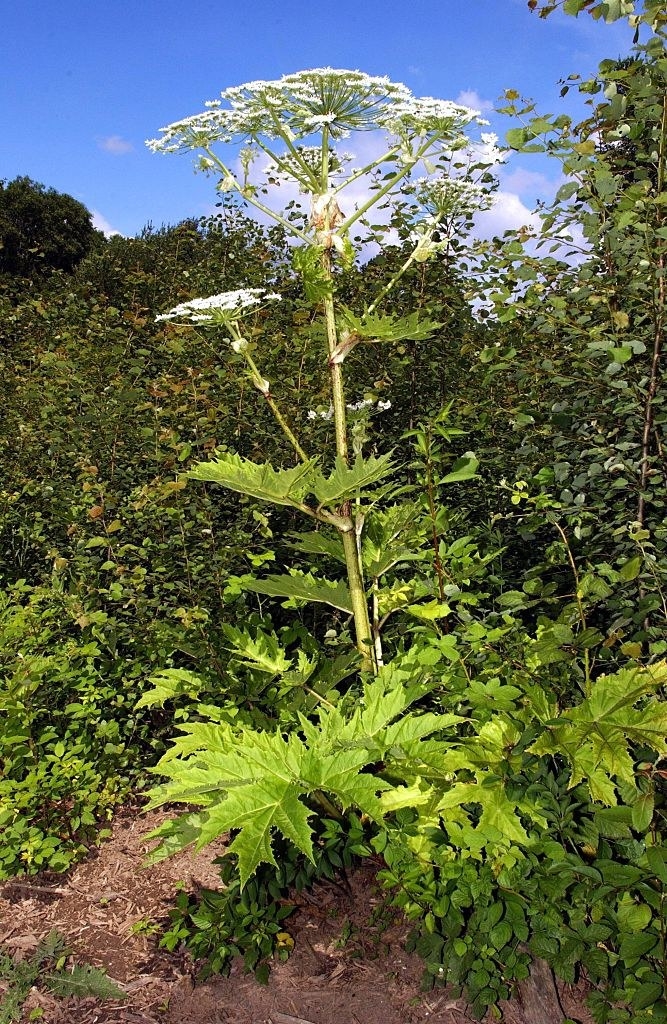
I have seen a couple of these back home in Pennsylvania, they were taller than me (I'm 5'7")! I don't really care for herbicides but I won't hesitate to use it on these nasty plants! Share this article from BuzzFeed with everyone......
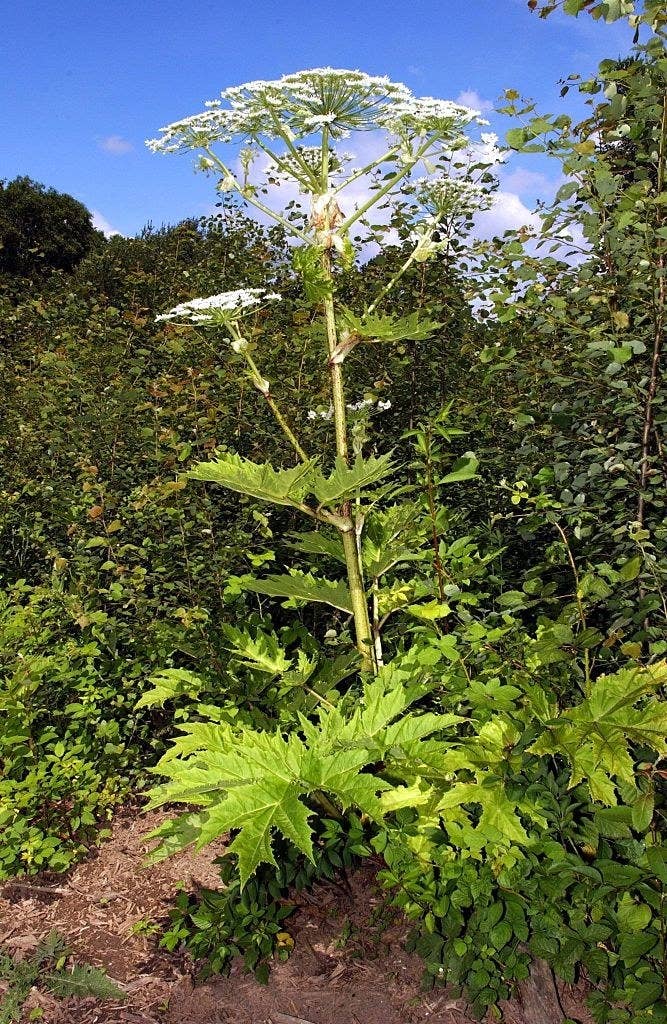
Giant hogweed, or Heracleum mantegazzianum, is a large, flowering, perennial plant. It's native to the Caucasus Mountain region in Asia and was introduced to the US in the early 1900s as a garden plant, according to the New York State Department of Environmental Conservation (NYSDEC).
It is an invasive species that is known to grow in New York, Vermont, Pennsylvania, New Jersey, Wisconsin, Michigan, Oregon, and Washington. Giant hogweed is listed as a noxious weed by the federal government, which means it's illegal to transport across state lines without a permit.
The Massey Herbarium at the Virginia Polytechnic Institute and University, which researches plant species in the state, wrote in a Facebook post that it had identified Virginia's first giant hogweed population. The organization discovered about 30 plants in Clarke County, which is located in the Northern part of the state, about 60 miles west of Washington, DC.
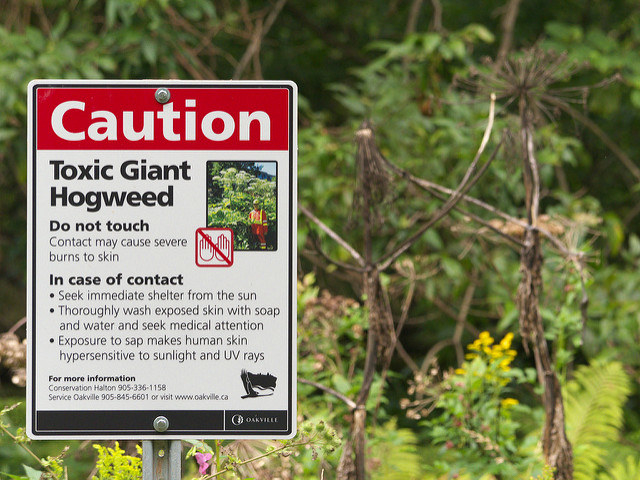
This invasive species isn't just a problem for the environment — it's also a health hazard.
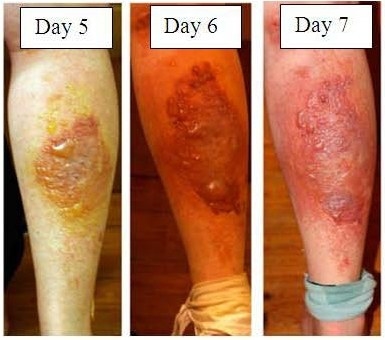
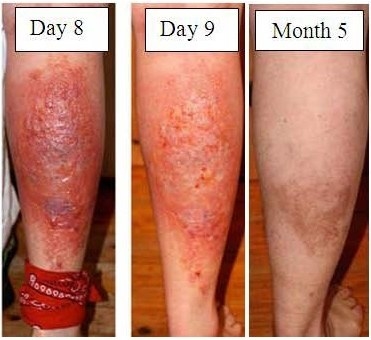
The giant hogweed's sap can cause blistering burns on the skin, long-lasting scars, and even permanent blindness.
Bob Kleinberg / NYS DEC
The plant produces a toxic sap full of photosensitizing furanocoumarins, which are organic chemicals that can do some serious damage. When the sap makes contact with the skin and is combined with sunlight it can cause severe irritation, burns, and blisters (also called phytophotodermatitis), according to NYSDEC.
Basically, the sap makes the skin incredibly photosensitive so it can't protect itself and sunlight causes a third-degree burn. (That's the most serious type of burn and the outer skin layer, or epidermis, is harmed, in addition to the layers underneath, or dermis.) The irritation can worsen if there is moisture, such as dew on the plant or sweat on the skin. People are usually exposed to the sap when they brush against the bristles of the plant or break the stems and leaves.
The skin reaction can start as soon as 15 minutes after exposure. It usually takes about 48 hours for the painful blisters to form, which can then become pigmented and scab over. It can take weeks to heal and the scars from hogweed burns can last for months or even years.
Scars aren't the only permanent damage resulting from contact with a hogweed. If the sap gets into the eyes, it can burn the cornea (the eye's outermost layer) and cause permanent blindness.
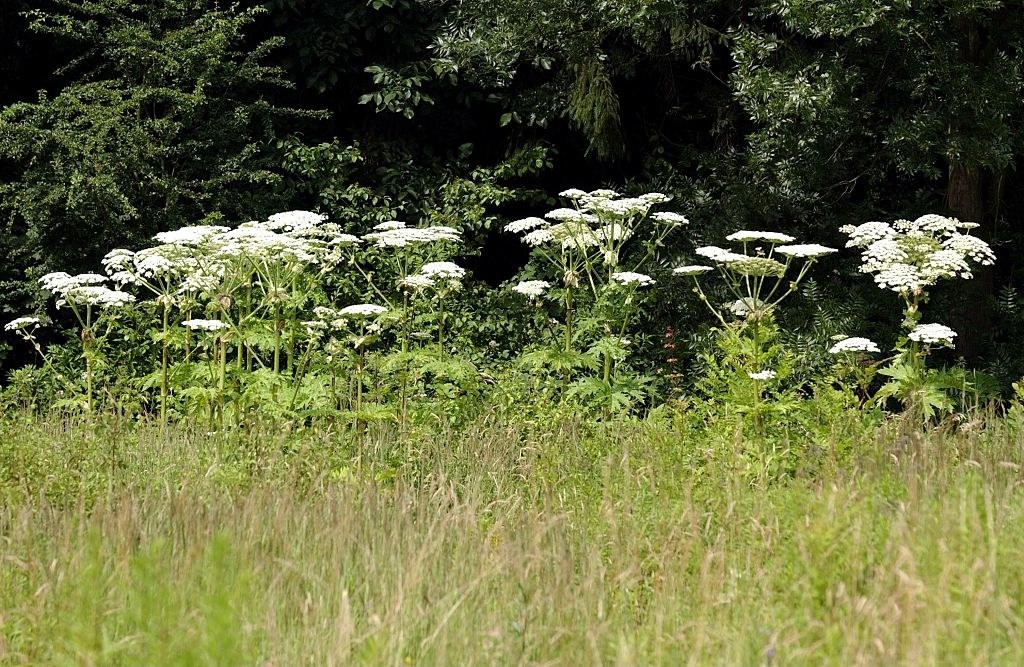
This botanical nightmare can grow up to 14 feet tall and you'll find it in forests, yards, fields, and roadsides. Do not touch it.
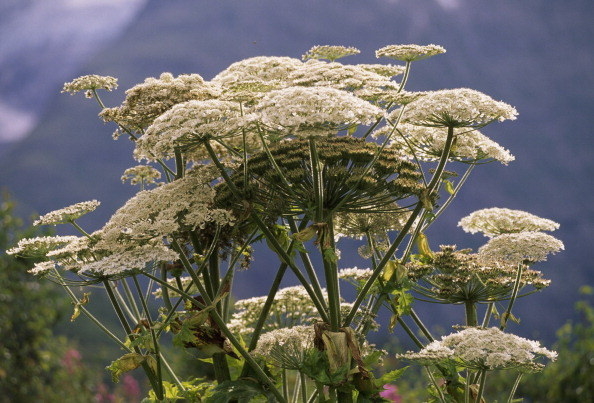
The giant hogweed is an absolute unit. It can take a few years for the plant to mature and start producing flowers, which is when it's easiest to recognize. The hogweed can grow to towering heights and sprout leaves up to 5 feet wide and has flowers up to 2.5 feet wide.
These plants can also live for decades and have long taproots that make them especially hardy and difficult to remove. Giant hogweed can grow anywhere — gardens, backyards, along streams and rivers, hiking trails — so it's important to know what the plant looks like so you can avoid it in the future.
Giant hogweed is a tall plant with white flowers in umbrella-like clusters, lobed leaves, and stems covered in purplish-red spots. But the plant isn't always easy to identify and can be easy to confuse with other flowering plants like Queen Anne's Lace. Queen Anne's Lace, which is also known as wild carrot, is beautiful, harmless, and can be found in wedding bouquets and roadsides near you — so don't mistake it for the giant hogweed!
Do not go near or touch this plant. The sap is concentrated on the stems but it can get anywhere on the plant or its flowers. If you need to remove giant hogweed on your property, wear gloves, cover any exposed skin, and wash all clothes and equipment that touch the plant afterward. Here's a complete list of hogweed removal safety guidelines.
If you are exposed to giant hogweed sap, wash your skin with cold water, stay out of sunlight, and consult a physician if you have concerns.
If the worst happens, there are steps you can take to ease the pain and reduce the severity of the reaction. First you should wash the area of skin immediately with cold water. Because the sap makes the skin photosensitive, keep the exposed area out of sunlight for at least 48 hours, according to NYSDEC. If you get sap in your eyes, wash them out immediately and wear sunglasses.
Once the skin reaction starts, you can use topical steroids such as calamine lotion or painkilling creams to ease inflammation and discomfort. It's a good idea to stay out of the sun and wear protective clothing or sunscreen until it has healed — the scars can be sensitive to sunlight for years.
If you ever have any questions or concerns about a reaction to giant hogweed sap, contact a physician.
There you have it — beware of this monster plant. It is out to get you.
MY Mom has been legally blind for years, she has glaucoma. One of her eyes is dead, she sees nothing with it. Over this past year she has lost most of her sight in her other eye, now she can only see shapes and variations of light. We thank God for the treatment and care she has received since MAY this year from Dr Sabita Ittoop, if it wasn't for her aggressive treatment of and actual concern for my Mom she would be totally blind by now. I strongly recommend anyone with glaucoma to consider contacting Dr Ittoop at Glaucoma Consultants of Washington if you are going blind from glaucoma and / or are not satisfied with the care and treatment you are receiving. These articles from +NPR give me hope for my Mom, I got goosebumps when I heard the first one while getting ready for work. They also make me a bit angry because if a minority of radical religious fanatics had not stopped funding for research using embryonic stem cells maybe my Mom would not be as blind as she is, maybe she would have sight in both her eyes. My siblings and I will be checking this out as a possible treatment for our Mom as she has said she is willing to participate in clinical trials.
Isabella Beukes, of Santa Rosa, Calif., has been legally
blind for more than 40 years. An experimental treatment derived from
embryonic stem cells seems to have enabled her now to see not just color
but also some shapes.
Tim Hussin for NPR
Scientists are reporting the first strong evidence that human embryonic stem cells may be helping patients.
The
cells appear to have improved the vision in more than half of the 18
patients who had become legally blind because of two progressive,
currently incurable eye diseases.
The researchers stress that
the findings must be considered preliminary because the number of
patients treated was relatively small and they have only been followed
for an average of less than two years.
But the findings are
quite promising. The patients had lost so much vision that there was no
expectation that they could benefit, the researchers say.
"I'm astonished that this is working in the way that it is — or seems to be working," says Steven Schwartz, a UCLA eye specialist who led the study, which was published Tuesday in the British medical journal The Lancet. "I'm very excited about it."
Other researchers agreed the work is preliminary, but also highly promising.
"It really does show for the very first time that patients can, in fact, benefit from the therapy," says Dr. Anthony Atala, a surgeon and director of the Wake Forest Institute for Regenerative Medicine at Wake Forest University.
"That allows you to say, 'OK, now that these cells have been used
for patients who have blindness, maybe we can also use these cells for
many other conditions as well, including heart disease, lung disease and
other medical conditions,' " Atala says.
Human embryonic stem
cells have the ability to become any kind of cell in the body. So
scientists have been hoping the cells could be used to treat many
diseases, including Alzheimer's, diabetes and paralysis. But the study
is the first human embryonic stem cell trial approved by the Food and
Drug Administration that has produced any results.
"It is really a very important paper," Atala says.
The study involved patients suffering from age-related macular degeneration and Stargardt's macular dystrophy,
the two leading causes of adult and juvenile blindness in the developed
world, Schwartz says. The diseases destroy a person's central vision.
"Whatever
you're looking at is gone — whether it's faces, or reading or food on a
plate, or whether something is a step or stripe," Schwartz says. "It's
very, very difficult to perform activities of daily life that we, you
know, don't even think about."
Working with Advanced Cell Technology Inc.
of Marlborough, Mass., Schwartz and his colleagues took human embryonic
stem cells and turned them into the kind of cells that are killed by
these diseases — retinal pigment epithelial cells. Then, they infused
between 50,000 and 150,000 cells into the retinas of the patients.
"What
we did is put them into patients who have a disease where those
particular cells are dying; and we replaced those dying tissues with new
tissue that's derived from these stem cells," Schwartz said. "In a way
it's a retinal transplant."
No one expected the cells to help any of these patients see
better, because the study was designed mostly just to see if doing this
was safe. Researchers were concerned the cells could destroy whatever
vision was left or lead to tumors in the volunteers' eyes. So Schwartz
picked patients whose eyes were so far gone that they weren't risking
losing any vision. That also meant that there was little hope the cells
could help either.
"We did not expect to help these patients, and they did not expect to be helped," Schwartz says.
Some
patients experienced side effects from the procedure itself and from
the drugs they had to take to suppress the immune system, but none of
the side effects were considered serious. The cells themselves have
produced no safety problems so far, the researchers reported.
And,
surprisingly, many of the patients did start to see better, according
to the report. Ten of the 18 patients can see significantly better. One
got worse, but the other seven either got better or didn't lose any more
vision.
"These are patients that didn't see better for 30
years and all of a sudden they're seeing better," Schwartz says. "It's
amazing."
The patients include a graphic artist who could
suddenly make out the woodwork carved on a piece of furniture in her
bedroom, an international consultant who regained the ability to walk
through busy airports without help, and an elderly rancher who's riding
his horse again, Schwartz says.
"He couldn't see things like a
barbed-wire fence or whether in the distance a stray cow was under a
tree," Schwartz says. "And six months after the transplant he's back to
running his cattle again. And he can, in fact, see a snake on the ground
or sort of tell whether a distant shadow is a cow or something else. So
it's made a big difference for him in his life."
Isabella
Beukes of Santa Rosa, Calif., has been legally blind for more than 40
years. But within weeks of getting the cells, she started to see better.
She could make out the cursor on her computer screen and the color of
her clothes. Today, she can hike the hills near her house all by
herself.
"The improvement, I mean, from where I was coming is
just, it's very, very significant for me. I think it's fantastic,"
Beukes says. "I just think to be part of groundbreaking research work is
amazing."
Just being able to see well enough to to hike the hills
around her Santa Rosa home by herself is a huge improvement, Beukes
says.
Tim Hussin for NPR
The research is controversial, however. Embryos are destroyed to get the cells, and some people think that's immoral.
"The
problem we have with embryonic stem cells is simply the fact that you
have to destroy a young human being to get embryonic stem cells," says David Prentice,
senior fellow for life science at the Family Research Council, an
advocacy group. "We would reject the idea that any human being be
destroyed for experimental purposes."
For his part, Schwartz
says he's just trying to help blind people see better. But he cautions
that this work is still at a very early stage.
"I don't want
patients to come in to their doctor saying, 'Hey, I heard about the stem
cells on the radio and I'd really like to get that treatment done, and
what do you think?' " he says. "It's not ready. Maybe in a few years.
Maybe not. We have to wait and see. The jury is way out still."
Schwartz
has continued treating more patients using larger doses of cells and
trying it on patients who haven't lost as much vision to see if that
works even better. He has also expanded his study to Boston, Miami,
Philadelphia and London.
For the first time, scientists are reporting that human embryonic
stem cells may be helping treat patients — in one instance, the cells
seem to been enabling some blind people to see better.
AUDIE CORNISH, HOST:
For
the first time ever, scientists are reporting that human embryonic stem
cells may be helping treat patients. In the medical journal The Lancet,
researchers describe how the cells seem to help restore eyesight to
some blind people.
NPR's Rob Stein has the details of the first study to demonstrate that embryonic stem cells could alleviate human suffering.
ROB
STEIN, BYLINE: Human embryonic stem cells can be turned into any kind
of cell in the body. So scientists have been hoping they could treat
lots of diseases. But no one's done a careful study to find out if
that's true until now. Steven Schwartz at UCLA tried using stem cells to
help people suffering from two types of incurable eye diseases.
STEVEN SCHWARTZ: These represent the two leading causes of adult and juvenile blindness in the developed world.
STEIN:
They're called age-related macular degeneration and Stargardt's macular
dystrophy. They don't make people totally blind, but they destroy
everything but peripheral vision.
SCHWARTZ: Whatever you're
looking at is gone whether it's faces or reading or food on a plate or
whether something's a step or a stripe. It's very, very difficult to
perform activities of daily life that we, you know, don't even think
about.
STEIN: Here's what they did. Schwartz and his colleagues
took human embryonic stem cells and turned them into the kinds of cells
that are killed by these diseases. Then, they infused tens of thousands
of these cells into the retinas of 18 patients.
SCHWARTZ: What
we did is put them into patients who have a disease where those
particular cells are dying. And we replaced those dying tissues with new
tissue that's derived from these stem cells. In a way, it's a retinal
transplant.
STEIN: The study was designed mostly just to see if
doing this was safe. There were big worries the whole thing could
backfire. The cells could destroy whatever vision was left or turn into
horrible tumors in the volunteer's eyes. So Schwartz picked patients
whose eyes were so far gone that they weren't risking losing any vision.
But that meant there was little hope the cells could help patients
either.
SCHWARTZ: We did not expect to help these patient. And they did not expect to be helped.
STEIN:
It's been nearly two years since the first patients got the cells. And
so far, there are no signs of any safety problems. And to everyone's
surprise, a lot of the patients did start to see better. Ten of the 18
patients can see a lot better. One got worse, but the other seven either
got better or didn't lose any more vision.
SCHWARTZ: These are patients that didn't see better for 30 years, and all of a sudden, they're seeing better. It's amazing.
STEIN:
There's a graphic artist who could suddenly make out the woodwork
carved on a piece of furniture in her bedroom, an international
consultant who eventually regained the ability to walk through busy
airports without help, and an elderly rancher who's riding his horse
again.
SCHWARTZ: He couldn't see things like barbed wire fence
or whether in the distance a stray cow was under tree. And six months
after the transplant, he's back to running his cattle again. And he can,
in fact, see a snake on the ground or see a barbed wire fence from his
horse or tell whether or not a distant shadow is a cow or something
else. And so it's made a huge difference for him in his life.
STEIN:
Isabella Bewkes (ph) of Santa Rosa, California has been legally blind
for more than 40 years. But within weeks of getting the cells, she
started to see better. She could make out the cursor on her computer
screen, the color of her clothes. Today, she can hike the hills near her
house all by herself.
ISABELLA BEWKES: The improvement, I mean
from where I was coming, is just - it's very, very significant for me. I
think it's fantastic. I just think to be part of groundbreaking
research work is amazing.
STEIN: This research is
controversial. Embryos are destroyed to get the cells. Some people think
that's immoral. For his part, Schwartz says he's just trying to help
blind people see better. But he cautions that this work is still at a
very early stage. He's only treated a few dozen patients altogether so
far and followed them for just 22 months.
SCHWARTZ: I don't want to increase suffering by creating expectations that can't be met.
STEIN:
Other researchers agree that these findings need to be considered
preliminary, but they say the results so far are really promising.
Anthony Atala is at Wake Forest University.
ANTHONY ATALA: It's
really a very important paper because it really does show for the very
first time that patients can in fact benefit from the therapy that
allows you to say OK, now these cells have been used for patients who
have blindness. Maybe we can also use these cells for many other
conditions as well, including heart disease and lung disease and other
medical conditions.
STEIN: Schwartz has continued treating more
blind patients using bigger doses of cells and trying it on patients
who haven't lost as much vision to see if that works even better. He's
also expanded his study to Boston, Miami, Philadelphia and London. Rob
Stein, NPR News.
NPR
transcripts are created on a rush deadline by a contractor for NPR, and
accuracy and availability may vary. This text may not be in its final
form and may be updated or revised in the future. Please be aware that
the authoritative record of NPR's programming is the audio.