NORTON META TAG

Showing posts with label Vets Administration. Show all posts

10 April 2017

kapo jared kushner is in charge of WHAT?!?!?!?!?


THE only thing kapo jared kushner is experienced in is licking fotze ivanka drumpf's/trump's dad's ass! This just proves the drumpf/trump-pence administration isn't about America, it is about taking from America because kapo kushner will make sure the 1% profits from everything he is "in charge" of....

30 May 2014

Republicans outraged over treatment of veterans filibustered better health care for vets in February & Documents Show the VA Debacle Began Under George W. Bush 21&30MAI14

THIS APPLIES TO VETS HEALTH CARE TOO!!!!!

 We just celebrated MEMORIAL DAY, and with the nation outraged over the lack of adequate health care and programs for our military vets, there are repiglicans and tea-baggers, using right wing media like fox "news" and right wing extremist pundits, feigning outrage and concern over the sorry state of health care and support programs for our vets. Most of these politicians voted against and /or filibustered adequate and / or increasing funding for the Vets Administration and these much needed programs, but they aren't about to let the reality of their voting record keep them from manipulating this scandal for their own political gain, nor will their voting record keep the voluntarily ignorant and those who are so consumed  with hate for this current administration because of racism from supporting them. And where was their outrage during the george w bush administration? They all like the superficial "Support Our Troops" e mails and bumper stickers, and some are even moved to tears with military displays at sport events and other public gatherings. They will complain about the lack of care and concern for our Vets and then vote for the very politicians who vote against adequate funding for the very programs and policies our vets need while voting for weapons systems and outsourcing what were military functions to enrich the military-industrial complex. This from +Daily Kos and +Mother Jones , and check out the links above, and just think about how you actually support our troops. 

Republicans outraged over treatment of veterans filibustered better health care for vets in February

by Hunter

U.S. Senate Minority Leader Mitch McConnell (R-KY) speaks to the media on Capitol Hill in Washington June 18, 2013. REUTERS/Yuri Gripas
McConnell's team filibustered veterans' healthcare improvements only weeks ago.
Someday the Republicans and Fox News will be outraged enough about our treatment of veterans that they will agree to do something about it. Why, Reince Priebus is beside himself. Don't bet on it, though; remember, it was less than three months ago that they again blocked the expansion of health care programs for those same veterans:
U.S. Senate Republicans blocked legislation on Thursday that would have expanded federal healthcare and education programs for veterans, saying the $24 billion bill would bust the budget. Even though the legislation cleared a procedural vote on Tuesday by a 99-0 vote, the measure quickly got bogged down in partisan fighting. [...]
Referring to recent budget deals that aim to bring down federal deficits, Republican Senator Jeff Sessions of Alabama said: "This bill would spend more than we agreed to spend. The ink is hardly dry and here we have another bill to raise that spending again."
"Partisan fighting" means the Republican senators filibustered it.

Originally posted to Hunter on Wed May 21, 2014 at 09:15 AM PDT.

Also republished by Military Community Members of Daily Kos and Daily Kos

The Bush administration was aware of the backlogs and secret waiting lists but failed to fix the problem.

| Fri May 30, 2014 6:00 AM EDT

President Barack Obama embraces former President George W. Bush after the 2013 dedication of the George W. Bush presidential library.
President Barack Obama and his administration have come under fire following a string of revelations about the huge backlogs of patients at Department of Veterans Affairs clinics and the underhanded tactics many of them used to hide the long wait times for medical care. As of Thursday evening, more than 100 lawmakers were calling on Secretary of Veterans Affairs Eric Shinseki to step down. But according to VA inspector general reports and other documents that have gone overlooked in the current firestorm, federal officials knew about the scheme at the heart of the scandal—falsifying VA records to cover up treatment delays—years before Obama became president. VA officials first learned of the problems in 2005, when George W. Bush was entering his second term, and the problems went unfixed for the duration of his presidency.
The underlying issues date back even further. In 1995, as part of a broader overhaul, the VA began pressing clinics to cut wait times for new patient appointments to 30 days. But there was no system for tracking which facilities were meeting this target until 2002, when the VA introduced electronic waiting lists to keep tabs on patients who couldn't be seen within a month. Managers who slashed wait times were given bonuses and other perks. This created an incentive to game the system, especially after veterans of the Iraq and Afghan wars began flooding into VA clinics and straining their already stretched resources.
The efforts to mask delays burst into public view last month, when CNN reported that at least 40 patients—many of whom never made it onto electronic waiting lists—had died while awaiting care from the VA system in Phoenix.
Since then, the VA has faced a volley of scathing allegations about the use of "secret" paper waiting lists to hide lengthy treatment lags. These accusations echo the findings of a 2005 VA inspector general's report that documented a raft of violations—including the widespread use of paper lists in place of the electronic ones to hide the glut of veterans awaiting appointments. The report urged the Veterans Health Administration "to ensure the electronic waiting list is complete and accurate" and proposed steps to remedy the problem.
Two years later, another inspector general audit found that the VA had failed to act on these recommendations and that schedulers were still using paper lists and other tactics to mask the backlogs. The report recommended that the VA "establish procedures to routinely test the accuracy of reported waiting times and the completeness of electronic waiting lists, and take corrective action when testing shows questionable differences." At the time, the VA agreed to convene a work group to tackle the issue. A VA spokeswoman declined to comment on whether it had actually done so.
After the 2007 audit, the inspector general's office continued to field complaints about schedulers cooking the books. In 2008, then-Sen. Daniel Akaka (D-Hawaii), the chairman of the Senate Committee of Veteran Affairs, asked the inspector general to investigate allegations that supervisors at VA facilities in North Florida and South Georgia were "manipulating their waiting list." The IG later received an anonymous tip alleging that managers in the Portland VA hospital were instructing employees "to use paper wait lists to hide the access problems," which had created a backlog of more than 3,500 patients in one clinic alone.
White House spokesman Jay Carney says the commander-in-chief was unaware of these allegations until news of the Phoenix VA scandal hit. But according to a memo obtained by the Washington Times, Obama's transition team briefed him on the issue before he took office. The document noted that scheduling problems were "systemic throughout" the VA medical system and that the agency had made "only limited progress in addressing" issues such as the "accuracy of reported waiting times, and completeness of electronic waiting lists."
"This is not only a data integrity issue," the memo continued. "It affects quality of care by delaying—and potentially denying—deserving veterans timely care."
VA higher-ups certainly knew about the ongoing problem. In April 2010, William Schoenhard, the VA's deputy undersecretary for health for operations and management, sent a lengthy memo to the VA's regional directors that outlined 17 "gaming strategies" schedulers were using to hide treatment delays—including paper waiting lists. Politicians and pundits have seized on this as evidence that the Obama administration dropped the ball. And Robert Petzel, the undersecretary of health for Veterans Affairs, was forced to step down after being confronted with the memo during a congressional hearing earlier this month. But the 2010 memo shows that the VA took some steps to solve the problem. Schoenhard called on VA network directors across the country to take "immediate action" to "identify and eliminate" the gaming strategies and offered detailed instructions for detecting these schemes, which he warned "will not be tolerated."
The White House would not comment on what happened with these efforts to address the waiting list problems, but in a statement to Mother Jones it said that the VA had "been working on the issue of inaccurate reporting for many years" and that administration officials were "working to assess the full scope of this issue so we can fix it and ensure that veterans have timely access to care."
While the VA pressed its managers to redress the backlog, the Obama administration opened the VA health system to a flood of new claims. In 2010, the administration expanded treatment for post-traumatic stress and diseases stemming from Agent Orange exposure—a move that veterans and their advocates had sought for decades. Just how much this added to the backlog is unclear, but the Government Accountability Office found that Agent Orange cases consumed 37 percent of the VA's claims-processing resources between October 2010 and March 2012.
More than 40 VA systems across the country are now under investigation for allegedly using paper lists and other strategies to hide backlogs. An interim report on the Phoenix VA released by the inspector general on Wednesday found that more than 1,700 veterans were missing from electronic waiting lists and were "at risk of being lost or forgotten." ​Shinseki called these findings "reprehensible" and pledged to fix the problem. But his future is looking increasingly shaky, as more lawmakers call for his resignation. The nation's largest veterans group, the American Legion, is also demanding he step down.
Other veterans organizations, meanwhile, are wary of pinning blame on a single official or administration. "This is not a new problem," says Rick Weidman, executive director of government affairs at Vietnam Veterans of America. "But the media latched onto the idea of 'secret lists' and suddenly it exploded. Instead of buying into the hysteria and finger pointing, we should be addressing root problems."


29 August 2013

No, thanks: Stop saying “support the troops” Compulsory patriotism does nothing for soldiers who risk their lives -- but props up those who profit from war 25AUG13

 I have endured the scorn, and been in arguments with family members and friends over the inane and hypocritical "support our troops" propaganda campaign. I have offended and outraged some by refusing to forward e mails of prayers and candles for the troops, sending the e mail back noting it does nothing to support the troops and asking the sender when they last called or e mailed their Rep and Senators and told them to adequately fund the Vets Administration to provide the care our troops need? (How you ask? End corporate welfare and cut spending on military programs, projects and weapons systems that are not needed and at times not wanted by the Pentagon. End control of the Defense budget by the military-industrial ccomplex) I have been accused of hating vets and or troops because I have scoffed at the "patriotic" PR campaigns of corporate America, but nobody has ever been able to offer a counter argument when I point out it would be more patriotic for these corporations to pay their fair share of taxes so the government would have the funding to adequately supply the troops in war zones and provide the care required for our troops and vets in need. Just a few of my own experiences as one who supports our troops by agitating for the best supplies and care for them as well as opposing sending them to battle when we should not be involved. I often tell people who think I am not patriotic and don't deserve to live in America that they are wrong, that I practice that age old American tradition, I think, because it's patriotic..... 
This from Salon...

Compulsory patriotism does nothing for soldiers who risk their lives -- but props up those who profit from war

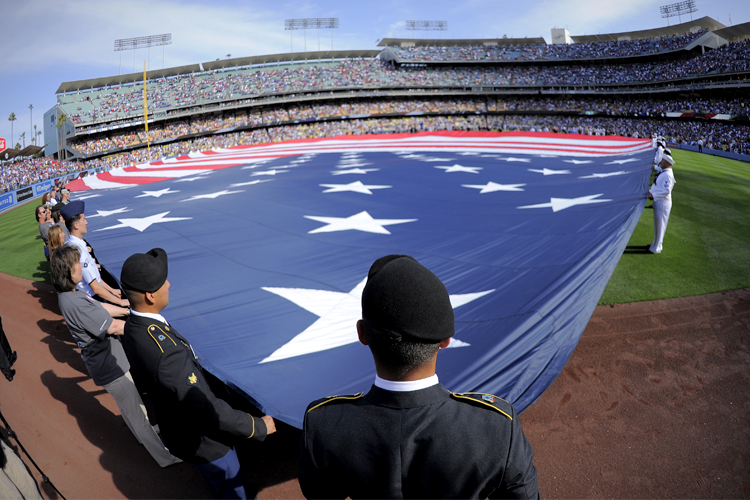
No, thanks: Stop saying Enlisted military and veterans hold the american flag during the national anthem prior to the Los Angeles Dodgers' baseball game (Credit: AP/Mark J. Terrill)
My 16-month-old son was having a bad day. When he doesn’t sleep in the car, he usually points and babbles his approval of all the wonderful things babies notice that completely escape adult attention. On this afternoon, though, he was teething and hungry, a lethal scenario for an energetic youngster strapped into a high-tech seating apparatus (approved and installed, of course, by the state).
When it became clear he couldn’t, or wouldn’t, sleep it out, my wife and I stopped at a nondescript exit, the kind one finds every six miles in the South, with two gas stations and three abandoned buildings (if you’re lucky, you also get a Hampton Inn and Cracker Barrel). While she tended to the baby, I entered a convenience store — one of those squat, glass and plastic rectangles that looks like a Sears & Roebuck erector set — praying it would have something other than beer, cigarettes and beef jerky.
I settled on two Kraft mozzarella sticks, resisting the urge to purchase for myself a shiny red can of Four Loko.
“That’ll be $1.82,” the lady at the counter cheerily informed me. After I handed her two ones, she asked, “Would you like to donate your change to the troops?” I noticed a jar with “support our troops” taped to it in handwritten ink.
“No, thank you,” I answered firmly.
“Well … OK, then, sir,” she responded in subtle reproach, her smile not quite so ascendant anymore. “You have a good day now.”
She had good reason to be disappointed. The vast majority of customers, I imagine, spare a few dimes and pennies for so important a cause. Her response evinced more shock than anger. She wasn’t expecting a refusal of 18 cents, even from a guy who looks very much like those responsible for the danger to our troops.
Besides, nobody likes to have their altruism invalidated by a recalcitrant or ungrateful audience.
I could have asked how the donations would be used, but no matter the answer I would have kept my 18 cents. I don’t consider patriotism a beneficent force, for it asks us to exhibit loyalty to nation-states that never fully accommodate their entire populations. In recent years I’ve grown fatigued of appeals on behalf of the troops, which intensify in proportion to the belligerence or potential unpopularity of the imperial adventure du jour.

In addition to donating change to the troops, we are repeatedly impelled to “support our troops” or to “thank our troops.” God constantly blesses them. Politicians exalt them. We are warned, “If you can’t stand behind our troops, feel free to stand in front of them.” One wonders if our troops are the ass-kicking force of P.R. lore or an agglomeration of oversensitive duds and beggars.
Such troop worship is trite and tiresome, but that’s not its primary danger. A nation that continuously publicizes appeals to “support our troops” is explicitly asking its citizens not to think. It is the ideal slogan for suppressing the practice of democracy, presented to us in the guise of democratic preservation.
I returned to the car, wondering if it will ever be possible to escape the inveterate branding of war as a civic asset in the United States. My son happily grabbed his snack and giggled as I jingled the change before dropping it into the ashtray.
* * *
The troops are now everywhere. They occupy bases and war zones throughout the Arab world and Central Asia and have permanent presence in dozens of countries. They also occupy every tract of discursive territory in the United States. The troops are our omnipresent, if amorphous, symbols of moral and intellectual austerity.
No televised sporting event escapes celebration of the troops. Networks treat viewers to stars and stripes covering entire football fields, complementing the small-but-always-visible flags the studio hosts sport on their lapels. The national anthem is often accompanied by fighter jets and cannon blasts. Displays of hypermasculine prowess frame the reciprocal virtues of courage and devotion embedded in American war mythology.
Corporate entities are the worst offenders. On flights, troops are offered early boarding and then treated to rounds of applause during the otherwise forgettable safety announcements. Anheuser-Busch recently won the Secretary of Defense Public Service Award and in 2011 “Budweiser paid tribute to America’s heroes with a patriotic float in the Rose Parade®.” The Army’s website has a page dedicated to “Army Friendly Companies”; it is filled with an all-star lineup of the Forbes 500 as well as dozens of regional businesses.
I do not begrudge the troops for availing themselves of any benefits companies choose to offer, nor do I begrudge the companies for offering those benefits. Of greater interest is what the phenomenon of corporate charity for the troops tells us about commercial conduct in an era of compulsory patriotism.
It tells us, first of all, that corporations care far less about the individuals who happen to have served in the military than they do about “the troops” as an exploitable consumer category. Unthinking patriotism, exemplified by support of the troops (however insincere or self-serving), is an asset to the modern business model, not simply for good P.R., but also for the profit it generates.
Multinational corporations have a profound interest in cheerleading for war and in the deification of those sent to execute it. For many of these corporations, the U.S. military is essentially a private army dispatched around the world as needed to protect their investments and to open new markets. Their customers may “support our troops” based on sincere feelings of sympathy or camaraderie, but for the elite the task of an ideal citizenry isn’t to analyze or to investigate, but to consume. In order for the citizenry to consume an abundance of products most people don’t actually need, it is necessary to interject the spoils of international larceny into the marketplace.
* * *
“Support the troops” is the most overused platitude in the United States, but still the most effective for anybody who seeks interpersonal or economic ingratiation. The platitude abounds with significance but lacks the burdens of substance and specificity. It says something apparently apolitical while patrolling for heresy to an inelastic logic. Its only concrete function is to situate users into normative spaces.
Clichés aren’t usually meant to be analyzed, but this one illuminates imperialism so succinctly that to think seriously about it is to necessarily assess jingoism, foreign policy, and national identity. The sheer vacuity and inexplicability of the phrase, despite its ubiquity, indicates just how incoherent patriotism is these days.
Who, for instance, are “the troops”? Do they include those safely on bases in Hawaii and Germany? Those guarding and torturing prisoners at Bagram and Guantánamo? The ones who murder people by remote control? The legions of mercenaries in Iraq? The ones I’ve seen many times in the Arab world acting like an Adam Sandler character? “The troops” traverse vast sociological, geographical, economic and ideological categories. It does neither military personnel nor their fans any good to romanticize them as a singular organism.
And what, exactly, constitutes “support”? Is it financial giving? Affixing a declarative sticker to a car bumper? Posting banalities to Facebook? Clapping when the flight attendant requests applause?
Ultimately, the support we’re meant to proffer is ideological. The terms we use to define the troops — freedom-fighters, heroic, courageous — are synecdoche for the romance of American warfare: altruistic, defensive, noble, reluctant, ethical. To support the troops is to accept a particular idea of the American role in the world. It also forces us to pretend that it is a country legitimately interested in equality for all its citizens. Too much evidence to the contrary makes it impossible to accept such an assumption.
In reality, the troops are not actually recipients of any meaningful support. That honor is reserved for the government and its elite constituencies. “Support our troops” entails a tacit injunction that we also support whatever politicians in any given moment deem the national interest. If we understand that “the national interest” is but a metonym for the aspirations of the ruling class, then supporting the troops becomes a counterintuitive, even harmful, gesture.
The government’s many appeals to support the troops represent an outsourcing of its responsibility (as with healthcare, education and incarceration). Numerous veterans have returned home to inadequate medical coverage, psychological afflictions, unemployment and increased risk of cancer. The free market and corporate magnanimity are supposed to address these matters, but neither has ever been a viable substitute for the dynamic practices of communal policymaking. A different sort of combat ensues: class warfare, without the consciousness.
As in most areas of the American polity, we pay taxes that favor the private sector, which then refuses to contribute to any sustainable vision of the public good. The only serious welfare programs in the United States benefit the most powerful among us. Individual troops, who are made to preserve and perpetuate this system, rarely enjoy the spoils. The bonanza is reserved for those who exploit the profitability of warfare through the acquisition of foreign resources and the manufacture of weapons.
Supporting the troops is a cheerful surrogate for enabling the friendly dictators, secret operations, torture practices and spying programs that sustain this terrible economy.
* * *
My wife and I often discuss what our son might grow up to accomplish. A consistent area of disagreement is his possible career choice. She can think of few things worse than him one day joining the military (in any capacity), while I would not object to such a decision.
Those who know me might be surprised by my position, but it arises from a belief consistent with my political outlook, that the power of institutions can never overwhelm the simple act of thinking. In other words, even if the military as an institution often does bad things, the individuals that comprise the military do not have to become bad people. Soldiers can certainly be awful human beings, but so can professors, clerks, musicians, executives, landscapers and athletes.
This way of thinking also inversely demystifies the troops, who are burdened with untenable narratives of heroism the vast majority (like those in all professions) do not deserve. I am neither smart nor foolish enough to define “heroism,” but I am comfortable saying the mere fact of being a soldier doesn’t automatically make one a hero, just as the mere fact of being in prison doesn’t necessarily make one evil.
If we recognize that the troops are in fact human beings, then we simultaneously accept that they are too complex to be reduced to patriotic ephemera. Such recognition is unusual, though. People speak frequently of “our troops,” highlighting the pronoun as if it is imperative to their sense of national belonging. It is an act of possession that projects fantasies of virtue onto an idealized demographic in the absence of substantive virtuous practices that might otherwise foster national pride. Plutocracy ravages the state; we rebuild it with narratives of glory and selflessness, the troops acting as both the signifier and the signified in this nationalistic uplift.
The selflessness of our troops is particularly sacred. Not only do they bring order and democracy to lesser peoples; they also risk (and sometimes give) their lives for the good of others, so that civilians might continue driving, shopping, dining and watching movies, the hallmarks of American freedom. That these notions of sacrifice connote a Christ-like narrative of individual-death-for-collective-pleasure only endows them with even greater cultural power.
Whether or not our son ever joins the military, questions about the deployment of mythological slogans in the service of socioeconomic iniquity need to be addressed. His joining or not joining will have no effect on that need, which will remain even if he becomes a teacher or doctor. I want him to enter into adulthood in a world where people impeach and diminish the mystification of corporate plunder. More than anything, I want him to participate in the process, whether he does it from a barrack, a cubicle or a corner office.
It would be wise to avoid countervailing slogans, such as the assertive but nonetheless meager Support Our Troops, Bring Them Home! One goal is to disrupt and rethink, something much easier to accomplish in the absence of shibboleths. Another goal is to continue exploring why support for troops as prescribed by sports leagues and conglomerates actually does a great disservice to the human beings who comprise the military and reinforces a plutocratic imperium for those who do not.
Next time you are asked to “support our troops,” then, remember that in a country where wealth decides the fate of so many communities, such an uncritical gesture isn’t even worth the change from a broken dollar.

Steven Salaita is an associate professor of English at Virginia Tech. He tweets at@stevesalaita.
http://www.salon.com/2013/08/25/no_thanks_i_wont_support_the_troops/

23 December 2010

Philanthropist Provides Care That The Pentagon Won't 21DEZ10

ALL the propaganda from politicians off all strips, but especially right wing republicans and tea-baggers, about the heroism and sacrifice of our troops, and then this from NPR and Propublica exposing the shameful truth about how we neglect them in their hour of need, the government and the U.S. military should be ashamed, as should we all if we don't try to provide and improve adequate treatment for our wounded soldiers. SAPPY E MAILS JUST DON'T DO IT. Though they may be well meaning, they do not improve the lot of our wounded service members. Contacting, repeatedly, your members of Congress, telling them to provide the care and treatment these men and women need is a real statement of support for our troops. Find the contact information for your Senators here
http://www.senate.gov/general/contact_information/senators_cfm.cfm 
find the contact information for your Representative here
https://writerep.house.gov/writerep/welcome.shtml
and contact President Obama here
http://www.whitehouse.gov/contact/ 
Be sure to check out all the stories on this from NPR and Propublica, especially the fight they are waging with the government and military over their FOIA request.

Bobby McKinney, 29, prepares to groom a horse at the Chastain Horse Park in Atlanta.
Enlarge John W. Poole/NPR Bobby McKinney, 29, prepares to groom a horse at the Chastain Horse Park in Atlanta as part of the cognitive rehabilitation therapy provided by the Project Share program, which aids brain-damaged soldiers.
Bobby McKinney, 29, prepares to groom a horse at the Chastain Horse Park in Atlanta.
John W. Poole/NPR
Bobby McKinney, 29, prepares to groom a horse at the Chastain Horse Park in Atlanta as part of the cognitive rehabilitation therapy provided by the Project Share program, which aids brain-damaged soldiers.
One afternoon this fall, Bobby McKinney hunched over a coffee table with a clear glass surface. A lamp with a bare light bulb illuminated it from below. Pencil in hand, the former Marine traced the pattern for a tattoo across delicate paper, a swirling, intricate design reminiscent of a Celtic cross.

Tricare Investigation

Tricare is an insurance-style program covering nearly 4 million active-duty military and retirees. It is refusing to pay for a therapy that teaches life basics, otherwise known as cognitive rehabilitation, to troops with traumatic brain injuries.
NPR News and ProPublica.org
McKinney's small apartment in Atlanta faded from his thoughts: The closet filled with shirts and pairs of jeans, hung three inches apart, all facing exactly the same direction, the way the Marines had taught him. The box packed with a dozen brown plastic medicine bottles. The worn couch that he slept on instead of the bed. The eraser board on his refrigerator where he had scrawled "A coward dies a 1,000 deaths. A warrior dies one."
Suddenly, a nurse's aide knocked on the door. Had he checked the oven? McKinney leapt up and ran to the kitchen, pulling out a tin of brownies on the point of burning.
"I guess I was just very focused on the tattoo design," he told a counselor later, pushing a camouflage baseball cap back on his head. "I set the alarm. I guess I just didn't hear it."
"Try to work on one thing at a time," she told him. "Multitasking is just asking the brain to do two or three things not too well."
McKinney, 29, nodded in agreement. It seemed so obvious once she said it. But his mind — the mind that once helped sniper teams in Iraq, that navigated battlefield maps and complex rules of enemy engagement — had just not come up with the idea to do one task instead of many. "When you think about it, it kinda makes sense. But I wouldn't think about it on my own," he said.
McKinney is an Iraq war veteran who suffered multiple concussions, also known as mild traumatic brain injuries. Bomb blasts jarred his brain, leaving him with no outside scars, but with nagging mental problems. His short-term memory is bad. He moves slowly through ordinary chores. He gets disoriented easily, and can't find his way to the home that he has lived in for months without the aid of a GPS.
A farm boy fond of the Georgia Bulldogs and chewing tobacco, McKinney has pinned his hopes for recovery on cognitive rehabilitation therapy, a subtle and complex treatment for a subtle and complex injury. Doctors and studies have shown that the therapy helps soldiers. But the Pentagon's primary health plan for soldiers and seriously wounded veterans, called Tricare, will not cover the treatment, saying it is still unproven.
Cognitive Rehabilitation in Action
To see what cognitive therapy looked like, ProPublica and NPR spent several days with McKinney and fellow soldiers and veterans at Project Share, a charity to help brain-damaged soldiers. The program is based out of the Shepherd Center for Brain and Spinal Cord Injury in Atlanta, a nationally recognized hospital for head injuries.
Bobby McKinney, 29, hugs Becky Bunnell, an instructor at the Chastain Horse Park with its therapeutic program.
Enlarge John W. Poole/NPR Bobby McKinney, 29, hugs Becky Bunnell, an instructor at the Chastain Horse Park, where he goes for part of his treatment.
Bobby McKinney, 29, hugs Becky Bunnell, an instructor at the Chastain Horse Park with its therapeutic program.
John W. Poole/NPR
Bobby McKinney, 29, hugs Becky Bunnell, an instructor at the Chastain Horse Park, where he goes for part of his treatment.
Former Home Depot magnate and philanthropist Bernie Marcus founded Project Share in January 2008 to fill the gaps left by Tricare and military and veterans hospitals, which often lack the expertise and staffing to provide a full-scale program of cognitive rehabilitation therapy.
Cognitive rehabilitation is "very time consuming. It's not an easy deal," said Marcus. "Isn't this worthwhile? Isn't this something we should all be concerned about? Whatever it takes is what we should give them."
The visit revealed no flashy techniques, no cutting-edge medical devices. Instead, the men spent their entire days with therapists who focused on improving their memory, speech, balance and psychological health.
Soldiers got individualized treatment plans from a team of therapists who administered an intensive, two-week long evaluation to pin down their cognitive needs.
Therapists from different fields closely coordinated. A behavioral therapist provided counseling, since nearly all of the soldiers have post-traumatic stress disorder, a psychological injury which frequently accompanies traumatic brain injuries.
A speech therapist taught basic organizational techniques to overcome memory problems: How to make lists, how to pay bills, how to organize paperwork. A physical therapist helped them manage pain and relearn balance, which is often thrown off after a blast injury.
In the evenings, the men lived in apartments provided by the center. They did daily field trips, doing errands that are commonplace for most, but difficult for those with cognitive problems. They shopped at a grocery store. They cooked dinner. They helped assemble wheelchairs for the needy. They went to a horse park, where they combed, fed and rode horses.
You're not the way you used to be. And it's really tough to grasp that concept. I used to think I was pretty good, and now I have to use a lot of adaptive equipment to remind myself, or to even be half as good as I used to be. That's what I got to do. That's my life now.
At each step, a therapist helped them prepare for the job at hand. They suggested making to do lists; using an iPod to keep track of medications; storing medical and military records into clearly labeled file folders.
Soldiers get a blue rubber bracelet with the initials SWAPS. The letters are supposed to remind them of a course of action should they become frustrated or mentally overloaded. The letters are an acronym: Stop; What's the problem?; Alternatives and options; Pick a plan; Satisfied?
The men stay for two and three months at a time. Afterwards, a Project Share worker follows them for up to a year to make sure that they are using the techniques they have learned to cope with life in the real world.
"It's very cozy and cocoon-like and warm and fuzzy here," said Tina Raziano, who visits soldiers and veterans at their homes and military bases to make sure they are adjusting. "When they leave here, they go through major, major changes. You really have to adjust to a new normal."
Cognitive therapy is not a silver bullet, nor is it a one-time treatment, or a rigid, well defined program. Instead, therapists here say, it employs a variety of techniques designed to do the hard work of retraining each soldier's brain to compensate for the things it can no longer do.
"We all see that they start out unable to do basic tasks," said Bonnie Schaude, a speech pathologist who coordinates many of the treatments. "People are leaving here, and they can function independently."
The Intricacies Of Care
Brendan Jannesen, 23, works with Brian Smith (right), a physical therapist, on issues with his knee. Jannesen, who was injured in Afghanistan while working as a Forward Observer for the Army, is strapped into a machine that measures his body's responses to abrupt balance changes.
Enlarge John W. Poole/NPR Brendan Jannesen works with Brian Smith (right), a physical therapist, at Project Share. Jannesen, who was injured in Afghanistan while working as a Forward Observer for the Army, is strapped into a machine that measures his body's responses to abrupt balance changes.
Brendan Jannesen, 23, works with Brian Smith (right), a physical therapist, on issues with his knee. Jannesen, who was injured in Afghanistan while working as a Forward Observer for the Army, is strapped into a machine that measures his body's responses to abrupt balance changes.
John W. Poole/NPR
Brendan Jannesen works with Brian Smith (right), a physical therapist, at Project Share. Jannesen, who was injured in Afghanistan while working as a Forward Observer for the Army, is strapped into a machine that measures his body's responses to abrupt balance changes.
The visit made just as clear, however, the difficulty of implementing such an intensive, long-term plan for the military or Department of Veterans Affairs. Official Pentagon figures show that 188,000 soldiers have suffered some kind of brain injury since 2000. The number includes blast wounds, but also head trauma sustained in vehicle crashes, training accidents and household falls. Previous NPR and ProPublica stories have shown that the number likely falls short of the full tally by tens of thousands of soldiers.
The vast majority of head injuries are concussions, from which most soldiers recover quickly. The only treatment needed is bed rest and perhaps pain medication for headaches. But providing the kind of care available at Project Share to even the small percentage of brain-damaged soldiers who need it would require a tremendous commitment of time and money from military and veteran medical systems.
Project Share provides more than 30 hours of rehabilitation a week for several months at a time, and a year of follow up. In contrast, most VA and military systems can provide only a few hours of therapy a week. All Project Share's services are in one building, across the street from the Shepherd Center and its scores of cognitive experts. Military and VA facilities can spend months recruiting a single neurologist at a base for 30,000 soldiers.
The Pentagon's medical budget is $50 billion a year, expected to skyrocket to $65 billion by 2015. The system already cannot fill the slots available for psychologists, counselors and neuropsychologists, who can make better money in the private sector. The VA also has to care for an enormous population of aging veterans, whose geriatric needs are far different than the needs of injured Iraq and Afghanistan war veterans.
Project Share even has the resources to fly in family members and spouses on private planes, the costs and time donated by volunteers. A pilot flew Tiffany Dantzler, 22, from South Carolina to Georgia one recent day to visit her boyfriend, Ashley Craft, so the two could receive joint counseling on what to expect from brain damage recovery.
Struggling To Be 'Half As Good'
Craft, 26, sustained burns and a brain injury in a 2006 roadside bomb explosion in Iraq. After the explosion, he could not remember his own name. A specialist in the Marine Corps, he was medically retired in August 2007. He suffered from post-traumatic stress. He got angry quickly. A mechanic who worked on military vehicles, he could no longer tune up a car back home.
Craft got treatment at VA hospitals in Richmond and Columbia, S.C., near his home. But each time he left the programs, he felt lost and abandoned, he said.
His captain in the Marine Corps heard about Project Share, and got him admitted. Craft now hopes that the intensive rehabilitation will help him return to a normal life. At a recent session on anger management, he tried to take notes on a handheld memory device, painfully typing in one pointer after another.
These guys look completely healthy. They're walking, they're talking. You don't realize they're struggling with their daily lives
"You're not the way you used to be. And it's really tough to grasp that concept," he said. "I used to think I was pretty good, and now I have to use a lot of adaptive equipment to remind myself, or to even be half as good as I used to be. That's what I got to do. That's my life now."
Shy and hesitant when he talks, a man who has seen his expectations dashed more than once, Craft said he is more hopeful, now. Project Share provides him far more intensive care than he was able to receive in the military, he said. His girlfriend has already noticed a difference.
"He seems more confident about what he says. His memory seems a little bit better," Dantzler said. "He seems more alive."
Marcus, the philanthropist who supports the program, said the expense and effort are worth it. In July 2008, he visited officials at the Army Surgeon General's office to pitch cooperation between Project Share and the military. He got a tepid response, according to Marcus and several others present at the meeting. The military said it wanted to focus more on improving its own treatment centers.

More About Traumatic Brain Injury

Photo

Timeline: Diagnosing The Wars' Signature Injury

Reports of traumatic brain injury affecting soldiers came out as early as 2003. Still, many soldiers are not receiving treatment.
Scale

Shifting Numbers

The number of soldiers with mild TBI and lingering problems is open to debate.
TBI graphic

Graphic: How War Blasts Damage The Brain

An explosion generates a blast wave that travels faster than sound and creates a surge of high pressure.
 
Marcus left frustrated. He had visions of an alliance between the military and a nationwide network of civilian treatment programs. Instead, Project Share has treated about 70 soldiers since it began two and half years ago. Since there's no formal relationship with the military, soldiers generally get referred by word of mouth. The military sent one therapist to receive training.
"That's where the problem is, trying to keep it internal when in fact you don't have the resources,: Marcus said.  "If you can't do it yourself, outsource what you can't do. That's the name of the game." Military and VA officials "all say things that you want them to say, but the bottom line is, it's not happening."
As he talked, Marcus grew agitated.
"I don't feel that Washington has paid attention to this thing. I don't think that Washington has done enough on this. I blame the president, I blame the Congress, for not giving these kids the opportunity to go on with a fruitful life after they have devoted their service to this country and put their lives on the line," Marcus said.
"It just doesn't make sense to me. It frustrates me. And it angers me. Kids are wandering around the streets today that will become tomorrow's criminals that were yesterday's heroes. How pathetic is that?
"We owe these kids a hell of a lot more."
Cpl. Brendan Jannesen, 23, a special forces soldier in the 75th Ranger Regiment, was patrolling at  night in Afghanistan in August 2010 carrying heavy gear when he slipped off a trail, falling down a steep slope.
Brendan Jannesen, 23, plays Wii ping pong has part of his balancing therapy with physical therapist Brian Smith.
John W. Poole/NPR Brendan Jannesen, 23, plays Wii ping pong as part of his balance therapy with physical therapist Brian Smith. Project Share provides a combination of physical, speech and occupational therapy, coping skills and psychological counseling to brain-injured troops.
Tall, thin and fit, Jannesen had been a forward observer, trained to coordinate airplane and artillery strikes with soldiers on the ground attacking Taliban fighters. A math whiz, he could simultaneously juggle people screaming in both ears as he figured out the angle for incoming mortar strikes in the middle of battle.
When he awoke from his fall, however, Jannesen struggled to do simple arithmetic. He had to use his fingers to add. Jannesen's sergeant sent him to Project Share, hoping that its intensive approach would help.
Sitting in a common room with a poker table, Jannesen became passionate as he described how much he wants to return to duty, how much he has improved so far.
"I could do degrees, azimuth, you have to calculate the time of flight, the number of rounds, how fast your target is moving to try to get a direct hit on target. It was very, very heavy on cognitive demands," he said. "Now, I get worn out trying to write out a to-do list. It's very, very frustrating and very difficult to handle. You want to do stuff, but you can't do it."
Basic ReTraining
About half the patients at Project Share are veterans, medically retired from the service and hoping to return to civilian life. The others are active duty soldiers who aim to return to their units. They are mostly Marines and special operations soldiers whose superiors have heard about the program through the close-knit communities that characterize those two forces.
Now, I get worn out trying to write out a to-do list. It's very, very frustrating and very difficult to handle. You want to do stuff, but you can't do it
Therapists say that nearly all of their patients are motivated: To get better, to navigate their lives, to recover from a baffling condition that has fundamentally changed the way they think and act in ways all but invisible to the outside world.
Mild traumatic brain injury "can be a blessing and a curse," said Irene Spychalla, case manager for Project Share. "These guys look completely healthy. They're walking, they're talking. You don't realize they're struggling with their daily lives."
A Marine since 1998, Sgt. Orville Wempner, Jr. was sitting on a tarmac in Iraq in 2004 when a mortar landed nearby. He remained conscious but was left with pounding headaches for weeks afterwards.
A water purification specialist, Wempner grew perplexed after he started having trouble operating the enormous, 5-ton pumping machine whose internal workings he had mastered long before the blast. He began to carry around a small green notebook to write down all his tasks. One day, he was alone taking care of his 6-year-old daughter and he simply forgot to feed her dinner.
Wempner, a Minnesotan known to his friends as Junior, knew that something was wrong. His brain, he said, was like a car engine with miswired spark plugs.
Wempner said his brain "feels like it's misfiring. There are days that I'm sitting there and everything is clear and then there's more days when I'm confused, not knowing what I'm supposed to be doing, where I need to go."
Wempner entered the Project Share program in September. Therapists worked hard on helping him learn to organize and prioritize. They retaught him to make lists. They trained him how to keep a calendar with all his appointments written down.
Basic stuff. But for Wempner, they were the tools to getting his brain working right again.
"It does sound pretty simple and down to earth," he said. "But when you're not thinking clear … simple things like that don't really work."
 
  • NPR News Investigations
     
  • Brain Wars: How The Military Is Failing Its Wounded


11 November 2010

Bumper-Sticker Patriotism Is No Way to Honor Our Veterans from AARON SORKIN/HUFFPOST 11NOV10

I was 18 when President Carter rattled America's saber. The Soviets had just invaded Afghanistan, and Carter wanted to show the Russians that we weren't kidding around so he re-instituted registration for the draft. (He didn't re-institute the draft, just registration for the draft.) I'd just finished my freshman year at Syracuse University and had a summer job in Boston when my 18th birthday came up. My parents insisted that I register at a Boston post office, using my Scarsdale, New York, home address and my Syracuse, New York, dormitory phone number in the hopes that it would somehow slow the draft board down should things escalate beyond boycotting the Olympics. I'm not my father, who served and fought in World War II, and I'm not my sister Debbie, who after graduating from law school signed up with the Navy Judge Advocate General's Corps. I'm not my brother Noah, who after graduating from law school took a job with the Brooklyn District Attorney's Office -- rising through the ranks to the Organized Crime Division. (Much to our mother's unhappiness, Noah would often be one of the very few people who knew where key prosecution witnesses were being hidden -- making his throat a prime target for Luca Brasi.) And I'm not my mother, who taught public school in New York City her whole adult life in spite of having an education and a resume that would have allowed her to get paid a lot more for a lot less. To be clear, the most dangerous thing I do is get reviewed by the New York Times. When I sacrifice it's by writing a check.

Not so for U.S. Army Sgt. Mike Pereira. Sgt. Pereira (who I'll call Mike for the rest of this brief column because that's what he prefers) enlisted when he was 18 years old. In 2005 and 2006 he was serving at the Bagram Internment Facility in Afghanistan where he analyzed who we'd just captured and why. His MOS (Military Operational Specialty) was 96 Bravo. "Nobody cared what my name was," he says. "Nobody cared what my skin color was or if I believed in God. 96 Bravo was my contribution to the fight."

Mike's quick to tell you that he wasn't ever shot at. "I mean we took mortars and rockets," he says, his voice implying but nothing more serious than that. Okay, so except for the mortars and the rockets, Mike wasn't fired at while he was in Afghanistan. He was honorably discharged, then hired by a civilian contractor working out of Fort Bragg. This time Mike went to Iraq, and he'd like me to not reveal any more information than this: It was once again his job to analyze prisoners. His interrogations took place in the ICU of the base hospital where he'd question prisoners who needed medical treatment. Once he saw an infant with no skin on his face.

Intelligence gathered from his interrogations would become operational the same night. That's why he was riding in a CH-77 helicopter back to his base. "I wouldn't worry unless any of them were worried." The "them" he's talking about were the Navy SEALs he was riding with. But suddenly the SEALs were worried. The large metallic box filled with supplies and attached to the bottom of the CH-77 was making the bird swivel like a pendulum. Outside his window, Mike saw a fire. "There are always fires in Iraq," he says. "I don't know why." But this fire kept going past his window and past his window and past his window. The helicopter was spinning out of control. The SEALs were shouting.
"This is it," he thought. "Right now." And Mike blacked out.
He doesn't remember how the helicopter got on the ground -- just that he sat there under the stars breathing for hours. And that it took it him some time to understand that he wasn't dead. Mike quit his job and came home to Bellingham, Washington. He and his girlfriend had saved enough money to go to school.

The first 30 days were fine. It was the 31st day that would get him. He took his girlfriend to a local movie theater to see Transformers. In the middle of the movie he experienced a dizziness that was completely foreign to him. He was anxious -- "like when you're thinking, 'Did I leave the coffee pot on? Something's wrong. Someone's in danger.'" His heart started racing and he couldn't breathe. He excused himself, went to the men's room and splashed water on his face. His girlfriend took him home.

He went back to see Transformers again, having missed most of a movie he wanted to see. It happened all over again and, incredibly, right at the same moment in the movie, except this time Mike understood why.

Michael Bay had staged a helicopter crash.

Every day after that got worse. He told his father, "I feel like I'm dying." He went to a doctor who gave him a Xanax and told him he should really see a doctor.

And it just kept on coming. He couldn't sleep, he couldn't eat, he couldn't socialize with his friends and "listen to them talk about cars and style. I wanted to tell them, 'I died.'" His family, "bless their hearts," told him to give it up to God. His girlfriend "took a pretty hard hit from me" -- something he won't be able to get back. Mike told his girlfriend she had to leave -- that he's now a danger and is no longer in control of himself, and here comes some heroics from the girlfriend. She doesn't go anywhere.

She tells everyone she can find that "there's something wrong with my boyfriend. This isn't him. There's something going on." And she takes Mike to a psychiatrist where he's diagnosed with Post-Traumatic Stress Disorder and Traumatic Brain Injury. Mike foots the medical bill.

He was introduced to Tim Nelson, a former marine who was good with returning vets with PTSD. The two would sit on a park bench for hours telling stories. He really felt like Tim Nelson was exactly who he needed to talk to and that Tim was helping.

Mike helped clean up the blood when Tim Nelson committed suicide by shooting himself in the face.

Mike was now certain he was going to suffer the same fate. He decided he needed to serve. He had to. That's what he was trained for, and that's where he was comfortable. He went to Big Brothers/Big Sisters to sign up. They loved him. A returning vet who didn't drink or smoke. The 22-year-old kid behind the desk said:
"Listen, we just need to ask you three questions:
1. Have you ever killed anyone? No.
2. Have you ever been shot at? No, not really.
3. What's PTSD?"

Mike was denied. He had letters of recommendation from his doctors but he didn't get the gig. Mike was dead, and nobody would believe him.

Least of all Eric Greitens. Greitens, a former SEAL, founded The Mission Continues, and somehow Mike found Eric Greitens. "You don't need an MOS to serve," Eric told him. "You're going to be a leader. I promise you. In civilian life you're going to be a leader. But first do what I tell you to do." Okay. "There's a 90-year-old woman who can't stand up by herself. She lives in a hole. Go fix up the outside of her house." Mike did as he was told, and soon he was joined by five other vets and five became thirty and one house became fifteen and fifteen houses became five blocks and weeds were pulled and fences painted and garages cleared out. Now Mike had a fellowship with the Mission -- a monthly stipend so that he could go to school while he served, and at school he started to soar.

His girlfriend is now his wife and Mike is now the Director of the Fellowships Program at The Mission Continues. He still has hard days, but Mike knows he's alive.

There have been more than Mike and Mike's girlfriend, Tim Nelson and Eric Greitens. Mike's serious injuries should have been diagnosed and treated way before he went to the movies.
I don't have room here to talk about the tens of thousands of other Mikes. I don't have room to fully talk about Specialist Jennifer Crane, who needed a permission slip from her parents when she enlisted because she was 17 and a half -- who finished Basic Training on Sept. 11, 2001, and was deployed to Afghanistan less than two years later -- who took mortar fire from the Taliban and who, after returning home with undiagnosed PTSD, slept in her car, turned to coke and paid for it first with her savings, then by sleeping with her dealer and then by sleeping with whoever her dealer told her to sleep with. Jennifer has five years clean now, is married with a two-year-old daughter and is the head of Give an Hour. She travels the country speaking to Iraq and Afghanistan War veterans with PTSD and addiction.

At Give an Hour and The Mission Continues they know what hardly any of us know -- that 15 percent of American casualties in Iraq and Afghanistan are suicides.

During Veterans Week you're going to hear people -- particularly those for whom Veterans Week merely means we're one week closer to the Iowa Caucuses -- tell us to "Support Our Troops." And when they do I'd like us to politely ask them to put their pom poms down for a moment. I'd like us to tell them that if you really want to honor our troops you won't use them for an easy applause line, that you won't use them to get votes, or, most insulting to them of all, to divide us into real Americans and fake Americans. I'd like us to ask them what, other than saying it, are they actually doing to support our troops? I'd like to ask the people who say government's bad what they think of the Department of Veteran's Affairs. When we're fighting two wars, should they get more money or less? And where is that money going to come from -- magic or taxes? Mostly I'd like to ask them three questions, but out of respect for President Bring it On, who couldn't get it together to protect Florida from Alabama, I'll skip the first two and just ask the bumper-sticker patriots Question #3: What's PTSD?

If you have to turn to an aide for an answer to that, please get off the stage. There are real leaders like Mike and Jennifer we'd like to listen to. And that's how you can support our troops.

02 September 2010

Following Simpson’s Comments On Veterans’ Benefits, Veterans Groups Call For Him To Be Fired 2SEP10 & Agent Orange and Veterans: A 40-Year Wait 30AUG10

SIMPSON HAS GOT TO GO....how dare he make such an outrageous charge! My Uncle Bud was an Army lifer, served in Vietnam with the Green Berets, was exposed to massive amounts of Agent Orange, and died a terrible death from a rare form of leukemia that was caused by Agent Orange. He all he is doing is protecting corporate welfare and the military industrial complex on the backs of the retired, working and middle class, vets and the poor, typical republican platform and proposals. See my post on 25 AUG 10 on Simpson complaining Social Security is a milk cow with 310 million tits, and search this blog for more information on the fight to protect Social Security from Simpson and the deficit commission. PRESIDENT OBAMA, GET RID OF ALAN SIMPSON! I have also included the WH blog posting on the new Vets Admin policy on Agent Orange.
As ThinkProgress noted yesterday, Deficit Commission co-chair Alan Simpson recently started a political firestorm by complaining that veterans benefits allocated for servicemembers exposed to Agent Orange run “contrary to efforts to control federal spending.” He even went as far as to say that “the irony” is that “the veterans who saved this country are now, in a way, not helping us to save the country in this fiscal mess.”
Now, veterans advocacy group VoteVets, the nation’s largest progressive veterans organization, is calling on President Obama to fire Alan Simpson. Citing not only his comments about veterans benefits but also his earlier remarks comparing Social Security to a “milk cow with 310 million tits,” VoteVets asks that Obama remove Simpson from “his current position so that the commission can continue its work in a way that will give the military community — and all Americans — confidence in the conclusions it reaches”:
The nation’s largest progressive veterans organization, VoteVets.org, is calling on President Obama to relieve former Senator Alan Simpson from his chairmanship of a deficit reduction commission for defamatory comments about veterans. [...]
His comments came on the heels of outrageous comments about seniors and others on Social Security, as well as women. The veterans pointed to those comments as well, but wrote that Simpson’s attacks on ill veterans compelled them to write. They said firing Simpson was a matter of honoring our veterans. [...] “We ask that you remove [Simpson] from his current position so that the commission can continue its work in a way that will give the military community–and all Americans–confidence in the conclusions it reaches,” the letter concludes.
Additionally, last night on Countdown With Keith Olbermann, Paul Sullivan, executive director of the veterans advocacy group Veterans for Common Sense appeared to call for Simpson to be fired as well, saying he was “absolutely not” the right person to be co-chairing the commission. When Olbermann asked Sullivan if the the ex-senator should be fired, Sullivan replied, “Let me put it to you politely. There’s lots of work for out of work politicians in Washington. I’ll leave it at that.” Watch it:


The White House Blog
Agent Orange and Veterans: A 40-Year Wait
Posted by Secretary Eric K. Shinseki on August 30, 2010 at 04:59 PM EDT

With the unwavering support of President Obama, VA is transforming to meet its 21st Century responsibilities. Advocacy, on behalf of every generation of Veterans, is central to this transformation.

Agent Orange was a blend of herbicides used by the U.S. military, during the Vietnam conflict, to deny concealment to enemy forces. More than 19 million gallons of herbicides were sprayed to remove foliage and undergrowth. The most common, Agent Orange, was sprayed in all four military zones of South Vietnam.

Heavily sprayed areas included the inland forests near the Demilitarized Zone; inland forests at the junction of the borders of Cambodia, Laos, and South Vietnam; inland forests north and northwest of Saigon; mangrove forests on the southernmost peninsula of Vietnam; and mangrove forests along major shipping channels southeast of Saigon.

The issue of Agent Orange’s toxic effects on Veterans, who served in Vietnam, has simmered for decades. Its insidious impact on those exposed to it has become increasingly apparent. That growing awareness has resulted in the Congress’, this Department’s, and the Institute of Medicine’s previous validations of some 12 diseases, which, to date, have been granted presumption of service connection for those exposed to Agent Orange.

Last October, based on the requirements of the Agent Orange Act of 1991 and the Institute of Medicine’s report, “Veterans and Agent Orange: Update 2008,” I determined that the evidence provided was sufficient to support presumptions of service connection for three additional diseases: Parkinson’s Disease, Hairy Cell and other Chronic B-Cell Leukemia, and Ischemic Heart Disease. After a public rulemaking process, we are now issuing a final regulation creating these new presumptions.

This action means that Veterans who were exposed to herbicides in service and who suffer from one of the “presumed” illnesses do not have to prove an association between their medical problems and their military service. This action helps Veterans to overcome the evidentiary requirements that might otherwise make it difficult for them to establish such an association in order to qualify for healthcare and other benefits needed as a result of their diseases. The “Presumption” simplifies and accelerates the application process and ensures that Veterans will receive the benefits they deserve.

As many as 150,000 Veterans may submit Agent Orange claims in the next 12 to 18 months. Additionally, VA will review approximately 90,000 previously denied claims from Vietnam Veterans for service connection for these three new diseases. All those who are awarded service-connection, and who are not currently enrolled in the VA health care system, will become eligible for enrollment.

Veterans who served in the Republic of Vietnam, including its inland waterways, between January 9, 1962 and May 7, 1975, are presumed to have been exposed to herbicides. If you know a Veteran who may have been exposed to herbicides in service and who suffers from one of the diseases that may be presumptively service connected, the Veteran or the Veteran's family can visit our website to find out how to file a claim for presumptive conditions related to herbicide exposure, as well as what information is needed by VA to determine disability compensation or survivors’ benefits. Additionally, VA’s Office of Public Health can answer questions about Agent Orange and VA’s services for Veterans exposed to it.

This rule is long overdue. It delivers justice to those who have suffered from Agent Orange’s toxic effects for 40 years. I have been invited to testify before the Senate Veterans Affairs Committee on 23 September to explain these decisions, and I am happy to do that. It was the right decision, and the President and I are proud to finally provide this group of Veterans the care and benefits they have long deserved.

VA is committed to addressing the health care needs of Veterans from all eras. Forty years from today, a future Secretary of VA should not be adjudicating presumptive disabilities associated with our current conflicts. Change is difficult for any good organization, but we are transforming this Department to advocate for Veterans. We will not let our Veterans languish without hope for service-connected disabilities resulting from their service.

Eric K. Shinseki is Secretary of Veterans Affairs