NORTON META TAG

Showing posts with label National School Walkout. Show all posts

13 March 2018

ACLU Advice for parents and teachers regarding upcoming school walkouts 13MAR18

Image may contain: text
ADVISE from the ACLU of Virginia on the National School Walkout to end gun violence, it is good advise and should be shared throughout the Commonwealth and nationwide. Makes me proud to be a sustaining member of the ACLU, have been for years.....
Across the nation, teens of from all backgrounds are uniting to make their views known about an issue that has affected them directly and deeply – gun violence in schools. Time and time again in our country's history, we have seen young people lead the way in times of crisis, and the first step in that is hearing what they have to say.
As part of their activism, students moved by the recent, tragic school shooting in Parkland, Florida are planning mass school walkouts during school hours. This Wednesday, March 14 has been identified as National School Walkout Day, and other upcoming dates are being mentioned in news reports as well. Many school administrators, teachers and parents are struggling with how to deal with this issue.
In Virginia, we have encouraged school officials to treat this as an educational opportunity, rather than behavior that calls for discipline. On March 2, we sent a letter to all Virginia school superintendents that included some guidelines that we think should guide how schools respond.
Legally, school administrators have the power to discipline students for walking out of school. They can only do so, however, if they can demonstrate that the students' conduct materially and substantially disrupted the educational programs at the school or interfered with other students' rights. And, they can't punish a student more harshly for walking out in protest of something than another student whose absence is unexcused for a different reason. That would be unconstitutional.
From our perspective, however, the most important thing to consider is that the power to discipline need not be exercised at all if students, parents, teachers and school administrators can come together to define these student protests as educational activities that enhance student community and civic engagement.
For Parents:
Talk to your teen about whether they plan to participate in a walkout should one occur at their school, and review their school's student handbook and code of conduct with them. Suggest that they engage in self-study regarding free speech and civil disobedience. Henry David Thoreau's "On Civil Disobedience" might be a good place to start.
Ask your school principal how they would respond to a walkout. Suggest that they view this as a teachable moment grounded in the belief that peaceful protest over matters one cares about deeply is an act of courage and positive community engagement that should be admired and encouraged, not an act of defiance requiring punishment. And if they do intend to impose discipline on any students who walk out, ask them to ensure it is consistent with punishments handed out for other types of unexcused absences.
It is also important that the rights of students who choose not to walk out be protected, and that their educational experience is without significant disruption. Facilitating a walkout, should one occur, will reduce the potential for disruption and help protect everyone's rights. Lastly, administrators should understand that students have a right to express themselves through their clothing and other means even while on school grounds during school hours.
For Teachers:
Many teachers have asked us whether they have a right to join their students in a walkout protest during school hours. The simple answer is no, but we would defer to guidance being offered by the National Education Association (NEA). In addition, we encourage you to talk with your fellow teachers and administrators about how their actions will leave a lasting impression on the young people in their care.
Additionally, we have resources available on this matter. Please forward this email to anyone who might be interested or affected by this issue. If any students you know who walk out receive a punishment that seems disproportionate or overly severe, encourage them to submit an intake for our Legal Team to review.
Very truly yours,
Claire G. Gastanaga
Claire signature
Claire G. Gastanaga
Executive Director
ACLU of Virginia
Defend liberty, equality & justice. Become a member »

How School Walkouts Test Student Rights And School Responsibilities 13MAR18

Image may contain: text
#ENOUGH. The nationwide school walkout is tomorrow, March 14th, and it is important for as many students as possible to participate, to WALK OUT because NOT MY pres drumpf/trump, after stating how many politicians are afraid of the nra becomes one of the politicians who not only was bought and paid for by the nra and is afraid of them too. He is backing away from his proposals on gun control and has appointed a commission to study the issue of school safety and security after ridiculing commissions as a waste of time. So students, teachers, school administrators and officials, if you have had #ENOUGH of local, state and national politicians  placing contributions from the nra above school safety and preventing more mass shootings WALK OUT at 10:00 AM local time in solidarity with the victims of all school shootings. From NPR.....

How School Walkouts Test Student Rights And School Responsibilities

Protestors
Wednesday morning, at 10 o'clock, students at schools across the country will walk out of their classrooms. The plan is for them to leave school — or at least gather in the hallway — for 17 minutes. That's one minute for each of the victims in last month's school shooting in Parkland, Fla.
The walkout has galvanized teens nationwide and raised big questions for schools about how to handle protests.
The organizers, Women's March Youth EMPOWER, have made it clear: While this walkout is meant to honor the victims in Parkland, as well as anyone who's experienced gun violence, it is also a political call to action.
"It's about protesting Congress' inaction when it comes to gun violence," says Kaleab Jegol, a 17-year-old high school senior and protest coordinator from Ohio.
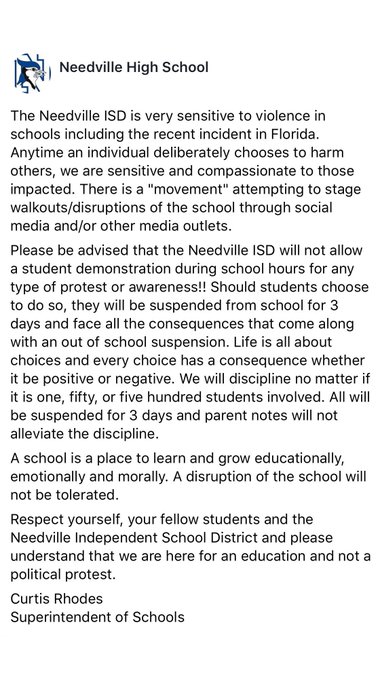
Organizers have posted their demands online, including an assault weapons ban and expanded background checks. Jegol knows, their protest isn't sitting well with some school leaders. In Needville, Texas, Superintendent Curtis Rhodes issued a stern warning to students and parents:
Needville High School's Facebook page, where the letter was posted, has since been taken down. Rhodes did not respond to an interview request, but the district tells NPR that it stands by its suspension threat. This is why, Jegol says, students need to know their rights.
"If it's possible to work with [your school's] administration, then great," Jegol says. "But if consequences like suspension are being threatened, students still do have those First Amendment rights."
Turns out, this walkout is a fascinating walk — out onto a tightrope, stretched between students' free speech rights and schools' legal obligations. And like any tightrope, this one's full of tension.
Students' free speech rights
"It can hardly be argued that either students or teachers shed their constitutional rights to freedom of speech or expression at the schoolhouse gate."
So wrote a 7-2 majority of the U.S. Supreme Court in 1969, after hearing the case of Mary Beth Tinker. The Des Moines teenager had worn a black armband to school, in protest of the Vietnam War, and school leaders suspended her for it. The Court sided with Tinker because, the justices reasoned, her protest did not "materially and substantially disrupt the work and discipline of the school."
A walkout, though, is no armband, and likely exceeds students' free speech protections.
"Is [the demonstration] going to be disruptive to the learning and educational mission of the school?" asks Esha Bhandari, a staff attorney with the American Civil Liberties Union. If so, Bhandari says, then schools are within their rights to intervene and even punish students.
Some schools have promised not to punish students who walk out. Others have said the walkout will be considered an unexcused absence and punished accordingly, usually gently. For schools like those in Needville, that have promised harsher punishment, Bhandari has a warning:
"Students shouldn't be punished any differently than any other unexplained or unexcused absence would be. I think that's the really critical distinction here."
It all comes down to pre-existing district policy. If the student code of conduct says skipping class should trigger a note home or detention, then school leaders can't start handing out three-day suspensions. If they do, it could be argued, they're punishing students for their political speech, not for their actions.
So what should schools do?
Schools' options and responsibilities
We'll be a little reductive here, but it's worth mapping out schools' basic options in response to the walkout. And you'll see, there are no basic options.
Instead of attempting to shut down the walkout before it starts with threats of harsh punishment, principals could head in the opposite direction, just letting students walk.But, that's complicated, too.
"Schools stand in what's known as loco parentis, so we don't simply release our students into the ether," says Francisco Negron, Chief Legal Officer at the National School Boards Association.
"In loco parentis" is a legal term, and it means schools are legally obligated to safeguard students. The irony is that this walkout is all about keeping students safe, but that's also why school leaders don't want to let them walk out. Negron recently sent guidance to districts to help them walk this tightrope.
Instead, many districts have said they'll allow the walkout — but only for students whose parents sign them out or sign a permission slip.
In an effort to keep students inside, some schools have talked about trying to turn the walkout into an assembly, to give protesters a safe forum. But Negron warns that even this can be tricky:
"When you open up a forum for protests to happen, then you open up the possibility that those parties that you don't allow in could claim that you're discriminating on the basis of viewpoint."
That's why, when administrators in Gwinnett County, Ga., announced that they could not condone a student walkout, they spelled out why: enforcing school rules for some protests but not others is grounds for a First Amendment violation.
Some schools have tried to protect themselves from such a charge of discrimination by arguing that the walkout or assembly they've sanctioned is an apolitical event meant to commemorate the victims in the Parkland shooting. The problem is, as we've said, many students and organizers have been clear that they believe the walkout is and should be considered a political protest.
Perhaps the best plan for schools is also the most complicated — and creative.
Administrators in Wallingford, Conn., have offered students there a variety of alternatives to the walkout, including time to write letters to their representatives or complete homework in study hall.
Thirty minutes north, in Hartford, Conn., "Staff, administration, and students will be walking out, down to our football field, and we will stand there in silence for 17 minutes," says Gage Salicki, who teaches social studies at Bulkeley High School.
So the walkout will happen at Bulkeley, but that's only half the story.
"In preparation for this walkout, we asked that students design something related to civic action," Salicki says.
In fact, Salicki helped build a multi-day lesson plan around the walkout — one he began teaching last week. His class watched cell phone footage taken by students during the shooting at Marjory Stoneman Douglas High School and explored all sides of America's raging gun debate.
"We wanted to make sure that students, if delving into some heavy legal territory related to Second Amendment rights, would have equal access to the pros and cons of the issue," Salicki says.
The school's approach wasn't to shy away from politics but to give students a range of resources and encourage them to think critically about the facts. Students were then asked to do one of a few things: make a poster to carry during the walkout, write a letter to a person in power or write a song or poem about what they've learned.
Salicki hopes they've turned this tension-filled moment into a teachable moment.