BUCKNACKT'S SORDID TAWDRY BLOG
We should not be a journey to the grave with the intention of arriving safely in an attractive & well preserved body, but rather to skid in sideways, chocolate, bier or wein in hand, body thoroughly used up, totally worn out and screaming "WHOO-HOO, WHAT A RIDE!!!!!!"
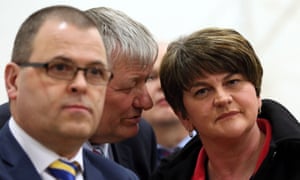
DOES the latest vote in North Ireland indicate a break with the U.K. because of BRexit? Will the occupation in London allow a reunification referendum? From the Guardian... DUP leader Arlene Foster (R) at the count centre in Omagh, Co Tyrone, on 3 March. ‘The logical thing is for Ms Foster to consider her position – as others are surely doing for her.’ Photograph: Paul Faith/AFP/Getty
On the surface, the results of the 2017 Northern Ireland assembly elections look very familiar. The largest unionist party, the DUP, has again come first in Thursday’s voting, as it has done in all five assembly elections of the 21st century. The largest nationalist party, Sinn Féin, has come second, also for the fifth time in a row. The other parties trail in the DUP’s and Sinn Féin’s wakes, again in the usual order. Heady talk that 2017 might prove to be the election in which cross-community transfers of votes might finally dent the historic sectarianism of elections has proved misplaced. The old familiarities have reasserted themselves.
The immediate consequences also have a predictable air. Under Northern Ireland’s power-sharing political settlement, the main parties must now negotiate a programme for joint government. The Northern Ireland secretary, James Brokenshire, has invited them all for talks at Stormont on Monday. But progress is unlikely to be rapid. The last power-sharing executive led by the DUP and Sinn Féin collapsed in January because the DUP leader, Arlene Foster, refused to step aside to allow an investigation of the flawed “cash for ash” renewable energy scheme, which she oversaw. That issue remains unresolved. It is therefore a serious stumbling block to a new agreement within the appointed three weeks. In Northern Ireland’s zero-sum politics, that means Mr Brokenshire may fail to broker a new deal. This could lead to direct rule from Westminster, with the assembly suspended, or to yet another election.
All this has a grim familiarity. Yet beneath the surface, the results reveal very significant shifts. The DUP may have once more emerged on the top of the pile, but its share of the first preference vote has slipped for the third election in a row, now down to 28.1%. Sinn Féin’s, in contrast, has risen to its highest ever share, 27.9%. The gap between them across the whole of Northern Ireland is now fewer than 1,200 votes, and there is only a one seat difference between them in the slimlined 90-seat assembly. For the first time in Northern Ireland’s devolved politics, the two main nationalist parties (Sinn Féin and the more moderate SDLP) now have more seats than the two main unionist parties (the DUP and the UUP, whose leader, Mike Nesbitt, has resigned). The voters have not produced the new non-sectarian result that Mr Nesbitt and some others hoped for. But they have not produced the same old result either.
The bulk of this shift has been caused by the DUP circling the wagons. Ms Foster could have avoided all this simply by standing aside for a few weeks, and in a less polarised polity she would have resigned before the old assembly collapsed. She remains a block in the road, just as before the election. Sinn Féin advanced because its campaign centred on the demand to be treated equally and with respect by unionists such as Ms Foster. That is a resonant demand in Northern Ireland. In some ways it is what the whole period of the Troubles and the peace process has been about from a nationalist standpoint. The upshot was that nationalist Northern Ireland rallied behind Sinn Féin and the SDLP last week more thoroughly than unionist Northern Ireland rallied behind the DUP and UUP. She may lead the largest party, but the logical thing is for Ms Foster to consider her position – as others are surely doing for her.
The UK’s disastrous vote for Brexit makes matters even more fraught, and the formation of a power-sharing executive even more imperative. The DUP’s decision to support leaving the EU in the 2016 referendum was massively irresponsible. It sent yet another message of disrespect to nationalists north and south. It was also out of line with Northern Irish opinion, which voted to remain. But post-unionist pro-remain voters have not emerged as a significant force from within the unionist community, so it would be both imprudent and irresponsible for Sinn Féin to push too hard its demand for a border poll. The impact on communal relations would be far more toxic than that of any assembly election.
Theresa May’s hard Brexit is irresponsible too. It makes the consequences in Ireland even worse, as a break with the single market and, in particular, the customs union, inescapably makes a hard border into a reality. That would be a disaster for both parts of Ireland, with major implications for the rest of the UK and its component parts. This is why Northern Ireland’s latest political impasse matters so much, to all of us in Britain as well as in both parts of Ireland. We cannot sit idly by as this country is broken up and sacrificed on the altar of Brexit.
WHAT a disgrace, people perverting their faith, Christianity, to inflict violence on each other. Here is the followup report from the PBS News Hour on the loyalist parades in N Ireland on 12JUL12. See my earlier post on N Ireland here Peace in Northern Ireland, But Religious Divide Remains 11JUL12 http://bucknacktssordidtawdryblog.blogspot.com/2012/07/peace-in-northern-ireland-but-religious.html
Nationalist protestors argue with police as Orangemen march past the
Nationalist Ardoyne shops of North Belfast in Northern Ireland on
Thursday. Photo by Peter Muhly/AFP/Getty Images.
Attempts to prevent violence at a contentious annual
Protestant-Loyalist Orange Order parade in North Belfast appeared to
backfire Thursday when protestors clashed with police in a Catholic part of town.
The July 12 parade, honoring Protestant King William's victory over
Catholic rival King James II in 1690, routinely sparks trouble when the
marchers pass the predominantly Catholic part of the Ardoyne
neighborhood.
On Thursday, police used water cannons and plastic bullets on
protestors who threw stones and bricks and torched a vehicle. At least four police officers were injured.
Some said this year's violence was caused not only by the parade itself but by official decisions made prior to the parade.
On July 6, the Northern Ireland Parades Commission, an official body
that regulates parade routes by Protestant-Unionists and proposed
counter-protests by Catholic-Nationalist groups, ordered part of this
year's Belfast July 12th parade to return earlier than in previous years
-- by 4 p.m. -- in an attempt to minimize the potential for violence.
But a Catholic-Nationalist group called the Greater Ardoyne
Residents' Collective was granted permission to stage a protest march
starting at 5:30 p.m.
Protestant-Unionists decried the commission's early-return order as
caving in to the threat of violent protest and challenged the ruling in
court.
Those challenges failed, and on Thursday morning the Loyalist Orange
Order Belfast district chaplain, Mervyn Gibson, announced what he called
a "peaceful solution to an appalling predicament." The idea was to bus some of the marchers to get them to the contentious stretch by the deadline.
But that decision angered Catholics, who saw it as shortcutting less
controversial streets to get to their stretch, and they considered it
even more provocative than the original marching plans.
One politician in North Belfast called for their secretary of state to fire the Parades Commission for how it handled the march.
Neil Jarman, director of the Institute for Conflict Research,
said that a great deal of important peace building work is going on in
North Belfast, especially projects involving ex-combatants working in
tandem to address communal issues, and educational projects that bring Protestant and Catholic young people together. But that work suffers each summer when the marching season arrives, he said.
"You start to move forward from September to May and then in between
May and September, you tend to go backwards or at best stand still so
that it's two steps forward, one step backward." Kira Kay and Jason Maloney of the Bureau for International Reporting reported on the persistent tensions in Belfast on Wednesday's NewsHour: http://www.pbs.org/newshour/rundown/2012/07/protestant-march.html
I am proud of the Scot-Irish heritage from my mother's side of our family, and though I am a Protestant Christian (but support the Unionist in their nonviolent political actions to reunite the North with the Irish Republic) I refuse to recognize those committing act of violence against each other as catholic or protestant because there is nothing religious about this conflict. Neither side participating in the violence is following the teachings of Jesus Christ, of Christianity. They are misguided, mislead, deceived Unionist and Republicans who have been persuaded through a propaganda campaign of hate that violence is the only way to defend the union with England or achieve union with the Irish Republic. Yet all they will achieve is further division of their communities, economic depression, educational stagnation and emmigration. This is a report from the PBS News Hour on the resurgence of the troubles in N Ireland....
Protesters have been out on the streets of
Belfast in recent days in advance of Thursday's annual parade honoring
Protestant King William's victory over his Catholic rival in 1690.
Special correspondent Kira Kay reports on the ongoing religious tension
-- 14 years after Ireland's sectarian conflict formally ended.
JUDY WOODRUFF: Now: the simmering unrest in Northern Ireland.
Protesters have been out on the street in Belfast for the past two
days in advance of an annual parade tomorrow. NewsHour special
correspondent Kira Kay looks at the ongoing religious tensions 14 years
after Ireland's sectarian conflict formally ended.
KIRA KAY: It's a compelling sight: the parades that wind their way down the Shankill Road in the heart of Belfast's Protestant community.
This parade is one of the first of the so-called marching season,
when during the summer months, Protestant Northern Ireland residents
loyal to the United Kingdom commemorate a series of historic moments.
The largest takes place tomorrow, July 12, honoring Protestant King
William's victory over his Catholic rival in 1690.
Wesley McCreedy has been marching the Shankill Road for 50 years. WESLEY MCCREEDY, Marcher: It's very much important
the way of the Shankill Road. The Shankill Road are a very loyal people,
a very worthwhile people, and they all stick together. WOMAN: That's what I was brought up to believe in, too. It's my culture. KIRA KAY: For Joanne Harrison and her husband, Tommy, the parades are a family tradition, but also a matter of self-preservation. MAN: Have to keep the culture going. WOMAN: Have to keep it going. We have to keep walking. It's the queen's road. It's the queen's highway KIRA KAY: You have to keep it going, why? WOMAN: Well, if we don't, the other side is going to take over. KIRA KAY: The other side she refers to are the
Catholics living just a few blocks away. The Shankill is virtually
encircled by Catholic neighborhoods.
And this small area, where West and North Belfast meet, saw some of
the worst violence of the 30 years of sectarian conflict here, known as
the Troubles; 3,500 people died in bombings, assassinations and clashes
between nationalist militants like the IRA and the British army and
loyalist paramilitaries.
In 1998, peace came, with an agreement that maintained Northern
Ireland as part of the United Kingdom, but brought Catholic nationalist
party Sinn Fein into government in a power-sharing arrangement with its
former loyalist foes. MARTIN MCGUINNESS, Deputy First Prime Minister,
Northern Ireland: It has been a remarkable journey. We're now in the
control effectively of one of the most successful peace processes in the
world today. KIRA KAY: Martin McGuinness, once a militant IRA commander, is now co-leader of the power-sharing government. MARTIN MCGUINNESS: Throughout the course of the last 14 or 15 years, many things that were considered unimaginable have actually happened. KIRA KAY: Downtown Belfast, once cordoned off by
security fences and army checkpoints, now hosts bustling streets and
cafes. A new museum about the Titanic, built in Belfast, beckons
tourists. MARTIN MCGUINNESS: We have been working away at
trying to attract foreign direct investment. We have brought on
thousands of jobs over the course of the last couple of years. You go
out on the streets of Belfast and Derry, there's been a transformation.
All that said, we're still very conscious of the fact that a lot of work
needs to be done. NEIL JARMAN, Director, Institute for Conflict
Research: The peace agreement did certain things, in that it brought
Sinn Fein and the IRA out of the political wilderness to some extent and
into the institutions of power. But it didn't deal with some of the
wider issues of Northern Ireland, which are around segregation and
hostility between the two dominant communities. KIRA KAY: Dr. Neil Jarman directs the Institute for
Conflict Research. He says that, while the peace agreement has brought a
welcome end to full-scale violence, parts of the country remain divided
and on edge. NEIL JARMAN: In Belfast, they're most visibly
expressed in working-class communities, which are almost entirely
segregated. And the tensions really break out where those residential
areas meet, where a Catholic area butts up against a Protestant area. KIRA KAY: North and West Belfast resemble a
patchwork quilt. Catholic and Protestant neighborhoods alternate every
few blocks, sometimes dramatically separated by physical barriers called
peace walls.
Most were built during the Troubles, but some have gone up even since
the peace agreement, as intercommunal attacks continued. Stark and
sometimes militaristic murals make it impossible to escape the weight of
history and identity here.
Jarman says that, while a great deal of the year the streets here are
calm, that changes during the marching season, with the palpable
culture clash the parades bring. NEIL JARMAN: Parades can cause very real tensions,
because it's almost impossible to find a route through North Belfast
that doesn't come into contact with a Catholic area or a Protestant
area. KIRA KAY: In recent years, parades have sparked
upheaval. First come the protests by Catholic community groups over the
parades passing through their area, followed later in the evening by
full-scale riots of angry youth.
Last year, the riots cost two-and-a-half million dollars to police. WINSTON IRVINE, North and West Belfast Parades
Forum: We need to understand, appreciate and respect the fact that we
have cultural differences, we have historical differences and religious
and political differences here in Northern Ireland. KIRA KAY: Winston Irvine defends the Protestant
community's right to march at annual negotiations over the parades
routing through the most contentious streets. WINSTON IRVINE: We as a Protestant community
understand that there are different perceptions and there are different
notions towards loyal order parades. But I think that the only way to
discuss those issues is around a table. And I think it's totally
illegitimate to use any means of violence to protest or to express
opposition to someone else's culture. FERNANDO MURPHY, Ardoyne Youth Providers Forum: The
parade is -- it's a triumphalism of the Protestants against the
Catholics. It brings us back 20 years every time that parade goes down
the road. You know, it brings this community back to what we have tried
to move on and tried to let everybody else see that it has moved on. KIRA KAY: Outreach worker Fernando Murphy lives in
the Ardoyne neighborhood, a particularly poor and marginalized Catholic
community. Peace walls virtually encircle Ardoyne, creating what Murphy
describes as a siege mentality. And he fears the upcoming July 12 parade
will roil communal tensions yet again. FERNANDO MURPHY: Across the way, there is the
Protestant area, and this side is the Catholic side. And on the 12th of
July, the parade comes up here. It comes up past here and comes into the
Catholic area and up past all these houses. All these shops have to
shut. People can't go about their normal daily life. This usually
culminates in a riot situation. KIRA KAY: Protestant Representative Winston Irvine says the two communities have to find a way to agree on parading. WINSTON IRVINE: The single biggest, most important
aspect of reconciliation for unionists and for Protestants living
particularly in working-class areas of Northern Ireland will be to see a
resolution of the parading dispute. That will be a visible affirmation
that reconciliation has begun. KIRA KAY: But Fernando Murphy says his Catholic
community will never accept the parades on their streets. So, instead,
his organization runs field trips for local youths to remove them from
the area on July 12. FERNANDO MURPHY: Community groups are -- actually
don't want the people to be taken away. I can see their issue by saying,
why should we remove our young people from our area because of one
parade? Why doesn't the parade just remove itself from our area?
We see it necessary, because it stops young people from getting a criminal record or being exposed to sectarian violence. KIRA KAY: On the streets of North and West Belfast,
young people are living with the reality of segregation. Kids in
Protestant neighborhoods are busy building towering bonfires to be lit
on the eve of the July 12 march. YOUTH: Aye, it's brilliant. KIRA KAY: It's brilliant? YOUTH: Aye, I love it. KIRA KAY: Why? MAN: Because, I don't know, I have been waiting for this time of year all year, to start collecting for the bonfire. YOUTH: There's nothing to do up these here streets. So whenever a bonfire comes up, there's just really something to do. KIRA KAY: Do you ever go into the Catholic neighborhoods? YOUTH: Not really, no. KIRA KAY: How come? YOUTH: Just probably end up getting hurt if you end up caught over there. YOUTH: Different religion. KIRA KAY: People still feel differently here? YOUTH: Yes. Conflict hasn't changed, to be honest with you. KIRA KAY: Among a group of Catholic kids on the other side of town, there is some initial bluster. YOUTH: They're orange bastards. They're British. KIRA KAY: They're orange bastards? YOUTH: Yes, they're British, so they're not our people. KIRA KAY: They are not your people. YOUTH: No. KIRA KAY: But then also some promising signs of curiosity.
You would like to meet some Protestants? YOUTH: Well, I would. YOUTH: Aye. KIRA KAY: You would like to understand them a little bit. YOUTH: Aye, see if they get on like us, see if they're different. KIRA KAY: Would any of you go to the same school with them? YOUTH: I would. KIRA KAY: You would? Why? YOUTH: Aye. YOUTH: See what it's like. YOUTH: Aye. See what it's like. KIRA KAY: See what it's like.
More than 90 percent of Northern Ireland's schools are segregated.
But Hazelwood Primary School is different. Its goal is integration.
Patricia Murtagh is the principal. PATRICIA MURTAGH, Principal, Hazelwood Integrated
Primary School: One of the things that parents that set up a school like
ours were banking on, that the relationships that the children would
establish here would be continued as they got older, and as they got
older they would realize the significance of those relationships, that
I'm living in a Catholic area, my friend is living in a Protestant area,
and yet we're still friends. KIRA KAY: The school maintains a strict sectarian
balance, both in numbers of students and topics covered. But even
Hazelwood's campus abuts a peace wall, erected just a few years ago when
nearby homes were torched. PATRICIA MURTAGH: And, actually, we use it as a
discussion point without children, too. You know, it's a resource. And
we go and talk to them and ask, why is it there and why do you think
people felt threatened sufficiently to have something like that
constructed? KIRA KAY: For schools like Hazelwood to become the
norm and for communities to integrate, activists are looking towards
removing the peace walls bit by bit.
Alexandra Park has been split in half for 18 years. But now, in an
experiment, the gates are being opened from 9:00 a.m. to 3:00 p.m. on
weekdays. NEIL JARMAN: As it moves on, the intention is that
the gates will be open, rather than they will be closed. And once that
norm has become established, you can then take away the rest of the
fence. It will take a long time, but we will get there. MARTIN MCGUINNESS: You can't flick a switch and go
from darkness into light. It's a process. And it's going to take a lot
of effort and a lot of recognition by people within communities that we
have to work together. KIRA KAY: The Northern Ireland Parades Commission
has now ruled that this year's July 12 march must end earlier than in
previous years, in an attempt to avoid clashes with protesters.
Protestant politicians called the decision outrageous. Catholics said it
didn't go far enough. GWEN IFILL: Kira's story is part of the series "Fault Lines of Faith," produced in partnership with the Bureau for International Reporting.
You can learn more about their stories by following a link on our Web
site. Plus, on our World page, read about how one group is using video
diaries to try to bridge the divide between Catholic and Protestant
youth in Belfast. Video link http://www.youtube.com/watch?v=j48XwoTeFC4 http://pbs.org/newshour/rss/media/2012/07/11/20120711_nireland.mp3



 Nationalist protestors argue with police as Orangemen march past the
Nationalist Ardoyne shops of North Belfast in Northern Ireland on
Thursday. Photo by Peter Muhly/AFP/Getty Images.
Nationalist protestors argue with police as Orangemen march past the
Nationalist Ardoyne shops of North Belfast in Northern Ireland on
Thursday. Photo by Peter Muhly/AFP/Getty Images.