NORTON META TAG

Showing posts with label Canadian Parliament. Show all posts

23 October 2014

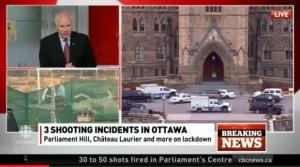
Canada's Coverage of the Ottawa Shootings Put American Cable News to Shame 22OKT14

THERE is much praise for the CBC's coverage of the shootings in Ottawa on Wednesday, 22 OCT 14 and the general consensus is mainstream American media could learn a thing or two from their Canadian counterparts. From +Mother Jones .....
| Wed Oct. 22, 2014 5:28 PM EDT

Police set up a perimeter near Parliament Hill, in Ottawa, Canada.
The Canadian Broadcasting Corporation today gave a master class in calm, credible breaking-news reporting.
Anchored by the unflappable Peter Mansbridge, news of the shootings in Ottawa unfolded live on the CBC much like they do here in the United States: lots of sketchy details, conflicting reports, unreliable witnesses, and a thick fog of confusion. All of that was familiar. What was less familiar was how Mansbridge and his team managed that confusion, conveying a concise and fact-based version of fast-moving events to viewers across Canada and the world.
This live bit of level-headed reporting by Mansbridge, from around 11:10 a.m. Wednesday, should be given to journalism students around the country. It basically contains everything you need to know about why CBC did its audience proud:
MANSBRIDGE: And so, the situation is, as we say, tense and unclear. And it's on days like this—we keep reminding you of this and it's important—it's on days like this, where a story takes a number of different pathways, a number of changes occur, and often rumors start in a situation like this. We try to keep them out of our coverage, but when they come, sometimes from official sources, like members of Parliament, you tend to give them some credence. But you carefully weigh it with what we're also witnessing. It's clear that the situation is not over. It is clear the police are in an intense standby situation and continue to be on the lookout, and until somebody blows the all-clear on this we will continue to stay on top of it and watch as the events unfold.
Watch below, courtesy of the CBC:

The broadcast was deliberative and deferential to the facts even when they were sparse. Exacting and painstaking, but never slow or boring, Mansbridge weighed the credibility of every detail, constantly framing and reframing what we knew and, most crucially, how we knew it. He literally spoke the news as it happened, using his experience not to opine nor fill the gaps in his knowledge, but to provide the necessary support for his team's reporting.
Getting things wrong during fast-moving live coverage is, of course, common. Coverage of the Washington Navy Yard shooting last year got the details wrong early and often: It misstated the perpetrator's name, age, and how many guns he had. Following the Boston Marathon bombing in April 2013, there was false coverage about the identity of the bombers, and anonymous sources leading journalists to nonexistent bombs and arrests. On the Media's handy "breaking news consumer's handbook" is a great roundup of the reporting errors that get repeated every time there is a mass shooting.
No newscast, especially live news, is immune to mistakes, and during the initial haze of leads and counterleads, it's easy to point fingers. But for the six-some hours of CBC broadcasting I watched off-and-on (mostly on) today, I never once felt lost in the wall-to-wall speculation that has characterized so many recent breaking-news broadcasts in the United States.
It seems like others on Twitter agree that CBC did pretty damn well today:
  Mike Wickett @mwickett
Exactly right. @cbcnews and @petermansbridge covered today’s awful events properly: calmly, carefully and accurately. http://via.wickett.ca/1FEbRIO 

GOD BLESS CANADA! Details Emerge Of Alleged Assailant In Canadian Parliament Attack & Harper's Canada and the Attack on Parliament Hill & Canada, At War For 13 Years, Shocked That ‘A Terrorist’ Attacked Its Soldiers 22OKT14


OH CANADA! You have been violated, your hurt is great, pain, anger, sorrow and fear rage inside, and this terrible act against your nation will never be understood. The assault on your democracy, the deaths of two of your military can not be allowed to destroy your national traditions of freedom, liberty, and multiculturalism, if it does you will have lost the Canada you know and love now and you will never get it back. My prayers are for the families of those murdered (as well as the families of the murderers, what parent raises a child expecting them to commit such acts?) and the healing, safety and strength of your people, your nation. God Bless Canada! From +NPR , Montreal Simon, and a very good, hard hitting piece from +FIRST LOOK MEDIA .....
A makeshift memorial sits on a downtown street a block away from Canada's National War Memorial in Ottawa to remember Canadian soldier Nathan Cirillo, who was shot and killed by an assailant Wednesday.
Warren Toda/EPA/Landov
Updated at 8:55 a.m. ET
Authorities in Canada today were taking stock of Wednesday's dramatic attack in the capital city that killed a soldier and led to a shootout inside a Parliament building between police and the alleged attacker, identified as 32-year-old Michael Zehaf-Bibeau.
Canada's MPs, despite many of them spending hours in lockdown on Wednesday as police swept the area in downtown Ottawa for a possible second assailant, expected to return to work today.
In a speech Wednesday evening, Canadian Prime Minister Stephen Harper called the events on Parliament Hill "an attack on our values."
NPR's Jackie Northam, reporting from Ottawa, says that while the area where the shooting took place will be open for government business, it remains closed to the public.
The Canadian Security Intelligence Service has so far declined to comment on the identity of the gunman, but U.S. and Canadian media have quoted unnamed American officials as saying he is Zehaf-Bibeau, a man Jackie says is being described as "a fairly recent convert to Islam" who had a criminal record in multiple provinces.
"He was also the son of a very senior official of Canada's immigration department," she says.
The Globe and Mail says he was "a labourer and small-time criminal — a man who had had a religious awakening and seemed to have become mentally unstable."
The newspaper reports: "Mr. Zehaf-Bibeau was born in 1982 and was the son of Bulgasem Zehaf, a Quebec businessman who appears to have fought in 2011 in Libya, and Susan Bibeau, the deputy chairperson of a division of Canada's Immigration and Refugee Board. The two were divorced in 1999."
The Globe and Mail quotes an acquaintance of Zehaf-Bibeau's who said the alleged attacker had frequently spoken of the presence of devils or demons in the world and had recently expressed a desire to go back to Libya to study. He apparently had been blocked from getting a visa to Libya by Canadian authorities "who have been taking measures to prevent Canadians from joining extremists overseas," the newspaper says.
The Canadian Broadcasting Corp. says Zehaf-Bibeau was charged in 2004 with drug possession, pleaded guilty and served 60 days in jail.
According to the CBC:
"Zehaf-Bibeau was in trouble with the law again in 2011, this time in British Columbia.
"Following a robbery in Vancouver, Zehaf-Bibeau was charged with robbery and uttering threats. He was found guilty of the lesser charge of uttering threats and sentenced to one day in jail, with credit for 66 days already served, according to court documents.
"Quebec court documents from 2004 show Zehaf-Bibeau lived in Montreal at the time, in the north-end neighbourhood of Villeray."
Meanwhile, Ottawa police said early Thursday they had finally ruled out the possibility of a second shooter. And it wasn't yet clear whether the incident was tied to one the day before in which two soldiers were run down in a car, one killed and the other injured by someone who had been radicalized by Islam.
"It could just be a coincidence but certainly it did raise concern that the attacks happened so closely together," Jackie reports from Ottawa. "This all comes at a critical time for Canada, when Canada says it's going to help in the fight against the so-called Islamic State and Canada is providing men and support for that effort."

Harper's Canada and the Attack on Parliament Hill


I'm sure you've all seen the pictures of this nightmare day on Parliament Hill, this criminal assault on our democracy. 

So all I have to say tonight is this:

(1) To the crazy fanatics who killed a young soldier today and another one in Quebec the other day: you and your kind will not intimidate us.

And we will remember Cpl. Nathan Cirillo and  Warrant Officer Patrice Vincent​...


Long after we have forgotten their cowardly killers. 

(2) To the Con regime: you said you would change Canada beyond recognition and you certainly have. Turned us into a more violent war-like country, full of kooks and religious fanatics and more guns than you can count.

(3) I don't agree with everything Glenn Greenwald wrote in this column after the first attack in Quebec. But some things cannot be denied. 

It is always stunning when a country that has brought violence and military force to numerous countries acts shocked and bewildered when someone brings a tiny fraction of that violence back to that country. Regardless of one’s views on the justifiability of Canada’s lengthy military actions, it’s not the slightest bit surprising or difficult to understand why people who identify with those on the other end of Canadian bombs and bullets would decide to attack the military responsible for that violence. 

That’s the nature of war. A country doesn’t get to run around for years wallowing in war glory, invading, rendering and bombing others, without the risk of having violence brought back to it. Rather than being baffling or shocking, that reaction is completely natural and predictable. The only surprising thing about any of it is that it doesn’t happen more often.

For there can be no justifying those senseless acts of violence, but when we try to explain how it could happen in a country like Canada, that's where we must start.

(4) The police may have acted swiftly and bravely today, but they are still going to have to explain this one:

Federal sources have identified the suspected shooter as Michael Zehaf-Bibeau, a man in his early 30s who was known to Canadian authorities. Sources told The Globe and Mail that he was recently designated a “high-risk traveller” by the Canadian government and that his passport had been seized – the same circumstances surrounding the case of Martin Rouleau-Couture, the Quebecker who was shot Monday after running down two Canadian Forces soldiers with his car.

And why a man who had also had his passport seized wasn't more closely monitored.

(5) Let nobody forget that just one day after the first murderous assault, Stephen Harper released this attack ad to try to play politics with tragedy...


And try to make us believe that only he can keep us safe...


When in fact the evidence is that his pathetic posturing for crass political reasons has only made our lives more DANGEROUS.

And he too should understand that like those violent crazies, he will not intimidate us either. Or turn this country into a police state.

Or scare decent Canadians into voting for him. When no leader has done more to harm our democracy.

And this is still true.

This country does not need to change its democratic traditions or surrender to fear. It just needs a new government.

And we will not be safe, and we will not be Canada.

Until the day he is defeated...


Canada, At War For 13 Years, Shocked That ‘A Terrorist’ Attacked Its Soldiers

Featured photo - Canada, At War For 13 Years, Shocked That ‘A Terrorist’ Attacked Its Soldiers
(updated below – Update II)
TORONTO – In Quebec on Monday, two Canadian soldiers were hit by a car driven by Martin Couture-Rouleau, a 25-year-old Canadian who, as The Globe and Mail reported, “converted to Islam recently and called himself Ahmad Rouleau.” One of the soldiers died, as did Couture-Rouleau when he was shot by police upon apprehension after allegedly brandishing a large knife. Police speculated that the incident was deliberate, alleging the driver waited for two hours before hitting the soldiers, one of whom was wearing a uniform. The incident took place in the parking lot of a shopping mall 30 miles southeast of Montreal, “a few kilometres from the Collège militaire royal de Saint-Jean, the military academy operated by the Department of National Defence.”
The right-wing Canadian government wasted no time in seizing on the incident to promote its fear-mongering agenda over terrorism, which includes pending legislation to vest its intelligence agency, CSIS, with more spying and secrecy powers in the name of fighting ISIS. A government spokesperson asserted “clear indications” that the driver “had become radicalized.”
In a “clearly prearranged exchange,” a conservative MP, during parliamentary question time, asked Prime Minister Stephen Harper (pictured above) whether this was considered a “terrorist attack”; in reply, the prime minister gravely opined that the incident was “obviously extremely troubling.” Canada’s Public Safety Minister Steven Blaney pronounced the incident “clearly linked to terrorist ideology,” while newspapers predictably followed suit, calling it a “suspected terrorist attack” and “homegrown terrorism.” CSIS spokesperson Tahera Mufti said “the event was the violent expression of an extremist ideology promoted by terrorist groups with global followings” and added: “That something like this would happen in a peaceable Canadian community like Saint-Jean-sur-Richelieu shows the long reach of these ideologies.”
In sum, the national mood and discourse in Canada is virtually identical to what prevails in every Western country whenever an incident like this happens: shock and bewilderment that someone would want to bring violence to such a good and innocent country (“a peaceable Canadian community like Saint-Jean-sur-Richelieu”), followed by claims that the incident shows how primitive and savage is the “terrorist ideology” of extremist Muslims, followed by rage and demand for still more actions of militarism and freedom-deprivation. There are two points worth making about this:
First, Canada has spent the last 13 years proclaiming itself a nation at war. It actively participated in the invasion and occupation of Afghanistan and was an enthusiastic partner in some of the most extremist War on Terror abuses perpetrated by the U.S. Earlier this month, the Prime Minister revealed, with the support of a large majority of Canadians, that “Canada is poised to go to war in Iraq, as [he] announced plans in Parliament [] to send CF-18 fighter jets for up to six months to battle Islamic extremists.” Just yesterday, Canadian Defence Minister Rob Nicholson flamboyantly appeared at the airfield in Alberta from which the fighter jets left for Iraq and stood tall as he issued the standard Churchillian war rhetoric about the noble fight against evil.
It is always stunning when a country that has brought violence and military force to numerous countries acts shocked and bewildered when someone brings a tiny fraction of that violence back to that country. Regardless of one’s views on the justifiability of Canada’s lengthy military actions, it’s not the slightest bit surprising or difficult to understand why people who identify with those on the other end of Canadian bombs and bullets would decide to attack the military responsible for that violence.
That’s the nature of war. A country doesn’t get to run around for years wallowing in war glory, invading, rendering and bombing others, without the risk of having violence brought back to it. Rather than being baffling or shocking, that reaction is completely natural and predictable. The only surprising thing about any of it is that it doesn’t happen more often.
The issue here is not justification (very few people would view attacks on soldiers in a shopping mall parking lot to be justified). The issue is causation. Every time one of these attacks occurs — from 9/11 on down — Western governments pretend that it was just some sort of unprovoked, utterly “senseless” act of violence caused by primitive, irrational, savage religious extremism inexplicably aimed at a country innocently minding its own business. They even invent fairy tales to feed to the population to explain why it happens: they hate us for our freedoms.
Those fairy tales are pure deceit. Except in the rarest of cases, the violence has clearly identifiable and easy-to-understand causes: namely, anger over the violence that the country’s government has spent years directing at others. The statements of those accused by the west of terrorism, and even the Pentagon’s own commissioned research, have made conclusively clear what motivates these acts: namely, anger over the violence, abuse and interference by Western countries in that part of the world, with the world’s Muslims overwhelmingly the targets and victims. The very policies of militarism and civil liberties erosions justified in the name of stopping terrorism are actually what fuels terrorism and ensures its endless continuation.
If you want to be a country that spends more than a decade proclaiming itself at war and bringing violence to others, then one should expect that violence will sometimes be directed at you as well. Far from being the by-product of primitive and inscrutable religions, that behavior is the natural reaction of human beings targeted with violence. Anyone who doubts that should review the 13-year orgy of violence the U.S. has unleashed on the world since the 9/11 attack, as well as the decades of violence and interference from the U.S. in that region prior to that.
Second, in what conceivable sense can this incident be called a “terrorist” attack? As I have written many times over the last several years, and as some of the best scholarship proves, “terrorism” is a word utterly devoid of objective or consistent meaning. It is little more than a totally malleable, propagandistic fear-mongering term used by Western governments (and non-Western ones) to justify whatever actions they undertake. As Professor Tomis Kapitan wrote in a brilliant essay in The New York Times on Monday: “Part of the success of this rhetoric traces to the fact that there is no consensus about the meaning of ‘terrorism.’”
But to the extent the term has any common understanding, it includes the deliberate (or wholly reckless) targeting of civilians with violence for political ends. But in this case in Canada, it wasn’t civilians who were targeted. If one believes the government’s accounts of the incident, the driver waited two hours until he saw a soldier in uniform. In other words, he seems to have deliberately avoided attacking civilians, and targeted a soldier instead – a member of a military that is currently fighting a war.
Again, the point isn’t justifiability. There is a compelling argument to make that undeployed soldiers engaged in normal civilian activities at home are not valid targets under the laws of war (although the U.S. and its closest allies use extremely broad and permissive standards for what constitutes legitimate military targets when it comes to their own violence). The point is that targeting soldiers who are part of a military fighting an active war is completely inconsistent with the common usage of the word “terrorism,” and yet it is reflexively applied by government officials and media outlets to this incident in Canada (and others like it in the UK and the US).
That’s because the most common functional definition of “terrorism” in Western discourse is quite clear. At this point, it means little more than: “violence directed at Westerners by Muslims” (when not used to mean “violence by Muslims,” it usually just means: violence the state dislikes). The term “terrorism” has become nothing more than a rhetorical weapon for legitimizing all violence by Western countries, and delegitimizing all violence against them, even when the violence called “terrorism” is clearly intended as retaliation for Western violence.
This is about far more than semantics. It is central to how the west propagandizes its citizenries; the manipulative use of the “terrorism” term lies at heart of that. As Professor Kapitan wrote yesterday in The New York Times:
Even when a definition is agreed upon, the rhetoric of “terror” is applied both selectively and inconsistently. In the mainstream American media, the “terrorist” label is usually reserved for those opposed to the policies of the U.S. and its allies. By contrast, some acts of violence that constitute terrorism under most definitions are not identified as such — for instance, the massacre of over 2000 Palestinian civilians in the Beirut refugee camps in 1982 or the killings of more than 3000 civilians in Nicaragua by “contra” rebels during the 1980s, or the genocide that took the lives of at least a half million Rwandans in 1994. At the opposite end of the spectrum, some actions that do not qualify as terrorism are labeled as such — that would include attacks by Hamas, Hezbollah or ISIS, for instance, against uniformed soldiers on duty.
Historically, the rhetoric of terror has been used by those in power not only to sway public opinion, but to direct attention away from their own acts of terror.
At this point, “terrorism” is the term that means nothing, but justifies everything. It is long past time that media outlets begin skeptically questioning its usage by political officials rather than mindlessly parroting it.
Photo: AP/The Canadian Press, Adrian Wyld
UPDATE: Multiple conservative commentators have claimed that this article and my subsequent discussion of it are about this morning’s shooting of a solider in Ottawa. Aside from the fact that what I wrote is expressly about a completely different incident – one that took place in Quebec on Monday – this article and my comments were published before this morning’s shooting spree was reported. So unless someone believes I possess powers of clairvoyance, the claim that I was commenting on the Ottawa shooting – about which virtually nothing is known, including the identity and motive of the shooter(s) – is obviously false.
Then there’s also the extremely predictable accusation that I was justifying the attack on the soldiers. I know from prior experience in discussing these questions that no matter how clear you make it that you are writing about causation and not justification, many will still distort what you write to claim you’ve justified the attack. That’s true even if one makes as clear as the English language permits that you’re not writing about justification: “The issue here is not justification (very few people would view attacks on soldiers in a shopping mall parking lot to be justified). The issue is causation.” If there’s a way to make that any clearer, please let me know.
One more time: the difference between “causation” and “justification” is so obvious that it should require no explanation. If one observes that someone who smokes four packs of cigarettes a day can expect to develop emphysema, that’s an observation about causation, not a celebration of the person’s illness. Only a willful desire to distort, or some deep confusion, can account for a failure to process this most basic point.
UPDATE II: In that brilliant essay I referenced above, published just three days ago in The New York Times, Professor Tomis Kaptian made this point:
Obviously, to point out the causes and objectives of particular terrorist actions is to imply nothing about their legitimacy — that is an independent matter….
That point is so simple and, as he said, “obvious” that I have a hard time understanding what could account for some commentators conflating the two other than a willful desire to mislead.

06 May 2011

Canadian Socialists Show Unprecedented Gains 6MAI11

AN interesting look at the recent Canadian election and the rise of the NDP to become the opposition party in Parliament. From Tikkun Daily.....

by: Ralph Seliger

I’m not a Canadian, but I’ve lived in Canada and was an enthusiastic supporter of the New Democratic Party, the perennial third (sometimes fourth) party in that country until a few days ago. I don’t wish to steal Peter Marmorek’s thunder as an actual Canadian and I look forward to his post-election analysis, but I would like to share some reflections of my own.
When I was a student at McGill in the early ’70s, I campaigned for an NDP candidate in Montreal. Naturally, he finished a distant third (if not fourth). But I understand that dramatic NDP gains in Quebec (where it nearly wiped out the separatist Bloc Québécois, down from 47 seats to four) have catapulted it into a respectable and unprecedented second place finish nationally–up from 37 to 102 seats, with the Liberals crashing from 77 to 34.
The ruling Conservative Party won a majority of the seats but only 40% of the vote. The key to the election strategically seems to be that a close split between Liberal and NDP voters in Canada’s most populous province, Ontario, allowed the Conservatives to win a decisive number of seats there.
I was drawn to the NDP out of a sense of international solidarity as a young American socialist who was a member of the Socialist Party-USA and later its successor organizations, the Social Democrats-USA and the Democratic Socialist Organizing Committee. DSOC, a left-wing split-off from the somewhat rigid and surprisingly hawkish SD-USA, was led by the brilliant democratic socialist thinkers and writers, Michael Harrington and Irving Howe. In 1982, I was present when DSOC merged with the New America Movement to form the Democratic Socialists of America.
I also vaguely recall seeing Michael Lerner on that occasion, who was one of NAM’s key leaders. Unfortunately, although the DSA enrolled an impressive number of stellar thinkers and activists–including Barbara Ehrenreich, Cornell West, Jerrold Nadler and many others–it was clearly not successful in moving the United States in a social democratic or democratic socialist direction (I like to think of these two terms as basically synonymous). The DSA still exists, yet it cannot be said to be truly influential.
American socialists had reason to envy Canadians for its NDP, even though it was not one of the two major parties contending for national power. It generally elected 20-40 Members of Parliament and would occasionally win power in a province or two (it has actually governed five of Canada’s ten provinces, including Ontario, plus the Yukon Territory). With these new elections, however, this pattern has changed, as the NDP is now the official opposition in Canada’s parliament, having decisively displaced the Liberals, historically that country’s most successful political party.
Whether the NDP remains a major force and even forms the government one day, largely depends upon how well it navigates what might be called the challenge of utopianism, or “making the perfect the enemy of the merely good.” I refer back to Michael Harrington to explain my meaning: I recall him saying that a utopian vision is of value because it defines the direction in which you want to move society; but he warned that if you ever thought that you’ve actually arrived at this ideal state, then you (actually, we) are in trouble, because you’ve probably established a totalitarian order. Still, a movement devoid of idealism, rots from within and is corrupted by the allure of power.
Hopefully, the NDP can do a lot of good despite these potential pitfalls. Mind you, even when only a third party, it left an indelible mark on our neighbor to the north by modeling on a provincial level Canada’s one-payer health care system.

29 April 2011

What Is Happening in That Canadian Election?!? 28APR11

THIS is going to be fascinating to watch, the possibility of a NDP socialist led government in Canada will provide a valuable lesson in democracy for us and third party politics in national elections. While I don't see a viable party organization in time for the 2012 elections, with the economy in the state it is in and the nation devolving to a plutocracy, the right wing extremism of the gop / tea-baggers and the lack of moral courage of the Democratic party to stand fast and defend the poor, the working class and the middle class, it is possible enough progressive candidates could be elected to Congress in 2016 to have a real affect on government policy. This from Tikkun....

by: Peter Marmorek

We elect a new government next Monday in Canada after a one month election that began with a lot of whimpering, but seems to be ending with a remarkable bang. To the surprise of media, pundits, and most of the country, the NDP, the socialist party that has been forever mired in third place federally (behind the Liberals and Conservatives) has suddenly surged into second, closing fast on the governing Conservatives (3% behind at the last poll). The second place Liberals, who have been advocating that NDPers vote strategically for them on an ABC (Anybody But Conservative) rationale are catatonic with horror as the same rationale rolls round onto them.
Fortunately, Ian Welsh is around to explain what this all means, who the players are, and who owns the teams on which they play. I’ve deeply admired Ian’s analyses (of politics both Canadian and International) over the years in the Agonist, in Pogge, in Firedoglake, and now on his own website. Here’s a taste of his explanation, which aligns with mine so precisely as to make any further comment of mine redundant. His whole piece is well worth reading!
The scourge of the NDP has been the perception that they can’t win Federally.  As a result, in most Federal elections vote switching has often cost them at least 5% of their vote, and I’d argue up to 10%…. As a result, parties that range from Center to Left (the Liberals, NDP and Bloc) have regularly pulled in about 60% of the vote, and yet the Conservatives have had minority governments for much of the last decade.  This is also due to the fact that, like the US system, ours is first past the post, winner take all.
….There are other factors.  Ignatieff, the Liberal leader, is a sleazeball who apologized for torture…. So when the Liberals went on the offensive against the Conservatives, claiming Conservatives couldn’t be trusted with Medicare (which in Canada means universal single payer health care), I suspect that many Canadians thought “well, that’s true.  But I don’t think I can’t trust you with it either.”  ….Whatever one thinks of the NDP, even its detractors know that the NDP loves universal healthcare.
So, what’s outcome of this election going to be?  Damned if I know.  The polls are all over the place.  The most likely outcome remains a Conservative minority government.  The second most likely outcome seems to be that the NDP and Liberals, together, get more seats than the Conservatives, in which case they could form a coalition government, probably with the NDP as the senior coalition member
How good a government Layton would run I don’t know. I don’t have a good feel for the wonks behind him, or for how strong a leader he’d be.  Nonetheless I am confident that of the possibilities, he’s the best man for the job.  Ignatieff is a weasel, and no one who has apologized for torture should be in charge of anything, anywhere, while Harper is a conservative ideologue who thinks that Canada should be more like the US, as well as being an autocrat who spits over Canada’s democratic and parliamentary traditions.  The sooner he retires, the better.
The outcome is still uncertain. … But still, for the first time in a long time, I am actually seeing some hope for the future.