NORTON META TAG

Showing posts with label Billy Graham. Show all posts

08 November 2012

Sins of the son: Sad treatment for Billy Graham & Franklin Graham's New Obama-Muslim Conspiracy Theory (with video) 8NOV12 & 21MAR11

I believe Ms Quinn is correct, and that franklin graham not only used his father's good name to influence the election he is probably the one who ordered the change on the BGEA website reversing the description of mormonism as a cult. I do not believe Billy Graham would have done either, and I do wonder if he even knows either took place. I still have the highest regard and respect for Billy Graham, I believe he is a true man of God. Be sure to read more about franklin graham's support of right wing politics and conspiracy theories, and watch the video of his newsmax interview in the Mother Jones article following this from the Washington Post.....

By

On Sunday, two days before the election, a full page advocacy ad in The Washington Post featured a huge picture of the Rev. Billy Graham, along with a signed statement by the world-famous evangelist advising readers to  ”VOTE BIBLICAL VALUES TUESDAY, NOVEMBER 6.”
Of all the sad things that have happened during this year’s seemingly endless, divisive and vitriolic campaign, this ad was the saddest.
It read: “The legacy we leave behind for our children, grandchildren, and this great nation is crucial. As I approach my 94th birthday, [which was Nov. 7] I realize this election could be my last. I believe it is vitally important that we cast our ballots for candidates who base their decisions on biblical principles and support the nation of Israel. I urge you to vote for those who protect the sanctity of life and support the biblical definition of marriage between a man and a woman. Vote for biblical values this Nov. 6 and pray with me that America will remain one nation under God. “
Billy Graham has been admired as the pastor to presidents and has prided himself on never endorsing any one politician. He is a man of God and ministers  to everyone, becoming more and more accepting and pluralistic as he has has aged.
So how did it happen that he virtually endorsed Mitt Romney the weekend before the election?
On Oct. 11, Billy Graham and his son,  the Rev.Franklin Graham, who is head of the Billy Graham Evangelistic Association,  met with Romney. The photo op and the meeting were seen as a virtual endorsement of Romney at that time.
What was so surprising was that the Billy Graham Evangelical Association Web site at that time considered Mormonism  a “cult.” Graham had once described cult members as those who “reject what Christians have believed for 2,000 years, and substitute instead their own beliefs for the clear teachings of the Bible.”  Shortly after the meeting, that listing disappeared.  According to Ken Barun, the Association’s chief of staff, “we removed the (cult) information from the website because we do not wish to participate in a theological debate about something that has become politicized during this campaign.”
So calling Mormonism a cult is a “theological debate that has become politicized” while the debate over abortion and same sex marriage is not?
I ask this because just last spring the association bought 14 full-page ads in North Carolina newspapers from Billy Graham for North Carolina Amendment 1, recognizing  marriage between a man and a woman as the only legal domestic union. Franklin Graham has made his position on that issue very clear. “It grieves me, “ he said, “that our president would now affirm same sex marriage, though I believe it grieves God even more.”
Franklin  also said in Decision Magazine, “there is no place for compromise or straight forward moral issues such as abortion and same sex marriage.  God has given us clear biblical direction that we must follow and obey. “
Billy Graham has not escaped controversy. He had a very bad moment in 2002 when tapes of conversations from 1973 with Richard Nixon became public. In the tapes, Nixon railed against Jews and Graham responded  that Jews befriended him  but “they don’t know how I really feel about what they are doing to this country.” The rest of the conversation was decidedly anti-Semitic. When the tapes came to light, Graham said he didn’t remember the conversation but apologized profusely.
 Graham also was  rejected by some  fundamentalist Christians as a legitimate evangelical voice when he gave this interview in 1997. “I’ve met people in various parts of the world in tribal situations,” he said. They had never seen a Bible or heard about a Bible, had never heard of Jesus “but they’ve believed in their hearts that there is a God….” In fact , he was accused of being a heretic by many of these fundamentalists for suggesting that Jesus is not the only way to salvation and for his willingness to work with liberals and Catholics.
But Franklin Graham is no Billy Graham. Where Billy Graham has always been a voice for inclusion, even of religions other than his own, Franklin has not. In fact, in April 2010 the Pentagon rescinded an invitation for Franklin to attend their National Day of Prayer service because, after Sept. 11 he had referred to Islam as a “very evil and wicked religion” and said that Muslims are “enslaved” by their own religion.
Franklin has always leaned toward being more political than his father. He owns a house in Alaska and befriended Sarah Palin. He invited Palin to come visit his father in North Carolina. Shortly afterward, his father issued a statement saying that “Sarah and her family will always be welcome in the Graham family home.”
Today, at 94, Billy Graham is feeble, has hearing, vision and other health problems, and uses walkers and wheelchairs. He spends most of his day watching television. He has never been as active in the Association as has Franklin. He is a revered figure around the world, particularly because he has stayed above the fray, never using his religion for political purposes or personal gain. 
I do not believe that Billy Graham would have instigated the ad essentially endorsing Romney. I wouldn’t be surprised if Billy Graham didn’t even know about it.  I think that he is being exploited by his son to further Franklin’s political objectives. I also believe that it is a travesty because it is not the legacy he would have left behind, had it not been for Franklin using his father’s name and taking advantage of his father’s popularity.
Billy Graham was and is a great man. 
Franklin should stop this exploitation now.
On the outcome of the election, the Rev. Gary Hall, the new dean of the National Cathedral, had this to say: “This year’s election has proven to be as divisive as any in recent history, which is all the more reason that we must move through the challenge of political partisanship and come together as Americans.”
I believe that’s what the real Billy Graham would have said.
More on On Faith:
Anne Graham Lotz: Does God hear our cries?
Lisa Miller: A time to compromise    
Compassion in chief: Why Obama won
Figuring Faith: Examining the election results
What lies ahead for the Mormons?
http://www.washingtonpost.com/national/on-faith/sins-of-the-son-sad-treatment-for-billy-graham/2012/11/08/a31f5de2-29f4-11e2-96b6-8e6a7524553f_print.html 

Franklin Graham's New Obama-Muslim Conspiracy Theory

Billy Graham's son says the president has allowed the Muslim Brotherhood to infiltrate the US government.

| Mon Mar. 21, 2011 11:01 PM PDT
Yes, there's a new Obama-Muslim conspiracy theory on the right: The evangelical son of one of America's most famous evangelists says that President Barack Obama has allowed the Muslim Brotherhood to become part of the US government and influence administration decisions.
In an interview last week with Newsmax.com, a conservative website (that pushes the Obama-was-born-in-Kenya conspiracy theory), [see clarification at the end of the article] Franklin Graham, an evangelist like his father, Billy Graham, claimed that the fundamentalist Islamic political group has burrowed into the Obama administration and is shaping US foreign policy. Sounding a bit like Glenn Beck, Graham explained:
The Muslim Brotherhood is very strong and active in our country. It's infiltrated every level of our government. Right now we have many of these people that are advising the US military and State Department on how to respond in the Middle East, and it's like asking a fox, like a farmer asking a fox, "How do I protect my henhouse from foxes?" We've brought in Muslims to tell us how to make policy toward Muslim countries. And many of these people we've brought in, I'm afraid, are under the Muslim Brotherhood.
Infiltrated every level of our government—that's quite a claim. Yet Graham did not name a single Muslim Brotherhood infiltrator or cite a specific Obama administration decision that has been manipulated by these crafty behind-the-scenes Islamists. (The quotes in the Newsmax article reporting Graham's remarks differ slightly from what he actually said during his interview with Newsmax, according to the video of the interview, which is posted below.) CLICK to link to the Mother Jones article at the bottom of post to view the video.
Though Graham did not back up his charge that Obama has opened the US government to the Muslim Brotherhood, he did say that he believes the president is more concerned with helping Muslims than Christians—both in the United States and abroad. When the Newsmax interviewer asked Graham if Obama has been doing enough to support Christianity and Christians at home and overseas, Graham replied, "No...If anything, it's the opposite." He added, "The Muslims are protected more in this country than Christians."
Graham did not cite specifics on this point, either. A spokesman said Graham was unable to comment on his remarks to Newsmax since he was en route to Africa.
While Graham did not question Obama's Christian faith during this interview, his comments tracked with the extremist right-wing claim that the president is a secret Muslim. And Graham has raised the matter of an Obama Islamic connection in the past. Last August, he told CNN that because Obama's father had been a Muslim, Obama had a perception "problem." The president's father, who was not involved in Obama's rearing, was born a Muslim, but as an adult he was an atheist. Obama was not raised as a Muslim.
It's no surprise that Franklin Graham is worried about Muslims sneaking into the US government. He has declared Islam "a very evil and wicked religion." Last year, he was disinvited from a National Prayer Breakfast event at the Pentagon after his Islam-bashing became an issue. (Sarah Palin quickly rushed to Graham's rhetorical rescue, pronouncing his excommunication from this ecumenical breakfast a travesty.)
For his part, Graham was not at all apologetic about his attacks on Islam. Instead, he called the revoking of his invitation "a slap at all evangelical Christians." He blamed the White House for orchestrating the move: "I don't know if it's exactly from President Obama. But I'm certain that some of the men around him are very much opposed to what we stand for and what we believe." Graham added, "I just don't understand why the president would be giving Islam a pass." Could it be precisely because the Muslim Brotherhood had infiltrated Obama's circles? Graham didn't say so back then. Perhaps that was before he had discovered this plot.
CLARIFICATION: After this story appeared, Newsmax sent a note taking issue with the article's characterization that it "pushes the Obama-was-born-in-Kenya conspiracy theory." The conservative site says,
Newsmax does not 'push' that Obama was born in Kenya. What Newsmax has written about in the past is that Obama was born in the U.S., but should reveal his birth certificate in order to put the matter to rest. Here is an example: http://www.newsmax.com/Ruddy/Obama-birth-certificate/2009/12/12/id/341849. And in this case, Newsmax columnist Ron Kessler makes it clear that Obama was born in the U.S.: http://www.newsmax.com/RonaldKessler/obama-birth/2008/12/08/id/326987.
Indeed, the site has not championed the Kenya conspiracy; we apologize for the error. But it has generally aligned itself with birthers who suggest there is some sort of conspiracy afoot involving Obama's birth documentation. During the 2008 election, the site ran a piece asking, "Where Was Obama Born?" In 2009, anti-Islam activist Pam Geller wrote a Newsmax article that noted there "might be something more sinister at work here," regarding the president's birth certificate. But the site has not gone Kenya.

02 March 2012

Black Evangelicals, White Evangelicals, and Franklin Graham's Repentance 1MAR12 & A GIRL'S MESSAGE TO ALL CHRISTIANS (VIDEO) & Franklin Graham apologizes for questioning Obama’s faith 28MAR12

HERE is a great article on the different perceptions of Christianity by Christians from Sojourners, followed by a beautiful video on this same issue.....

Get a free trial issue of Sojourners Get a free issue of Sojourners
Donate to Support Sojourners
Donate to support
Sojourners
When Franklin Graham expressed doubts about President Obama’s Christian faith during an interview on Morning Joe last week, it reminded me of an uncomfortable dinner I had in the late ‘90s.
I sat down for a pleasant meal in the home of two great friends — one of them a white evangelical faith leader deeply committed to social justice. Well into the evening’s conversation — when we’d dropped all our pretenses and our exchanges moved well past mealtime niceties — one friend asked me something that caught me entirely off guard.
“Do you think Martin Luther King, Jr. was a Christian?” he said.
I was dumbstruck. I had never heard anyone actually ask that question before.
“Yes,” I replied. “What would make you doubt that?”
As he explained, it became clear: My friend wasn’t sure whether Dr. King was a Christian because King’s Christianity didn’t look like my friend’s Christianity.
Dr. King valued justice. My friend valued justice.
King professed personal faith in Jesus. My friend professed personal faith in Jesus.
And yet my friend still was hung up about King’s faith because, to his eye, King didn’t seem interested in “evangelism” as my friend defined it — i.e. the practice of calling sinners into personal relationship with God through faith in Jesus Christ, whose death on the cross is payment for our sins.
Twentieth-century white evangelical understanding of the Gospel guided (and in many ways defined) my friend’s Christian walk. Therein lies the disconnect between his Christian faith and Dr. King’s.
According to sociologists Michael Emerson and Christian Smith (authors of Divided by Faith: Evangelical Religion and the Problem of Race in America), only one thing separates white and black evangelicals, but it makes all the difference in the world: Vastly different experiences of structural and systemic oppression.
Black evangelicals have a long history of interaction with oppressive systems and structures. When African Americans read the Bible, they see the more than 2,000 passages of scripture about God’s hatred for poverty and oppression. They see God’s desire for systems and structures to be blessings to all of humanity — not a curse to some and a blessing for others.
And they see Jesus’ own declaration that he had come to preach good news to the poor, which, by the way, is decidedly not a reference to the “spiritually impoverished.” Jesus meant that he had come to preach good news (of liberation, freedom, and new life) to people trapped in material poverty.
White evangelicals generally do not experience such systemic oppression. According to Emerson and Smith, most white evangelicals don’t prioritize or even see the thousands of references in the Hebrew Scriptures and New Testament about structural and systemic injustice.
Accordingly, the Gospel — and by extension their evangelism — is about only one thing: Personal salvation through faith in Jesus Christ, who died for their sins, and a personal relationship with him.
Black evangelicals also have personal faith that Jesus’ death paid for their sins, but their Gospel doesn’t end with personal (and individual) salvation. For Dr. King and Sojourner Truth and Fannie Lou Hamer and the Rev. John Perkins and Nelson Mandela and for hundreds of thousands of Black Christians around the world and for me, the good news of the Gospel is that Jesus’ life, death, and resurrection were for the redemption of both individual souls and the redemption of whole societies.
Franklin Graham’s father, Dr. Billy Graham, didn’t always understand this, either. The elder Graham’s revivals began as segregated affairs, but the Supreme Court’s desegregation ruling in Brown v. Board of Education of Topeka (1954) agitated his conscience and he quickly course corrected. From that point on, Billy Graham never again held a segregated revival.
What’s more, in 1957 Dr. Graham invited Dr. King, to share his pulpit for a 16-week revival in New York City.
For Billy Graham, Martin King was a Christian.
In the last decade or so, a new generation of white evangelicals — such as my friends Shane Claiborne, Kelly Moltzen, Josh Harper, and others — have intentionally displaced themselves, moving into impoverished communities of color in order to gain the experience their parents and grandparents lacked. As a result, their white evangelical eyes are open.
They see those 2,000 scriptures about poverty and injustice. And this new generation of white evangelicals is committed to fight systemic and structural justice because of the Gospel.
So, it grieved me to hear Franklin Graham’s doubt-filled commentary on President Obama’s faith.
Obama has described in his own words (and quite publicly) how he has a personal relationship with Jesus Christ, how as a young community organizer in Chicago in the late ‘80s he walked down the aisle of a church during an altar call to make a public profession of that faith — a practice developed by one of the greatest American evangelists of all time, Charles Finney.
The president has clearly professed his belief that Jesus died on the cross as payment for his sins. And Obama repeatedly invokes the words of Jesus that guide his world view: “Just as you did to the least of these, you did to me.” (Matthew 25:40)
For a moment, Franklin Graham’s cynicism tested my own faith. I wondered if he had any idea that, when he questioned the president’s faith, it felt as if he were questioning my faith.
I wanted to know if the transformational power of Jesus’ death and resurrection, which is powerful enough to save our souls also could open Franklin’s eyes and soften his heart to the world and experience of his black brothers and sisters.
Repentance is sweet, not only for the sinner, but also for the world. It reminds us all of what is right; what is good; what is true. Franklin Graham apologized for his comments and repented this week.
This public discussion is now a lesson for us all. I have an abiding hope that, just maybe, the power of Jesus’ resurrection is powerful enough even to save the church.
Lisa Sharon Harper is the Director of Mobilizing at Sojourners. She is also co-author of Left, Right and Christ: Evangelical Faith in Politics and author of Evangelical Does Not Equal Republican ... or Democrat.
A Girl's Message To All Christians:

Hey there! I'm Emanuella. I'm a Christian. I have been a "good" Christian most of my life. It was my identity. I used to like to tell people how "good" I was, how I kept all the Commandments. I thought that was "Good"......

Then I realized something...I Failed!!! "Christian" was just a name I wore...kind of like a pretty coat over a dirty body...It didn't match my heart. Here's why:

If you were an Atheist or Agnostic or anything else...And if you didn't agree with me...I would disdain you as a person. I feel like a hypocrite! I feel disgusting! And I can't take it anymore! I wasn't interested in being your "Friend". I just wanted to change you. I thought that was my job.

Christianity is about being like "Christ". Jesus loved everyone, First. If they didn't accept what He said, He still loved them. Its not my job to change you, I can't. But its my job to love you. That I can.

So this is an appeal to my Christian Brothers and Sisters, not all but some... stop the Damnation. Stop the Judgement. Stop the Religism. Thats not our business.

It doesn't matter how well you can preach...How many Bible Verses you've memorized or How many people "think" you are all that. If you don't have love, you're nothing. Love is not a chore. Its a revelation. The Christ you serve revealed it in its purest form.

Gandhi said: "I like your Christ, but I do not like your Christians."

Don't be one of "those". This is an invitation....
Start the LOVE...Join the movement...

Franklin Graham apologizes for questioning Obama’s faith

23 February 2012

Franklin Graham Calls Obama's Religious Beliefs Into Question 21FEB12

I have heard a lot of people make comments about Billy Graham and Franklin Graham not being Christians because of their conservative values. I have defended both, pointing out Billy Graham and the BGEA has never been rocked by financial or sexual scandals and that Billy Graham has confessed to errors in judgement concerning his statements on political and social issues (Nixon, the Vietnam war, Jews) and that the story of Franklin Graham is like that of the prodigal son. And I told those who would judge the Graham's faith to leave the judging to God. Franklin Graham has plenty in his life to cause some to question his claim to being a Christian, so who is he to question the claim of Christianity by Pres Obama? Franklin Graham, there is nothing in your judgement that is Christian, and you definitely are no BILLY GRAHAM! From HuffPost.....

Barack Obama
Evangelist Franklin Graham called President Barack Obama's religious views into question on Tuesday, stating that he does not know for sure if Obama is a Christian.
Graham, who is the son of Billy Graham and the CEO of the Billy Graham Evangelistic Association, said on MSNBC's "Morning Joe" that Obama "has said he's a Christian, so I just have to assume that he is."
"All I know is I'm a sinner, and God has forgiven me of my sins... you have to ask every person," he said about whether he could say for sure that Obama is indeed of the Christian faith.
However, when asked about GOP presidential candidate Rick Santorum's religion, Graham gave a much more concrete answer.
"I think so," Graham said when asked if he believes Santorum is a Christian. "His values are so clear on moral issues. No question about it... I think he's a man of faith."
MSNBC's panelists questioned the reverend's double standard, but Graham continued to draw distinctions between the candidates on the issue of faith. On Mitt Romney, Graham was again evasive, stating that "most Christians would not recognize Mormonism as part of the Christian faith."
But Graham was more willing to label Newt Gingrich's faith. "Newt's been married several times... but he could make a good candidate," Graham said. "I think Newt is a Christian. At least he told me he is."
Later in the segment, Graham also said he could not be sure that Obama was not a Muslim.
"All I know is under Obama, President Obama, the Muslims of the world, he seems to be more concerned about them than the Christians that are being murdered in the Muslim countries," he said.
He continued, "Islam sees him as a son of Islam... I can't say categorically that [Obama is not Muslim] because Islam has gotten a free pass under Obama."
Graham drew the criticism of the White House last spring when he suggested in an interview with ABC that Obama had not been born in the United States.
During that same interview, Graham also questioned whether Obama's actions and values matched up with his identification as a Christian.
"Now he has told me that he is a Christian. But the debate comes, what is a Christian?" Graham said of Obama. "For him, going to church means he's a Christian. For me, the definition of a Christian is whether we have given our life to Christ and are following him in faith and we have trusted him as our lord and savior."
Watch Graham's full interview on MSNBC:
<object width="420" height="245" id="msnbc1260d3" classid="clsid:D27CDB6E-AE6D-11cf-96B8-444553540000" codebase="http://download.macromedia.com/pub/shockwave/cabs/flash/swflash.cab#version=10,0,0,0"><param name="movie" value="http://www.msnbc.msn.com/id/32545640" /><param name="FlashVars" value="launch=46464672&amp;width=420&amp;height=245" /><param name="allowScriptAccess" value="always" /><param name="allowFullScreen" value="true" /><param name="wmode" value="transparent" /><embed name="msnbc1260d3" src="http://www.msnbc.msn.com/id/32545640" width="420" height="245" FlashVars="launch=46464672&amp;width=420&amp;height=245" allowscriptaccess="always" allowFullScreen="true" wmode="transparent" type="application/x-shockwave-flash" pluginspage="http://www.adobe.com/shockwave/download/download.cgi?P1_Prod_Version=ShockwaveFlash"></embed></object><p style="font-size:11px; font-family:Arial, Helvetica, sans-serif; color: #999; margin-top: 5px; background: transparent; text-align: center; width: 420px;">Visit msnbc.com for <a style="text-decoration:none !important; border-bottom: 1px dotted #999 !important; font-weight:normal !important; height: 13px; color:#5799DB !important;" href="http://www.msnbc.msn.com">breaking news</a>, <a href="http://www.msnbc.msn.com/id/3032507" style="text-decoration:none !important; border-bottom: 1px dotted #999 !important; font-weight:normal !important; height: 13px; color:#5799DB !important;">world news</a>, and <a href="http://www.msnbc.msn.com/id/3032072" style="text-decoration:none !important; border-bottom: 1px dotted #999 !important; font-weight:normal !important; height: 13px; color:#5799DB !important;">news about the economy</a></p>

11 November 2011

From Jim Wallis to Billy Graham, on His 93rd Birthday: "Thank you!" 7NOV11

IF there has ever been a leader of the Christian Church in America it has been Billy Graham. He is the face of Christianity in the U.S. and we couldn't have better. Humble, honest, human, a man of faith who is trusted to lead and teach believers in the U.S. and around the world. He has made mistakes and confessed them. As leader of the BGEA (Billy Graham Evangelistic Association) he and the organization have never been rocked by the financial or sexual scandals suffered by so many others. Here is a great piece on Rev Graham by Jim Wallis of Sojourners......

Billy Graham is 93 years old today. And all over the world, people are discussing his influence and impact and remembering their own encounters with the world's leading evangelist.
I, too, am thinking Billy Graham -- more specifically, I'm recalling with great gratitude and fondness the first time I met him.
Sojourners had just settled and started up in Washington D.C., and I was still in my early twenties. The annual National Prayer Breakfast was approaching and, as was the custom then, a pre-Prayer Breakfast meeting for top evangelical leaders was organized to enable a more informal time of fellowship and discussion. Again it was a breakfast, the day before the big event where the president traditionally speaks to members of Congress and the Senate, most of the cabinet, and about 2,000 invited special guests from around the world -- all about the contribution of faith and prayer to our public life.
I had never been invited to the famous prayer breakfast, and certainly had not to the very-established evangelical leaders' meeting just beforehand.
Imagine my surprise when I got a personal invitation to the "leaders' breakfast." Why are they inviting me, I wondered, quite suspiciously to tell you the truth.
At Sojourners we were speaking out strongly for social justice, challenging racism in both the society and the church, and especially in opposing the war in Vietnam -- not commitments the evangelical world was known for at the time.
Why would they include me in a meeting like this? What do they want from me? Do they want to argue with me, or perhaps hope to try to co-opt me?
I arrived a little late -- not used to getting to fancy hotels and finding parking -- and the room was already full. But when I gave my name, the hostess seemed to know right where to take me.
"Follow me," she said. As we began to wind our way through the very old-looking crowd of white men, I saw that she seemed to be taking me to a table in the far corner of the hotel banquet room.
Then I saw him. Billy Graham was sitting at that table!
I almost stopped in my tracks. Graham was a household name in my evangelical family as I was growing up, and we faithfully watched all his crusades on television. No person in the world was more respected by my parents, or by our little evangelical Plymouth Brethren Church.
I noticed there was an empty chair right next to him. And then Graham looked up, saw me coming, and motioned to the open spot and for me to sit down.
I was stunned and speechless. But I sat down in the chair that had apparently been waiting for me, to Graham's dazzling smile, the warmest greeting, and embracing handshake that has mesmerized people all over the world.
Graham looked at me with those penetrating eyes and said, "Jim, it is so good to meet you. I think that you will be a leader for the next generation of young Christians. And I am a leader for the older establishment of evangelicals. There are people who would divide us, and pull us apart; but we can't let them do that. I want them to know that I agree with you on more things than they would imagine, and I thought we should start talking together."
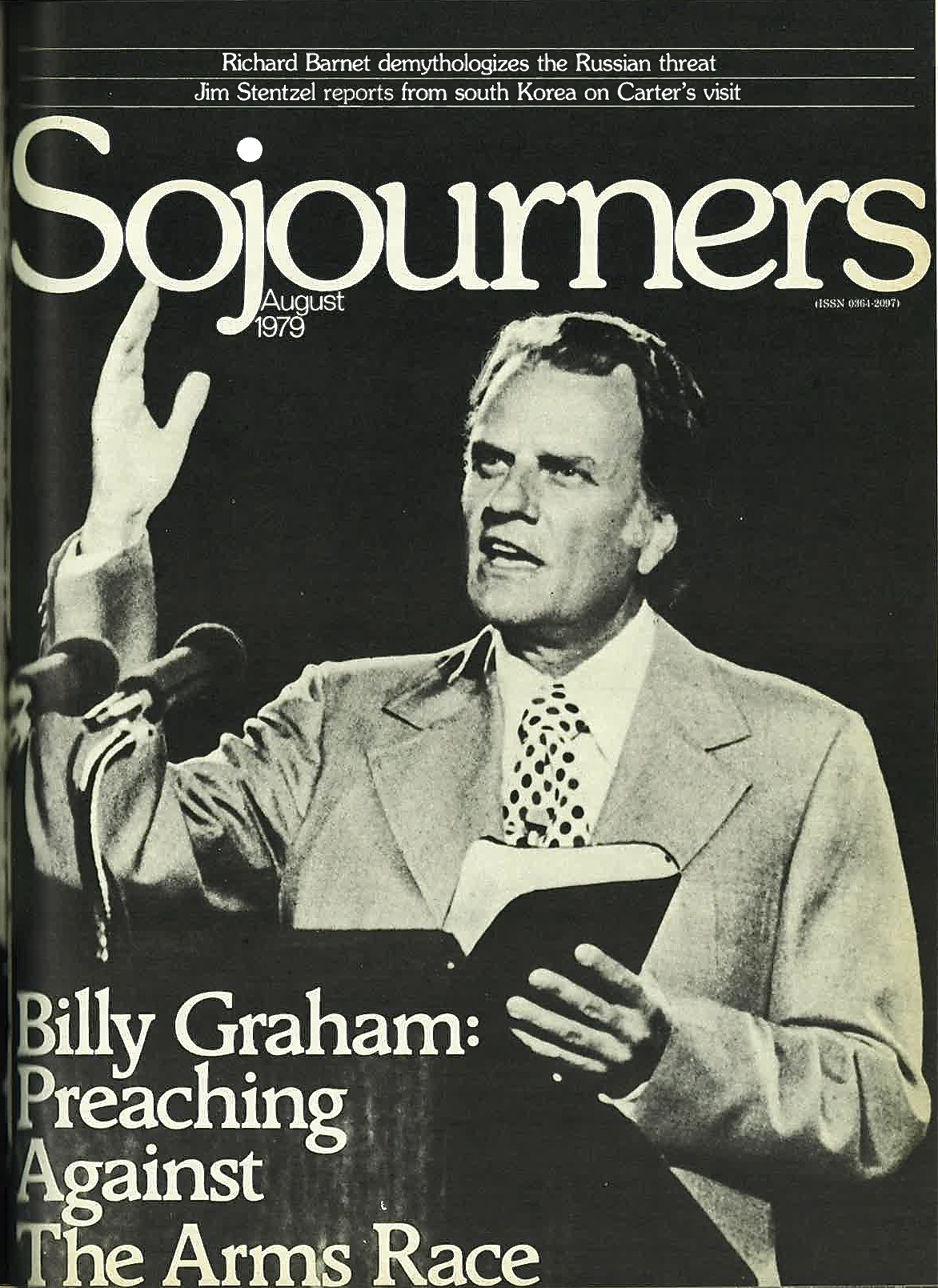
So we did, ovBilly Graham cover(1)er one of the most memorable breakfasts of my life. I soon realized that he had something to do with my surprising invitation to breakfast with the evangelical establishment that day. More conversations followed over the years and, in one of them, he said to me, "My calling is to preach the gospel of personal salvation, and yours in to preach the social implications of that same gospel. So I think our ministries are complementary."
Looking back now, I can hardly believe how gracious that early invitation and conversation was. We were just a bunch of rag-tag young evangelicals proclaiming a gospel of justice and peace, and were both willing and sometimes eager to challenge the establishments of both church and state on that message.
As the preeminent evangelical leader of the day, Graham didn't have to engage us at all, let alone put his arm around the back of the chair next to him at breakfast and ask a young evangelical what he and his generation thought about a lot of things. All of which showed what kind of leader -- and man --he always has been. Not only gracious and warm, he has been a bridge builder, mentor, and an encourager.
Graham has always been a life-long learner, passionate about preaching the gospel but always ready to understand more about what that gospel means in the world. It was never surprising to me that this southern-born-and-raised American evangelist decided early on to insist on preaching only to racially integrated coliseums and crusades, when many others just went along with their culture.

01 April 2010

Billy Graham’s Theological Humility Should Challenge Evangelical Attitudes from SOJO 3NOV09

Thought this was a good article to post during Holy Week when we celebrate the sacrifice and resurrection of Jesus. Following that is the 14AUG06 Newsweek interview with/article on Billy Graham.

Every three years, young evangelists from around the world gather in Portland Oregon to attend a conference put on by the Next Generation Alliance, an organization dedicated to mentoring the next generation of global gospel preachers. While I’m looking forward to the Innovative Evangelism Conference next week, I think a serious reflection on the man that most of us attending the conference draw the bulk of our inspiration from—Billy Graham—is in order.

The typical Billy Graham narrative goes something like this. Billy started his ministry as a self-assured fundamentalist. In the early days of his ministry, preaching the gospel went hand in hand with defeating communism. Eventually Graham’s championing of the Vietnam War and his close association with Richard Nixon caught up with him and he got burned, resulting in a crisis of faith that produced a much gentler and wiser Billy Graham.

As familiar as this story is, I think it’s a mistake to reduce Graham’s metamorphosis to pre-Nixon and post-Nixon—as if the only thing Graham learned in his older age was that it’s a mistake to politicize the gospel. Such an oversimplification of Graham’s life and ministry overlooks a key aspect of Billy Graham’s legacy: a middle ground between fundamentalism and theological liberalism.

Take for example two issues that have become litmus tests for orthodoxy among Biblical fundamentalists—evolution and the fate of the unevangelized on judgment day. On the subject of evolution, Billy Graham has consistently maintained throughout his ministry that Christianity and evolution are compatible. While it may be fashionable for evangelical leaders today to speak of intelligent design over and against young earth creationism, Billy Graham goes even further by insisting that the Bible is not a science book, and shouldn’t be read as such. (See Billy Graham: Personal Thoughts of a Public Man, by David Frost, p 73.) On this matter Graham is further to the left than the average evangelical, although his Biblical hermeneutic on the rest of the Scriptures remain a far cry from theological liberalism (For example: Graham may see the seven days of Genesis as figurative, but he maintains that Jonah was actually swallowed by a whale).

The same can be said for Billy Graham’s agnostic position on the fate of the unevangelized on judgment day. When asked by Newsweek if he felt that heaven would be open to people of other faiths besides Christianity, Billy Graham responded,

Those are decisions only the Lord will make. It would be foolish for me to speculate on who will be there and who won’t … I don’t want to speculate about all that. I believe the love of God is absolute. He said he gave his son for the whole world, and I think he loves everybody regardless of what label they have.

Some have even attributed his comments—and other comments like these—to senility. Still others have written him off as a heretic. Again, the reality is more complex. Billy Graham has never wavered in his belief that Christ’s death and resurrection is the only means by which a person can be saved, and neither does he apologize for his commitment to preach the gospel for the conversion of sinners to Christ. What the older Billy Graham has learned, however, is that a person can be resolute in their commitment to the gospel and be theologically humble at the same time.

Ironically, it’s Billy’s example of theological humility that may free the next generation to ask some hard questions about the classic evangelical gospel that he popularized. For example, does the classic evangelical gospel, complete with an altar call and the standard sinner’s prayer, take seriously enough the teachings of Jesus against accumulating wealth and earthly possessions? To what extent should non-violence and identification with the poor be proclaimed as part of the gospel of the Kingdom? Has the sinner’s prayer been overemphasized at the expense of baptism as the initiation into the Body of Christ?

These are difficult questions with no easy answers, which is why the next generation of evangelists could use a dose of Billy Graham’s theological humility. Billy Graham has served his generation faithfully, but even Billy knows that he doesn’t have a corner on truth—and neither will the next generation that follows in his footsteps. Billy Graham has led the way, but now it’s up to us, the next generation, to carry the mantle and hear what the Spirit is saying to our world today. I think Billy would agree.

HERE IS THE NEWSWEEK ARTICLE MENTIONED ABOVE, COPY AND PASTE THE LINK TO GO TO IT ON THE NEWSWEEK SITE
http://www.newsweek.com/id/46365
Pilgrim's Progress
In the twilight, Billy Graham shares what he's learned in reflecting on politics and Scripture, old age and death, mysteries and moderation. A NEWSWEEK exclusive.

By Jon Meacham | NEWSWEEK

From the magazine issue dated Aug 14, 2006

Earlier this summer, on a warm Carolina evening, Billy Graham awoke in the middle of the night. He had been asleep in his bedroom at the end of a long hall off the main part of the log house he and his wife, Ruth, have lived in for 50 years. The house, which sits atop a small mountain in Montreat, N.C., is sprawling but simple; the only hint a celebrated figure lives here is a mechanical gate, a precaution suggested by J. Edgar Hoover. At 87 Graham uses a hospital bed; Ruth ("that angel in there," he calls her) sleeps next door. Over the stone fireplace in his room--dark this time of year; the air conditioner hums loudly--hangs a homemade family tree decorated with snapshots of his five children and dozens of grandchildren and great-grandchildren. An enormous television sits in the corner. Graham remains a news junkie, following developments in the Mideast, North Korea--and in nearby Durham, where he keeps an eye on coverage of the Duke lacrosse rape case.

On this particular night, Graham lay in the darkness, trying to recite the 23rd Psalm from memory. He begins: "The Lord is my shepherd, I shall not want ... " Then, for a moment, he loses the thread. "I missed a sequence, and that disturbed me," Graham recalls. It was frustrating--the man who has preached the Gospel to more human beings than anyone in history does not like to forget critical verses of the Bible--but in the end the last line comes back to him: "Surely thy loving-kindness and mercy shall follow me all the days of my life; and I will dwell in the house of the Lord forever." Relieved, he drifts back to sleep.

To everything there is a season, says the author of Ecclesiastes, and for Billy Graham this is the season of coping with the toll of time. Getting around is harder; so is recalling familiar Scriptures. Yet rather than simply withdrawing into the shadows to enjoy a few richly deserved quiet years with his wife and family, Graham believes he may have been called to a last mission: to soldier on by faith, praying and pondering and sharing what he

has come to see and feel and think in the twilight of his life. In the same way he refused to give up searching his memory for the verses to the psalm, he seems congenitally incapable of surrendering completely to the weakness of the body. "All my life I've been taught how to die, but no one ever taught me how to grow old," Graham remarked one day to his daughter Anne Graham Lotz. "And I told him, 'Well, Daddy, you are now teaching all of us'." The lesson of age, Anne says, is this: "When you get older, secondary things, like politics, begin to fall away, and the primary thing becomes primary again--and for Daddy, the primary thing is, as Jesus said, to try to love God totally, and to love our neighbor as ourselves."

And that, in a way, is Billy Graham's last testament. As his days dwindle, the man whose heyday was consumed with preaching and with presidents is increasingly reflective. In interviews with news-week in recent months, Graham has made it clear that partisan politics and the culture wars feel far away. He will not offer opinions on stem-cell research, for instance, and he has stopped giving political counsel to the powerful, a habit that began with Eisenhower. He was tempted to call President George W. Bush in the run-up to the Iraq war to advise him on the difference between Sunnis and Shiites, but decided against it.

You can see more from a mountain, and from the perspective of years. Graham believes both the right and the left in America have sometimes gone too far, elevating transitory issues when, in Graham's view, the core message of the Gospel, and the love of God "for all people" should take priority: "The older I get, the more important the eternal becomes to me personally." His mind is on the heavenly more than the temporal, on the central promises of Christianity more than on the passing political parade.

It was not always this way. After the 1963 March on Washington, Graham said: "Only when Christ comes again will the little white children of Alabama walk hand in hand with little black children." In 1965, he dismissed demonstrations for peace in Vietnam, saying, "It seems the only way to gain attention today is to organize a march and protest something." Just 10 years ago, he told the St. Paul Pioneer Press that "I don't think there is a single social issue I haven't spoken on."

But more recent years have given him something he had little of in his decades of global evangelism: time to think both more deeply and more broadly. As he has grown older, Graham has come to an appreciation of complexity and a gentleness of spirit that sets him apart from many other high-profile figures in America's popular religious milieu--including, judging from their public remarks, his own son Franklin Graham, and men such as Jerry Falwell and Pat Robertson.

Others relish the battlefield; Graham now prizes peace. He is a man of unwavering faith who refuses to be judgmental; a steady social conservative in private who actually does hate the sin but loves the sinner; a resolute Christian who declines to render absolute verdicts about who will get into heaven and who will not; a man concerned about traditional morality--he is still slightly embarrassed that he kissed "two or three girls" before he kissed his wife--who will not be dragged into what he calls the "hot-button issues" of the hour. Graham's tranquil voice, though growing fainter, has rarely been more relevant.

An old man's musings will not bring peace to the Middle East or stop religious conservatives from demonizing homosexuality or religious liberals from demonizing religious conservatives, but they are musings that resonate in a global climate shaken and shaped by the war in Iraq, the threat of terror and the violence between Hizbullah and Israel. "I've been watching the news from the Middle East full time," Graham says. "I think that history began there, and it is going to end there. The whole Bible is centered in the Middle East and so many of the events that are taking place in some ways already have taken place many times, and my heart goes out to all those people who are suffering on all sides ... I pray for those people constantly--they're on my mind, they're on my heart. I pray that somehow they will find a solution. I'm not sure they will ever find a permanent solution. Christ, who I believe is going to come back, will settle all of those things in a great period of righteousness."

The administration cannot count on the Second Coming to resolve the crisis, but Graham's spirit of moderation, of concern for both sides, is welcome not only overseas but at home, for Americans seem hungry for a ceasefire in the culture wars. In a Pew Research Center survey released last week, 66 percent of all Americans want a "middle ground" on abortion. Six out of 10 white evangelicals also support compromise; meanwhile, 44 percent of white evangelicals--the highest figure recorded in five years of polling--back stem-cell research.

Though flocks of the faithful have lionized Graham, turning his crusades into epic events, his books into best sellers and even his house into a shrine, he remains contradictory and controversial. One of the most formidable figures in the 2,000-year story of Christian evangelism, he is the first to tell you he is far from perfect. He was caught on tape exchanging anti-Semitic remarks with Richard Nixon, and he allowed himself to be used as an occasional political prop in the Eisenhower, Kennedy, Johnson and Nix-on years, bestowing benediction on the presidents with whom he golfed, prayed and embraced--often as photographers clicked away. Such images have long led critics to dismiss Graham as a name-dropping, theologically naive showman.

The new interviews with NEWSWEEK, however, reveal a more intriguing figure than either his followers or his critics might assume. He is an evangelist still unequivocally committed to the Gospel, but increasingly thinks God's ways and means are veiled from human eyes and wrapped in mystery. "There are many things that I don't understand," he says. He does not believe that Christians need to take every verse of the Bible literally; "sincere Christians," he says, "can disagree about the details of Scripture and theology--absolutely." And he is an old man who loved the life he led and acknowledges that aging and facing the prospect of death are things he has only recently come to embrace. "I can't say that I like the fact that I can't do everything I once did," he says, "but more than ever, as I read my Bible and pray and spend time with my wife, I see each day as a gift from God, and we can't take that gift for granted."

Graham has always been torn between absolutism and moderation. Born four days before the Armistice in 1918 and raised by Presbyterian parents on a 300-acre dairy farm near Charlotte, N.C., he left home for Bob Jones's fundamentalist college in the fall of 1936, but soon dropped out, moving on to a Florida Bible college and ultimately to Wheaton in Illinois. Ordained as a Baptist preacher in 1939, he preached a conservative but not fundamentalist brand of Christianity with a style that took him to six different continents and into the company of 10 presidents. He was ubiquitous, opining on issues ranging from civ-il rights to Vietnam to nuclear arms. Given Graham's Southern roots, the Jim Crow question was especially fraught. Graham made occasional go-slow remarks that undercut the movement, but he also refused to hold segregated crusades and asked Martin Luther King Jr. to appear with him in New York in 1957. The two men once traveled together to Brazil, holding long talks. (Like many intimates, Graham called King "Mike.")

After years of vigor, infirmity came with little warning. Graham was perennially mindful of his health; his biographer William Martin once noted how much Graham amused his staff by "racing off to the Mayo Clinic at the slightest hint of illness." In 1999, when he turned 80, "All of a sudden it all changed, and I became physically very limited," Graham says. There were brain operations, a broken hip and a broken pelvis. He now suffers from prostate cancer and has shunts in his brain to fight hydrocephalus. Meanwhile, Ruth, a funny, devout and feisty woman, is also ailing. In 1979 she was fixing a swing for the grandchildren and fell from a tree--it was 14 feet to the ground, Graham says--breaking bones and inaugurating a long period of pain. (Ruth was, and is, a wonderful ballast to Graham. Barbara Bush, another formidable woman with a peripatetic husband, likes to tell this story: when Ruth was asked by an interviewer whether, as a Christian woman, she had ever considered divorce, Mrs. Graham replied, "Divorce? No. Murder? Yes.")

Graham spends hours now with his Bible, at once savoring and reconsidering old stories and old lessons. While he believes Scripture is the inspired, authoritative word of God, he does not read the Bible as though it were a collection of Associated Press bulletins straightforwardly reporting on events in the ancient Middle East. "I'm not a literalist in the sense that every single jot and tittle is from the Lord," Graham says. "This is a little difference in my thinking through the years." He has, then, moved from seeing every word of Scripture as literally accurate to believing that parts of the Bible are figurative--a journey that began in 1949, when a friend challenged his belief in inerrancy during a conference in southern California's San Bernardino Mountains. Troubled, Graham wandered into the woods one night, put his Bible on a stump and said, "Lord, I don't understand all that is in this book, I can't explain it all, but I accept it by faith as your divine word."

Now, more than half a century later, he is far from questioning the fundamentals of the faith. He is not saying Jesus is just another lifestyle choice, nor is he backtracking on essentials such as the Incarnation or the Atonement. But he is arguing that the Bible is open to interpretation, and fair-minded Christians may disagree or come to different conclusions about specific points. Like Saint Paul, he believes human beings on this side of paradise can grasp only so much. "Now we see but a poor reflection as in a mirror," Paul wrote, "then we shall see face to face." Then believers shall see : not now, but then .

Debates over the exact meaning of the word "day" in Genesis (Graham says it is figurative; on the other hand, he thinks Jonah was actually swallowed by a whale) or whether the "Red Sea" is better translated as "sea of reeds"--which takes Moses' miracle out of the realm of Cecil B. DeMille--or the actual size of ancient armies in a given battle may seem picayune to some. For many conservative believers, however, questioning any word of the Bible can cast doubt on all Scripture. Graham's position, then, while hardly liberal, is more moderate than that of his strictest fellow Christians.

Belief in mystery is crucial to the Gospel Graham has preached for so long--a Gospel centered on the story that, for reasons unknown to the human mind, God chose to effect salvation through the execution and resurrection of his son. "As time went on, I began to realize the love of God for everybody, all over the world," he says. "And in his death on the cross, some mysterious thing happened between God and the Son that we don't understand. But there he was, alone, taking on the sins of the world."

Despite Graham's physical difficulties--walking uneasily, hearing poorly, tiring quickly--he felt called to come to New York to preach one last great crusade in the summer of 2005. In interview after interview, he underscored that he was going to discuss only the Gospel--a public hint that the man who had not shied away from the arena in past years had rethought his role. "I think the Lord led me in that decision, and that's where I am now," he says. "I spend more time on the love of God than I used to." He pauses, and, alluding to more politically active conservative ministers, adds: "But I have tried to maintain friendships with all these people."

One of those people is Jerry Falwell, who called on Graham after New York. They sat together in Graham's kitchen and discussed the distinction between an evangelist, whose job is to spread the Gospel, and a pastor, who, in Falwell's view, has a duty "to confront the culture." "There is no question that your role and mine are opposites," Falwell told Graham. "You are an evangelist; I am a pastor. I have prophetic responsibilities that you do not have." Falwell is unapologetic about his own calling. "I have spent the last 30 years forming the religious right," Falwell told NEWSWEEK. "I write a letter every week and send a newspaper every month to 200,000 pastors who are broadly called evangelicals, bringing them up to date on what is happening in Washington, in the state capitals, in the culture, and what we need to do about it. And of course I'm criticized for it, and of course I have calculated the positives and the negatives, but I have long been at peace with what I do."

For Graham, politics is a secondary to the Gospel, which transcends party lines and, for believers, transcends earthly reality itself. When NEWSWEEK asked Graham whether ministers--whether they think of themselves as evangelists, pastors or a bit of both--should spend time engaged with politics, he replied: "You know, I think in a way that has to be up to the individual as he feels led of the Lord. A lot of things that I commented on years ago would not have been of the Lord, I'm sure, but I think you have some--like communism, or segregation, on which I think you have a responsibility to speak out." Such proclamations, however, should not be "the main thing," and he admits he has no perfect formula: "I don't know the total answer to that."

A partial answer may lie in a distinction Graham draws between lobbying organizations and the spirit of individual Americans. "In the founding era of our country, it was not organized religion but personal faith that brought focus and unified the early leadership--maybe an unspoken faith in God, and certain values that came with that faith," he says. "So in that sense, we cannot discount, in my judgment, religious faith in politics." But he is talking about faith as one factor--perhaps the most important, but still just one--in the life of a people, not about churches or lobbies using the name of God to win votes.

One way for a minister to fulfill his duty to his flock on public-policy questions is to focus on ends while leaving the means to others. An ex-ample of this in Graham's own life was his work for nuclear disarmament. When he spoke out on the cold-war arms race, he urged a change of heart--he did not rally support for a particular treaty or a particular agenda.

As Graham draws farther from the arena, his son Franklin, 54, is in the midst of it. "My father certainly has views on politics," says Franklin, the founder of Samaritan's Purse, a global relief organization. "There are moral issues that do find their way into politics--he is very supportive of the right to life, for example. Now he doesn't go out and make a huge issue of it, or of any political question, because my father does not feel God has called him to speak out against any particular sin. He is against all sin, and believes the heart of man has to be changed by Christ. He doesn't get pulled into these political issues, and I think he's right."

Franklin, however, does get pulled in, and sometimes just jumps in. When a NEWSWEEK reporter mentioned the religious right in passing, the younger Graham said: "I don't think the Christian right dominates America in the way some in the media believe they do. I think the last election was a moral one--people of all faiths, Christian, Jewish, Hindu, Muslim, Buddhist, felt that the gay agenda that the Democratic Party had essentially adopted and supported was scary. It scared a lot of people of all faiths."

In perhaps his most celebrated remark, Franklin has referred to Islam as "a very evil and wicked religion," and declines to back down. "After 9/11, there were a lot of things being said about how the God of Islam and the God of the Christian faith were one and the same, but that's simply not true ... ," Franklin told NEWSWEEK. "The God that I worship does not require me to kill other people. The God that I worship tells me I am to love my enemy, to give him food when he's hungry and water when he's thirsty." Asked whether he thinks such observations are helpful, the younger Graham said: "It's not the calling of my life to preach against Islam. You're a reporter; you ask me, and I answer the question. I don't go on television or into stadiums and make Islam or gay marriage or the right to life my theme. But in the work that I do I come up against belief systems all over the world. I see much of the damage that is done in the name of religion. In the Balkans, Milosevic would have Orthodox priests bless the troops before they would rape and kill. Man's heart is evil and wicked until it is changed by Christ."

Asked about his son's use of the phrase "evil and wicked" in reference to Islam, Graham says: "I would not say Islam is wicked and evil ... I have a lot of friends who are Islamic. There are many wonderful people among them. I have a great love for them. I have spoken at Islamic meetings, in Nigeria and in different parts of the world." The father's view, then, is different from the son's. "I'm sure there are many things that he and I are not in total agreement about," Graham says. "I'm an old man, he's a young man in the prime of life." Anne Graham Lotz, after expressing her deep respect for her brother's life and work, said: "When Daddy was my brother's age, he was saying some pretty strong things, too, so you have to remember that experience and the living of a life can soften your perspective."

For Graham the softening of perspective began with Watergate. He believed he had a genuine friendship with Nixon, only to find himself horrified by the president's misdeeds and by the ferocious profanity evident on the White House tapes.

Those recordings ultimately brought about Graham's own darkest hour. In a conversation released in 2002, Graham was heard exchanging anti-Semitic remarks about alleged Jewish control of the media. The shock of the revelation was magnified because of Graham's longtime support of Israel and his refusal to join in calls for the conversion of the Jews. "If it wasn't on tape, I would not have believed it," says Graham. "I guess I was trying to please. I felt so badly about myself--I couldn't believe it. I went to a meeting with Jewish leaders and I told them I would crawl to them to ask their forgiveness." In a statement, Graham said: "Much of my life has been a pilgrimage--constantly learning, changing, growing and maturing. I have come to see in deeper ways some of the implications of my faith and message, not the least of which is in the area of human rights and racial and ethnic understanding." The lesson for Graham was that earthly power was alluring but perilous for a man of faith. The bitterness of the Nixon connection was complete, and Graham saw the wisdom of the Psalmist, who wrote: "Put not thy trust in princes."

If he had his life to live over again, Graham says he would spend more time immersed in Scripture and theology. He never went to seminary, and his lack of a graduate education is something that still gives him a twinge. "The greatest regret that I have is that I didn't study more and read more," he says. "I regret it, because now I feel at times I am empty of what I would like to have been. I have friends that have memorized great portions of the Bible. They can quote [so much], and that would mean a lot to me now."

A unifying theme of Graham's new thinking is humility. He is sure and certain of his faith in Jesus as the way to salvation. When asked whether he believes heaven will be closed to good Jews, Muslims, Buddhists, Hindus or secular people, though, Graham says: "Those are decisions only the Lord will make. It would be foolish for me to speculate on who will be there and who won't ... I don't want to speculate about all that. I believe the love of God is absolute. He said he gave his son for the whole world, and I think he loves everybody regardless of what label they have." Such an ecumenical spirit may upset some Christian hard-liners, but in Graham's view, only God knows who is going to be saved: "As an evangelist for more than six decades, Mr. Graham has faithfully proclaimed the Bible's Gospel message that Jesus is the only way to Heaven," says Graham spokesman A. Larry Ross. "However, salvation is the work of Almighty God, and only he knows what is in each human heart."

The Grahams' days are largely quiet. He rises late in the morning, spends time with Ruth in her room and takes some of his meals in the big kitchen, watching the news on a big-screen television. Graham's retirement is as peculiar in its way as his career was. President George W. Bush telephoned one day to see how he was doing--"out of the blue," Graham says--and a handwritten letter from Queen Elizabeth arrived in the mail, checking in on him.

Ruth dwells at the center of his world. "At night we have time together; we pray together and read the Bible together every night," he says. "It's a wonderful period of life for both of us. We've never had a love like we have now--we feel each other's hearts." She suffers from macular degeneration, and so her secretary types out the psalms on a word processor, printing the words in huge type--there might be six or eight words on a page--and then collects the text in big black binders, from which Ruth reads.

At night, as they read and reminisce and sometimes just gaze at one another, the Grahams' conversation often turns to what they believe awaits them beyond the grave. "I think about heaven a great deal, I think about the failures in my life in the past, but know that they have been covered by the blood of Christ, and that gives me a great sense of confidence," says Graham. "I have a certainty about eternity that is a wonderful thing, and I thank God for giving me that certainty. I do not fear death. I may fear a little bit about the process, but not death itself, because I think the moment that my spirit leaves this body, I will be in the presence of the Lord."

Though Graham returns to the 23rd Psalm when he wakes in the small hours, Ruth has spent time in these summer months memorizing and reciting Psalm 90: " Lord, thou hast been our refuge, from one generation to another. Before the mountains were brought forth, or ever the earth and the world were made, thou art God from everlasting, and world without end ." It is an appropriate text for the end of day, and a fitting benediction for Billy Graham--a man who has, at journey's end, found refuge in hope and humility.