NORTON META TAG

Showing posts with label Rev Franklin Graham. Show all posts

08 January 2016

Franklin Graham Starts Cross-Country Rallies: ‘America Needs the Christian Vote’ & Evangelist Franklin Graham quits the Republican Party over Planned Parenthood funding 5JAN16&

THIS is significant because Rev Franklin Graham is not promoting any political party or candidate but is promoting Christianity and calling on the faithful to pray for the nation and the candidates and for guidance in who they should vote for. Rev Graham left the republican party two weeks ago and has made it very clear he is not advocating for any party. UNFORTUNATELY, Rev Graham isn't calling on the presidential candidates to address the issues of American poverty, inadequate funding of the social safety net, wage and income inequality and insecurity, the greed of the 1%, racism, social justice and the responsibility of all Americans to contribute (through taxes) their fair share to the American social contract. I am also disturbed by Rev Graham's endorsement of the religious racism of donald trump and his followers, there is nothing Christian in his position on Muslim immigration, just consider Jesus' parable of the Good Samaritan.  I am sure many will have a lot of  things to say about this, but Rev Graham is calling on the Christian community to consider their faith and practice their faith throughout this presidential election year. If Christians heed Rev Graham's call I do not see how any of the republican candidates could be elected president in 2016. From +Sojourners and +Religion News Service and +Washington Post  .....
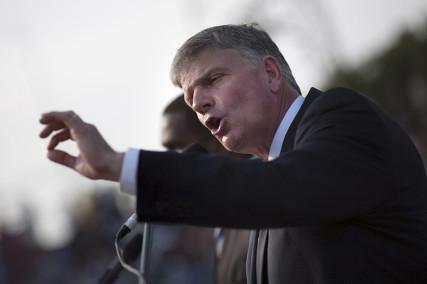
Franklin Graham Starts Cross-Country Rallies: ‘America Needs the Christian Vote’

Franklin Graham
Franklin Graham, son of evangelist Billy Graham, addresses the crowd at the Festival of Hope in Haiti, on Jan. 9, 2011. Photo courtesy of REUTERS/Allison Shelley
Evangelist Franklin Graham kicked off a “Decision America Tour” on Tuesday in Des Moines, Iowa, urging evangelical Christians to pray about the upcoming election and vote for candidates of any party who agree with their biblical values.
“Our moral walls and gates are down,” said Graham, standing before 2,600 people at the state’s gold-domed Capitol. “Any type of wicked thought and activity can come and go and our educators and our politicians and our churches seem many times to be more concerned about political correctness than God’s truth and his righteousness.”
Graham said that praying and voting Christians are needed to address the troubles facing the country. But, two weeks after he announced his departure from the Republican Party, he said no one party has the answer.
“I have no hope in the Democratic Party,” said the president of the Billy Graham Evangelistic Association. “Listen to me: I have zero hope in the Republican Party. I have no hope in Tea Party or any other party. My only hope is in almighty God and his son Jesus Christ.”
The crowd, bundled up in warm coats and knit hats with some holding small American flags, cheered.
Saying “America needs the Christian vote,” Graham proposed next steps after the rally, which he intends to replicate across the country from Jan. 12 in Tallahassee, Fla., to March 31 in Sacramento, Calif. Some prayer rallies are still in the planning stages.
The tour’s website includes a three-point pledge for people to commit to pray, vote, and consider running for office.
Noting the millions of evangelicals who stayed home during the 2012 election, Graham asked ralliers to make sure their relatives — including nieces and nephews — were registered to vote and to form groups to pray for their communities.

Evangelist Franklin Graham quits the Republican Party over Planned Parenthood funding

(RNS) Evangelist Franklin Graham has announced he is abandoning the Republican Party in disgust over the move by the GOP-led Congress last week to pass a budget that Graham said was “wasteful” and provided funding for Planned Parenthood, which he compared to the Nazis.
Graham has previously said he has no faith in any political party, but his apparent renunciation of his Republican affiliation is an indication of anger on the right and the strong interest many disaffected evangelicals have shown in populist outsiders like Donald Trump.
Graham himself has expressed admiration for Trump, the surprise frontrunner in the Republican presidential field, and has voiced support for some of Trump’s more controversial positions — such as his call to ban Muslims from the U.S. — which have drawn condemnation from more mainstream evangelical leaders.
[Why Franklin Graham says Donald Trump is right about stopping Muslim immigration]
The federal government provides $528 million in funding for Planned Parenthood — about 40 percent of the organization’s annual budget — primarily through payments to Medicaid for health services for low-income Americans. Federal law prohibits funding of most abortions and Planned Parenthood separates federal taxpayer dollars from those used to provide abortions.
Social conservatives have long fought to strip taxpayer funding from Planned Parenthood, and, after the release of a series of undercover videos by anti-abortion activists earlier this year, those calls ramped up to a fever pitch.
Activists said the undercover videos show Planned Parenthood officials negotiating the sale of fetal organs — which they called “baby parts” — for profit to medical researchers; making money off such organs or tissue could be illegal and unethical. Planned Parenthood denied that it was profiting from the sale and said it was quitting the practice.
In the wake of that white-hot controversy, there was wide expectation that with Republicans in control of both the House and Senate Congress would eliminate funding for 2016. Some conservatives in the GOP threatened to shutdown the government if that wasn’t done.

But the shooting massacre at a Colorado Springs Planned Parenthood clinic late last month by a lone gunman, Robert Lewis Dear, who proclaimed himself “a warrior for the babies,” seemed to change the calculus and congressional leaders last week reached a deal that averted a shutdown and funds the government through September of next year.
[Opinion: A conservative theologian explains why he disagrees with Jerry Falwell Jr. on Christians and guns]
The deal also funds Planned Parenthood at previous levels — a development that has enraged many on the religious right, including Graham, son of the renowned evangelist Billy Graham.
“This is an example of why I have resigned from the Republican Party and declared myself Independent. I have no hope in the Republican Party, the Democratic Party, or Tea Party to do what is best for America,” the younger Graham declared on Facebook on Monday.
“Seeing and hearing Planned Parenthood talk nonchalantly about selling baby parts from aborted fetuses with utter disregard for human life is reminiscent of Joseph Mengele and the Nazi concentration camps!” Graham wrote. “That should’ve been all that was needed to turn off the faucet for their funding.”
Graham drew immediate support on social media but how much sway he carries with voters is debatable.
Billy Graham, who is 97, infirm and largely incommunicado, over the years came to rue his involvement with politics, saying it drew the focus from his evangelism.
But his son has not been hesitant to offer his opinion of politicians and in particular hot-button electoral issues of interest to social conservatives. In fact, in denouncing the Republican Party this week, Graham made a pitch for the prayer rallies he will hold in every state next year, starting in Iowa in January shortly before the crucial first presidential primary.
The rallies, as Graham says, aim to “challenge Christians to live out their faith at home, in public and at the ballot box.”
Graham has said that if more evangelical voters turn out it could prove the difference in national and local elections, a point also made by Republican candidates.
(David Gibson is a national correspondent for RNS)

02 March 2012

Black Evangelicals, White Evangelicals, and Franklin Graham's Repentance 1MAR12 & A GIRL'S MESSAGE TO ALL CHRISTIANS (VIDEO) & Franklin Graham apologizes for questioning Obama’s faith 28MAR12

HERE is a great article on the different perceptions of Christianity by Christians from Sojourners, followed by a beautiful video on this same issue.....

Get a free trial issue of Sojourners Get a free issue of Sojourners
Donate to Support Sojourners
Donate to support
Sojourners
When Franklin Graham expressed doubts about President Obama’s Christian faith during an interview on Morning Joe last week, it reminded me of an uncomfortable dinner I had in the late ‘90s.
I sat down for a pleasant meal in the home of two great friends — one of them a white evangelical faith leader deeply committed to social justice. Well into the evening’s conversation — when we’d dropped all our pretenses and our exchanges moved well past mealtime niceties — one friend asked me something that caught me entirely off guard.
“Do you think Martin Luther King, Jr. was a Christian?” he said.
I was dumbstruck. I had never heard anyone actually ask that question before.
“Yes,” I replied. “What would make you doubt that?”
As he explained, it became clear: My friend wasn’t sure whether Dr. King was a Christian because King’s Christianity didn’t look like my friend’s Christianity.
Dr. King valued justice. My friend valued justice.
King professed personal faith in Jesus. My friend professed personal faith in Jesus.
And yet my friend still was hung up about King’s faith because, to his eye, King didn’t seem interested in “evangelism” as my friend defined it — i.e. the practice of calling sinners into personal relationship with God through faith in Jesus Christ, whose death on the cross is payment for our sins.
Twentieth-century white evangelical understanding of the Gospel guided (and in many ways defined) my friend’s Christian walk. Therein lies the disconnect between his Christian faith and Dr. King’s.
According to sociologists Michael Emerson and Christian Smith (authors of Divided by Faith: Evangelical Religion and the Problem of Race in America), only one thing separates white and black evangelicals, but it makes all the difference in the world: Vastly different experiences of structural and systemic oppression.
Black evangelicals have a long history of interaction with oppressive systems and structures. When African Americans read the Bible, they see the more than 2,000 passages of scripture about God’s hatred for poverty and oppression. They see God’s desire for systems and structures to be blessings to all of humanity — not a curse to some and a blessing for others.
And they see Jesus’ own declaration that he had come to preach good news to the poor, which, by the way, is decidedly not a reference to the “spiritually impoverished.” Jesus meant that he had come to preach good news (of liberation, freedom, and new life) to people trapped in material poverty.
White evangelicals generally do not experience such systemic oppression. According to Emerson and Smith, most white evangelicals don’t prioritize or even see the thousands of references in the Hebrew Scriptures and New Testament about structural and systemic injustice.
Accordingly, the Gospel — and by extension their evangelism — is about only one thing: Personal salvation through faith in Jesus Christ, who died for their sins, and a personal relationship with him.
Black evangelicals also have personal faith that Jesus’ death paid for their sins, but their Gospel doesn’t end with personal (and individual) salvation. For Dr. King and Sojourner Truth and Fannie Lou Hamer and the Rev. John Perkins and Nelson Mandela and for hundreds of thousands of Black Christians around the world and for me, the good news of the Gospel is that Jesus’ life, death, and resurrection were for the redemption of both individual souls and the redemption of whole societies.
Franklin Graham’s father, Dr. Billy Graham, didn’t always understand this, either. The elder Graham’s revivals began as segregated affairs, but the Supreme Court’s desegregation ruling in Brown v. Board of Education of Topeka (1954) agitated his conscience and he quickly course corrected. From that point on, Billy Graham never again held a segregated revival.
What’s more, in 1957 Dr. Graham invited Dr. King, to share his pulpit for a 16-week revival in New York City.
For Billy Graham, Martin King was a Christian.
In the last decade or so, a new generation of white evangelicals — such as my friends Shane Claiborne, Kelly Moltzen, Josh Harper, and others — have intentionally displaced themselves, moving into impoverished communities of color in order to gain the experience their parents and grandparents lacked. As a result, their white evangelical eyes are open.
They see those 2,000 scriptures about poverty and injustice. And this new generation of white evangelicals is committed to fight systemic and structural justice because of the Gospel.
So, it grieved me to hear Franklin Graham’s doubt-filled commentary on President Obama’s faith.
Obama has described in his own words (and quite publicly) how he has a personal relationship with Jesus Christ, how as a young community organizer in Chicago in the late ‘80s he walked down the aisle of a church during an altar call to make a public profession of that faith — a practice developed by one of the greatest American evangelists of all time, Charles Finney.
The president has clearly professed his belief that Jesus died on the cross as payment for his sins. And Obama repeatedly invokes the words of Jesus that guide his world view: “Just as you did to the least of these, you did to me.” (Matthew 25:40)
For a moment, Franklin Graham’s cynicism tested my own faith. I wondered if he had any idea that, when he questioned the president’s faith, it felt as if he were questioning my faith.
I wanted to know if the transformational power of Jesus’ death and resurrection, which is powerful enough to save our souls also could open Franklin’s eyes and soften his heart to the world and experience of his black brothers and sisters.
Repentance is sweet, not only for the sinner, but also for the world. It reminds us all of what is right; what is good; what is true. Franklin Graham apologized for his comments and repented this week.
This public discussion is now a lesson for us all. I have an abiding hope that, just maybe, the power of Jesus’ resurrection is powerful enough even to save the church.
Lisa Sharon Harper is the Director of Mobilizing at Sojourners. She is also co-author of Left, Right and Christ: Evangelical Faith in Politics and author of Evangelical Does Not Equal Republican ... or Democrat.
A Girl's Message To All Christians:

Hey there! I'm Emanuella. I'm a Christian. I have been a "good" Christian most of my life. It was my identity. I used to like to tell people how "good" I was, how I kept all the Commandments. I thought that was "Good"......

Then I realized something...I Failed!!! "Christian" was just a name I wore...kind of like a pretty coat over a dirty body...It didn't match my heart. Here's why:

If you were an Atheist or Agnostic or anything else...And if you didn't agree with me...I would disdain you as a person. I feel like a hypocrite! I feel disgusting! And I can't take it anymore! I wasn't interested in being your "Friend". I just wanted to change you. I thought that was my job.

Christianity is about being like "Christ". Jesus loved everyone, First. If they didn't accept what He said, He still loved them. Its not my job to change you, I can't. But its my job to love you. That I can.

So this is an appeal to my Christian Brothers and Sisters, not all but some... stop the Damnation. Stop the Judgement. Stop the Religism. Thats not our business.

It doesn't matter how well you can preach...How many Bible Verses you've memorized or How many people "think" you are all that. If you don't have love, you're nothing. Love is not a chore. Its a revelation. The Christ you serve revealed it in its purest form.

Gandhi said: "I like your Christ, but I do not like your Christians."

Don't be one of "those". This is an invitation....
Start the LOVE...Join the movement...

Franklin Graham apologizes for questioning Obama’s faith

07 October 2010

Rev. Franklin Graham says churches and synagogues are forbidden in most Muslim countries 3OKT10

On ABC's This Week on Oct. 3, 2010, host Christiane Amanpour held a town hall debate on whether Americans should fear Islam.

Naturally, the issue of the so-called Ground Zero mosque came up.

Amanpour asked the Rev. Franklin Graham, son of evangelist Billy Graham, about his comments following 9-11 that Islam is a "very evil and very wicked" religion.

"I understand what the Muslims want to do in America," said Graham, president of both the Billy Graham Evangelistic Association (BGEA) and the international Christian relief organization Samaritan's Purse. "They want to build as many mosques and cultural centers as they possibly can so they can convert as many Americans as they can to Islam. I understand that...I understand what they're doing. And I just don't have the freedom to do this in most Muslim countries. We can't have a church. We're not able to build synagogues. It's forbidden."

Imam Osama Bahloul, leader of the Islamic Center of Murfreesboro, Tenn., and a panelist on the show, said Graham was incorrect.

"For someone to say we are not allowed to build a church in a Muslim country, this is absolutely not right. You can Google this," Bahloul said.

We spoke to several experts on religion and government in Muslim countries. And the consensus was clear: there are, in fact, Christian churches and/or synagogues in almost every Muslim country.

"Reverend Graham is wrong," said Yvonne Haddad, Professor of History of Islam and Christian-Muslim Relations at Georgetown University. "Churches are flourishing in Jordan and Syria. In Egypt, the Christians find restrictions on church construction which has recently been partially lifted."

  Ibrahim Hooper, a spokesman for the Council on American-Islamic relations, agreed that Graham was incorrect. "There are lots of Christian churches and synagogues in Egypt, Lebanon, Syria, Iraq, Iran, Turkey, Jordan, Indonesia, Qatar, Kuwait ... If you go to any number of so-called Muslim countries you will see thriving Christian and Jewish populations."

One member of the Iranian parliament is Jewish, Hooper noted.

"The only one where you don't see it, where you can't have a Christian church or synagogue is Saudi Arabia," Hooper said. "It's only an issue in Saudi Arabia."

The cities of Mecca and Medina in Saudi Arabia are considered the two holiest cities in Islam, explained Akbar S. Ahmed, chair of Islamic Studies at American University. And so, he said, no churches or synagogues are allowed there.

"That is like the Vatican in terms of Catholicism," Ahmed said.

But where he grew up in Pakistan, for example, Ahmed said, there is a huge Christian church. While there are now very few Christians left there, the building is deserted but remains untouched. After 1948, he said, most Jewish people living in Muslim countries migrated to Israel. But there are still many churches in Muslim countries, as well as synagogues. One of the top advisers to the king of Morocco is Jewish, he said.

There may be periods of turmoil, or some narrow-minded leaders who have attacked churches over the years, Ahmed said, but there is nothing formalized in Islamic law that forbids the building of churches or synagogues.

"Today, because of the general atmosphere in the air, there are many untruths being spread about Islam," Ahmed said.

While the facts about whether most Muslim countries allow churches or synagogues is pretty cut-and-dried, there is another facet to this claim. Graham was speaking in the context of Muslims building mosques in order to convert people to Islam in the United States. And so we think it's fair to also look at whether it's possible to build a church or synagogue in most Muslim countries with the aim of converting people. And on that point, Graham is on firmer ground.

According to a 2007 Council on Foreign Relations "backgrounder" on religious conversion and sharia law, authored by Lionel Beehner, "Conversion by Muslims to other faiths is forbidden under most interpretations of sharia and converts are considered apostates...Some Muslim clerics equate this apostasy to treason, a crime punishable by death."

According to the report, while a vast majority of Muslim countries no longer prescribe death for apostates (instead opting for some lesser form of punishment), "some states, including Iran and Saudi Arabia, still do hand out death sentences."

Shireen Hunter, visiting professor at Georgetown University School of Foreign Service, said that Graham "cannot be more wrong," about there being a prohibition against churches or synagogues in most Muslim countries.

But, she said, "conversion is a totally different thing."

There is a great deal of debate in the Muslim community about Islamic law regarding conversions. Some argue Islam teaches there is no compulsion to faith. And while enforcement of religious laws against conversion is more aggressively applied by some Muslim countries than others, "this is an issue that is there."

In many countries in the Middle East, religion dictates your legal status as well, explained Nathan Brown, an expert on Islamic law at the Carnegie Endowment for International Peace. While legal enforcement of bans against conversions from Islam are rare in most Muslim countries, "conversions are practically difficult," he said.

We think a Catholic church recently built in Qatar is a good example of how this is handled.

According to a March 2007 Al Jazeera story about the construction of a Catholic church: "Although the country's native inhabitants are entirely Muslim -- and are prohibited by law from converting to another faith -- the new Catholic church will cater to the large number of Christian migrants who have come to the Arabia Gulf state in search of work."

Archbishop Paul Hinder, the Catholic Church's Bishop of Arabia, explained in the story that he oversees churches in Qatar, UAE, Bahrain, Oman, Yemen and even in Saudi Arabia, "the birthplace of Islam, where Christianity is practiced behind closed doors." On the Christian communities in Saudi Arabia, Hinder clarified: "It's not an open church. Privately the Christians may gather in their houses in a very discreet manner."

We think Graham erred when he said that in most Muslim countries, "We can't have a church. We're not able to build synagogues. It's forbidden." That's demonstrably false. The construction of churches is not forbidden in most Muslim countries, only Saudi Arabia. And so, on balance, we rate Graham's comment False.

08 September 2010

Religious leaders reaching out to pastor who aims to burn Korans on Sept. 11 8SEP10

By Michelle Boorstein
Washington Post Staff Writer
Wednesday, September 8, 2010; 6:40 PM


Geoff Tunnicliffe heads of one of the world's largest faith organizations -- the World Evangelical Alliance -- but on Wednesday morning when he reached the Florida pastor planning to burn the Koran on Sept. 11, "I felt like a deer in the headlights."
For weeks, Tunnicliffe had remained silent about the intention of the tiny Gainesville church to publicly torch Islam's holy book, not wanting to lend legitimacy to the Dove World Outreach Center or its controversial pastor, Terry Jones. But after hearing from Pentecostal leaders around the globe about their fears that the scripture-burning could spark sectarian violence, he decided he needed to appeal to Jones as a fellow Christian.
Tunnicliffe is among the religious leaders who have tried to reach out to Jones in recent days and persuade him to abandon his plans, which have been condemned by everyone from Secretary of State Hillary Rodham Clinton to Gen. David H. Petraeus to conservative commentator Glenn Beck to actress Angelina Jolie. Even Franklin Graham, son of famed evangelist Billy Graham and an outspoken critic of Islam, tried twice without a success to reach Jones on Wednesday to express his disapproval of defacing or destroying the sacred texts or writings of other religions, a spokesman said.
During a 10-minute cellphone conversation, Tunnicliffe described himself as "pleading" with the man whose plans have already sparked angry protests in Jakarta and Kabul and that some fear could put the lives of U.S. troops in Muslim countries at risk.
"I tried to talk about the impact this would have on his own stated goals of taking the gospel to the world," said Tunnicliffe, whose group represents hundreds of millions of evangelicals, including those who live in Muslim countries.
He told Jones that Christian leaders and missionaries around the world were opposed to the burning and asked, "What are you hearing from God that these people aren't hearing?" He asked how Jones would feel if the event led to the death of a pastor or the destruction of a church in another part of the world?
Jones listened, but remained noncommittal. "He said they might not change their minds, but that they were praying about it," Tunnicliffe said.
At the end of the phone call, Tunnicliffe prayed for Jones.
"Here's the reality: That video will never go away," Tunnicliffe said. "It will be so detrimental to our work with religious liberty around the world. Everywhere I go around the world I will have to address this for years to come."
He and others described their lobbying efforts this week as delicate and strange. Jones doesn't belong to a religious denomination and doesn't appear to know fellow pastors in his town.
Some religious leaders said that they feared Jones wouldn't listen to strangers or that they didn't want to fuel something they hoped would go away. Others said the lack of more action by evangelical leaders reflects a distant and sometimes tense relationship with Muslims and the fact that many in that community are skeptical about Islam.
"People don't speak out the way they should, because they don't have personal relationships," said Richard Cizik, a former longtime lobbyist for the National Association of Evangelicals, the U.S. branch of the World Evangelical Alliance. He noted that an NAE poll of evangelical leaders in 2008 found none who said they had a good friend who was Muslim.
Nevertheless, NAE President Leith Anderson issued a statement Wednesday asking Muslims not to judge "all Christians by the behavior of one extremist. One person with 30 silent followers does not speak for 300 million Americans who will never burn a Koran."
Christian leaders from other denominations echoed those sentiments on Wednesday, saying that there was no support in their communities for Jones. The question was how to reach the former hotel manager who sells furniture on eBay to make extra money.
Richard Land, president of the Southern Baptist Convention's Ethics and Religious Liberty Commission, said he decided not to approach Jones because he believes the pastor would disapprove of Land's advocacy for the rights of religious minorities and his general engagement with pluralism.
"If I know my boy, he thinks we're apostate liberals anyway," Land said. "My guess is my call would be counterproductive. My calling him would just encourage him to do it."
City commissioners and the mayor of Gainesville have called Jones, as have local clergy, including the Rev. Dan Johnson of the 4,000-member Trinity United Methodist Church, the closest house of worship to the Dove center. Johnson tried several times to make appointments with Jones without success before the Dove pastor called Johnson "yellow-bellied" in a local paper, said Troy Holloway, Trinity's director of stewardship development.
Tunnicliffe said he had offered to come to Florida on Friday to speak with Jones's church and was planning to deliver a letter to the congregation and run an advertisement in the Gainesville newspaper.
Asked if evangelicals leaders -- including himself -- had delayed trying to stop the Koran-burning because many Christians feel anxious about the spread of Islam, he said he didn't believe that was the case.
"They may have some concerns, but you'd only find the very fringe that would have any support for this, even among the most conservative," Tunnicliffe said. "I think there would be a strong consensus that this kind of approach is absolutely not acceptable and not biblical."