NORTON META TAG

Showing posts with label rural Pennsylvania. Show all posts

15 July 2018

Pennsylvania Republican to anti-gay cult: '98 percent of what you believe in, I believe in' & The cultlike church behind a ceremony with AR-15s and bullet crowns, explained 11JUL&1MAR18

Composite of Pennsylvania Republican Scott Wagner (on left) and cult leader Hyung Jin Moon
VOLUNTARY IGNORANCE, hatred, bigotry, name-your-ophobia, cults, apostate religion, and guns. More and more this is the face of rural Pennsylvania which is not the rural Pennsylvania I grew up in. These things existed when I was a kid in PA, but the practitioners were generally not accepted by society at large and were often publicly challenged and condemned. Many people had long guns for hunting and competitive shooting, many had pistols, the police and PA National Guard had the military assault weapons. Politicians did not seek the endorsements of these extremist, these living on the fringe of society. How things have changed, and this is why scott wagner and too many other Pennsylvania republicans seek out the voluntarily  ignorant, the hate groups, bigots, homophobes, islamophobes, misogynist, sexist, cultist, religious apostates (right wing religious hypocritical fanatics) and gun owner extremist. It is no wonder the drumpf/trump-pence administration is in power. REMEMBER, THE MIDTERM ELECTIONS ARE ON TUESDAY, 6 NOV 18. VOTE, BECAUSE THE FUTURE OF OUR NATION WILL BE DETERMINED BY THE RESULTS.  GO TO ROCK THE VOTE or VOTE.ORG to make sure you are registered to vote or to register to vote as well as information about voting in your state. GO TO Ballotpedia for information on candidates for office and ballot issues in your state. From Daily Kos and Vox.....
Pennsylvania Republican to anti-gaycult: '98 percent of what you believe in, I believe in'


State Sen. Scott Wagner, the Republican nominee in Pennsylvania’s race for governor this fall, has suddenly found himself busy trying to disavow a local cult leader who gave the invocation at a campaign event over the weekend. But Wagner's efforts to squirm away from Hyung Jin Moon, whom the Pittsburgh Tribune-Review has described as "the 'second king' of an assault rifle-wielding Christian sect headquartered in Eastern Pennsylvania," are gonna require some extra Vaseline: The dedicated trackers at American Bridge captured audio of Wagner at the gathering telling a Moon acolyte (who made his affiliation crystal clear), "Ninety-eight percent of what you believe in, I believe in."
And what does Moon’s cult believe in? We actually know because, amazingly enough, this isn't the first time Moon has come up during this race. Back in January, Wagner's GOP primary opponent, Paul Mango, appeared on Moon's radio show and received intense criticism for doing so. During that interview, Mango nodded along as Moon declared that public school students are "getting indoctrinated into the homosexual political agenda—they're getting indoctrinated in the transgender agenda." Among those who slammed Mango at the time? Scott Wagner.
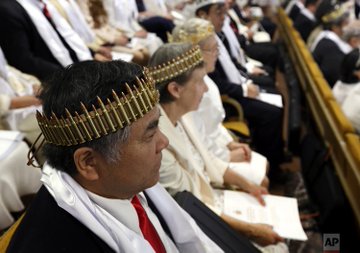
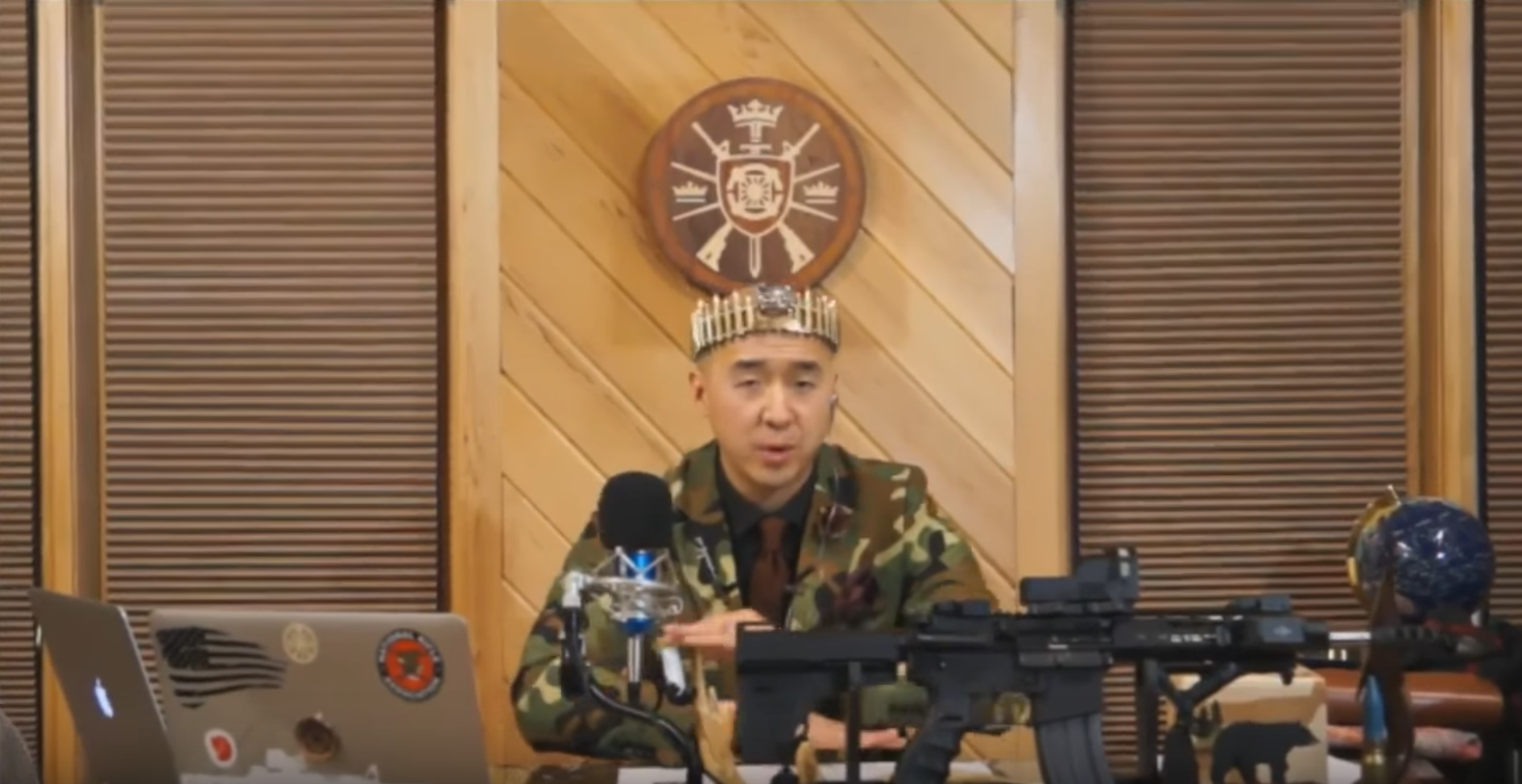
Wagner's campaign claims that it had no idea Moon would be attending the meet-and-greet, but the event took place at a gun shop owned by none other than Moon's brother. And we know Moon loooves guns: In video of Mango's interview with Moon, a heavy-duty AR-15 sat propped in front of the host, who also wore a crown that appeared to be made out of bullets. (Not kidding.) It shouldn't be that hard to notassociate with gun-worshipping anti-gay cults and tell them you agree with what they say, but apparently, for Pennsylvania Republicans, it is.

The cultlike church behind a ceremony with AR-15s and bullet crowns, explained

A nearby elementary school had to be shut down for safety.


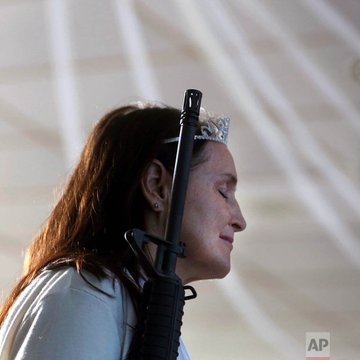
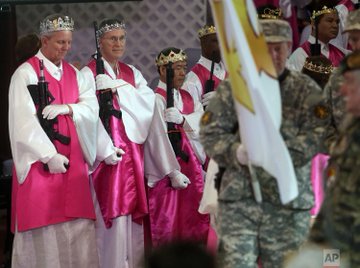
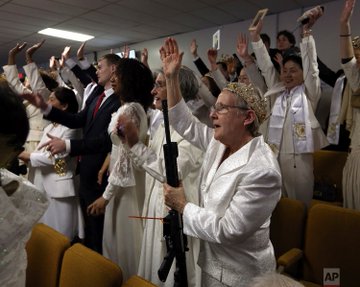
Controversial Rev. Sean Moon encouraged couples to bring AR-15 rifles to worship as part of a commitment ceremony.
 Spencer Platt/Getty Images
Map of Pennsylvania, with county borders indicated. A red dot in the upper right-hand corner is labeled "Newfoundland, Pennsylvania."
Newfoundland
Newfoundland's Location within Pennsylvania.
As the debate over gun control raged across America in the wake of last month’s school shooting in Florida, a group of worshippers wearing bullet crowns and toting AR-15 rifles gathered in a Pennsylvania church this week to hold a “commitment ceremony” for about 250 couples.
The ceremony was held at the World Peace and Unification Sanctuary in Newfoundland, Pennsylvania. The weapons, which Reuters reported were unloaded, were meant to represent the biblical “rod of iron” referenced in the Book of Revelation, used by God’s representative to dominate his enemies.
As the nearby Wallenpaupack Area School District moved its students to another school over concerns about the armed celebrants, church leaders argued for the power of guns to do God’s will — and protect the innocent. “Each of us is called to use the power of the ‘rod of iron’ not to arm or oppress as has been done in satanic kingdoms of this world, but to protect God’s children,” said the church leader, Rev. Hyung Jin “Sean” Moon, in a statement. “If the football coach who rushed into the building to defend students from the shooter with his own body had been allowed to carry a firearm, many lives, including his own, could have been saved.”
While the ceremony itself had been planned long before the February 14 shooting in Parkland, Florida, in which a man with an AR-15 rifle killed 17 students and staff members, participants in the blessing nevertheless celebrated the power of guns to stop potential future shootings.
The ceremony, which was held by an offshoot of a controversial Christian group that critics call a cult, seemed to perfectly encapsulate the anxieties of the current political climate: a conflation of pro-Trump and Christian nationalist rhetoric, fervently pro-gun sentiments, and multibillion-dollar business interests in the arms trade.

The Unification Church has a controversial history

Now there’s Sean Moon’s World Peace and Unification Sanctuary, but the story begins in Korea with the Moon family, which has run spiritual organizations since 1954. The family has been deeply controversial in religious circles, and its organizations have often been denounced by Christians and secular critics alike as “cults.”
Sun Myung Moon, Sean’s father, came to widespread prominence in America in the 1970s with his Unification Church, an ostensibly Christian organization that reveres both the traditional Bible and the Moon-authored Divine Principle as sacred texts. His teachings stress that true enlightenment, like that achieved by Jesus, can be achieved in part through marriage (often arranged) to other church members.
The elder Moon’s Unification Church — which worshipped Moon as a messianic figure — became popular in America. By 1976, the elder Moon was preaching to estimated crowds of 25,000 or more at a series of rallies across the country. Moon’s followers, who were often derogatorily referred to in the media as “Moonies,” became known for their public mass weddings for thousands of couples, who were often total strangers.
The church became extraordinary financially successful, bringing in millions of dollars a year from the US and abroad, a venture Moon ultimately parlayed into a series of successful businesses including a cable TV network, a shipbuilding studio, and a seafood empire. That cash was often used to fund political lobbying, including advocating for Korean unification and pro-South Korean causes and foreign policy. Today, Moon’s business empire is known as the Tongil Group, a multibillion-dollar conglomerate that supports Unification Church goals.
The connection between Moon’s religious and financial activities bordered, at times, on the illegal. Moon served 11 months in prison during the 1980s for income tax evasion, and a 1976 investigation found links between the church and the Korean military intelligence apparatus, suggesting that the church may have been, at least in part, a tool for Korean government interests.
The Unification Church also became closely involved with right-wing and GOP party politics. As Mariah Blake wrote in 2013 for the New Republic, Moon amassed “extraordinary political influence, building a vast network of powerful right-wing organizations and forging alliances with every Republican presidential administration since Ronald Reagan’s.” As late as 2004, Republican lawmakers were attending Unification Church ceremonies in which Moon was ceremonially “crowned.”
Sean Moon’s church is not part of the Unification Church proper, but is a splinter of his father’s organization (after Moon died in 2012, rivalries between his children have resulted in them largely operating independently of one another). But the Moon family more broadly has, in recent years, made pro-gun rhetoric a major part of their religious and financial activities. Among the Tongil Group’s holdings is Kahr Arms: a small-arms company founded by another of Moon’s sons, Justin Moon.
The company has long received attention from politically connected public figures. In 2016, Eric Trump attended the opening of one Tongil-affiliated gun store, as Blake pointed out on Twitter Wednesday:
This week’s ceremony is firmly tied into the political arena: its liturgy and celebration capturing a quintessentially American blend of Christian nationalism and corporate pro-gun sponsorship. A few days prior to Wednesday’s ceremony, Sean Moon’s church hosted a pro-gun rights “Thank You Trump” dinner. The dinner’s sponsor? Kahr Arms.

The Moons reveal a broader alliance between faith and finance in American political culture

Despite the Moon family’s controversial religious beliefs, they’re nevertheless financially and, to an extent, structurally part of the American political fabric. Their business and political interests, which include promoting gun ownership, align neatly with the religious rhetoric they espouse. Their Bible-inflected fetishization of guns may differ in degree from the pro-gun rhetoric found across the religious right, but it — and the Moon’s family churches more widely — does not differ in kind.
And many of the techniques that the Unification Church used to proliferate in America — such as the focus on worshipping in fragmented “home churches” outside of the aegis of an official church organization or building — have been embraced by the mainstream evangelical community.
The Unification Church and its offshoots are, of course, hardly representative of the religious right as a whole; it’s debatable whether we should consider them “Christian” at all.
But the intensity with which its members have embraced guns as a deeply religious weapon, an instrument of divine protection, should tell us something about gun culture in America more widely. Sean Moon is tapping into an existing truth of gun culture: that they have become fetishized and imbued with a wider cultural ritualistic significance.
Not everyone may literally worship guns, but — for the 77 percent of white evangelicals who feel safer with a gun around, a percentage unmatched by any other religious group — it’s worth investigating how close gun ownership and religious identity really are.

31 August 2016

UPDATE 31AUG16

I have been off line for 2 months as I have been caring for my parents, providing a home for them and taking care of their health issues. But now the are actually home, back in the house we built as a family in 1969-1970, in Scandia, Pennsylvania. My retired brother and sister-in-law have moved in with them and will take care of them until they die.  Mom and dad are so happy to be home with their family still in the area, their Church and friends, and to be in the wilds of Northwestern Pennsylvania. They wanted to be home to die, and we are all praying that will not be for a long, long time.......

04 September 2014

Pittsburgh Health Care Giants Take Fight To Each Other's Turf & UPMC and Highmark, A Confusing Truce 19AUG & 1JUL14

UPMC and Highmark may have resolved their differences in Pittsburgh but there is a health care crisis in the works in rural NW Pennsylvania. Warren General Hospital in Warren, PA is now affiliated with UPMC, and as of 1 JAN 15 if you aren't in the UPMC health care network your doctor can't treat you at Warren Gen Hospital. Private practice doctors not part of the UPMC system are barred from treating their patients at Warren Gen Hospital as of the new year. Many people, working and retired, have Highmark BCBS health insurance and will have to travel to Corry, PA (30 miles from Warren) or Jamestown, NY (20 miles) or Erie, PA (66 miles) for in hospital and out patient treatment. While the distances may not seem like much (the distances are from Warren, for many the distance will be more as Warren County is very rural), they are when many of these people are elderly and in poor health with extremely limited means of transportation. And nobody really wants to travel any farther than what should be necessary when they are sick. 
For 114 years Warren General Hospital has been able to treat everyone in need. Patients could be admitted to the hospital and treated by their own doctor as long as they were accredited by the hospital, no matter what health care insurance one had. Now, corporate greed is forcing people out of their community hospital, and both those in need of hospital care and out patient hospital services and Warren General Hospital will suffer the consequences. The history of Warren General starts as an act of pure Christian charity with the founding of the Door of Hope in 1895, operated by the Society of Christian Workers and then with the chartering of the hospital (paid for by a local doctor) in 1898 with the hospital opening in 1900. The death of Warren General Hospital will probably happen in a few years as UPMC continues to reduce access to the facility, continues to loose patients to other area hospitals,  reduces staff and services (directing patients to Erie or Pittsburgh to maximize the profitability of those facilities) until it becomes a drain on their corporate profit margins and the lights are turned off and the doors locked. If a death certificate would be issued cause of death would be corporate greed. Warren has experienced a lot of loss over the past 50 years due to corporate greed, but to loose the hospital, so vital to a rural community and county, could be what finishes it off. This from +NPR stations +WAMU 88.5 and +90.5 WESA 
The headquarters for University of Pittsburgh Medical Center and Highmark Blue Cross/Blue Shield dominate the Pittsburgh skyline much as they organizations have dominated health care in the region for decades.
Jeff Brady/NPR
Pittsburgh's dominant health insurance company and its largest healthcare provider are, essentially, getting a divorce.
For decades, Highmark Blue Cross/Blue Shield and University of Pittsburgh Medical Center worked together. But as the line between insurance companies and health care providers across the country blurs, these longtime allies are venturing into each other's business and becoming competitors.
In the process, patients can get caught in the middle. Day-care worker Gail Jameson has Highmark insurance and she's been going to the same UPMC medical office for more than 20 years. "I could go in and just stop in if I needed to because it's close to my work," Jameson says. "I go past it every day."
She's about five years from retirement and was disappointed to learn her Highmark policy will no longer include UPMC providers. She has to find all new doctors through another health system that is unfamiliar to her.
The road to divorce began when insurer Highmark got into the hospital business. It bought the struggling West Penn Allegheny Health System, which was UPMC's main competitor.
"Highmark stepped in in order to ensure that there was competition in the marketplace and there would continue to be consumer choice," says Highmark President and CEO David Holmberg. In a town where UPMC controls more than 60 percent of the market, Holmberg says there needs to be healthier competition among providers.
YouTube Highmark's TV ad from 2013 encourages UPMC to sign a long-term service contract.
There's another reason an insurance company would decide to become a healthcare provider: the Affordable Care Act. It tells insurance companies what basic services to offer; who they must insure and even what percent of premiums can go to administrative expenses and profits. That takes away a lot of what insurance companies used to do, so they're looking for new reasons to exist.
"Insurers are trying to demonstrate that they bring value to the table and are doing more than just brokering a benefit ... and doing more than paying bills," says Gail Wilensky, senior fellow at Project HOPE.
Wilensky says some insurance companies are responding by building more efficient networks of high-quality providers. Highmark went a step beyond that and became a provider of health care itself.
UPMC responded by expanding its existing insurance business and refusing to sign a new long-term contract with Highmark, saying it could not both compete and work with Highmark.
YouTube UPMC's TV ad from 2013 explains why it can't sign a new long-term service contract with Highmark.
"We couldn't have a contract with them," says UPMC President and CEO Jeffrey Romoff, "Because they [Highmark] have the burden of keeping their provider side alive. So, for every one of their insurance subscribers they will want to steer them to go to their own providers."
The divorce of Highmark from UPMC is all but final now. An agreement between the two companies will expire on January 1, 2015. The state of Pennsylvania negotiated a transition agreement. It does things like ensure Highmark subscribers already in certain kinds of treatment at UPMC can continue receiving care.
Now the Pittsburgh health care landscape looks very different. "It went from one of the least competitive environments that you can imagine — a dominant insurer and a dominant health system joined at the hips with a long term contract," says Romoff, "To one without a long-term contract with, now, five choices."
In addition to the two new competitors, UPMC invited three large insurance companies into the Pittsburgh market: Cigna, Aetna and United Healthcare. "Competition is good," says Romoff, "It keeps us all on top of our game. It gives us incentive to not be fat and sloppy."
With competition come the marketing campaigns. UPMC is banking on its good reputation. Highmark will appeal to those concerned about price. "For some people their monthly premium and the cost of their health care may be more important than having access to everything," Holmberg says.
In Pittsburgh now people have a lot more choices — and decisions — to make when it comes to their health care. That's supposed to be a good thing. But for Jameson, who was satisfied with her Highmark-UPMC combination, the extra work is a pain. "I just don't like change. I shouldn't have to change," says Jameson.
It's not just patients dealing with change. Employers who buy insurance for their workers face difficult decisions too. With two insurance/provider networks that don't allow access to each other, Pittsburgh employers can be put in the position of, effectively, choosing which doctors treat their workers.
"Employers want to provide benefits that allow them to be competitive and attract and retain a productive work force," says Jessica Brooks, executive director of the Pittsburgh Business Group on Health. "They don't want to be in the business of making personal life decisions around who their employees can see and who they can't see," she says.
The Affordable Care Act aims to increase the quality and affordability of health care. Creating competitive marketplaces is part of the plan. It will be a few years before people in Pittsburgh and around the country know whether the changes happening now make those goals reality.

UPMC and Highmark, A Confusing Truce


Highmark and UPMC have finally come to terms, but aspects of the agreement may confuse many policy holders.
Credit Life Mental Health / Flickr
The announcement of a five-year consent decree brokered by state officials seems to be bringing a truce between Highmark and UPMC. What exactly will the agreement mean for policy holders? State Insurance Commissioner Michael Consedine highlights some of the major aspects of the decree to policyholders who may be experiencing some confusion with these “out of network” hospitals.
Some of UPMC’s most prominent hospitals are not in the network, included Magee Women’s Hospital. Commissioner Consedine says the largest issues surrounding the agreement are not which specialty hospitals will remain open in the network, but rather contingency of those already being treated by UPMC doctors, oncology care, and emergency services.
“Emergency service is a big one. You know, downtown Pittsburgh, you get to go to the nearest ER that you want to go to. There’s an emergency situation so we’re not putting patients in the position of making those choices in the midst of a medical crisis….from a patient perspective, you don’t have to make the choices to what ER may or may not be accessible, both at West Penn facilities and UPMC facilities.”
Commissioner Consedine also mentions the aspect of contingency of care the agreement mentions regarding those who are being treated by UPMC doctors. Those currently being treated by UPMC doctors will be able to continue care until treatment is complete.
“With three million people in Western Pennsylvania, there are three million hypotheticals that we could get with different conditions. We wrote for purposes this first step, the consent to creed, to be very broad, on continuity of care provisions.”
Hospitals such as Children’s Hospital of Pittsburgh and Western Psychiatric will still be accessible with Highmark insurance.

Corbett Creates Team to Facilitate UPMC-Highmark Dispute 3JUN14

Allegheny County Commits to Highmark Through 2015 15APR14

 UPMC, Highmark Testify at PA House Health Committee Hearing 18DEZ13

Bills Forcing Highmark and UPMC to Open Networks Introduced 3OKT13