NORTON META TAG

Showing posts with label budget reconciliation. Show all posts

13 June 2021

PLEASE SIGN BERNIE'S PETITION: tell President Biden and the Congress you support legislation that will address the needs of the American people even if a single Republican refuses to add their vote to these policies. 12JUN21


 THE gop / greed over people-republican party is waging class warfare against the 99% with their opposition of  all of the Biden-Harris administration's proposals on infrastructure, renewable energy, climate change, education, healthcare, economic stimulus, voting rights and criminal justice reform. Majorities of Americans support these proposals but sen mitch mcconnell frr* KY is reinstituting the obstructionism he imposed on the Obama administration culminating in denying Attorney General Merrick Garland Senate hearings and a vote on his Supreme Court nomination. He will do everything in his power to stop the Senate from voting on these proposals and has unleashed a dishonest, deceptive propaganda campaign against them. mcconnell is no different than the traitorous trash of the last administration and of his party that attacked American democracy on 6 JUN 21. They do not "govern" with the best interest of the American people and our nation in mind. They are committed to replacing our democratic Republic with an authoritarian theocratic oligarchy serving their 1% masters, the wall street-finance cabal and the military-industrial complex. PLEASE sign this petition supporting Sen Bernie Sanders' plans to fund Pres Biden's plans and proposals and to bring them to the Senate for a vote. And please take the time to e mail your representative and senators and tell them to support the Biden-Harris administration's and Sen Sanders' agenda (I did).

As we attempt to transform this country and address the long term crises facing working families in terms of decent paying jobs, health care, tax reform, education, child care, climate change, racial justice and immigration reform, do I believe that we will have 10 Republican votes in the Senate to overcome a filibuster and do what has to be done?

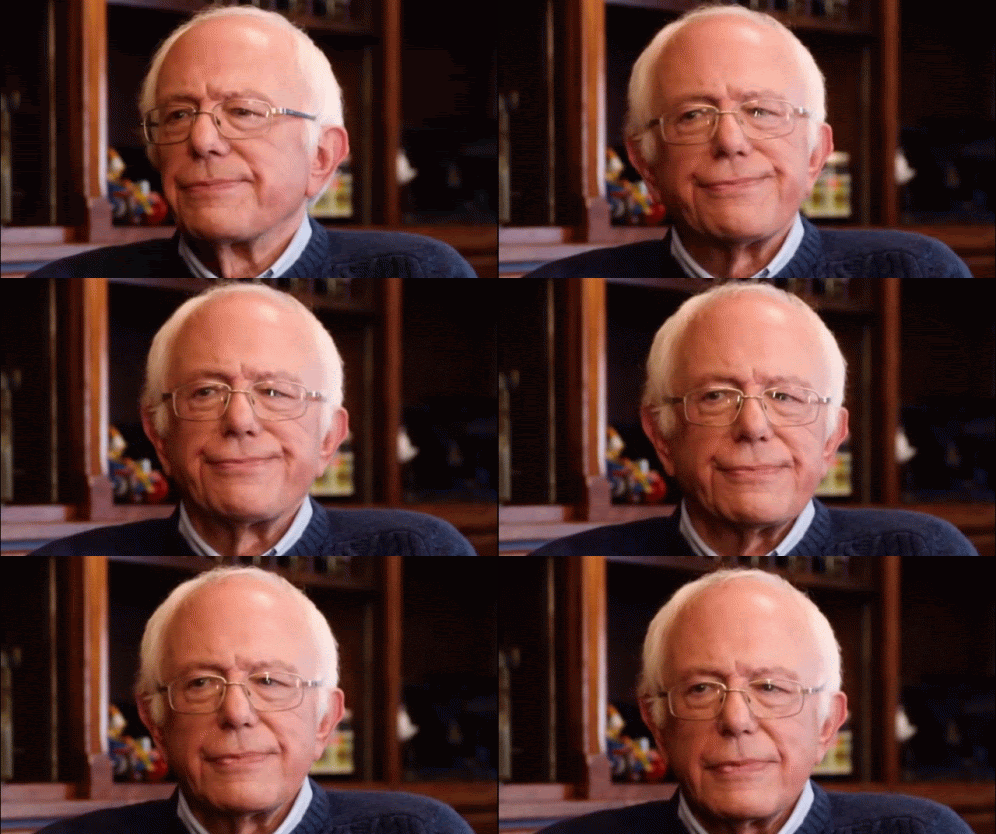
Bernie shaking head no

No. No, I do not.

Do I personally believe that Republicans are serious about doing anything significant that would impact their wealthy campaign contributors and help the working families of this country?

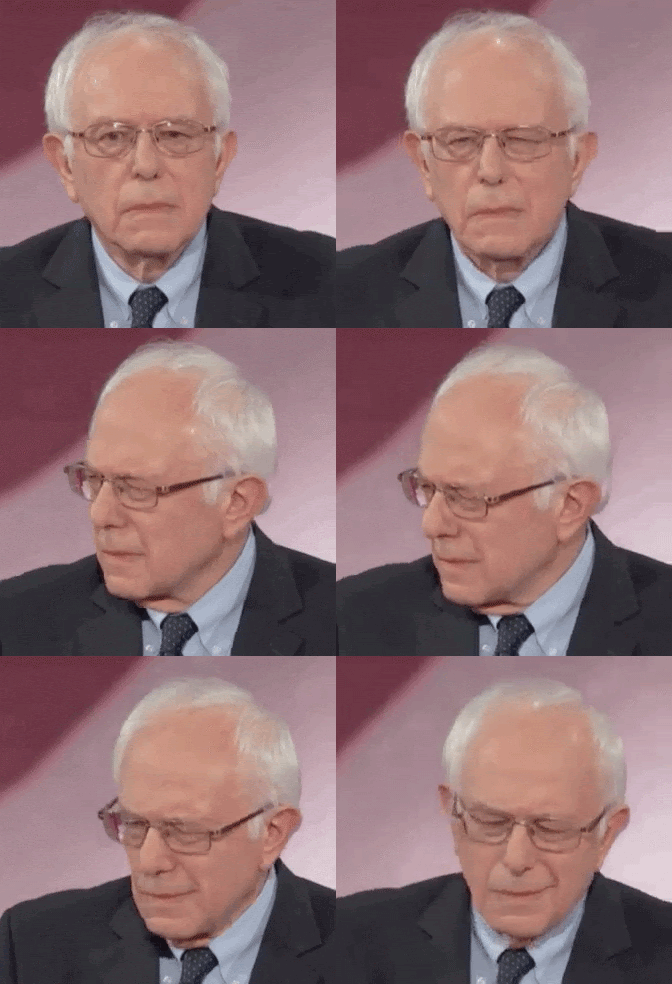
Bernie shaking head no

No. No, I do not.

Do I believe that we should take Senate Republican Leader Mitch McConnell at his word when he said that he would do everything possible to undermine President Biden's agenda?

Yes, I do.

It should be clear to everyone that, at this point, if Republicans do not want to cooperate in passing legislation to address the long-neglected needs of working class Americans, then we have to move forward without them. We did that with the all-important American Rescue Plan. We're going to have to do it again. While the Democratic margins are slim in both the House and the Senate, we do have majorities in both bodies. Let's use them.

If Republicans do not want to cooperate, then we have to move forward without them to create millions of good-paying jobs rebuilding our roads, bridges, water systems and railroads.

If Republicans do not want to cooperate, then we have to move forward without them to tackle the existential threat of climate change and transform our energy system away from fossil fuels.

If Republicans do not want to cooperate, then we have to move forward without them to build the millions of units of affordable housing that we desperately need.

If Republicans do not want to cooperate, then we have to move forward without them to lower the cost of prescription drugs and make health care a human right, not a privilege.

If we are going to pass a bold and progressive agenda through the Senate we must do it with 51 votes, instead of 60, by using the budget reconciliation process. And as Chairman of the Senate Budget Committee, that is exactly what I intend to do.

At a time when half of our people are living paycheck to paycheck and real, inflation-accounted-for wages have not gone up for workers in 48 years, the task at hand is not to please talk show pundits or to create a phony "bipartisanship" which accomplishes nothing. The time is NOW to address the needs of the American people, millions of whom are working two or three jobs just to put food on the table and a roof over their head.

The time has come for the United States Senate to stop representing wealthy, powerful and billionaire campaign contributors, and to start representing the working families of this country.

Now, Republicans will moan and groan if Democrats go forward without their support, but they appear to have very short memories.

Let us not forget that Republicans passed a $2 trillion tax cut for the wealthiest people of this country without a single Democratic vote.

They also tried to repeal the Affordable Care Act and take away health care from tens of millions of people in this country without a single Democratic vote as well.

So Democrats must use our majority in a different way — one that helps all Americans, not just the 1% and large, profitable corporations.

And the truth is, my colleagues need to hear from you that you agree. So I am asking:

Sign my petition: tell President Biden and the Congress you support legislation that will address the needs of the American people even if a single Republican refuses to add their vote to these policies.

In this moment, we have got to be bold in terms of jobs, health care, nutrition, education, racial justice, immigration, criminal justice reform, housing, climate change and many other important issues.

Will it be easy?

Of course it won’t be easy.

But we must mobilize people of all backgrounds and from all communities in order to get it done. Because in the history of our country, that is the only way change has ever happened.

In solidarity,

Bernie Sanders


Bernie is working hard in the Senate to pass an agenda that works for ALL of our people, not just those at the top. Today he is counting on you to say you are with him in that effort.

Sign Bernie's petition: tell President Biden and the Congress you support legislation that will address the needs of the American people even if a single Republican refuses to add their vote to these policies.

ADD YOUR NAME


09 April 2011

BOHICA!!!! Deal To Avert Government Shutdown Saves $38 Billion — Bush Tax Cut Deal Spent $150 Billion from THINKPROGRESS 9APR11

IF the gop and tea-baggers have accepted this deal then it is bad for the 98% of us who aren't rich.
Late last night, just minutes from an impending government shutdown, congressional negotiators and President Obama reached a deal to fund the government for the rest of the fiscal year, cutting $38.5 billion under current funding levels, per Republican demands. House Speaker John Boehner (R-OH) and other Republicans hailed the deal as an important step to reining in the deficit. In a speech addressing the deal, Obama compared the compromise to the one he helped broker late last year on extending the Bush tax cuts for two years.
But a look at those two deals suggests Republicans are not as interested in cutting the deficit as they claim. In both cases, Democrats made big concessions on key Republican agenda items — tax and spending cuts — in the face of intransigent opposition from the GOP. But while the appropriations deal from last night cuts $38.5 billion in spending over the next six months (through the end of the fiscal year in September), the tax cut deal deprives the government of roughly $150 billion in revenue over a similar period of time.
Extending the Bush tax cuts “would result in a $200 billion to $300 billion cost to the US Treasury compared to what had been expected” in one year — or $100 to $150 billion in six months. So while they very nearly shut down the government to extract painful spending cuts, Republicans had already wiped out those spending cuts many times over with the revenue lost from extending the Bush tax cuts.
Surrounded by news media, House Speaker John Boehner announces a deal was reached, avoiding a government shutdown.
Enlarge Jacquelyn Martin/AP Surrounded by news media, House Speaker John Boehner announces a deal was reached, avoiding a government shutdown.
Reports of the death of compromise in Washington are greatly exaggerated.
That's one important message from the 11th-hour agreement that averted a partial shutdown of the federal government Friday night.
"No compromise" has been the rallying cry of the Tea Party movement. Some Republican lawmakers have echoed that.
But the agreement reached Friday was the epitome of compromise. Republicans had come into the negotiations demanding $61 billion in spending cuts from the remainder of fiscal year 2011 which ends in September.
GOP lawmakers also wanted numerous policy riders on the legislation that would have placed restrictions on social policies. They included the much-argued Planned Parenthood rider to bar the organization from receiving any federal funding.
  By the time negotiations ended late Friday, Republicans had agreed to $41 billion in cuts, including $2 billion in a stopgap bill that funds the government through next Thursday, and had dropped most of their policy riders.
For their part, Democrats had initially offered a far smaller menu of cuts, then begrudgingly got up to about $30 billion before finishing about $11 billion above that level.
Meanwhile, Senate Democrats agreed to allow votes on defunding the Affordable Care Act and Planned Parenthood and agreed that there would be no additional funding of Internal Revenue Service agents to enforce the new health care law's individual mandate provisions.
The defunding votes aren't expected to pass in the Senate but, again, it was a a not inconsiderable concession by Democrats to promise the floor votes at all. The health care law vote, for instance, will likely cause heartburn for some Democrats facing tough re-election fights, like Sen. Clair McCaskill of Missouri and Sen. Ben Nelson of Nebraska.
That a compromise was possible and a shutdown averted at least proves that Democrats and Republicans are capable of bridging fierce differences, if only when they are staring into the abyss.
Heading into the fights over raising the federal debt-ceiling as well as the fiscal 2012 budget, the agreement establishes what is possible. Not that those fights will be easy.
The dynamics of each of those will be different because of their greater significance.
The debt ceiling is about the "full faith and credit" of the U.S., which has even greater long-term consequence than the 2011 budget.
And the 2012 budget fight will in large part be a battle over the future of the Medicare and Medicaid entitlements.
But with lawmakers clearly blinking at the prospect of shutting down the government if even for a few days, it's difficult to imagine them wanting to cause a worldwide financial disruption by failing to increase the debt ceiling.
Of the three major players in the shutdown showdown, Speaker John Boehner probably had the most to gain and lose if the government had been forced to partially close.
The other major players, President Obama and Senate Majority Leader Harry Reid, had already proven their ability to get major complicated legislation over the finish line, past resistance in their own and opposition parties.
If Boehner hadn't been able to close a deal, it would have thrown into doubt his ability to deliver during future negotiations with the White House and Senate.
Instead, he has achieved an important success. He showed he can ride herd on his Tea Party firebrands enough to successfully close a deal like the spending agreement.
He can also take credit for forcing Democrats to accept a historic level of spending cuts.
Boehner told reporters late Friday:
"As you all know, this has been a lot of discussion and a long fight. But we fought to keep government spending down because it really will, in fact, help create a better environment for job creators in our country."
But Democrats were spinning the agreement as a victory, too. The hallmark of a compromise is when both sides can claim a win.
Obama's reaction to the agreement was upbeat and confident, as though things had worked out exactly as he had envisioned.
With the Washington Monument clearly visible through the White House window behind him, the president provided viewers a visual reminder of what was averted, the closing of tourist attractions like the world's most famous obelisk.
But what was particularly striking was how quickly the president moved to co-opt the Republican spending-cut message.
Obama said:
"This agreement between Democrats and Republicans, on behalf of all Americans, is on a budget that invests in our future while making the largest annual spending cut in our history. Like any worthwhile compromise, both sides had to make tough decisions and give ground on issues that were important to them. And I certainly did that.
"Some of the cuts we agreed to will be painful. Programs people rely on will be cut back. Needed infrastructure projects will be delayed. And I would not have made these cuts in better circumstances.
"But beginning to live within our means is the only way to protect those investments that will help America compete for new jobs — investments in our kids' education and student loans; in clean energy and life-saving medical research. We protected the investments we need to win the future."
As a sign of how far the discussion has shifted in Washington since Election Day, Reid also spoke of the importance of spending cuts.
And he gave credit to some players in the drama who haven't gotten much attention in recent days but who apparently played a role in urging Republicans to come to an agreement — the business community. He thanked the U.S. Chamber of Commerce and the Business Roundtable for their help.
A Democratic president and Senate majority leader talking about spending cuts and praising big business. It was definitely a sign of the times.

Related NPR Stories

08 April 2011

TELL REP JOHN BOEHNER AND HIS TEA-BAGGER ALLIES "I STAND WITH PLANNED PARENTHOOD" 8APR11

URGENT CALL TO ACTION FROM PLANNED PARENTHOOD, CLICK THE LINK TO SEND YOUR LETTER....

I Stand With Planned Parenthood
Planned Parenthood

Dear Craig,
The unthinkable is happening today in Washington, and we urgently need your action.
As I write this, Representative John Boehner is caving to extremists in Congress and preparing to shut down the federal government because of their outdated and outrageous ideology, devastating the daily lives of millions of Americans. They will not rest until they have closed every single Planned Parenthood health center in the country, no matter the consequences.
Craig, it is essential that we stand together and stand strong in stopping them today. We urgently need your action right now. Add your name to this letter we are sending Representative Boehner and his extreme colleagues today — and then you must share it far and wide. Please do it now — we don't have a single moment to waste.


AN OPEN LETTER TO REPRESENTATIVE BOEHNER AND HIS EXTREMIST COLLEAGUES IN CONGRESS:
Your willingness to shut down the federal government and devastate the daily lives of millions of Americans because of your vendetta against Planned Parenthood is utterly despicable.
And it is absolutely clear that your actions have never been about reducing government spending. They have always been about your vendetta against Planned Parenthood. I know it; you know it; and so do millions of Americans. We stand together to stop you, and we will not back down.
We are teachers and students, mothers and fathers, Republicans and Democrats, lawyers, doctors, and manual laborers, women and men. We know that the health care Planned Parenthood provides to screen for cancer, test for HIV, prescribe birth control, and empower and educate women, men, and teens is essential. We are millions strong — and growing.
The hardships a government shutdown will create are unacceptable, and we implore you to stop.

Sign The Letter
If you have ever found care at a Planned Parenthood health center… if you care about women's health… if you are unwilling to see millions of people suffer because of an extreme political agenda... sign this letter.
I know that we've asked a lot of you during the past few months, and every time you've come through. Thank you in advance for doing so again today. We cannot let this vengeful, narrow-minded assault on Planned Parenthood and the people we serve continue. If we fail, millions of women could pay a terrible price. Sign the letter right now.
Thank you, once again, for standing with us now to stop Representative John Boehner and his extremist colleagues.
Sincerely,


Cecile Richards, President
Planned Parenthood Federation of America

Harry Reid moves to box John Boehner in (on the budget)8APR11

WAY TO GO SEN REID!!!! The one thing the gop and tea-baggers fear is the truth, and Sen Reid has thrown it out there for God and everyone in America to see!!!! I hope the rest of the Senate Democrats and Pres Obama have the same courage to keep up the good fight!!!!!

Harry Reid, on the Senate floor moments ago, uncorked a blast at Republicans over Planned Parenthood that suggests Dems think they’ve got John Boehner boxed in big time:
“Republicans want to shut down the government because they think there is nothing more important than keeping women from getting cancer screenings? That is indefensible, and everyone should be outraged — women and men. Republican leaders in the House have only a few hours left to look in the mirror, snap out of it and realize how positively shameful that would be.”
“For months, this conversation has been about billions and trillions of dollars. It has been about weighty issues and difficult decisions. This debate used to be about saving money.
“No longer. We have an agreement on the cuts and savings. And that agreement includes a historic level of cuts...
“The consequences of letting our country’s funding expire would be devastating. It would be devastating to our troops, to our small businesses and to Americans’ everyday lives – people who just want to get a home loan or get their tax refund or get their paycheck. It would damage our image and credibility around the world.
“But Republicans are asking me to sacrifice my wife’s health, my daughter’s health and my nine granddaughters’ health. They’re asking me to sacrifice the health of women in Nevada and across America. I won’t do it.
“As a legislator, I’m frustrated. And as an American, I’m appalled. As a husband, a father and a grandfather, I’m personally offended.”
Republicans, of course, maintain that this is still a battle over spending — that there is no agreement on the level of spending cuts. And it seems clear that Republicans are holding out on Planned Parenthood funding mainly in order to increase their leverage and extract even more spending cuts.
But now it looks like Dems are preparing a new way of undercutting the GOP claim that there’s no spending agreement. Charles Schumer claimed on ABC’s Top Line — which is set to run at noon — that John Boehner offered Obama and Dems a target number in private talks, and that Dems accepted it. ABC’s Rick Klein Tweeted Schumer’s quote moments ago:
“Boehner offered a number...Obama said OK we’ll take that.”
I’m assuming House GOPers will deny this, and in truth, we can’t know what exactly was said behind closed doors. Separately, however, Harry Reid is claiming that Dems are prepared to agree to $38 billion in cuts. Republicans have said all along that they are holding out for the biggest cuts possible, and from their perspective, $38 billion simply isn’t enough. But Dems can now counter that they have agreed to more than half the $61 billion in cuts House conservatives wanted.
The key to keep in mind here is that there’s a massive opinion gap between the GOP base and independents on whether they prefer a comromise or a government shutdown. The base wants a shutdown, but it would risk squandering the GOP’s gains among independents in 2010, and it could play into the Dem strategy of winning back indys for 2012 by painting the GOP as hostage to Tea Party extremists. If Democrats can make Reid’s floor remarks the storyline — that there’s no longer even a debate over money, and Republicans are prepared to shut down the government not even over abortion, but over federally-funded women’s health programs — it seems pretty clear that it could put Republican leaders in a difficult political spot.
By Greg Sargent  |  11:59 AM ET, 04/08/2011

JUST WHAT WOULD JESUS CUT? Sojourners Supporters and Partners Challenge Congress on Budget Cuts 28FEB11 thru 28MAR11

UPDATES on the struggle for a moral budget, something long overdue for this country. An interesting note, the proponents of tax cuts for the wealthy, subsidies for big oil and the rest of corporate America and increasing the Pentagon budget and so increasing the profits of the military-industrial complex can not, dare not, claim theirs is a moral budget in any definition of the word. That fact alone should give pause to their supporters, and should empower those fasting, praying, and taking other actions promoting a moral budget as well as strengthen the resolve, steel the courage of the decision makers in Washington to pass a moral budget worthy of a nation that has declared itself Christian to the rest of the world.   Click the header to go to the SOJO blog...

Sojourners Supporters and Partners Challenge Congress on Budget Cuts

by Tim King 02-28-2011
1100228-politico-adThanks to Sojourners supporters and our partners, there is a full page ad in Politico today asking Congress, “What Would Jesus Cut?” The ad is signed by nearly 30 national Christian leaders and challenges our legislators to remember that a budget is a moral document. (See the ad here.) More than 10,000 Sojourners activists have sent emails to members of Congress also asking, “What would Jesus cut?”, and 1,000 activists have sent members bracelets that read, “WWJC?”
The ad comes just a few weeks after the House passed a budget that disproportionately cut programs that protect the poor and help lift them out of their poverty. The House budget includes significant cuts to programs such as Head Start, Women, Infants, and Children (WIC), and critical international aid programs.
The advertisement calls for Congress to defend:
  • International aid that directly and literally saves lives from pandemic diseases
  • Critical child health and family nutrition programs — at home and abroad
  • Proven work and income supports that lift families out of poverty
  • Support for education, especially in low-income communities
The following statements were also issued by three of the ad’s signers:
Cutting programs that help those who need them most is morally wrong. Reducing the federal deficit is critical for our nation’s long term health but it should not be done at the expense of the most vulnerable. When Jesus talked about how God will judge nations, he said that God will focus on what we did or did not do for the neediest among us.
-Rev. David Beckmann, President of Bread for the World and World Food Prize laureate
As evangelical Christians, we stand committed to a biblical solution in respect to America’s fiscal crisis. A biblical framework reconciles deficit reduction with the preservation of spending for compassionate empowerment domestically and abroad. As we cut spending in so many areas, which we should, let us not cut funding for Matthew 25 and Luke 4 (the poor and vulnerable). For at the end of the day, our nation’s greatest asset lies embedded in our commitment to ‘the least of these.’
-Rev. Samuel Rodriguez, President of the National Hispanic Christian Leadership Conference, the country’s largest Hispanic Evangelical organization
People of faith will be profoundly disappointed if the debate on the budget splits along partisan or ideological lines. For us, the matter of how the people’s money is spent is not a question of Tea Party slogans or liberal polemics. Our faith requires us to preach Jesus’ love for the poor, and to declare our conviction that the budget must not take away support from Americans who live in poverty — millions of whom are working families with children seeking a way out of their desperate situation with help only the government can provide.
-Rev. Dr. Michael Kinnamon, General Secretary of the National Council of Churches, which represents 45 million people and 100,000 congregations in the U.S.
Tim King is communications manager and special assistant to the CEO at Sojourners. Follow Tim on Twitter @TMKing.
http://blog.sojo.net/2011/02/28/sojourners-supporters-and-partners-challenge-congress-on-budget-cuts/ 

Budgets Are Still Moral Documents

by Brian McLaren 02-28-2011
The “What Would Jesus Cut?” campaign, launched by Jim Wallis and the good people of Sojourners, assumes that massive budget cuts are coming, but raises the question of where we start. If budget cuts are a fiscal necessity (more on that in a minute), asking what we cut is a moral necessity. The campaign’s title, therefore, is intended to attract the attention — and stimulate the conscience — of American Christian voters. We all need to be reminded in the midst of what can become budget-frenzy that budgets are moral documents, and that the love of money can cause people to commit all sorts of evil things.
I agree that living within our means is a financial necessity, and long-term deficit spending is stupid and short-sighted. I think it’s sad, however, that Republicans have managed to paint Democrats as the bad guys on this, since it was a Republican administration that most recently turned a surplus into a deficit through tax cuts for the wealthy and two unfunded (and at least one unfounded) wars. I also think it’s sad that our discussion of the deficit jumps too quickly to prescription, not taking adequate time for careful diagnosis.
Such diagnostic examination would explore a number of causative factors, including the possibility that our national debt is in large part a consequence of a broken political campaign system where votes can be bought with the currency of short-sighted, self-interested promises. In this system, Republicans can buy votes and loyalty from rich people and want-to-be-rich people through tax cuts and promises of more security through an ever-bigger military. And Democrats can buy votes and loyalty from poor people and want-to-help-poor people through entitlements and promises of a stronger economic safety net. The latter strikes me as a more honorable form of vote-buying, I suppose, since poor people need help more than rich folks do. But buying votes isn’t a great way to run a democracy either way. One hopes more attention will be paid to these dimensions of our deficit in the process of reducing it.
The Republican House recently unveiled their plan for deficit reduction. Their proposal represents what Republican Michael Gerson rightly calls a squandering of an important Republican legacy. That’s why it’s important for more and more Republicans to speak up — not against getting our fiscal house in order — that’s a necessity — but about what should be cut and why. And Democrats need to enter the fray, not as anti-Republicans, but as responsible partners, and, probably in this case, balanced and thoughtful leaders who tell the whole truth that needs to be told, inviting the American people to be grown ups and face the facts.
Cutting programs that save lives in Africa, Asia, and Latin America is morally unacceptable. Far better is to ask questions like these:
  • How can we increase taxes on what we want less of (pollution, waste, pornography, tools of violence) and reduce taxes on what we want more of (work, earning, education, research and development, alternative energy, etc.)?
  • Why does a small segment of the super-rich control a larger and larger portion of national wealth; what are the consequences of this trend; and what should be done about it?
  • What percent of the national budget should be spent on the military? Are we heeding Eisenhower’s well-known, but too-little-heeded warning and advice about the “military-industrial complex”?
Eisenhower, we should remember, was a Republican. Like Gerson, he had a broader and more intelligent vision than the narrow, one-dimensional, reactionary one we see sweeping today’s Republican party like a tsunami of tea. Perhaps this is a good time to remember his parting words as he left the presidency 50 years ago this year:
So — in this my last good night to you as your President — I thank you for the many opportunities you have given me for public service in war and peace. I trust that in that service you find some things worthy; as for the rest of it, I know you will find ways to improve performance in the future.
You and I — my fellow citizens — need to be strong in our faith that all nations, under God, will reach the goal of peace with justice. May we be ever unswerving in devotion to principle, confident but humble with power, diligent in pursuit of the Nation’s great goals.
To all the peoples of the world, I once more give expression to America’s prayerful and continuing aspiration:
We pray that peoples of all faiths, all races, all nations, may have their great human needs satisfied; that those now denied opportunity shall come to enjoy it to the full; that all who yearn for freedom may experience its spiritual blessings; that those who have freedom will understand, also, its heavy responsibilities; that all who are insensitive to the needs of others will learn charity; that the scourges of poverty, disease, and ignorance will be made to disappear from the earth, and that, in the goodness of time, all peoples will come to live together in a peace guaranteed by the binding force of mutual respect and love.
That is the kind of American moral ethos I hope will prevail in re-calibrating the American budget in the weeks and months ahead.
Brian McLarenBrian McLaren is an author and speaker whose new book is A New Kind of Christianity: Ten Questions That Are Transforming the Faith.
http://blog.sojo.net/2011/02/28/budgets-are-still-moral-documents/ 

Faith Leaders Announce Fasting, Prayer, and Action

by Evan Trowbridge 03-28-2011
1100328-faithleaders4Facing scribbling reporters and flashing cameras at a packed room in the National Press Club, Jim Wallis and a band of faith leaders stood together this morning to declare the beginning of a hunger fast in response to immoral budget cuts that target poor individuals.
Standing with Jim was Ambassador Tony P. Hall, executive director of Alliance to End Hunger; Rev. David Beckmann, president of Bread for the World; Ritu Sharma, president of Women Thrive Worldwide; and one dozen other leaders committed to fasting, prayer, and action in defending those who are often left without a voice as lawmakers decide their fate.
“We do not fast today against fiscal responsibility. We fast against political hypocrisy,” Jim Wallis said, criticizing members of Congress who are focused on cutting programs that help poor people instead of going after wasteful corporate tax loopholes and military spending.
“There is a difference between deficit hawks and deficit hypocrites,” Jim Wallis said.
Tony Hall, who completed a 22-day fast while a member of Congress in 1993, said that the stakes are even higher now.
“17 million U.S. children are going to bed hungry,” Hall said. “We’ve talked and talked and talked. And we’ve lobbied and we’ve reasoned and we’ve sent letters and we’ve admonished. That’s why we’re having the fast. It’s time to call in God.”
Jim Wallis said the true focus of the fast shouldn’t be on those who were at the head of the room. Rather, he said, it should be on the collective action of each individual who is willing to stand up against immoral and unconscionable cuts to vulnerable individuals.
“We are calling on people to fast and pray, and if a circle of protection forms around these programs, that’s the power of it,” Jim Wallis said.
More than 3,000 Sojourners supporters have already joined this “circle of protection.” Please consider doing the same.
View photos from the event:
1100328-faithleaders1
1100328-faithleaders2
1100328-faithleaders3
1100328-faithleaders4
portrait-evan-trowbridgeEvan Trowbridge is the communications assistant at Sojourners.
http://blog.sojo.net/2011/03/28/faith-leaders-announce-fasting-prayer-and-action/ 

07 April 2011

FLASHBACK: GOP Insistence On Unrelated Policy Riders Shut The Government Down In 1995 7APR11

JUST like 1995, the right wing extremist of the gop and the tea-bagger in the house are forcing a shutdown of the government by insisting policy issues, this time women's health and the EPA being two of the most contentious, be included in any budget agreement. They know they can not get these passed on their own because a majority of the public doesn't support their positions. So they are resorting to holding the entire nation hostage to impose their minority mandated agenda. Pres Obama and the Democrats in the Senate need to hold firm with their position that none of the riders attached to the budget bill be included in any budget agreement, and if the government shuts down, so be it. From ThinkProgress....
This morning, Senate Majority Leader Harry Reid (D-NV) took to the Senate floor and announced that, while Republicans and Democrats had essentially agreed what spending cuts should be included in a bill to keep the government operating, a shutdown was likely because of the GOP’s insistence on unrelated policy riders:
REID: Our differences are no longer over how much savings we get under government spending. The only thing holding up an agreement is ideology. […]
I’m sorry to say, Mr. President, that my friend, the Speaker, and the Republican leadership have drawn a line in the sand. … the two main issues that are holding this matter up are the choice of women, reproductive rights, and clean air. These matters have no place on a budget bill, Mr. President. This is a bill to keep the government running with dollars. They want to roll back the Clean Air Act. So if this government shuts down – and it looks like it’s headed in that direction – it’s going to be based on my friends in the House of Representatives, the leadership over there, focusing on ideological matters that have nothing to do with funding this government.
It was this same insistence on unrelated policy riders by Republicans that prompted the last government shutdown in 1995. A look back:
Gingrich and Dole are offering the funding and higher-debt bills but have loaded them with ‘riders’ such as the Medicare bill that the president won’t accept and with other items such as limits on appeals by death-row inmates. [Denver Post, 11/15/95]
“One of the largest spending bills, for the Commerce, Justice and State Departments, is still being negotiated because it has riders on social issues like school prayer. The spending bill for the District of Columbia has been bogged down over a provision to bar Federal money to pay for abortions in the District and would prohibit public hospitals and clinics from offering abortion services.” [New York Times, 11/29/95]
“Congress has been unable to send any bill to the president because of the excessive number of anti-environmental riders.” [U.S. Newswire, 12/8/95]
The funding bill passed by the Republican-controlled House contains more than 80 unrelated policy riders on issues, from abortion to net neutrality to environmental regulations. You can check them out here.
Sen. Tom Coburn (R-OK) has urged his party to drop the policy riders so that a government shutdown can be avoided. Yesterday, Coburn said “And my recommendation to my friends in the House is, you know, it’s highly unlikely many riders are going to get passed…so why don’t you take the spending [cuts] and let’s get on to the budget.”

02 April 2011

Progressive And Labor Leaders To Fast In Protest Of Budget Cuts 1APR11

I am tired of Washington politicians being controlled by corporate masters and the military-industrial complex, wasting our money on corporate welfare and weapons systems and neglecting the needs of the American people. I am tired of the government always having money to subsidize corporate profit margins and obscene executive pay and bonuses and guns and tanks and missiles and aircraft carriers and no money for schools and health care and social safety net programs. I am tired of our troops being wasted on battlefields in Iraq and Afghanistan, sacrificed in wars that are illegal and immoral. I am tired of the lies from the political establishment in Washington and all levels of government who are nothing more than political whores for corporate America and the Pentagon. I am sick of the hypocrisy of the religious leadership of this nation in their support of these politicians, they are the worst, because they have turned from the basic teachings on Christ, that we are to love one another and take care of each other, especially the least among us. There is nothing scriptural that supports or defends their actions to turn their backs on the homeless, the sick, the hungry, those in need while supporting and promoting the greed of the the wealthy and the rampant violence of the military establishment. God bless those taking part in this fast, and those who take the time to contact the President and their members of Congress and demand a moral budget for our nation. You can contact President Obama here 
http://www.whitehouse.gov/contact
and your Senators here
http://www.senate.gov/general/contact_information/senators_cfm.cfm
and your Representative here
https://writerep.house.gov/writerep/welcome.shtml 
From HuffPost
WASHINGTON -- Top labor and progressive leaders will fast this coming weekend in a late-stage effort to call attention to the inequity of the sharp cuts being considered in congressional budget negotiations.
The heads of MoveOn.org, Service Employees International Union, Center Community Change, Green For All, Color of Change, Courage Campaign, Presente.org and CREDO announced on Friday morning that they would join a fast started earlier this week by religious activists to spotlight perceived injustices in the proposed federal budget cuts.
Several of the leaders are planning to fast through Monday -- meaning that budget negotiations will most probably outlast the fasting. Others, however, have vowed to go on for weeks, and the groups are asking their members to join on an ongoing basis. The underlying goal, in the end, is not necessarily to derail negotiations -- which have centered around roughly $33 billion in cuts from current spending levels -- but rather to influence what types of programs end up on the chopping block.
“At a time when billionaires are getting massive tax cuts and Wall Street profits are sky high, balancing the budget on the backs of those most vulnerable in America is simply immoral," said Justin Ruben, Executive Director of MoveOn.org. "I am fasting because this budget will leave pregnant women and children hungry, sick people without healthcare, children without pre-school and students without teachers--while giving tax breaks to those who caused this crisis.”
In an interview with Talking Points Memo on Thursday night, Sen. Chuck Schumer (D-N.Y.), the lead Democrat in the negotiations with House Republicans, echoed the concerns of these groups when he insisted that the party had “made good headway in getting some of their most reckless cuts off the table.”
That said, Democrats have already moved well beyond what was once the self-determined cutoff for negotiations. Speaking several weeks ago, Majority Whip Dick Durbin (D-Ill.) insisted that the party had pushed to the limit what it would allow in discretionary spending cuts. That was at $10 billion. Since then, leadership and the White House have agreed to approximately $15 billion more in discretionary cuts.
The fast, which was first announced on Monday, is being led by Ambassador Tony Hall, Jim Wallis, president and CEO of Sojourners, Rev. David Beckmann president of Bread for the World and Ritu Sharma, president of Women Thrive Worldwide.
The list of those joining the fast includes some luminaries in the progressive and labor worlds. Mary Kay Henry, President of the Service Employees International Union; Deepak Bhargava, Executive Director of the Center for Community Change; Phaedra Ellis-Lamkins, CEO, Green For All, James Rucker, Executive Director, ColorOfChange.org; Rick Jacobs, Chair and Founder, Courage Campaign; Joaquin Guerra, Executive Director, Presente.org; and Michael Kieschnick, President and CEO, CREDO are all fasting this weekend.
This Post Has Been Updated With Additional Reporting


22 March 2010

House Passes Historic Health Care Legislation 21MAR10

I watched the debates and the votes and that God this passed! Thank you Speaker Nancy Pelosi and all the brave Democrats and especially Rep. Bart Stupak! Click the header for the story on NPR. And following is the story about what parts of the law go into effect right away...copy and paste the link to go to that story.

Capping a year of legislative activity and ending decades of Democratic frustration, the House on Sunday passed a bill that would extend health care coverage to more than 30 million Americans.

"We have come to a defining moment in our nation's history," said James Clyburn (D-SC), the House Democratic whip. "This is the civil rights act of the 21st century."

As the GOP promised, not a single Republican voted for either health care measure before the chamber. "This is truly a remarkable moment in the life of this nation. Some say we’re making history. I say we’re breaking history, breaking with our best traditions," said Mike Pence (R-IN), who chairs the House GOP Conference. "Only in Washington, D.C, can you spend a trillion dollars and say that you’re saving the taxpayers money."

With a vote count of 219 to 212, the House gave its approval to a measure initially passed by the Senate on Christmas Eve. Thirty-four Democrats joined 178 Republicans in voting no. That bill now goes to President Obama for signing.

Quoting a letter from the late Sen. Ted Kennedy (D-MA) to President Obama, House Speaker Nancy Pelosi said, "Passing health care is the great unfinished business of our country." She added, "That is, until today."

The House also passed a so-called reconciliation measure on a 220 to 211 vote that makes significant changes to the main health care bill. Thirty-three Democrats voted against the bill, along with 178 Republicans. The measure now goes to the Senate, which is expected to begin debate within days.

Senate action will be marked by extensive parliamentary maneuvering. But Democrats are optimistic about their chances in that chamber.

And, for now, they are giddy about passing landmark legislation to provide insurance to 32 million Americans.

"There are not too many times in politics that you get to do something monumental," said Rep. Doris Matsui (D-CA). "Today is the day."

Obama watched the vote in the White House's Roosevelt Room with Vice President Joe Biden and about 40 staff aides. When the long sought 216th vote came in on the reconciliation bill — the magic number needed for passage — the room burst into applause and hugs. An exultant president exchanged a high-five with his chief of staff, Rahm Emanuel.

A Fundamental Transformation

Democratic presidents — as well as occasional Republicans including Richard M. Nixon — have long sought to enact universal health care legislation. President Bill Clinton's failed effort in 1993-94 had taken the issue off the table for over a decade.

President Obama has received considerable criticism for having "over-learned" the lessons of Clinton's experience. In contrast to Clinton's strategy of crafting a highly-detailed proposal, Obama let Congress work its will.

That looked like it might have been a mistake as legislation bogged down at various points — especially when it appeared to have been nearly derailed by the special election of Republican Sen. Scott Brown of Massachusetts in January, costing Democrats their 60-vote, filibuster-proof majority in the Senate.

But Democrats have now successfully jumped through most of the procedural hoops. Passage of the bill represents the biggest change in domestic policy since the enactment of Medicare and Medicaid in 1965, says Sara Rosenbaum, who chairs the department of health policy at George Washington University.

"We have now fundamentally transformed American society," she says. "We have gone from assuming many people will not have insurance to expecting that people will have insurance."

Highlights Of The Bill

We have come to a defining moment in our nation's history. This is the civil rights act of the 21st century.

The $940 billion bill seeks to extend health coverage to most Americans. Medicaid, the federal-state program that provides health insurance to the poor and disabled, will be expanded to cover all adults earning less than 133 percent of the federal poverty level.

Private health insurance will be made available to individuals and small companies through exchanges that will be run by the states. Individuals who do not buy insurance face fines, as do most employers who do not offer coverage to workers.

Bill sponsors predict that all but about 5 percent of non-elderly Americans will ultimately be covered. Half of those currently uninsured will receive coverage through the expansion of Medicaid and half through private insurance through the exchanges — often with subsidies that make up the bulk of the legislation's projected costs.

"There will be a broad public education effort, so that people understand what's in the legislation," says Ron Pollack, executive director of Families USA, a consumer group that lobbied for the bill. "As a result, I think there's going to be growing and substantial support for the reform."

Rep. Bart Stupak (D-MI) says an agreement reached with President Obama on Sunday banning use of federal funds for abortions will clear the way for the Democrats to have enough votes to pass the House health care bill.

The Congressional Budget Office has estimated that the legislation will reduce the federal deficit by $143 billion over the next 10 years and by some $1.2 trillion over the following decade.

"It's the biggest deficit reduction we will be able to vote on in this Congress, and other Congresses as well," said Steny Hoyer (D-MD), the House majority leader.

Critics of the bill say such savings are a fiction, as they are dependent on future Congresses sticking to plans to impose major cuts in Medicare and unpopular new taxes on health plans. "We are creating a massive new entitlement," Rep. Lincoln Diaz-Balart (R-FL) said during floor debate Sunday.

Pledging To Repeal

Republicans who are unanimous in their opposition to the legislation will continue their efforts to stymie it in the Senate. They have also vowed to make the issue the centerpiece of their campaign to regain control of Congress come November.

"This debate is not about the uninsured, it is about socialized medicine," said Rep. Devin Nunes (R-CA). Alluding to the ghosts of totalitarianism in the Soviet Union, he said, "With passage of this bill, they will haunt Americans for generations."

Two hundred Republican candidates and members of Congress have signed a pledge, promulgated by the Club for Growth, an anti-tax group, to repeal the legislation upon the party's return to power.

"If this bill passes, we will have an effort to repeal the bill," House GOP Leader John Boehner (R-OH), said on NBC's Meet the Press Sunday. "I'd have a bill on the floor the first thing out."

But even if Republicans do regain control of one or both chambers, they still would have to contend with Obama's potential veto of any major changes to the law, at least for two more years. And getting such changes to the president's desk might be just as problematic as passing the health bills in the first place.

"What are they going to be able to repeal without 60 votes?" says Robert L. Laszewski, president of Health Policy and Strategy Associates. "The 60-vote rule suddenly works to their disadvantage."

Constitutional Challenges

The legislation will face legal challenges as well. On Wednesday, Butch Otter (R-ID) became the first governor to sign a law requiring the state attorney general to sue the federal government if it forces individuals to buy health insurance – a central tenet of the legislation. Other states are likely to pass similar measures, including Arizona, where the question will be put directly to voters.

Challenges on states' rights grounds are not likely to succeed. But because of the novelty of the requirement that individuals buy insurance, other constitutional challenges are certain.

Two attorneys for the Congressional Research Service determined last summer that Congress is on shaky ground relying on its authority to regulate interstate commerce to create the so-called individual mandate.

"Whether such a requirement would be constitutional under the Commerce clause is perhaps the most challenging question posed by such a proposal," they wrote, "as it is a novel issue whether Congress may use this clause to require an individual to purchase a good or a service."

— With reporting from the Associated Press

What Are The Immediate Effects Of Health Bill Passing?
Julie Appleby and Kate Steadman
http://www.npr.org/templates/story/story.php?storyId=124999058&ps=rs
March 21, 2010

Obama administration officials and wonks call them "early deliverables." They're the benefits of the health legislation that would kick in this election year.

The provisions, which could just as easily be called the Democrats' "Incumbents' Protection Plan," suddenly are everywhere—touted on liberal blogs, on the Rachel Maddow Show, in talking points by Health and Human Services Secretary Kathleen Sebelius.

They're designed to counter Republican denunciations that the legislation is a government takeover of the health care system that will drain the federal treasury.

But the question for Democrats is whether promoting the early changes will be more persuasive with voters than the Republican arguments. The answer may determine whether the Democrats retain their congressional majority.

James Capretta, a top budget official in the George W. Bush administration, is skeptical. He says he assumes the people who would benefit by the changes before November are in the "single-digit millions," not enough to have a big impact. "There aren't enough people in those categories to say, 'Yes, the increased taxes are worth it.'"

But Chris Jennings, a consultant who was the Clinton administration's senior health policy advisor, says the legislation includes "many important, immediately available policies that people will care about." He adds: "If we can’t market them well, then we will have deserved to fail."

Changes that would occur this year include:

- Dependent children could remain on their parents' health insurance plans until age 26.

- Senior citizens would get more help paying for drugs in Medicare.

- People with health problems that left them uninsurable could qualify for coverage through a federal program.

These are among the more than a dozen features of the new health care overhaul law that would take effect in 2010 under the measure passed Sunday. (Although the Senate bill approved Sunday by the House would become law with President Barack Obama's signature, Senate action is needed on the separately-passed House measure that would amend that law.) Other first-year items include a ban on lifetime limits on medical coverage, more oversight of premium increases and tax credits for some small businesses.

The big changes in the law – the ones that could affect tens of millions of people – don't kick in until at least 2014. Those include insurance marketplaces called “exchanges"; rules requiring insurers to accept all applicants, even those with health problems, and an expansion of state Medicaid programs.

Capretta says that the legislation has big downsides for Democrats, including the sharp cuts to Medicare Advantage. Benefits in this private-plan part of Medicare likely will be pared because the bill includes payment reductions intended to make the program similar to traditional Medicare. Medicare Advantage, Capretta says, "is going to get hammered, and it's hard to see how they avoid taking the blame."

Stuart Rothenberg, editor of the The Rothenberg Political Report, a nonpartisan newsletter, has some sympathy for Capretta's argument. "The public is unhappy," he says. "The idea that suddenly after the bill passes that Democratic leaders could start talking about it and people would be happy strikes me as Pollyannaish at best."

Americans have been sharply divided over the legislation – Democrats hope attitudes toward it will swing in their favor as people focus on the details. While some of the more popular elements of the legislation go into effect quickly, some less popular items – such as the requirement that nearly all Americans carry insurance or face a fine – won’t occur until well after the election.

Meanwhile, Republicans are keeping up a steady drumbeat of their concerns, saying the legislation will harm more Americans than it helps by raising government spending in a time of record deficits. Many in the GOP want to build support for repealing the law.

Public opinion of Congress – aimed at both partie—-- and the legislative process is low. The deal-making to garner votes during the year-long health care debate, such as special payments to specific states, coupled with last-minute maneuvering after Democrats lost their filibuster-proof majority in the Senate, soured voters.

Some of the items that go into effect in the first year include:

New help for some uninsured: People with a medical condition that has left them uninsurable may be able to enroll in a new federally subsidized insurance program that is to be established within 90 days. The legislation appropriates $5 billion for this, although that may not be enough to cover all who apply; it's not clear how much consumers would pay as their share of the cost. About 200,000 people are covered in similar state programs currently, at an estimated cost of $1 billion a year, says Karen Pollitz, a research professor at Georgetown University.

Discounts and free care in Medicare: The approximately 4 million Medicare beneficiaries who hit the so-called "doughnut hole" in the program’s drug plan will get a $250 rebate this year. Next year, their cost of drugs in the coverage gap will go down by 50 percent. Preventive care, such as some types of cancer screening, will be free of co-payments or deductibles starting in 2010.

Coverage of kids: Parents will be allowed to keep their children on their health insurance plan until age 26, unless the child is eligible for coverage through a job. Insurance plans cannot exclude pre-existing medical conditions from coverage for children under age 19, although insurers could still reject those children outright for coverage in the individual market until 2014.

Tax credits for businesses: Businesses with fewer than 25 employees and average wages of less than $50,000 could qualify for a tax credit of up to 35 percent of the cost of their premiums.

Changes to insurance: All existing insurance plans will be barred from imposing lifetime caps on coverage. Restrictions will also be placed on annual limits on coverage. Insurers can no longer cancel insurance retroactively for things other than outright fraud.

Government oversight: Insurers must report how much they spend on medical care versus administrative costs, a step that later will be followed by tighter government review of premium increases.

This story was produced through collaboration between NPR and Kaiser Health News (KHN), an editorially independent program of the Henry J. Kaiser Family Foundation, a nonpartisan health-care policy research organization. The Kaiser Family Foundation is not affiliated with Kaiser Permanente.

21 March 2010

House approves Senate health-care bill, separate package of amendments 21MAR10

I watched the debates and the votes and I am so proud of the House, especially Speaker Nancy Pelosi and Rep. Bart Stupak! Thank God this passed!!!!!!

By William Branigin, Shailagh Murray and Paul Kane
Washington Post Staff Writer
Sunday, March 21, 2010; 11:34 PM

The House of Representatives passed landmark legislation Sunday night to overhaul the nation's health-care system, approving a Senate bill and a separate package of amendments after President Obama allayed the concerns of anti-abortion Democrats and secured their support.

By a vote of 219 to 212, the House approved the $940 billion Senate bill, then turned its attention to remaining matters, including the package of fixes, known as a reconciliation bill, that is to be taken up in the Senate this coming week. The amendments were aimed at making the final bill more palatable to House members.

After 9 1/2 hours of often contentious floor debate, parliamentary maneuvers and procedural votes, the House reached a major milestone in Obama's year-long effort to overhaul the nation's $2.5 trillion health-care system.

"Today we have opportunity to complete the great unfinished business of our society and pass health-insurance reform for all Americans," House Speaker Nancy Pelosi (D-Calif.) said moments before the vote.

"With this action tonight," she said, "32 million more Americans will have health-care insurance," and those who already have coverage "will be spared" from abusive insurance industry practices and "obscene" premium increases.

But House Republican Leader John A. Boehner (Ohio) charged that "we have failed to listen to America, and we have failed to reflect the will of our constituents."

Asking rhetorically whether lawmakers could say the legislation was arrived at openly and without "backroom deals," he declared, "Hell no, you can't!" He then asked if lawmakers had read the Senate bill and the reconciliation bill. "Hell no, you haven't!" he shouted.

After the vote on the Senate bill, the House turned back a Republican attempt to scuttle the package by offering an anti-abortion amendment originally proposed by Rep. Bart Stupak (D-Mich.), the leader of a bloc of Democrats who had stood against the Senate bill until Obama met their concerns. The House voted 199 to 232 on the amendment, which was widely viewed as unacceptable to the Senate.

"This motion is nothing more than an opportunity to continue to deny 32 million Americans health care," Stupak said in an impassioned floor speech that was repeatedly interrupted by catcalls from Republicans. "This motion is really a last-ditch effort of 98 years of denying Americans health care. . . . This motion is really to politicize life, not to prioritize life."

Following the House votes, Obama planned to launch a campaign aimed at countering conservatives' criticisms of the health-care bill, aides said.

Rallying last-minute support for the overhaul, Obama announced Sunday afternoon that he would issue an executive order after passage, attesting that the bill is consistent with longstanding restrictions on the use of federal funds for abortions.

The arrangement won the support of a key bloc of anti-abortion House Democrats, whose leader, Stupak, said at a news conference, "I'm pleased to announce we have an agreement."

Appearing with Stupak were half a dozen other holdout Democrats. With them on board, "we're well past" the 216 votes needed in the House to approve the health-care legislation, Stupak said.

White House officials said they believe the addition of the anti-abortion Democrats to the "yes" column will provide House Democratic leaders considerable breathing room as they head toward critical votes. Before Stupak's announcement, a top Obama adviser had said that without a deal, passage appeared possible but would have been extremely close. In the wake of the agreement, West Wing aides appeared relieved.

"While the legislation as written maintains current law, the executive order provides additional safeguards to ensure that the status quo is upheld and enforced, and that the health care legislation's restrictions against the public funding of abortions cannot be circumvented," White House Communications Director Dan Pfeiffer said in a statement. "The president has said from the start that this health insurance reform should not be the forum to upset longstanding precedent. The health care legislation and this executive order are consistent with this principle."

The announcement promptly came under fire from both sides of the abortion debate. Abortion rights groups blasted Obama for what they described as his appeasement of anti-abortion forces, while a leading anti-abortion organization charged that the promised executive order "changes nothing" about what it called "a pro-abortion bill."

The National Organization for Women said it was "incensed" that Obama was appeasing "a handful of anti-choice Democrats" and lending the weight of the executive branch to "the anti-abortion measures included in the Senate bill." The Planned Parenthood Federation of America expressed similar regrets.

But the National Right to Life Committee said the executive order is being issued "for political effect" and "does not correct any of the serious pro-abortion provisions in the bill."

The deal came despite warnings from Republicans on the House floor that such an executive order would be ineffective.

In a strongly worded statement after the announcement, Boehner argued that no executive order can trump "the law of the land" or "direct the private sector." He warned, "Make no mistake, a 'yes' vote on the Democrats' health-care bill is a vote for taxpayer-funded abortions."

The impasse-breaking deal was announced as the House engaged in its final health-care debate in preparation for a vote culminating a year-long political battle on Obama's signature domestic initiative.

"We have before us a bill to change an unsustainable course," House Majority Leader Steny H. Hoyer (D-Md.) said Sunday night. Denouncing what he called the GOP's "campaign of fear" against the bill, he challenged those who claim it represents a "government takeover" of health care to support repeal of veterans' health care and Medicare.

Rep. John Dingell (D-Mich.), 83, the longest-serving House member and the lawmaker who presided over the passage of Medicare in 1965, said Sunday's vote on the health-care legislation would rank with historic votes on civil rights, Social Security and Medicare in decades past. He brought with him the gavel that he used to pass Medicare and said he expected Pelosi to use it mark the passage of the health-care bill.

Rep. Nathan Deal (R-Ga.), who is retiring to run for governor of Georgia, argued that the bill is historic in a different way, saying it imposes "unprecedented and unconstitutional mandates on our states." If the bill becomes law and he is elected governor, he vowed, "I will devote my efforts to making sure the people of my state . . . are not subject to an unconstitutional mandate to expand our Medicaid role."

In one of a series of procedural votes earlier in the rare Sunday session, the House voted mainly along party lines to shelve a Republican challenge to the legislation, rejecting a bid to declare that the bill imposes an "unfunded mandate" on the states. The vote was 228 to 195. Key votes on final passage of the Senate-passed bill and a package of House fixes were expected later in the day.

As the debate and a series of votes went ahead, Democratic leaders and the White House continued their efforts to come up with a deal to assuage some Democrats' concerns over abortion funding through an executive order to be issued by Obama affirming his commitment to a long-standing ban on public funding of abortion except in cases of rape or incest or to save the life of the mother.

Pelosi gaveled the chamber into session shortly after 1 p.m. Eastern time, and Democratic and Republican members began a back-and-forth on the pros and cons of the $940 billion package in a series of one-minute speeches.

Earlier, Democratic leaders expressed confidence that sufficient support would materialize by the time the House votes, but they acknowledged that they were still trying to secure commitments to reach the bare majority needed to approve the package.

One key holdout on abortion, Rep. Marcy Kaptur (D-Ohio), gave the effort a boost when she announced on a Toledo television program Sunday morning that she would vote for the bill even though a deal on abortion funding was still being hammered out.

At the White House, Obama was in the West Wing, getting updates on the vote-wrangling and making calls to lawmakers as the House moved toward a vote, an aide said. In one of the series of speeches after the House session began, Rep. Louie Gohmert (R-Tex.) tried to dissuade anti-abortion Democrats from going along with a deal. "The executive order won't work," and the holdout Democrats' stand ultimately "will mean nothing," he said, adding, "You can't say you weren't warned."

Among the Democrats who spoke in favor of health-care reform, Steve Kagen (Wis.) told the chamber, "This bill will save lives and save jobs."

At one point during the initial series of votes, two protesters in the House gallery disrupted the chamber, standing and yelling, "Kill the bill!" as startled members looked on. Several Republicans on the House floor stood up and cheered the protesters, prompting a rebuke from Rep. Barney Frank (D-Mass.), who called the Republicans "clowns."

After the disruption, the two protesters were arrested and charged with disruption of Congress, according to Lt. Raymond Howell of the Capitol Police. He said neither resisted removal from the gallery. Disruption of Congress is a misdemeanor.

House Republican Conference Chairman Mike Pence (Ind.), though complimentary of the protests outside the Capitol, said he and his colleagues did not condone demonstrations inside the building.

"Outbursts of that nature are not appropriate on the floor of the House," he said.

Several Republican lawmakers waved "kill the bill" signs off the balcony of the Capitol to cheering protesters outside.

As several hundred conservative protesters on the lawn of the Capitol shouted slogans such as "Nancy, you will burn in hell for this," GOP lawmakers came onto the balcony to egg them on. Rep. John Carter (R-Tex.) held up a copy of the 2,700-page legislation, prompting boos from crowd. The protesters cheered when Rep. Geoff Davis (R-Ky.) waved a "Don't Tread on Me" flag.

Rep. Paul Ryan (D-Wis.) challenged the health-care bill on a "point of order" that it imposes an unfunded mandate. He charged that the Congressional Budget Office's assessment that it reduces the federal deficit by more than $1.3 trillion over two decades was achieved through "double counting and gimmicks and smoke and mirrors."

"This bill explodes the deficit; it explodes the debt," Ryan said. "This bill is a fiscal Frankenstein. It's a government takeover. It's not democratic."

He told lawmakers, "It's not too late to get it right. Let's start over. Let's defeat this bill."

Rep. Sheila Jackson Lee (D-Tex.) countered, "This is not an unfunded mandate." She displayed a poster saying that 45,000 Americans die every year because they lack health insurance.

"Today we will heal this land, and we will vote for the health-care bill," she declared.

The continued wrangling came after House Democratic leaders decided Saturday to stage a vote on the Senate's health-care bill, dropping a much-criticized strategy of allowing lawmakers to "deem" the landmark legislation into law.

But until Sunday's deal was announced, the outcome of that vote remained in doubt as a pivotal bloc of Democrats withheld its support over fears that the bill would open the door to the federal funding of abortion.

Pelosi's decision to have the House hold two votes, one on the Senate bill and one on a separate package of revisions, reversed an apparent plan laid earlier in the week, when Pelosi said she preferred not to force rank-and-file Democrats to cast a separate vote on the unpopular Senate bill. Republicans had accused her of trying to dodge responsibility for health-care reform, and even some Democrats complained about the move.

House passage would immediately send the slightly narrower Senate version of the health bill to the White House for Obama's signature, allowing the president to claim victory on his most important domestic initiative. The package of revisions would go to the Senate for action next week under special rules that protect it from a GOP filibuster. On Saturday, Senate Majority Leader Harry M. Reid (D-Nev.) publicly assured House Democrats that he has the votes to approve their changes, making "a good law even better."

The compromise package would spend $940 billion to extend coverage to 32 million Americans over the next decade, leaving only about 5 percent of non-elderly citizens without coverage, according to projections by the nonpartisan Congressional Budget Office. Millions of people would be added to the rolls of Medicaid, the government health program for the poor, while millions more who lack access to affordable coverage through the workplace would receive federal tax credits to buy insurance.

For the first time, every American would be required to obtain coverage or face a penalty of at least $695 a year. Employers, too, would have a new responsibility: to offer coverage or face penalties of $2,000 a worker. By cutting more than $500 billion from Medicare over the next decade and raising taxes on the well-insured and high-earners, the package would trim deficits by $138 billion over the next decade and by around $1.2 trillion in the decade thereafter, the CBO said.

Republicans questioned assertions of deficit-reduction, predicting that Democrats would abandon the measure's primary funding mechanisms when seniors begin to feel the pinch of Medicare cuts, or when union families fall victim to a new 40 percent tax on the most generous insurance policies set to take effect in 2018. If those and other politically painful provisions were removed, the CBO said, the measure would increase deficits.

Staff writers Lori Montgomery, Michael D. Shear, Ben Pershing, R. Jeffrey Smith and Perry Bacon Jr. contributed to this report.