BUCKNACKT'S SORDID TAWDRY BLOG
We should not be a journey to the grave with the intention of arriving safely in an attractive & well preserved body, but rather to skid in sideways, chocolate, bier or wein in hand, body thoroughly used up, totally worn out and screaming "WHOO-HOO, WHAT A RIDE!!!!!!"
NORTON META TAG
Showing posts with label Mary Jane Booth. Show all posts
On 9/11/2001, a town of 13,000 people in a Canadian town called Gander took in 6,700 stranded airline passengers. They opened their homes and hearts to complete strangers, in their most painful hour. That's what Canada does.
Jocelyn Brooks, shown in 1998, worked at the World Trade Center for an investment bank. (Jocelyn Brooks)
Jocelyn Brooks had escaped the World Trade Center — through 40 desperate stories of stairs, thick black smoke and dismembered body parts — when she looked toward the clear sky and realized she made it out alive.
People trapped inside New York City’s twin towers after the terrorist attacks of Sept. 11, 2001, were jumping from windows, trying to flee the greedy flames and instead falling to their deaths. In a clarifying moment, Brooks had two thoughts: She needed to watch her two children become adults, and she needed to pursue her childhood dream of working in medicine.
Surviving seemed like the hand of fate, she said, and she wasn’t going to waste it.
“I must become a nurse,” Brooks recalled thinking. “I’m getting a chance, and I am going to do it.”
It took about a decade of determination, but Brooks eventually graduated from nursing school and now works as a clinical nurse at a cancer center. She said surviving 9/11 guided her toward her purpose, following in the footsteps of her mother, who helped her and her 11 siblings when they were sick as children.
“I want to hold somebody’s hands when they’re crying and when they’re at their lowest because I survived,” Brooks, 61, told The Washington Post. “I walked out of that building. It could’ve been different. I am healthy, and I am thankful, and I will continue to have an attitude of gratitude.”
Jocelyn Brooks fulfilled her childhood dream when she started working as a nurse in 2012. (Jocelyn Brooks)
Growing up, Brooks said, her family couldn’t afford health care in Trinidad and Tobago, so her mother, Irene Woods, served as their makeshift doctor. She made tea with herbs to help with fevers and applied antiseptics to wounds. Brooks served as her mom’s assistant, sitting by her to hand her scissors, tape, gauze and rubbing alcohol.
That sparked Brooks’s interest in medicine, but when she moved to Brooklyn in 1986, she couldn’t afford medical school. She began working for an investment bank as a research assistant.
She still dreamed of working in medicine one day. Brooks’s children, Zyxmaa Niles and Randy Brooks, called her “Red Cross” because she always was helping others. Niles drew her mom wearing a white and red nursing cap in the mid-1990s — a drawing Brooks hung at her cubicle.
But with a steady job and children to raise, Brooks didn’t make immediate plans to attend nursing school until after 9/11.
Irene Woods, left, and Jocelyn Brooks in New York in the 1990s. (Jocelyn Brooks)
About an hour after arriving at her cubicle on the North Tower’s 40th floor that morning, Brooks heard a loud crash and the building shook. Debris fell outside a window. She recalled turning to a colleague and saying “This is it,” thinking she was about to die.
Brooks left her backpack, wallet and cellphone behind as she ran to the staircase, which was overcrowded with people descending and firefighters ascending. One woman stopped and shouted “I can’t breathe,” Brooks said, so Brooks thumped on her chest for about a minute and told her “breathe” until she calmed down.
Brooks saw dead bodies in the promenade between the towers before watching people leap from windows. Nearly 3,000 people died in the attacks. Brooks escaped the area by running on the West Side Highway before riding the subway to her sister’s house in Brooklyn. She spent the rest of the day connecting with family members who didn’t know if she had survived.
In the following years, speeding cars and the sound of sirens reminded Brooks of the panic of that day. But those moments also made her reflect.
“I took a long look at my life, and I said, ‘What if I had not lived?’” Brooks said. “I would not have gotten a chance to really follow my dreams.”
Brooks earned a bachelor’s degree in psychology from Long Island University in 2004. When a bank took over the investment bank Brooks worked at in 2008, she saw the turnover as an opportunity to leave and return to Long Island University for a nursing degree.
Her boss told her to consider her decision to leave for two weeks, Brooks said, but Brooks had long known what she wanted.
Jocelyn Brooks is still working as a nurse at 61. (Jocelyn Brooks)
Brooks began working as a nurse after she graduated in 2012. She has enjoyed sitting with patients who don’t have family in the area. She recalled telling one patient a few years ago: “I know your mom is not here today, but remember, you’re not alone. I’m here.” She said watching her patients’ health improve is “so rewarding.”
Since she started working at New York’s Memorial Sloan Kettering Cancer Center in 2018, Brooks has traded stories with patients who have developed cancer as a result of inhaling toxins at the World Trade Center during or after the attacks.
“She just has such a gentle, caring way about her that I’ve never seen in any other nurse,” said Brooks’s colleague, Rachel Lemmey.
On busy mornings when many nurses are overwhelmed, Lemmey said, Brooks is enthusiastic and gives a pep talk that Lemmey recites back to herself.
“We’re going to get through the day together,” Brooks said she tells her colleagues. “And it’s going to be a great day.”
REMEMBERING the terrorism on 9/11 (11 SEP 2001) and the terrorism of the insurrection on 6 JAN 21 I think it is appropriate to share what I think is one of the best as well as most sincere performances of our national anthem and the real story behind the Star Spangled Banner after Charlotte Parson's beautiful poem Nine-Eleven.....
You passed me on the street I rode the subway with you You lived down the hall from me I admired your dog in the park one morning We waited in line for a concert I ate with you in the cafes You stood next to me at the bar We huddled under an awning during a downpour We dashed across the street to beat the light I bumped into you coming round the corner You stepped on my foot I held the door for you You helped me up when I slipped on the ice I grabbed the last Sunday Times You stole my cab We waited forever at the bus stop We sweated in steamy August We hunched our shoulders against the sleet We laughed at the movies We groaned after the election We sang in church Tonight I lit a candle for you All of you
Lady Gaga sang the National Anthem on Jan. 20 to open President-elect Joe Biden’s inauguration ceremony. Gaga, who campaigned in November in Pennsylvania for Biden, posted a photo on Twitter and Instagram from the U.S. Capitol yesterday. She wrote that the inauguration was “a day of peace for all Americans. A day for love, not hatred. A day for acceptance not fear.”
How the flag that flew proudly over Fort McHenry inspired an anthem and made its way to the Smithsonian
Cate Lineberry
A conservator works on the Star-Spangled Banner in 1914. Corbis
On a rainy September 13, 1814, British warships sent a downpour of shells and rockets onto Fort McHenry in Baltimore Harbor, relentlessly pounding the American fort for 25 hours. The bombardment, known as the Battle of Baltimore, came only weeks after the British had attacked Washington, D.C., burning the Capitol, the Treasury and the President's house. It was another chapter in the ongoing War of 1812.
A week earlier, Francis Scott Key, a 35-year-old American lawyer, had boarded the flagship of the British fleet on the Chesapeake Bay in hopes of persuading the British to release a friend who had recently been arrested. Key's tactics were successful, but because he and his companions had gained knowledge of the impending attack on Baltimore, the British did not let them go. They allowed the Americans to return to their own vessel but continued guarding them. Under their scrutiny, Key watched on September 13 as the barrage of Fort McHenry began eight miles away.
"It seemed as though mother earth had opened and was vomiting shot and shell in a sheet of fire and brimstone," Key wrote later. But when darkness arrived, Key saw only red erupting in the night sky. Given the scale of the attack, he was certain the British would win. The hours passed slowly, but in the clearing smoke of "the dawn's early light" on September 14, he saw the American flag—not the British Union Jack—flying over the fort, announcing an American victory.
Key put his thoughts on paper while still on board the ship, setting his words to the tune of a popular English song. His brother-in-law, commander of a militia at Fort McHenry, read Key's work and had it distributed under the name "Defence of Fort M'Henry." The Baltimore Patriot newspaper soon printed it, and within weeks, Key's poem, now called "The Star-Spangled Banner," appeared in print across the country, immortalizing his words—and forever naming the flag it celebrated.
Nearly two centuries later, the flag that inspired Key still survives, though fragile and worn by the years. To preserve this American icon, experts at the National Museum of American History recently completed an eight-year conservation treatment with funds from Polo Ralph Lauren, The Pew Charitable Trusts and the U.S. Congress. And when the museum reopens in summer 2008, the Star-Spangled Banner will be its centerpiece, displayed in its own state-of-the-art gallery.
"The Star-Spangled Banner is a symbol of American history that ranks with the Statue of Liberty and the Charters of Freedom," says Brent D. Glass, the museum's director. "The fact that it has been entrusted to the National Museum of American History is an honor."
Started in 1996, the Star-Spangled Banner preservation project—which includes the flag's conservation and the creation of its new display in the renovated museum—was planned with the help of historians, conservators, curators, engineers and organic scientists. With the construction of the conservation lab completed in 1999, conservators began their work. Over the next several years, they clipped 1.7 million stitches from the flag to remove a linen backing that had been added in 1914, lifted debris from the flag using dry cosmetic sponges and brushed it with an acetone-water mixture to remove soils embedded in fibers. Finally, they added a sheer polyester backing to help support the flag.
"Our goal was to extend [the flag's] usable lifetime," says Suzanne Thomassen-Krauss, the conservator for the project. The intent was never to make the flag look as it did when it first flew over Fort McHenry, she says. "We didn't want to change any of the history written on the artifact by stains and soil. Those marks tell the flag's story."
While the conservators worked, the public looked on. Over the years, more than 12 million people peered into the museum's glass conservation lab, watching the progress.
"The Star-Spangled Banner resonates with people in different ways, for different reasons," says Kathleen Kendrick, curator for the Star-Spangled Banner preservation project. "It's exciting to realize that you're looking at the very same flag that Francis Scott Key saw on that September morning in 1814. But the Star-Spangled Banner is more than an artifact—it's also a national symbol. It evokes powerful emotions and ideas about what it means to be an American."
1 / 16
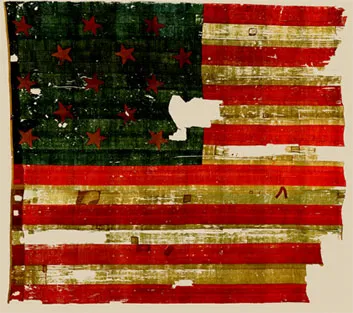
Smithsonian photographers created this composite image of the Star-Spangled Banner in 2004 from 73 separate photographs. The flag's large size (30-by-34 feet) prevented photographers from capturing it in one image while conservators worked on it in the specially-built conservation lab. Courtesy of the National Museum of American History
The Flag's Beginnings
The Star-Spangled Banner's history starts not with Francis Scott Key, but a year earlier with Maj. George Armistead, the commander of Fort McHenry. Knowing that his fort was a likely British target, Armistead told the commander of Baltimore defenses in July 1813 that he needed a flag—a big one. "We, sir, are ready at Fort McHenry to defend Baltimore against invading by the enemy…except that we have no suitable ensign to display over the Star Fort, and it is my desire to have a flag so large that the British will have no difficulty in seeing it from a distance."
Armistead soon hired a 29-year-old widow and professional flagmaker, Mary Young Pickersgill of Baltimore, Maryland, to make a garrison flag measuring 30 by 42 feet with 15 stars and 15 stripes (each star and stripe representing a state). A large flag, but one not unusual for the time. Over the next six weeks, Mary, her daughter, three of Mary's nieces, a 13-year-old indentured servant and possibly Mary's mother Rebecca Young worked 10-hour days sewing the flag, using 300 yards of English wool bunting. They made the stars, each measuring two feet in diameter, from cotton—a luxury item at the time. Initially they worked from Mary's home (now a private museum known as the Flag House), but as their work progressed they needed more room and had to move to Claggett's brewery across the street. On August 19, 1813, the flag was delivered to Fort McHenry.
For making the Star-Spangled Banner, Mary was paid $405.90. She received another $168.54 for sewing a smaller (17 by 25 feet) storm flag, likely using the same design. It was this storm flag—not the garrison flag now known as the Star-Spangled Banner—which actually flew during the battle. The garrison flag, according to eyewitness accounts, wasn't raised until the morning.
After the Battle of Baltimore
Armistead remained in command of Fort McHenry for the rest of his life. Historians are not sure how the Armistead family came into possession of the flag, but upon Armistead's death in 1818, his wife Louisa inherited it. It is she who is thought to have sewed the red upside-down "V" on the flag, beginning the stitches for the letter "A." She is also thought to have begun the tradition of giving pieces of the flag away to honor her husband's memory, as well as the memories of the soldiers who defended the fort under his command.
When Louisa died in 1861, she passed the flag down to their daughter Georgiana Armistead Appleton over the legal objections of their son. "Georgiana was the only child born at the fort, and she was named for her father," says Thomassen-Krauss. "Louisa wanted Georgiana to have it."
The Missing Pieces
In 1873, Georgiana loaned the flag to George Preble, a flag historian who until that time had thought the flag was lost. That same year, Preble had the first known photograph of it taken at the Boston Navy Yard and exhibited it at the New England Historic Genealogical Society, where he stored it until 1876.
While the Star-Spangled Banner was in Preble's care, Georgiana allowed him to give away pieces of the flag as he saw fit. Georgiana, herself, had given away cuttings of the flag to other Armistead descendants, as well as family friends. She once noted, "[H]ad we given all that we have been importuned for little would be left to show." This family tradition continued through 1880 with Armistead's grandson giving away the last documented piece, says Thomassen-Krauss.
Several of these cuttings from the Star-Spangled Banner have been located over the years, including about a dozen that are owned by the American History Museum. "We're aware of at least a dozen more that exist in other museums and private collections," says Kendrick.
But a missing 15th star has never been found. "There's a legend that the star was buried with one of the soldiers from Fort McHenry; another says that it was given to Abraham Lincoln," says Kendrick. "But no real evidence has surfaced to support these stories, and the true fate of the star remains one of the Smithsonian's great unsolved mysteries."
100 Years at the Smithsonian
After Georgiana's death, the flag passed to Eben Appleton, Armistead's grandson, who loaned it to the city of Baltimore for the 1880 sesquicentennial celebration. It then remained in a safe-deposit vault in New York City until Appleton loaned it to the Smithsonian in 1907. Five years later, he made the gift permanent, saying he wanted it to belong "to the Institution in the country where it could be conveniently seen by the public and where it would be well cared for."
When the flag arrived at the Smithsonian it was smaller (30 by 34 feet), damaged from years of use at the fort and from pieces being removed as souvenirs. Recognizing its need for repair, the Smithsonian hired Amelia Fowler, an embroidery teacher and well-known flag preserver, in 1914 to replace the canvas backing that had been added in 1873. Having worked on historic flags for the United States Naval Academy, Fowler had patented a method of supporting fragile flags with a linen backing that required a honeycomb pattern of stitches. With the help of ten needlewomen, Fowler spent eight weeks on the flag, receiving $1,243 for the materials and work.
For the next 50 years, with the exception of a brief move during World War II, the Star-Spangled Banner was displayed in what is now the Arts and Industries Building. Because of the flag's size and the dimensions of the glass case it was displayed in, the public never saw the entire flag while it was housed in this location.
That changed after architects designed the new National Museum of History and Technology, now the National Museum of American History, with space to allow the flag to hang. The Star-Spangled Banner remained in Flag Hall from 1964 until 1999, when it was moved to the conservation lab.
With the recent completion of the project, the Star-Spangled Banner will remain an icon of American history that can still be seen by the public. Says Glass, "The survival of this flag for nearly 200 years is a visible testimony to the strength and perseverance of this nation, and we hope that it will inspire many more generations to come."
You passed me on the street I rode the subway with you You lived down the hall from me I admired your dog in the park one morning We waited in line for a concert I ate with you in the cafes You stood next to me at the bar We huddled under an awning during a downpour We dashed across the street to beat the light I bumped into you coming round the corner You stepped on my foot I held the door for you You helped me up when I slipped on the ice I grabbed the last Sunday Times You stole my cab We waited forever at the bus stop We sweated in steamy August We hunched our shoulders against the sleet We laughed at the movies We groaned after the election We sang in church Tonight I lit a candle for you All of you
You passed me on the street
I rode the subway with you
You lived down the hall from me
I admired your dog in the park one morning
We waited in line for a concert
I ate with you in the cafes
You stood next to me at the bar
We huddled under an awning during a downpour
We dashed across the street to beat the light
I bumped into you coming round the corner
You stepped on my foot
I held the door for you
You helped me up when I slipped on the ice
I grabbed the last Sunday Times
You stole my cab
We waited forever at the bus stop
We sweated in steamy August
We hunched our shoulders against the sleet
We laughed at the movies
We groaned after the election
We sang in church
Tonight I lit a candle for you
All of you
When I heard the news this morning I thought about Mary Jane Booth, an American Airlines employee who worked at Dulles (IAD) with my brother-in-law, a lady I met a few times.....a happy, cheerful, lady who was on the AA flight that was hijacked and crashed into the Pentagon on 9/11. I am not sorry bin laden is dead, but I do not feel any joy in his death either, because Mary Jane is still dead, and so are almost 3000 others from that horrible day, as are thousands of other Americans who have been killed and wounded in the war in Afghanistan. osama bin laden died the way he lived, violently, the war in Afghanistan continues, and so it goes. God Bless and have mercy on the world.
A memorial site for the victims of 9/11 and their friends and families...
By now, we've all heard the news that Osama Bin Laden, the notorious leader of Al Qaeda and mastermind of the 9-11 terrorist attacks, was killed last night in a firefight with United States forces in Pakistan.
This doesn't end the wars or make us safe at last, but President Obama and his national security team deserve credit for finding Bin Laden after all this time and carrying out this mission without the loss of innocent lives -- American or otherwise.
Today we remember the families who lost loved ones on September 11, 2001, and in all of the years of war that followed. We earnestly and fervently hope that these events mean we are one step closer to an end.
Here at USAction/TrueMajority, we're taking the day to remember those who have been lost, honor those who fight to keep us safe and reflect on the meaning of this day. And we'd like to know what you're thinking too: How does this affect your feelings about the wars in Iraq and Afghanistan, or the broader "war on terror"?
If you'd like to share your thoughts, or send sympathy and well-wishes for the families of 9-11 victims, please join us on our facebook page: http://www.facebook.com/usaction
Sincerely, Darcy Scott Martin
USAction / TrueMajority