THE disaster in Japan worsens with the explosion at the Fukushima Dai-ichi nuclear power plant, with the risk of radioactive contamination of a large area of the NE part of Honshu. God help the people of Japan.....
SENDAI, Japan -- An explosion at a nuclear power station tore down the walls of one building Saturday as smoke poured out and Japanese officials said they feared the reactor could melt down following the failure of its cooling system in a powerful earthquake and tsunami.
It was not clear if the damaged building housed the reactor. Tokyo Power Electric Co., the utility that runs the Fukushima Dai-ichi plant, said four workers were injured but details were not immediately available.
Footage on Japanese TV showed that the walls of one building had crumbled, leaving only a skeletal metal frame standing. Puffs of smoke were spewing out of the plant.
"We are now trying to analyze what is behind the explosion," said government spokesman Yukio Edano, stressing that people should quickly evacuate a six-mile (10-kilometer) radius. "We ask everyone to take action to secure safety."
The trouble began at the plant's Unit 1 after Friday's massive 8.9-magnitude earthquake and the tsunami it spawned knocked out power there. The disaster has killed hundreds of people and devastated the country's northeastern coast, where rescuers began slowly arriving Saturday.
The toll of destruction was still not known more than 24 hours after the quake since washed-out roads and shut airports have hindered access to the area. An untold number of bodies were believed to be buried in the rubble and debris.
The official death toll stood at 413, while 784 people were missing and 1,128 injured. In addition, police said between 200 and 300 bodies were found along the coast in Sendai, the biggest city in the area near the quake's epicenter. Local media reports said at least 1,300 people may have been killed.
Adding to worries was the fate of nuclear power plants in the region. Japan has declared states of emergency for five nuclear reactors at two power plants after the units lost cooling ability.
The most troubled one is facing meltdown, officials have said.
Pressure has been building up in the reactor – it's now twice the normal level – and Japan's Nuclear and Industrial Safety Agency told reporters Saturday that the plant was venting "radioactive vapors." Officials said they were measuring radiation levels in the area.
The reactor in trouble has already leaked some radiation: Operators have detected eight times the normal radiation levels outside the facility and 1,000 times normal inside Unit 1's control room.
Wind in the region is weak and headed northeast, out to sea, according to the Meteorological Agency.
Ryohei Shiomi, an official with Japan's nuclear safety commission, said that even if there was a meltdown, it wouldn't affect people outside a six-mile (10-kilometer) radius – an assertion that might need revising if the situation deteriorates. Most of the 51,000 residents living within the danger area had been evacuated, he said.
Meanwhile, the first wave of military rescuers began arriving by boats and helicopters.
Prime Minister Naoto Kan said 50,000 troops would join rescue and recovery efforts following the quake that unleashed one of the greatest disasters Japan has witnessed – a 23-foot (7-meter) tsunami that washed far inland over fields, smashing towns, airports and highways in its way.
"Most of houses along the coastline were washed away, and fire broke out there," said Kan after inspecting the quake area in a helicopter. "I realized the extremely serious damage the tsunami caused."
More than 215,000 people were living in 1,350 temporary shelters in five prefectures, or states, the national police agency said. Since the quake, more than 1 million households have not had water, mostly concentrated in northeast.
The transport ministry said all highways from Tokyo leading to quake-hit areas were closed, except for emergency vehicles. Mobile communications were spotty and calls to the devastated areas were going unanswered .
Local TV stations broadcast footage of people lining up for water and food such as rice balls. In Fukushima, city officials were handing out bottled beverages, snacks and blankets. But there were large areas that were surrounded by water and were unreachable.
One hospital in Miyagi prefecture was seen surrounded by water. The staff had painted an SOS on its rooftop and were waving white flags.
Prime Minister Kan said a total of 190 military aircraft and 25 ships have been sent to the area, which continued to be jolted by tremors, even 24 hours later.
More than 125 aftershocks have occurred, many of them above magnitude 6.0, which even alone would be considered strong.
Technologically advanced Japan is well prepared for quakes and its buildings can withstand strong jolts, even a temblor like Friday's, which was the strongest the country has experienced since official records started in the late 1800s. What was beyond human control was the killer tsunami that followed.
It swept inland about six miles (10 kilometers) in some areas, swallowing boats, homes, cars, trees and even small airplanes.
"The tsunami was unbelievably fast," said Koichi Takairin, a 34-year-old truck driver who was inside his sturdy four-ton rig when the wave hit the port town of Sendai.
"Smaller cars were being swept around me," he said. All I could do was sit in my truck."
His rig ruined, he joined the steady flow of survivors who walked along the road away from the sea and back into the city on Saturday. Smoke from at least one large fire could be seen in the distance.
Smashed cars and small airplanes were jumbled up against buildings near the local airport, several miles (kilometers) from the shore. Felled trees and wooden debris lay everywhere as rescue workers coasted on boats through murky waters around flooded structures, nosing their way through a sea of debris.
Basic commodities were at a premium. Hundreds lined up outside of supermarkets, and gas stations were swamped with cars. The situation was similar in scores of other towns and cities along the 1,300-mile-long (2,100-kilometer-long) eastern coastline hit by the tsunami.
In Sendai, as in many areas of the northeast, cell phone service was down, making it difficult for people to communicate with loved ones.
"I'm waiting for my son to come here. But I cannot tell him he should come over here because mobile phones aren't working," a woman in her 70s told Japanese TV at a shelter in the town of Rikuzentakada, which appeared to be largely destroyed by the tsunami.
"My husband is missing," she said. "Tsunami water was rising to my knees, and I told him I would go first. He is not here yet."
President Barack Obama pledged U.S. assistance following what he called a potentially "catastrophic" disaster. He said one U.S. aircraft carrier was already in Japan and a second was on its way. A U.S. ship was also heading to the Marianas Islands to assist as needed, he said.
Most trains in Tokyo started running again Saturday after the city had been brought to a near standstill the day before. Tens of thousands of people had been stranded with the rail network down, jamming the streets with cars, buses and trucks trying to get out of the city.
Japan's worst previous quake was a magnitude 8.3 temblor in Kanto that killed 143,000 people in 1923, according to the USGS. A magnitude 7.2 quake in Kobe killed 6,400 people in 1995.
Japan lies on the "Ring of Fire" – an arc of earthquake and volcanic zones stretching around the Pacific where about 90 percent of the world's quakes occur, including the one that triggered the Dec. 26, 2004, Indian Ocean tsunami that killed an estimated 230,000 people in 12 countries. A magnitude-8.8 quake that shook central Chile in February 2010 also generated a tsunami and killed 524 people.
___
Associated Press writers Malcolm J. Foster, Mari Yamaguchi, Tomoko A. Hosaka and Shino Yuasa in Tokyo contributed to this report.
Earthquake, Tsunami Hit Japan
Nuclear Fears Emerge After Quake, Tsunami In Japan
March 11, 2011
A giant tsunami driven by one of the largest earthquakes on record swamped northern Japan's eastern coast Friday, leaving massive destruction in its wake and sparking safety concerns at two nuclear power plants.
Even as floods and fires wreaked havoc, Japanese officials were racing to repair failed cooling systems at the neighboring nuclear power plants. Meanwhile, Japan's nuclear safety agency was set to order the release of what is being described as "slightly" radioactive vapor.
- Japanese authorities said 200 to 300 bodies have been recovered in the city of Sendai in Miyagi prefecture, and an additional 178 people were confirmed killed and 584 missing.
- The 8.9 earthquake struck at 2:46 p.m. local time at a depth of 6 miles, about 80 miles off the eastern coast, according to the USGS. The temblor was felt as far south as the capital, Tokyo, and triggered a massive tsunami that swept over parts of northeast Japan.
- Tsunami alerts were issued for the low-lying islands of the Pacific, as well as the U.S. West Coast, Canada and Alaska and South America. Waves swamped Hawaii beaches and severely damaged harbors in California. At least one person was reported missing in Northern California after he was swept out to sea.
- Japanese officials ordered the evacuation of residents around a nuclear power plant in Fukushima prefecture after a cooling system for one of the reactors failed. Authorities were considering the release of slightly radioactive vapor to relieve pressure building inside the reactor. The turbine building of a nuclear plant in Miyagi prefecture caught fire.
- Public transportation in Tokyo was shut down, leaving people stranded. Broadcaster NHK said more than 4 million buildings in the capital were without power.
- President Obama expressed condolences and promised U.S. assistance. The U.N. also said it has rescue teams on standby if needed.
The final toll of the disaster is far from clear, but hundreds of people have been killed. Roads to the worst-hit areas were washed away or blocked by debris and airports were closed.
The quake sent tsunami waves
into Hawaii and the U.S. West Coast hours later, while warnings blanketed the entire Pacific, as far away as South America and Canada.
As dawn arrived Saturday, the extent of the damage started to become clearer. Aerial scenes of the town of Ofunato showed homes and warehouses in ruins. Sludge and high water spread over acres of land, with people seeking refuge on roofs of partially submerged buildings. At one school, a large white "SOS" had been spelled out in English.
The magnitude 8.9 earthquake rocked Japan at 2:46 p.m. local time — the biggest temblor to hit the country since officials began keeping records in the late 1800s. Dozens of cities and villages along a 1,300-mile stretch of coastline were shaken by violent tremors that reached as far away as Tokyo, hundreds of miles from the epicenter.
The seismic shaking unleashed a tsunami up to 30 feet high in some places, and more than 50 aftershocks followed, many of them magnitude 6.0 or greater.
On Friday, police said 200 to 300 bodies were found in the northeastern coastal city of Sendai in Miyagi prefecture, the city closest to the quake's epicenter. The official casualty toll was 236 killed, with more than 700 still missing.
Police also said more than a thousand people were injured. Japan's coast guard reported that it was searching for about 80 dock workers swept out to sea from a shipyard in Miyagi.
"The earthquake has caused major damage in broad areas in northern Japan," Prime Minister Naoto Kan said at a news conference.
Nuclear Power Plant Damage Prompts Evacuations
The massive quake caused power outages that disabled cooling systems at one reactor unit at the Fukushima No. 1 nuclear plant — 150 miles north of Tokyo — and three more at the nearby Fukushima No. 2 plant.
Officials emphasized there was no risk of a radiation leak. But nearly 3,000 people in Fukushima prefecture were ordered to evacuate the area. Residents were initially told to stay at least two miles away from the plants. That boundary was later expanded to six miles.
Though the plants were shut down after the quake — and some shut down automatically — leftover radioactive materials will continue to produce intense heat for a day or two, making it essential that pumps keep circulating cool water to prevent the core from melting.
This chart from the National Oceanic and Atmospheric Administration shows the tsunami's expected path across the Pacific Ocean. The dark black and purple indicate the highest rise in sea level. The light gray lines indicate the tsunami wave's expected arrival time.
View high-res version.
NOAA This chart from the National Oceanic and Atmospheric Administration shows the tsunami's expected path across the Pacific Ocean. The dark black and purple indicate the highest rise in sea level. The light gray lines indicate the tsunami wave's expected arrival time.
View high-res version. The pumps lost their main power in the earthquake — and a backup system of diesel generators failed to kick in, perhaps because of damage from the tsunami.
That left only a battery backup designed to operate for about eight hours.
Meanwhile, officials were considering the possibility of releasing slightly radioactive vapor to reduce pressure on the system.
Chief Cabinet Secretary Yukio Edano said the amount of radioactive element in the vapor would be "very small" and would not affect the environment or human health. "With evacuation in place and the ocean-bound wind, we can ensure the safety," he said at a televised news conference early Saturday.
Nuclear power plants like the one at Fukushima are designed to contain nuclear material even if the cooling system fails.
Japan, which relies on nuclear power for nearly a third of its electricity generation, closed at least three other plants as a precaution after the reports of damage at Fukushima and another facility, according to the International Atomic Energy Agency.
Airport Swamped, Hundreds Of Houses Swept Away
Japanese TV images from Sendai showed highways buckling and older wooded structures flattened by the force of the shaking. As the tsunami wave swept ashore, Sendai airport was instantly inundated. The wave washed through a fish market near the shoreline, picking up an entire parking lot full of cars and sweeping them into the sea.
I've been through many earthquakes, but I've never felt anything like this. I don't know if we'll be able to get home tonight.
- Osamu Akiya, 46, in Tokyo
In one town alone on the northeastern coast, Minami-soma, some 1,800 houses were destroyed or badly ravaged, a Defense Ministry spokeswoman said.
In Tokyo, video images showed a large building on fire and billowing smoke in the Odaiba district. The tremor bent the upper tip of the iconic Tokyo Tower, a 1,093-foot steel structure inspired by the Eiffel Tower in Paris.
Are Quake Prevention Efforts Helping?
Buildings shook violently and workers poured into the street for safety as the temblor hit, but there were few reports so far of collapsed buildings — a sign that stringent building codes may have averted a far greater disaster.
Earthquake experts in the U.S. say Japan has the strongest building standards in the world for withstanding earthquakes. It trains and prepares more for them. And unlike the United States, Japan adopted an expensive earthquake early warning system that gave people a precious few seconds to duck and cover.
The quake was 700 times more powerful than the one that struck Haiti last year, but the death toll appears to be far lower than the 220,000-plus killed in the Caribbean.
"If anyone is in the position to ride this out, it is the Japanese," said David Applegate, senior science adviser at the U.S. Geological Survey.
Even so, Friday's quake caused a rupture 186 miles long and 93 miles wide in the sea floor 80 miles off the eastern coast of Japan. It was caused when one giant tectonic plate was shoved under another — the same type of movement that caused the devastating 2004 Indonesian tsunami.
Largest Earthquakes Since 1900
Magnitude 9.5 — Southern Chile, 1960
Magnitude 9.2 — Prince William Sound, Alaska, 1964
Magnitude 9.1 — Off Northern Sumatra's West Coast, 2004
Magnitude 9.0 — Kamchatka, Russia, 1952
Magnitude 8.9 (preliminary estimate) — Japan, 2011
Source: USGS National Earthquake Information Center
"You're looking at something that's rupturing a very significant patch of the Earth's crust," Applegate said.
Tales Of Devastation
Osamu Akiya, 46, was working in Tokyo at his office in a trading company when the quake hit. It sent bookshelves and computers crashing to the floor, and cracks appeared in the walls.
"I've been through many earthquakes, but I've never felt anything like this," he said. "I don't know if we'll be able to get home tonight."
Tokyo airports closed and all public transportation was shut down. NHK said more than 4 million buildings were without power in the city and its suburbs.
As night fell and temperatures hovered just above freezing, tens of thousands of people remained stranded in Tokyo. The streets were jammed with cars, buses and trucks trying to get out of the city.
The city set up 33 shelters in city hall, on university campuses and in government offices, but many planned to spend the night at 24-hour cafes, hotels and offices.
"Normally, we're used to building shaking, but this just went on and on and on," Lucy Craft reported for NPR from Tokyo. She said she was in the building in Tokyo that houses Japan's Diet, or parliament, when the quake struck.
"The subways were stopped, most of the transportation links are halted now; the highways are closed; trains are not running. It's difficult to make phone calls," Craft said. "The country has just come to a screeching halt."
She said Japan spends huge amounts of money on disaster prevention and resistance. But even for a country used to earthquakes, this one was of horrific proportions.
Nations Stand Ready To Send Aid
The quake struck at a depth of six miles, about 80 miles off the eastern coast, according to the U.S. Geological Survey. The area is 240 miles northeast of Tokyo.
"The energy radiated by this quake is nearly equal to one month's worth of energy consumption" in the United States, USGS Scientist Brian Atwater told The Associated Press.
Edano, the Cabinet secretary, said the Defense Ministry was sending troops to the quake-hit region. A utility aircraft and several helicopters were on the way.
U.N. spokeswoman Elizabeth Byrs, speaking in Geneva, Switzerland, said 35 international search-and-rescue teams were on alert and would be dispatched immediately if Japan requested assistance.
Obama expressed his condolences and offered U.S. aid to Japan.
"Our hearts go out to our friends in Japan and across the region, and we're going to stand with them as they recover and rebuild from this tragedy," he said at a Friday afternoon news conference in Washington.
The president said the U.S. was sending an aircraft carrier to Japan and another ship to the Marianas Islands to assist as needed. The Defense Department also was working to account for all military personnel stationed in Japan, and the State Department was trying to account for all American citizens there.
Obama said he was heartbroken by the tragedy in Japan and that it was "a reminder of just how fragile life can be."
Earlier, he said U.S. officials were monitoring tsunamis in the Pacific and that he had ordered FEMA to be ready to assist Hawaii and any other affected U.S states and territories.
In Hawaii, where vulnerable areas were evacuated, water rushed up on roadways and into hotel lobbies on the Big Island, and low-lying areas in Maui were flooded as 7-foot waves crashed ashore. California harbors were severely damaged, and at least one person was reported missing in the northern part of the state after he was swept out to sea.
The tsunami warning extended to a number of Pacific, Southeast Asian and Latin American nations, including Japan, Russia, Indonesia, New Zealand and Chile.
A History Of Killer Quakes
The area of Japan devastated by Friday's quake had been hit by several temblors in recent days, including a magnitude 7.3 event Wednesday.
Japan's worst previous quake was in 1923 in Kanto, a 7.9-magnitude temblor that killed 143,000 people, according to the USGS. A 6.9-magnitude quake in Kobe city in 1995 killed 6,400 people.
Japan lies on the "Ring of Fire" an arc of earthquake and volcanic zones stretching around the Pacific where about 90 percent of the world's quakes occur, including the one that triggered the Dec. 26, 2004, Indian Ocean tsunami that killed an estimated 230,000 people in 12 nations. A magnitude-8.8 temblor that shook central Chile last February also generated a tsunami and killed 524 people.
With reporting from NPR's Louisa Lim in Beijing; Lucy Craft in Tokyo; Lisa Schlein in Geneva; and Jon Hamilton in Washington. Material from The Associated Press was used in this story.


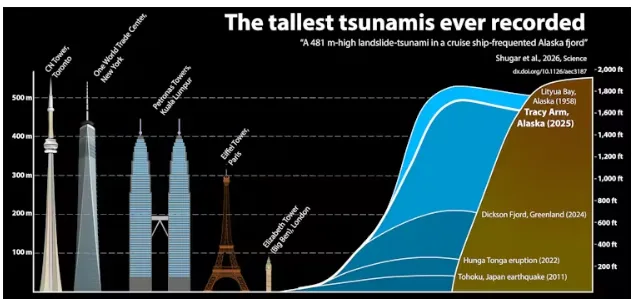 The Tracy Arm landslide generated a tsunami that sent a wave so high up the opposite fjord wall that it would have overtopped some of the world’s tallest buildings. Here’s how it compares to other large tsunamis around the world. Steve Hicks/University College London
 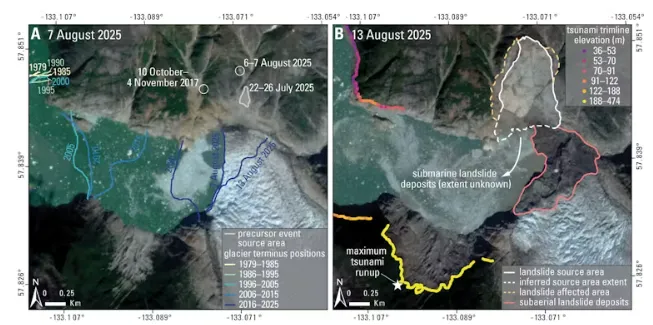 Maps show how the glacier has retreated over the years, moving past the section of mountain that collapsed (outlined in white on the right) in the days prior to the slide. The map on the right shows the height the tsunami reached on the fjord walls. Planet Labs
 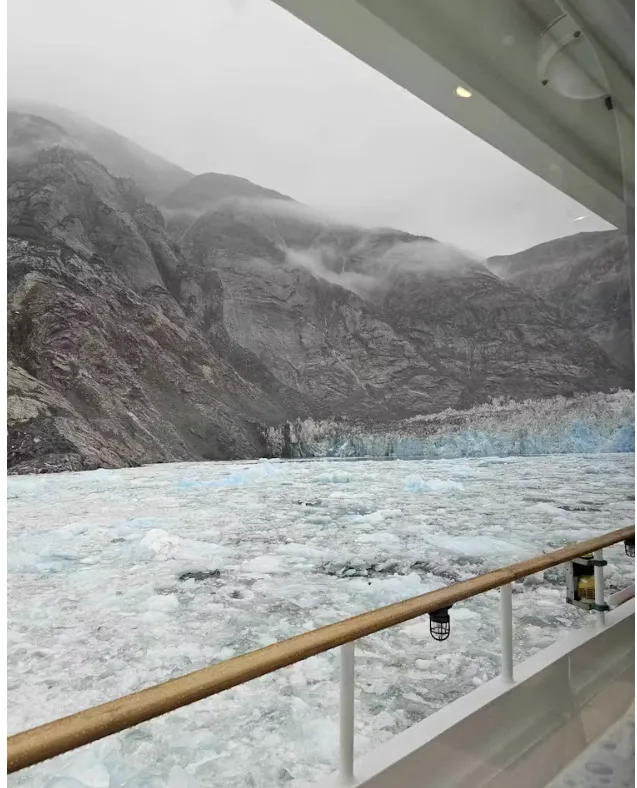 The view from the deck of the Hanse Explorer on Aug. 9, 2025, shows the mountain where the landslide occurred just 12 hours before it happened. Hanse Explorer
 Wind Farm in Japan by
  Kamisu Wind Farm 300 km from earthquake epicenter by Wind Power Ibaraki


