NORTON META TAG

Showing posts with label earthquake. Show all posts

07 December 2024

Watch "Moment Rare 7.2 Magnitude Earthquake Strikes Underwater | 10 News First" & Real Early 1900s Photo of Crowd Posing with Megalodon? 5&6DEZ24

 I would have shit my wetsuit and started looking around wondering if there was a Megladon on the way! The article is from Snopes.....


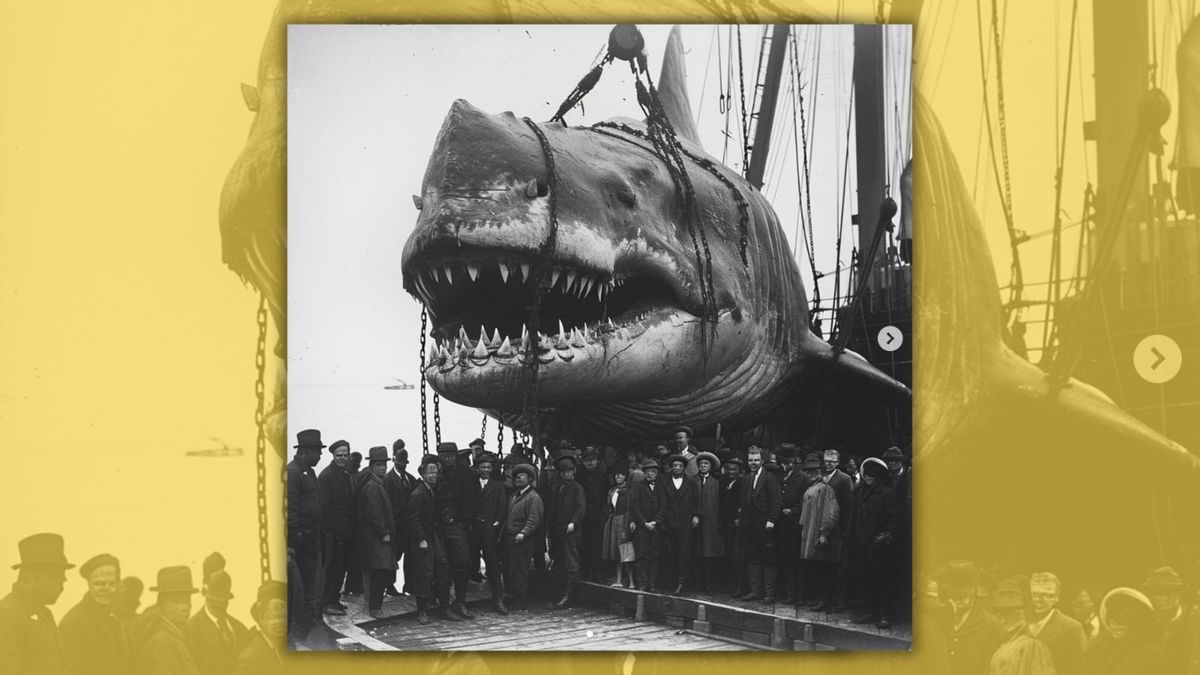
Real Early 1900s Photo of Crowd Posing with Megalodon?

Believed to have been the largest fish to ever exist, megalodons could weigh up to 120,000 pounds, according to scientists.

Caroline Wazer is a reporter based in Central New York. She has a Ph.D in history.


Published Dec. 6, 2024


 (Instagram account Fantasy Creatures)
Image courtesy of Instagram account Fantasy Creatures
Claim:
An image shared on social media was an authentic early 20th-century photo of a crowd posing with a megalodon, a type of giant prehistoric shark.
Context

The image originated as an AI-generated artwork.

In 2024, internet users shared an image allegedly showing a crowd posing with a captured megalodon, a type of prehistoric shark believed to have gone extinct around 3.6 million years ago. According to the posts, the image was an authentic black-and-white photo from the early 1900s.

(Facebook)

Posts featuring the image appeared on social media platforms including X (archived), Instagram (archived), and Facebook (archived). One Facebook post (archived) that included the image had received around 12,000 likes and 2,700 comments at the time of this writing. Text included in the post read in part:

The Megalodon is alive!

At the beginning of the 20th century, German fishermen aboard the ship Seesturm made an extraordinary discovery in the North Sea: a live Megalodon shark, a creature believed to have been extinct for millions of years. As the massive shadow loomed over their boat, the fishermen faced a tremendous challenge.

However, the image was a piece of AI art, not an authentic photo of a megalodon.

A Google reverse image search showed that the earliest securely datable online instance of the image was a Jan. 24, 2024, post (archived) by Fantasy Creatures, an Instagram account that posts art explicitly labeled as AI-generated. The account's bio read: "Imagining new worlds: AI-crafted fantasy creatures unleashed."

The post itself also included numerous hashtags indicating that the image of fishermen posing with a megalodon was a piece of AI art. These hashtags included #aiartwork, #aiart, and #generativeart, as well as the names of various generative AI programs including Midjourney, DALL-E 3, and Stable Diffusion. It was not immediately clear what program created the image of the megalodon.

We've reached out to the owner of the Fantasy Creatures account to ask for confirmation that they personally used AI software to create the image, and will update this story if and when they respond.

The image itself also contained signs of being the product of an AI program.

One obvious sign of AI generation was the distorted features of all the humans in the image, as can be seen in the below collage showing two zoomed-in clusters of people in the crowd. Although AI software is increasingly capable of producing more realistic human faces, mangled features are a well established hallmark of AI-generated images.

(Instagram account Fantasy Creatures)

Another sign that the image did not show an actual event was the physics of the chains shown supporting the megalodon in the photo. With the exception of one chain that appears to enter the animal's ear canal, the chains in the photo are draped over the megalodon's snout in a way that would not realistically support the animal. According to an article published by the Smithsonian's National Museum of Natural History, megalodons could have weighed up to 120,000 pounds.

In summary, the image purporting to show a circa 1900 photo of a crowd of people posing in front of a suspended megalodon is not a real photo. Instead, it is a piece of AI-generated art. As such, we've rated the image as miscaptioned.

We've investigated other claims related to megalodons, such as the assertion that a 2021 video showed a megalodon stalking a cruise ship.


13 March 2012

Dramatic New Video of Japan Tsunami [VIRAL VIDEO] 17APR11

11MAR12 was the one year anniversary of the massive earthquake and tsunami that killed almost 20000 people there. Here is a new video of the tsunami, it really is horrifying just watching it.
We've seen a lot of of the tragic Japan , but this clip is the most horrifying yet. Entitled "South Sanriku -- Tsunami seen from Shizugawa High School," it's shot from high ground, but toward the end of the video you can see panicked residents running for their lives.
Almost as dramatic as the video is its audio track, where even if you don't speak Japanese, you can tell the people are expressing concern at the beginning, but by the end, their voices have reached a high level of panic and horror as they watch their homes washing away.
Shortly after the tsunami, one survivor called the oncoming deluge "a gigantic pile of garbage coming down the street." That's an apt description, as you can see an entire town reduced to a huge pile of watery debris in a matter of minutes. Shocking.

05 January 2012

How Fracking Wastewater Is Tied To Quakes 5JAN12

THE oil and gas companies in Pennsylvania have paid for the commonwealth government now in Harrisburg, it is surprising the dept of environmental resources just didn't turn a blind eye to the toxic water from the waste treatment plants. If fish didn't die from the toxins they probably would have. Fracking will destroy the rural environment of PA, the earthquakes that are sure to occur will be the icing on the toxic cake being served to the local residents. From NPR....
With the skyline of Youngstown, Ohio, in the distance, a brine injection well owned by Northstar Disposal Services LLC is seen in Youngstown on Jan. 4. The company has halted operations at the well, which disposes of brine used in gas and oil drilling, after a series of small earthquakes hit the Youngstown area.
Amy Sancetta/AP With the skyline of Youngstown, Ohio, in the distance, a brine injection well owned by Northstar Disposal Services LLC is seen in Youngstown on Jan. 4. The company has halted operations at the well, which disposes of brine used in gas and oil drilling, after a series of small earthquakes hit the Youngstown area.
Small earthquakes in Ohio and Arkansas associated with hydraulic fracturing for natural gas have taken many people by surprise. Gas industry executives say there's no hard evidence that their activities are causing these quakes. But some scientists say it's certainly possible; in fact, people have been causing quakes for years.
In the 1960s, geologists realized that gold mines in South Africa had created small earthquakes. Caverns dug into the earth thousands of feet below the surface collapsed. The "pancake" effect caused quakes — in one case a magnitude-5.2 temblor.
Since then, scientists have found that even pumping water away from underground mines (to keep them from flooding) changes the dynamics of stress in rock formations enough to trigger a quake.
Some rock is saturated with water — the water occupies pores between rock particles. This creates what's called "pore pressure" and keeps the formation in a sort of equilibrium. If you suck the water out, particles tend to collapse in on themselves: the rock compresses. Add water, and you push particles apart. So moving water around underground can affect the stresses on those formations.
Creating Quakes
Now let's say there's a fault in the earth. If the water content around the fault is changed, the fault might slip. If the water gets into the fault itself, it can lubricate the fault and trigger a quake.
Hydraulic fracturing pumps a lot of water underground, where it's used to crack the rock and liberate gas. This may cause tiny quakes, but fracking goes on for a day or two, and the quakes are small.

Related NPR Stories

Recent quakes reported in Ohio and Arkansas are associated with wastewater wells, not fracking wells. The water first used in fracturing rock is retrieved and pumped into these waste wells, which take in lots of water. And at more than 9,000 feet deep, the water is under high pressure that can build up over months or years. It's this pressure that can actually create earthquakes.
In the 1960s, a wastewater well in Colorado at the Rocky Mountain Arsenal is believed to have been the trigger for a magnitude-4.8 quake.
A few geologists are familiar with these induced or triggered quakes. They're rare and usually small, but now fracking is creating thousands of wastewater wells, often in heavily populated areas that historically have not been seismically active. That means even small quakes get noticed.
Shipping Wastewater Out Of State

For decades, scientists have known that activities like mining, drilling and building dams can create earthquakes. As early as the 1960s, observers noted that deep-earth gold mining changed the stresses in rocks and caused earthquakes. Above, miners drill into the rock at the Sub Nigel East Gold Mine in Johannesburg in 1961, more than 6,000 feet below ground.
Ron Stone/Getty Images For decades, scientists have known that activities like mining, drilling and building dams can create earthquakes. As early as the 1960s, observers noted that deep-earth gold mining changed the stresses in rocks and caused earthquakes. Above, miners drill into the rock at the Sub Nigel East Gold Mine in Johannesburg in 1961, more than 6,000 feet below ground.
It can be hard, even then, to definitively nail down the source of a quake. And there are several ways big infrastructure projects can create them: People have created quakes when they excavate quarries — removing all that rock, or "overburden," changes the vertical stress on rock and the faults below. Likewise, dams increase the stress below when a lake is created. The Aswan Dam in Egypt and another in India are believed to have triggered quakes.
One way to avoid creating earthquakes is not to inject fracking wastewater into waste wells, but to recycle it instead. The state of Pennsylvania tried that, but they found that wastewater treatment plants couldn't get all of the toxic material out of fracking water, and the "cleaned up" water returned to rivers wasn't clean enough. So well operators in the state decided to ship wastewater to Ohio, where it has been going down into wells.
The U.S. Geological Survey is working on ways to head off quakes from wastewater wells. That would include performing seismic surveys before drilling the wells. Permeable rock like sandstone is better than hard, brittle basement rock that is riddled with faults. Operators might also limit the amount of water going into wells: USGS geologists have learned that the more water injected, the bigger an ensuing quake.

25 August 2011

DC aftershock: 4.5 magnitude quake rattles region 25AUG11

BIGGEST aftershock so far, I slept thru it....
Yes - if you awoke to your bed shaking, you felt a legitimate aftershock from Tuesday’s 5.8 magnitude earthquake. The U.S. Geological Survey reports a 4.5 magnitude quake occurred 9 miles south of Mineral, Va. at 1:08 a.m. this morning (Thursday).

23 August 2011

EARTHQUAKE UPDATE 23AUG11

I was finally able to reach my sister Jennie, everything is fine with them, just a few things off the walls but nothing broken, but while we were talking she started all "Oh my, shaking, shaking....." they were having another aftershock, this was about 1950, lasted about 10-15 seconds....

5.8 Magnitude Earthquake Rattles East Coast & D.C. earthquake: Powerful tremor shakes region 23AUG11

I was at my desk at work. All of the sudden there was this this rumbling and things started shaking on my desk and in the office, the rumbling got louder, and people started to get up from their desk, some ran outside. I got up from my chair when it started really shaking and moving on the floor, and then there was a really large booming sound and then it stopped. It was weird because it seemed you could feel and hear it building in intensity from the West. I remember looking over at my friend Russ and he was standing and was leaning on a desk, it looked like he was wiggling! Everyone was kinda wigged out but nobody freaked out. We never lost power, the phone and computer systems kept working, though the phone lines were jammed up for about an hour or so. Thank God there was no damage to my apartment, just a few little things fell off shelves and pictures are askew....but my birds are OK! I was able to get a text to my friends Pam and Tim, they are fine too. I couldn't get through to my sister Jennie and her husband Ted, but I did send them a text. They live southwest of me, closer to the epicenter, I hope they and Katie and their pets Niles and Tommy are OK. It was just a wild and weird experience!!! My third earthquake that I know of. Once, while I was still living in Scandia, PA in the early 80's. I worked nights and was sleeping and the woke up because the bed was shaking. I sat up, walked through my home, couldn't see anything amiss. I went outside, it was still daylight, not storming...so went back to bed. Found out later it was a 3.something quake. I was in San Francisco two weeks before the big quake in 89 visiting my sister and her family. I was woke up by this banging noise, sat up in bed, and then it stopped and all was quite. That morning my sister Sheila asked me if I felt the quake in the night. I told her some banging woke me up but (since my room was next to her's and Dick's) I thought they were just, you know.....She was so "offended", kept telling me I was such a pig....but everyone was laughing too! So that is my experience with earthquakes.....This report from NPR...
People gather on Freedom Plaza in Washington, D.C., after a earthquake on Tuesday.
Enlarge Mandel Ngan/AFP/Getty Images People gather on Freedom Plaza in Washington, D.C., after a earthquake on Tuesday.
The East Coast of the United States got a rare jolt this afternoon when an estimated 5.8 magnitude earthquake centered in Virginia shook buildings and rattled nerves from the Carolinas to New England.
The United States Geological Survey says the earthquake happened at 1:51 p.m. ET with an epicenter nine miles south of Mineral, Virginia and had a depth of 1 km.
The quake's epicenter was in north central Virginia.
NPR The quake's epicenter was in north central Virginia.
At NPR headquarters in Washington, D.C., about 83 miles northeast of the epicenter, the building swayed for a few seconds. Many of buildings in the downtown area were evacuated. There were no immediate reports of damage, but in an area unaccustomed to earthquakes, people were surprised and shaken.
The quake was much closer to Richmond, Va., which was only about 40 miles from the epicenter, but according to the Richmond Times-Dispatch so far there have been no reports of damage.
The Times-Dispatch reports:
There were no immediate reports of damage as buildings were cleared throughout Richmond and other cities in Virginia, but within minutes, Richmond police began receiving calls about possible property damage. Those calls included a possible collapsed wall at a house along East Broad Street in the city's East End and a possible wall collapse at a structure along Hioaks Road in South Richmond.
We'll be updating this post. Hit your "refresh" button to see our latest additions.
Update at 5:30 p.m. ET. Washington Monument Inspected:
CBS News' Mark Knoller tweets that reporter Mark Leshan from local CBS affiliate WUSA-TV says the National Park Service has inspected the Washington Monument from a helicopter and "finds no initial signs of damage."
Which brings up one of the many earthquake-related jokes making the rounds on Twitter:
"MSNBC says the Washington monument is leaning to left. Fox news says its to the right." (@jeffheimbuch)
Update at 5:02 p.m. ET. More On National Cathedral Damage:
The National Cathedral in Washington, D.C. sustained "significant damage," it said in a press release. Three of the four corner spires on the central tower were damaged.
Officials report:
"Specifically, three 'finials' (capstones shaped like fleurs-de-lys) have fallen from them, with more significant damage to two of the pinnacles. Similar decorative elements on the Cathedral's exterior also appear to be damaged. Cracks have appeared in the flying buttresses around the apse at the Cathedral's east end, the first portion of the building to be constructed, but the buttresses supporting the central tower seem to be sound."
Luckily no one was injured.
Update at 4:40 p.m. ET. Reports From Around The East:
Richmond Times-Dispatch: "The quake ... shook buildings and employees were ordered outside across Richmond and other cities in Virginia. Within minutes, Richmond police began receiving calls about possible property damage. Those calls included a possible stairwell collapse along North First Street downtown, a possible wall collapse along East Broad Street in the city's East End and a possible wall collapse at a structure along Hioaks Road in South Richmond — as well as numerous reports of possible gas leaks."
The Washington Post: "A senior Obama administration official said the White House 'shook pretty hard' and that employees evacuated onto the driveway between the White House and the Eisenhower Executive Office Building. Construction workers also got off scaffolding wrapped around the EEOB. Employees fled the U.S. Capitol, and House and Senate office buildings were evacuated, as tremors shook the buildings for several seconds."
Baltimore Sun: "In Baltimore, 113 miles from the epicenter, the quake startled many, rattling pictures off walls and sending downtown workers into the streets. In Annapolis, tremors shook plaster off the ceiling in parts of of the historic State House. Baltimore police said on Twitter that there have been no injuries reported in the city."
Philadelphia Inquirer: "Tall buildings from Center City, to Wilmington and Atlantic City were evacuated, including Philadelphia City Hall. Phone circuits were jammed after the ground shook around 1:55 p.m. and police urged residents not to call 911 except in an actual emergency. Anyone smelling fumes should call 311 or the Philadelphia Gas Works. There are no immediate reports of any serious injuries."
New York Daily News: The quake "sent thousands of people running out of swaying office buildings across the city and briefly grounded flights at Kennedy and Newark airports. ... No problems were reported with the MTA's bridges and tunnels or the subway, but flights at Newark and Kennedy Airports were briefly delayed as a precaution."
Update at 4:19 p.m. ET. The History:
Barbara Wainman, a spokeswoman for the USGS, says this earthquake is definitely in historic range. As Mark noted earlier, it is slightly smaller than 5.9 earthquake in 1897. Wainman says the biggest earthquake to strike the East Coast happened in the late 1800s in South Carolina. That was a magnitude 7 earthquake.
Update at 4:10 p.m. ET. On How Far Away It Was Felt:
The Associated Press writes that "shaking was felt at the White House and all over the East Coast, as far south as Charleston, South Carolina."
Update at 3:55 p.m. ET. Quakes Are Rare, But Not Unknown In Virginia:
The USGS has several historical notes posted about Virginia's earthquake history. Here, it reports that "the largest damaging earthquake (magnitude 4.8) in the seismic zone [where today's was centered] occurred in 1875." Elsewhere, it writes that "the largest earthquake to originate in Virginia in historic times occurred on May 31, 1897," in the southwestern part of the state." That temblor had an estimated 5.9 magnitude, meaning it was slightly stronger than today's.
Update at 3:52 p.m. ET. At The Pentagon.
Stars and Stripes writes that:
"The Pentagon violently shook during Tuesday's 5.9-magnitude earthquake in Arlington, Va., as thousands of employees and visitors ran full speed for the exits.
"Reporters in the second-floor media filing center felt some initial swaying and as some quickly noted they had felt no 'boom' to indicate any explosions (or ever-feared plane crashes) the walls began to roll back and forth more intensely, causing a rush for the doors."
Update at 3:46 p.m. ET. Magnitude Revised:
The USGS now says the earthquake registered 5.8 magnitude.
Update at 3:34 p.m. ET. Damage Reports:
So far the reports of damage have been minimal but the The Washington Post reports a building collapse in the Southeast part of the city:
A congressional staffer reported that a portion of a building collapsed on the 300 block of Pennsylvania Avenue in Southeast.
"A huge dust cloud came from the BBT building," he said, and "the people who came out of it said the back collapsed." The staffer said he was a pizza place and that "the entire ground literally moved up and down — you could see it."
The Richmond Times-Dispatch reports that after the earthquake, people started calling 911 to report possible damage:
Those calls included a possible stairwell collapse along North First Street downtown, a possible wall collapse along East Broad Street in the city's East End and a possible wall collapse at a structure along Hioaks Road in South Richmond _ as well as numerous reports of possible gas leaks.
Update at 3:30 p.m. ET. National Cathedral Damaged; Small Aftershock Reported:
The Washington Post reports that "the tip of the National Cathedral in Washington spire crashed onto the steps on Pilgrim Road. Three of the four pinnacles of the central tower are down and there's significant damage, said spokesman Richard Weinberg. No injuries were reported."
Meanwhile, according to the USGS, there was a 2.8 magnitude quake in the same area of Virginia at 2:46 p.m. ET.
Update at 3:23 p.m. ET. USGS Shakemap:
The USGS released this map that shows "instrumental intensity." It shows the epicenter was between Richmond and Charlottesville:
A USGS "shakemap."
USGS A USGS "shakemap."
Update at 3:20 p.m. ET. Nuclear Power Plant Goes "Offline":
There are two nuclear reactors at the North Anna Power Station in Louisa County, Va., not too far from the earthquake's epicenter. The Associated Press reports that federal officials say the reactors "were automatically taken off line by safety systems around the time of the earthquake" and that the plant is "being run off of four emergency diesel generators."
The company confirms on its Twitter page that "both reactors at North Anna Power Station were shut down safely with no reports of damage."
David McIntyre, spokesman for the U.S. Nuclear Regulator Commission, tells NPR there is usually enough diesel fuel for the generators to run for at least a week.
Another nuclear power plant in Virginia, as well as plants in Maryland, North Carolina, Pennsylvania and New Jersey felt the temblor but did not shut down, McIntyre said.
Update at 3:05 p.m. ET. Smithsonian Castle Damaged:
G. Wayne Clough, Secretary of the Smithsonian Institution and an earthquake engineer, said the Smithsonian Institution Building, or the castle as it's referred to, had suffered some damage. He was standing outside of the castle when he spoke to us and said he saw cracking inside the building and some of the windows had shattered.
Clough said it this was a big earthquake and he's experienced quite a few on the West Coast, he said.The problem in the area, he said, is that the construction is not made to withstand earthquakes. He said the Castle was built in 1881 with brick that was not reinforced, so they've decided to close the the building and will have it structurally inspected.
At the time of the quake, Clough said, he was in a meeting and he felt the tell tale sings of an earthquake, including the see-saw motion.
Update at 3 p.m. ET. "Oh, My God, This is An Earthquake":
In Washington, D.C., Anita Fogan was at her job with the United States Mint, "when I thought our building got hit by a wrecking ball from the construction site next door. Then, I heard things falling off shelves and thought 'Oh, my God, this is an earthquake.' That's when I got out of the building."
Update at 2:33 p.m. ET. Historical Perspective:
As we said earlier, earthquakes, especially this strong, are rare in the area. According to the USGS, "the largest damaging earthquake (magnitude 4.8) in the seismic zone occurred in 1875. Smaller earthquakes that cause little or no damage are felt each year or two.
(Contributing: Scott Neuman)

D.C. earthquake: Powerful tremor shakes region

Strongest quake to hit Virginia since 1897
Live chat transcript with Seismologist

The U.S. Geological Survey (USGS) has confirmed an earthquake struck central Virginia at 1:51 p.m ten miles south-southeast of Louisa, Va., near Mineral, Va. It was felt throughout the D.C. metro region and over a large part of the eastern U.S. USGS reports it measured 5.8 on the Richter scale.
Minutes after the quake,Marcia McNutt, USGS director -- who watched objects falling from the shelves in her office -- concerned about aftershocks, cautioned that the shaking might not be over.
“When something like this happens, remember what to do in the case of a seismic event. Duck, get under something sturdy like a desk or a doorway, get away from falling glass. Make sure that you are not in the way of falling objects like pictures, bookshelves, books, anything that’s not firmly connected the wall.”

(U.S. Geological Survey)
An earthquake also occurred in the D.C. metro region July 16, 2010. A 3.6 magnitude quake centered near Gaithersburg shook the area. Today’s 5.8 magnitude quake was about 160 times bigger than that quake and almost 2,000 times as powerful (USGS How Much Bigger Calculator).
Virginiaplaces.org reports:
Virginia is classified as a “moderate” seismic risk, and has a 10-20% chance to experience a 4.75 quake every century or so. In quakes above 4.5 on the Richter scale, buildings begin to fall...
Since 1977, Virginia has experienced 160 earthquakes, of which just 16% were felt according to Virginia Tech.
Experts say there are two active earthquake areas in Virginia: The one apparently responsible for Tuesday’s quake runs along the James River between Charlottesville and Richmond and is known as the Central Virginia Seismic Zone. The other is an area centered in Giles County in southwest Virginia, which had a 5.8-magnitude quake more than a century ago.
The Virginia Tech Seismological Observatory(VTSO) offers the following on earthquake history in the central Virginia seismic zone:
Since at least 1774, people in central Virginia have felt small earthquakes and suffered damage from infrequent larger ones. The largest damaging earthquake (magnitude 4.8) in the seismic zone occurred in 1875. Smaller earthquakes that cause little or no damage are felt each year or two.
It would appear today’s quake is the largest on record in that region. USGS said it was the strongest quake to hit the entire state since the 5.8 magnitude tremor in 1897.
VTSO adds the following:
A magnitude 4.0 eastern U.S. earthquake typically can be felt at many places as far as 100 km (60 mi) from where it occurred, and it infrequently causes damage near its source. A magnitude 5.5 eastern U.S. earthquake usually can be felt as far as 500 km (300 mi) from where it occurred, and sometimes causes damage as far away as 40 km (25 mi).
Reports on the USGS website indicate that the quake, 3.7 miles deep, was felt from Georgia to southeast Canada (see neat interactive map from Detroit Free Press).
The energy from the quake propagates farther in this region compared to a similar quake in the Southwest U.S. as the crust is colder and there are fewer cracks to dissipate the energy.
“The rocks are old and cold and they carry the seismic energy very far. Even a magnitude 6 or less earthquake can be felt over a considerably large area, unlike California where the shaking is more concentrated,” said Mike Blanpied, associate coordinator for the USGS earthquakes hazards program.
Useful Links: Virginia’s Largest Earthquakes
Virginia Earthquake history
More Virginia Earthquake resources
Aftershock risk?
USGS’s Blanpied cautioned aftershocks are possible:
“Aftershocks could go on for days, weeks, or even months. They’re most likely to be felt under the next three or four days.”
An aftershock of 2.8 on the Richter scale occurred at 2:46 p.m., 5 miles south-southwest of Mineral and a 2.2 magnitude aftershock occurred at 3:20 p.m. 8 miles south of Louisa.
Eyewitness account at epicenter from CWG’s Steve Tracton
Purely coincidentally myself, wife, and grand daughter were in a Food Lion within a mile of the center of the quake, Mineral ,Va. The first indication of something unusual was a the sound, louder than a loudest thunderclap I’ve ever heard, but not thunder like - more like an explosion. I knew of course from weather conditions it could not have been thunder and concluded immediately it had to be an earthquake (I’ve only felt one relatively minor earthquake before in when in Israel.)
Immediately after, the store floor shook violently, lights went out and everything - and I mean everything - came crashing down from shelves. Luckily we were not in an aisle so were not hit by falling cans and glass, although, of course, quite scared at first.
Everyone in the store was ordered out right after the building stopped shaking. I attempted to take some pix with phone camera but was blocked from doing so. I did hear that there was some structural damage to the store - cracks in the floor and possibly foundation.
Fortunately, it appeared no one was seriously injured, except possibly one woman who appeared to have been hit on the head by something. Certainly could have been worse but, nevertheless, an experience to be remembered.

USGS map indicating earthquake epicenter, where it was felt, and the degree of shaking. (See latest zoomed in map)

More Washington Post Earthquake coverage:
Earthquake rattles Washington area

18 March 2011

Battle-proof Wind Farms Survive Japan's Trial by Fire 17MAR11

MORE proof we need to support and finance renewable energy and just stop any plans for new nuclear power plants in the U.S.
As the world collectively holds its breath to see how the Fukushima crisis plays out (the quote of the day has got to be: "The worst-case scenario doesn't bear mentioning and the best-case scenario keeps getting worse...") there's a positive story which is not yet being reported.
Despite assertions by its detractors that wind energy would not survive an earthquake or tsunami the Japanese wind industry is still functioning and helping to keep the lights on during the Fuksuhima crisis.
2011-03-17-japanwindfarm.jpg Wind Farm in Japan by rjzii
Colleagues and I have been directly corresponding with Yoshinori Ueda leader of the International Committee of the Japan Wind Power Association & Japan Wind Energy Association, and according to Ueda there has been no wind facility damage reported by any association members, from either the earthquake or the tsunami. Even the Kamisu semi-offshore wind farm, located about 300km from the epicenter of the quake, survived. Its anti-earthquake "battle proof design" came through with flying colors.
Mr. Ueda confirms that most Japanese wind turbines are fully operational. Indeed, he says that electric companies have asked wind farm owners to step up operations as much as possible in order to make up for shortages in the eastern part of the country:
Eurus Energy Japan says that 174.9MW with eight wind farms (64% of their total capacity with 11 wind farms in eastern part of Japan) are in operation now. The residual three wind farms (Kamaishi 42.9MW, Takinekoshirai 46MW, Satomi 10.02MW) are stopped due to the grid failure caused by the earthquake and Tsunami. Satomi is to re-start operations in a few days. Kamaishi is notorious for tsunami disaster, but this wind farm is safe because it is locate in the mountains about 900m high from sea level.
The largest wind farm operator in Japan, Eurus Energy with about 22% of all wind turbines in Japan, is a subsidiary of Tokyo Electric Company (TEPCO) which operates the Fukushima nuclear facility. Right now, it is likely the company is very happy about its diversified portfolio:
While shares in the Tokyo stock market have fallen during the crisis, the stock price of Japan Wind Development Co. Ltd. has risen from 31,500 yen on 11 March to 47,800 yen on 16 March.
2011-03-17-Kamisuwindfarm.jpgKamisu Wind Farm 300 km from earthquake epicenter by Wind Power Ibaraki

13 March 2011

Update from Otsuchi, Japan - March 11, 2011 SEA SHEPHERD NEWS 12MAR11

RIVETING, moving first hand report from the Sea Shepherd Cove Guardians who were in Otsuchi, Japan when the earthquake and tsunami hit....click the header to go to Sea Shepherd to watch the video....seeing this you can't help but feel horrified and offer a prayer for the people of Japan.

by Scott West

Our path out of OtsuchiOur path out of Otsuchi (click to enlarge)The day started out as normal as can be when you are working on exposing and stopping the largest cetacean slaughter on the planet.  We were joined the night before by three new Guardians: Marley, Carisa, and Mike.  The six of us headed into town to check to see if any of the harpoon boats had gone out in the windy conditions.  Two had.  We also met with the Prefecture police who were waiting for us.
After one of the boats returned with a load of small fish, we began to give the new Guardians a tour of the area.  The police followed and so the three vehicles paraded in and around the harbor.  We came to light on a dock area in the central harbor.  We have felt several earthquakes and tremors since we have been here.  I lived in the San Francisco Bay area for a number of years.  This was like nothing I have ever experienced.  The vehicles were hopping around and it was difficult to stand.  I suggested we leave and no one needed coaxing.  There are (were) a number of fish processing plants out on this jetty.  The employees were streaming out of them and headed for the tsunami wall.  The police, who had taken up a post at the only place we could pass, were frantically motioning for everyone to get through the gates in the tsunami wall.
We got through.  These walls and gates are massive structures that appear to be built to withstand military bombardment.  They extend high up into the air and rim the entire harbor area of the town.  We knew about a small road that hugs the coast heading south out of town and from where we can see the porpoise processing area.  We went there.  As we were driving along the interior of the wall, the huge gates were being closed and lowered.  Many people were going about these tasks with determination.  We headed up to the vantage point and were soon joined by a fire truck and half dozen vehicles with local citizens.
It was not long before the water drained from the harbor and then refilled.  We learned from the firemen to expect to see several cycles of this draining and refilling.  The water then rapidly refilled the harbor and rose right up to inundate all of the areas on the water side of the wall.  It happened very quickly.  It drained again, this time almost down to the mud.  Then the returning water pushed past and over the draining water creating a wall of black howling water.  This time the water rose even faster and topped the wall.  It kept rising up on the hillsides and filling the valleys and crevices beyond.  Several times this happened and all the while aftershocks were happening.
Otsuchi, Japan, March 12Otsuchi, Japan, March 12 (click to enlarge)As darkness approached it was clear that we were not going to be able to drive off that hill.  Both ends of the road were blocked with debris and later we discovered the roadways were gone.  The firemen and locals hiked up over the hills to see what they could learn about their loved ones.  The cell phones were useless at this point. That left the six of us alone on the road with a young woman who had been visiting from another town.  Then it started to snow.  Mixing in with the snow was ash from the many fires burning in the hills and damaged buildings.  The smoke was choking.
The seven of us took refuge in our cars.  Once the snow stopped, we took stock of our situation.  The water was still falling and rising in the harbor below.  Debris consisting of houses, cars, oil tanks, boats, fishing equipment, personal belongings, and parts of the same were swirling around in the dim light.  We saw at least one body on the beach.  Later it came to rest in the limbs of a tree.
Suddenly, from out in this mess, we heard a woman’s cries for help.  With the twilight, we could make out her form out on a piece of floating debris.  We scrambled to find rope and tried in vain to get a boat going.  The Japanese woman with us called back to the woman.  Then Mike raced back up the road to commandeer the fire truck.  He brought it down to our location.  With its radio, we were able to notify the authorities of the woman’s plight.  No help came.
We continued to venture out on a seawall that was constantly being exposed and then over topped by water.  It was a gamble, but we thought it would get us closer to her.  She had no way to maneuver her platform and we had no way to get a line to her.  It was horrible.  The snow came back with a vengeance.  Her cries for help would come and go as the debris was being pushed and pulled by the fast currents of the water.  It was pitch dark by now.  We found the switches for the truck’s two spotlights and searched to find her.  Two boats appeared in the distance.  It took almost two hours to get their attention and divert them to where we thought the woman was located.  They came near her, and then moved away again.  We were in shock and disbelief.  The debris field then moved quickly away into the bay.  We could hear her no more.  We did notice that one of the boats was moving with the debris and we can only hope that the boat found her.
The temperature was hovering around freezing.  It was a long restless night with the seven of us huddled in two small cars.  Fortunately, we did have full tanks of gas and were able to run the heaters from time to time.  We also had some power bars and water with us.
Dawn brought more after shocks, smoke filled skies, and the return of the firemen.  They had discovered a couple of refugees in the woods too.  We packed up our things, locked the cars, and began our trek out.  At the bottom of the hill, we were better able to assess the damage to the road.  We did not know where the firemen were going, but they made it clear that we should follow them.
Our path out of OtsuchiOur path out of Otsuchi (click to enlarge)The path was impassable with mud, water, and rubble so the firemen decided that we would go up the hill.  This is a very steep hill, almost vertical.  Several of our belongings were abandoned on the climb.  Finally, we dropped back down into the top of a small valley that opened onto the sea.  Every house in this hamlet had been destroyed.  We found a welcome fire and were offered rice and soup from the pot cooking over timbers pulled from the wreckage.  The generosity of the people cannot be overstated.  With destruction and death surrounding them and an uncertain future ahead of them; they shared with us the little food they had.  As they began to salvage poles and other materials from the rubble it became clear to us that they were setting up camp for the long haul.  We did not want to be a burden and so decided to press on.  The firemen encouraged us to stay because they knew what was ahead.  We thanked them, gave them the couple of towels and blankets we had, and moved on.
Apocalyptic movie sets are nothing compared to the destruction we found as we slowly made our way.  Otsuchi was a fairly large town.  It is now all but gone.  Between the quake damage, tsunami, and fires, there is nothing left.  It was a physically difficult journey, complete with dead ends and dangerous crossings.  It was also an emotionally difficult journey.  The extent of misery is indescribable.  We finally came through a burning area and stepped up onto a roadway. The devastation was still all around us, but we were above most of the debris.  Most everyone we saw was in shock.
Not knowing the full extent of the damage across Japan, we hoped to find representatives from the US and Canadian embassies waiting for us.  We approached some policemen and began to learn how much on our own we were.  We had picked a hotel well inland to better hide from the authorities.  Our destination became our hotel in Tono.  Tono is about 32 miles from Otsuschi, but because of the mountains, it took about 90 minutes to drive it when we had a car.  The police said the roads were out and that we could not get to Tono.  We picked up our packs and began walking.  Sure enough, we passed more destruction along the way.  We walked several miles before we met a most amazing man.  At his destroyed town, he took on the project of finding us rides to Tono.  There was nowhere to rent a car because the car rentals were located in larger coastal towns that had all been destroyed.  Sure enough, he found two vehicles to take us a few miles further inland.  The couple in one of the cars had lost everything and was still willing to help out this band of foreigners.  We were taken to a roadhouse and asked to remain.  The man left, but came back again with a woman and her van.  Her shop in Otsuchi had been destroyed, but with great warmth and dignity she drove us up and over the mountain to Tono.
I cannot begin to describe the amount of kindness and generosity shown to us this day.  It confirms my beliefs that Japanese people are warm and kind.  The activities of the dolphin molesters in Taiji and the porpoise molesters of Iwate are aberrations and absolutely not the rule.  There is so much hope that we will see the end of the slaughters and that Japan will become the leader it should be in marine conservation.
Speaking of Taiji, we learned today that the tsunami came there too.  The fishing boats and molesters’ boats took to sea to ride out the wave.  No thought was given though to the dolphins trapped in the pens in the harbor.  Six times the water receded and returned, but did not flood the town.  Six times, the captive dolphins were smashed against rocks and screamed in agony.  At least 24 of the dolphins perished.  Any farmer would release livestock when confronted with a fire.  The souls of the dolphin molesters are without light.
For the Oceans,
Scott West

Tsunami in Otsuchi, Japan
on March 11th

Video credit: Sea Shepherd (4 minutes)

click an image below to view a larger version
Water receeding from the porpoise butcher houseWater receeding from the porpoise butcher house Water rushing out and into the harbor againWater rushing out and into the harbor again
March 12, Otsuchi, JapanMarch 12, Otsuchi, Japan March 12, Otsuchi, JapanMarch 12, Otsuchi, Japan
Fires across the harbor. Photo: Mike XVXFires across the harbor. Photo: Mike XVX Tarah and Carisa save a fish. Photo: Mike XVXTarah and Carisa save a fish. Photo: Mike XVX
Wave coming ashore. Note the scale with the houses floating in the water and notice the water line high up on the bank in the distance. Photo: Mike XVXWave coming ashore. Note the scale with the houses floating in the water and notice the water line high up on the bank in the distance.
Photo: Mike XVX

12 March 2011

Japan Earthquake 2011: Explosion At Nuclear Plant Tears Down Walls Of Building 12MAR11

THE disaster in Japan worsens with the explosion at the Fukushima Dai-ichi nuclear power plant, with the risk of radioactive contamination of a large area of the NE part of Honshu. God help the people of Japan.....
SENDAI, Japan -- An explosion at a nuclear power station tore down the walls of one building Saturday as smoke poured out and Japanese officials said they feared the reactor could melt down following the failure of its cooling system in a powerful earthquake and tsunami.
It was not clear if the damaged building housed the reactor. Tokyo Power Electric Co., the utility that runs the Fukushima Dai-ichi plant, said four workers were injured but details were not immediately available.
Footage on Japanese TV showed that the walls of one building had crumbled, leaving only a skeletal metal frame standing. Puffs of smoke were spewing out of the plant.
"We are now trying to analyze what is behind the explosion," said government spokesman Yukio Edano, stressing that people should quickly evacuate a six-mile (10-kilometer) radius. "We ask everyone to take action to secure safety."
The trouble began at the plant's Unit 1 after Friday's massive 8.9-magnitude earthquake and the tsunami it spawned knocked out power there. The disaster has killed hundreds of people and devastated the country's northeastern coast, where rescuers began slowly arriving Saturday.
The toll of destruction was still not known more than 24 hours after the quake since washed-out roads and shut airports have hindered access to the area. An untold number of bodies were believed to be buried in the rubble and debris.
The official death toll stood at 413, while 784 people were missing and 1,128 injured. In addition, police said between 200 and 300 bodies were found along the coast in Sendai, the biggest city in the area near the quake's epicenter. Local media reports said at least 1,300 people may have been killed.
Adding to worries was the fate of nuclear power plants in the region. Japan has declared states of emergency for five nuclear reactors at two power plants after the units lost cooling ability.
The most troubled one is facing meltdown, officials have said.
Pressure has been building up in the reactor – it's now twice the normal level – and Japan's Nuclear and Industrial Safety Agency told reporters Saturday that the plant was venting "radioactive vapors." Officials said they were measuring radiation levels in the area.
The reactor in trouble has already leaked some radiation: Operators have detected eight times the normal radiation levels outside the facility and 1,000 times normal inside Unit 1's control room.
Wind in the region is weak and headed northeast, out to sea, according to the Meteorological Agency.
Ryohei Shiomi, an official with Japan's nuclear safety commission, said that even if there was a meltdown, it wouldn't affect people outside a six-mile (10-kilometer) radius – an assertion that might need revising if the situation deteriorates. Most of the 51,000 residents living within the danger area had been evacuated, he said.
Meanwhile, the first wave of military rescuers began arriving by boats and helicopters.
Prime Minister Naoto Kan said 50,000 troops would join rescue and recovery efforts following the quake that unleashed one of the greatest disasters Japan has witnessed – a 23-foot (7-meter) tsunami that washed far inland over fields, smashing towns, airports and highways in its way.
"Most of houses along the coastline were washed away, and fire broke out there," said Kan after inspecting the quake area in a helicopter. "I realized the extremely serious damage the tsunami caused."
More than 215,000 people were living in 1,350 temporary shelters in five prefectures, or states, the national police agency said. Since the quake, more than 1 million households have not had water, mostly concentrated in northeast.
The transport ministry said all highways from Tokyo leading to quake-hit areas were closed, except for emergency vehicles. Mobile communications were spotty and calls to the devastated areas were going unanswered .
Local TV stations broadcast footage of people lining up for water and food such as rice balls. In Fukushima, city officials were handing out bottled beverages, snacks and blankets. But there were large areas that were surrounded by water and were unreachable.
One hospital in Miyagi prefecture was seen surrounded by water. The staff had painted an SOS on its rooftop and were waving white flags.
Prime Minister Kan said a total of 190 military aircraft and 25 ships have been sent to the area, which continued to be jolted by tremors, even 24 hours later.
More than 125 aftershocks have occurred, many of them above magnitude 6.0, which even alone would be considered strong.
Technologically advanced Japan is well prepared for quakes and its buildings can withstand strong jolts, even a temblor like Friday's, which was the strongest the country has experienced since official records started in the late 1800s. What was beyond human control was the killer tsunami that followed.
It swept inland about six miles (10 kilometers) in some areas, swallowing boats, homes, cars, trees and even small airplanes.
"The tsunami was unbelievably fast," said Koichi Takairin, a 34-year-old truck driver who was inside his sturdy four-ton rig when the wave hit the port town of Sendai.
"Smaller cars were being swept around me," he said. All I could do was sit in my truck."
His rig ruined, he joined the steady flow of survivors who walked along the road away from the sea and back into the city on Saturday. Smoke from at least one large fire could be seen in the distance.
Smashed cars and small airplanes were jumbled up against buildings near the local airport, several miles (kilometers) from the shore. Felled trees and wooden debris lay everywhere as rescue workers coasted on boats through murky waters around flooded structures, nosing their way through a sea of debris.
Basic commodities were at a premium. Hundreds lined up outside of supermarkets, and gas stations were swamped with cars. The situation was similar in scores of other towns and cities along the 1,300-mile-long (2,100-kilometer-long) eastern coastline hit by the tsunami.
In Sendai, as in many areas of the northeast, cell phone service was down, making it difficult for people to communicate with loved ones.
"I'm waiting for my son to come here. But I cannot tell him he should come over here because mobile phones aren't working," a woman in her 70s told Japanese TV at a shelter in the town of Rikuzentakada, which appeared to be largely destroyed by the tsunami.
"My husband is missing," she said. "Tsunami water was rising to my knees, and I told him I would go first. He is not here yet."
President Barack Obama pledged U.S. assistance following what he called a potentially "catastrophic" disaster. He said one U.S. aircraft carrier was already in Japan and a second was on its way. A U.S. ship was also heading to the Marianas Islands to assist as needed, he said.
Most trains in Tokyo started running again Saturday after the city had been brought to a near standstill the day before. Tens of thousands of people had been stranded with the rail network down, jamming the streets with cars, buses and trucks trying to get out of the city.
Japan's worst previous quake was a magnitude 8.3 temblor in Kanto that killed 143,000 people in 1923, according to the USGS. A magnitude 7.2 quake in Kobe killed 6,400 people in 1995.
Japan lies on the "Ring of Fire" – an arc of earthquake and volcanic zones stretching around the Pacific where about 90 percent of the world's quakes occur, including the one that triggered the Dec. 26, 2004, Indian Ocean tsunami that killed an estimated 230,000 people in 12 countries. A magnitude-8.8 quake that shook central Chile in February 2010 also generated a tsunami and killed 524 people.
___
Associated Press writers Malcolm J. Foster, Mari Yamaguchi, Tomoko A. Hosaka and Shino Yuasa in Tokyo contributed to this report.

Earthquake, Tsunami Hit Japan

Nuclear Fears Emerge After Quake, Tsunami In Japan

http://www.npr.org/2011/03/11/134444531/major-tsunami-damage-in-northern-japan?sc=nl&cc=brk-20110312-0534&ps=brk-mp 

March 11, 2011
A giant tsunami driven by one of the largest earthquakes on record swamped northern Japan's eastern coast Friday, leaving massive destruction in its wake and sparking safety concerns at two nuclear power plants.
Even as floods and fires wreaked havoc, Japanese officials were racing to repair failed cooling systems at the neighboring nuclear power plants. Meanwhile, Japan's nuclear safety agency was set to order the release of what is being described as "slightly" radioactive vapor.

Developments In Japan

Map of Japan Earthquake Epicenter
  • Japanese authorities said 200 to 300 bodies have been recovered in the city of Sendai in Miyagi prefecture, and an additional 178 people were confirmed killed and 584 missing.
  • The 8.9 earthquake struck at 2:46 p.m. local time at a depth of 6 miles, about 80 miles off the eastern coast, according to the USGS. The temblor was felt as far south as the capital, Tokyo, and triggered a massive tsunami that swept over parts of northeast Japan.
  • Tsunami alerts were issued for the low-lying islands of the Pacific, as well as the U.S. West Coast, Canada and Alaska and South America. Waves swamped Hawaii beaches and severely damaged harbors in California. At least one person was reported missing in Northern California after he was swept out to sea.
  • Japanese officials ordered the evacuation of residents around a nuclear power plant in Fukushima prefecture after a cooling system for one of the reactors failed. Authorities were considering the release of slightly radioactive vapor to relieve pressure building inside the reactor. The turbine building of a nuclear plant in Miyagi prefecture caught fire.
  • Public transportation in Tokyo was shut down, leaving people stranded. Broadcaster NHK said more than 4 million buildings in the capital were without power.
  • President Obama expressed condolences and promised U.S. assistance. The U.N. also said it has rescue teams on standby if needed.
The final toll of the disaster is far from clear, but hundreds of people have been killed. Roads to the worst-hit areas were washed away or blocked by debris and airports were closed.
The quake sent tsunami waves into Hawaii and the U.S. West Coast hours later, while warnings blanketed the entire Pacific, as far away as South America and Canada.
As dawn arrived Saturday, the extent of the damage started to become clearer. Aerial scenes of the town of Ofunato showed homes and warehouses in ruins. Sludge and high water spread over acres of land, with people seeking refuge on roofs of partially submerged buildings. At one school, a large white "SOS" had been spelled out in English.
The magnitude 8.9 earthquake rocked Japan at 2:46 p.m. local time — the biggest temblor to hit the country since officials began keeping records in the late 1800s. Dozens of cities and villages along a 1,300-mile stretch of coastline were shaken by violent tremors that reached as far away as Tokyo, hundreds of miles from the epicenter.
The seismic shaking unleashed a tsunami up to 30 feet high in some places, and more than 50 aftershocks followed, many of them magnitude 6.0 or greater.
On Friday, police said 200 to 300 bodies were found in the northeastern coastal city of Sendai in Miyagi prefecture, the city closest to the quake's epicenter. The official casualty toll was 236 killed, with more than 700 still missing.
Police also said more than a thousand people were injured. Japan's coast guard reported that it was searching for about 80 dock workers swept out to sea from a shipyard in Miyagi.
"The earthquake has caused major damage in broad areas in northern Japan," Prime Minister Naoto Kan said at a news conference.
Nuclear Power Plant Damage Prompts Evacuations
The massive quake caused power outages that disabled cooling systems at one reactor unit at the Fukushima No. 1 nuclear plant — 150 miles north of Tokyo — and three more at the nearby Fukushima No. 2 plant.
Officials emphasized there was no risk of a radiation leak. But nearly 3,000 people in Fukushima prefecture were ordered to evacuate the area. Residents were initially told to stay at least two miles away from the plants. That boundary was later expanded to six miles.
Though the plants were shut down after the quake — and some shut down automatically — leftover radioactive materials will continue to produce intense heat for a day or two, making it essential that pumps keep circulating cool water to prevent the core from melting.
This chart from the National Oceanic and Atmospheric Administration shows the tsunami's expected path across the Pacific Ocean. The dark black and purple indicate the highest rise in sea level. The light gray lines indicate the tsunami wave's expected arrival time. View high-res version.
NOAA
This chart from the National Oceanic and Atmospheric Administration shows the tsunami's expected path across the Pacific Ocean. The dark black and purple indicate the highest rise in sea level. The light gray lines indicate the tsunami wave's expected arrival time. View high-res version.
The pumps lost their main power in the earthquake — and a backup system of diesel generators failed to kick in, perhaps because of damage from the tsunami.
That left only a battery backup designed to operate for about eight hours.
Meanwhile, officials were considering the possibility of releasing slightly radioactive vapor to reduce pressure on the system.
Chief Cabinet Secretary Yukio Edano said the amount of radioactive element in the vapor would be "very small" and would not affect the environment or human health. "With evacuation in place and the ocean-bound wind, we can ensure the safety," he said at a televised news conference early Saturday.
Nuclear power plants like the one at Fukushima are designed to contain nuclear material even if the cooling system fails.
Japan, which relies on nuclear power for nearly a third of its electricity generation, closed at least three other plants as a precaution after the reports of damage at Fukushima and another facility, according to the International Atomic Energy Agency.
Airport Swamped, Hundreds Of Houses Swept Away
Japanese TV images from Sendai showed highways buckling and older wooded structures flattened by the force of the shaking. As the tsunami wave swept ashore, Sendai airport was instantly inundated. The wave washed through a fish market near the shoreline, picking up an entire parking lot full of cars and sweeping them into the sea.
I've been through many earthquakes, but I've never felt anything like this. I don't know if we'll be able to get home tonight.
In one town alone on the northeastern coast, Minami-soma, some 1,800 houses were destroyed or badly ravaged, a Defense Ministry spokeswoman said.
In Tokyo, video images showed a large building on fire and billowing smoke in the Odaiba district. The tremor bent the upper tip of the iconic Tokyo Tower, a 1,093-foot steel structure inspired by the Eiffel Tower in Paris.
Are Quake Prevention Efforts Helping?
Buildings shook violently and workers poured into the street for safety as the temblor hit, but there were few reports so far of collapsed buildings — a sign that stringent building codes may have averted a far greater disaster.
Earthquake experts in the U.S. say Japan has the strongest building standards in the world for withstanding earthquakes. It trains and prepares more for them. And unlike the United States, Japan adopted an expensive earthquake early warning system that gave people a precious few seconds to duck and cover.
The quake was 700 times more powerful than the one that struck Haiti last year, but the death toll appears to be far lower than the 220,000-plus killed in the Caribbean.
"If anyone is in the position to ride this out, it is the Japanese," said David Applegate, senior science adviser at the U.S. Geological Survey.
Even so, Friday's quake caused a rupture 186 miles long and 93 miles wide in the sea floor 80 miles off the eastern coast of Japan. It was caused when one giant tectonic plate was shoved under another — the same type of movement that caused the devastating 2004 Indonesian tsunami.
Largest Earthquakes Since 1900
Magnitude 9.5 — Southern Chile, 1960
Magnitude 9.2 — Prince William Sound, Alaska, 1964
Magnitude 9.1 — Off Northern Sumatra's West Coast, 2004
Magnitude 9.0 — Kamchatka, Russia, 1952
Magnitude 8.9 (preliminary estimate) — Japan, 2011
Source: USGS National Earthquake Information Center
"You're looking at something that's rupturing a very significant patch of the Earth's crust," Applegate said.
Tales Of Devastation
Osamu Akiya, 46, was working in Tokyo at his office in a trading company when the quake hit. It sent bookshelves and computers crashing to the floor, and cracks appeared in the walls.
"I've been through many earthquakes, but I've never felt anything like this," he said. "I don't know if we'll be able to get home tonight."
Tokyo airports closed and all public transportation was shut down. NHK said more than 4 million buildings were without power in the city and its suburbs.
As night fell and temperatures hovered just above freezing, tens of thousands of people remained stranded in Tokyo. The streets were jammed with cars, buses and trucks trying to get out of the city.
The city set up 33 shelters in city hall, on university campuses and in government offices, but many planned to spend the night at 24-hour cafes, hotels and offices.
"Normally, we're used to building shaking, but this just went on and on and on," Lucy Craft reported for NPR from Tokyo. She said she was in the building in Tokyo that houses Japan's Diet, or parliament, when the quake struck.
"The subways were stopped, most of the transportation links are halted now; the highways are closed; trains are not running. It's difficult to make phone calls," Craft said. "The country has just come to a screeching halt."
She said Japan spends huge amounts of money on disaster prevention and resistance. But even for a country used to earthquakes, this one was of horrific proportions.
Nations Stand Ready To Send Aid
The quake struck at a depth of six miles, about 80 miles off the eastern coast, according to the U.S. Geological Survey. The area is 240 miles northeast of Tokyo.
"The energy radiated by this quake is nearly equal to one month's worth of energy consumption" in the United States, USGS Scientist Brian Atwater told The Associated Press.
Edano, the Cabinet secretary, said the Defense Ministry was sending troops to the quake-hit region. A utility aircraft and several helicopters were on the way.
U.N. spokeswoman Elizabeth Byrs, speaking in Geneva, Switzerland, said 35 international search-and-rescue teams were on alert and would be dispatched immediately if Japan requested assistance.
Obama expressed his condolences and offered U.S. aid to Japan.
"Our hearts go out to our friends in Japan and across the region, and we're going to stand with them as they recover and rebuild from this tragedy," he said at a Friday afternoon news conference in Washington.
The president said the U.S. was sending an aircraft carrier to Japan and another ship to the Marianas Islands to assist as needed. The Defense Department also was working to account for all military personnel stationed in Japan, and the State Department was trying to account for all American citizens there.
Obama said he was heartbroken by the tragedy in Japan and that it was "a reminder of just how fragile life can be."
Earlier, he said U.S. officials were monitoring tsunamis in the Pacific and that he had ordered FEMA to be ready to assist Hawaii and any other affected U.S states and territories.
In Hawaii, where vulnerable areas were evacuated, water rushed up on roadways and into hotel lobbies on the Big Island, and low-lying areas in Maui were flooded as 7-foot waves crashed ashore. California harbors were severely damaged, and at least one person was reported missing in the northern part of the state after he was swept out to sea.
The tsunami warning extended to a number of Pacific, Southeast Asian and Latin American nations, including Japan, Russia, Indonesia, New Zealand and Chile.
A History Of Killer Quakes
The area of Japan devastated by Friday's quake had been hit by several temblors in recent days, including a magnitude 7.3 event Wednesday.
Japan's worst previous quake was in 1923 in Kanto, a 7.9-magnitude temblor that killed 143,000 people, according to the USGS. A 6.9-magnitude quake in Kobe city in 1995 killed 6,400 people.
Japan lies on the "Ring of Fire" an arc of earthquake and volcanic zones stretching around the Pacific where about 90 percent of the world's quakes occur, including the one that triggered the Dec. 26, 2004, Indian Ocean tsunami that killed an estimated 230,000 people in 12 nations. A magnitude-8.8 temblor that shook central Chile last February also generated a tsunami and killed 524 people.
With reporting from NPR's Louisa Lim in Beijing; Lucy Craft in Tokyo; Lisa Schlein in Geneva; and Jon Hamilton in Washington. Material from The Associated Press was used in this story.