NORTON META TAG

Showing posts with label privacy. Show all posts

21 June 2024

Your employer might be spying on your tech. Here’s how to check. 13JUN24


 IT is no surprise employers spy on their employees, through the employee's own phones, tablets, laptops and computers that employees may be required to use for work from home, business traveling and even in the office.  I have only used my phone for work and only because we are required to download an app to sign in to for security on company equipment. HUH? you ask? many of us employees ask the same. Check this out from the Washington Post .....

Your employer might be spying on your tech. Here’s how to check.

Six things you can do to get a sense of whether your employer is watching what you do on your devices.

Your employer may be able to see everything you’re doing on your phone or computer. They might know you’re reading this article right now. (Hi!) But how can you be sure?

Companies have a growing number of ways to keep tabs on workers. They can gather details from common workplace apps and use special monitoring software to see what’s happening on the company’s WiFi. The goal may be to protect sensitive company information or track employee performance, but there are bigger privacy implications for the people being watched.

“There’s little transparency,” said Hayley Tsukayama, associate director of legislative activism at the digital rights group Electronic Frontier Foundation (EFF). “Even figuring out what is on your computer can be a huge step to figuring out how you want to deal with it.”

While there’s no foolproof way to know whether you’re being monitored, some techniques could provide insight, according to privacy and security experts.


Know what tech is riskiest

You’re at a higher risk for spying if you’re using a company-issued device, which offers the least privacy and will ultimately return to your employer, experts say. But you also could be exposed if you downloaded work software on your personal device or use their networks. To be safe, do these checks on any device or network you use for work.

Check your devices for tracking software

There are a few settings on your smartphones and computers that may allow for your workplace to remotely monitor you.

Check to see whether your device has mobile device management software, or MDM, installed. That allows your employer to remotely monitor your activities and take control of the devices. On an iPhone, go to Settings → General → VPN → Device Management. You should see a profile listed if your employer is using the software. On an Android, search for a setting called Device Admin Apps (the setting name may differ slightly depending on your device). On a Windows laptop, go to Settings  Accounts  Access Work or School. It’s under Privacy & Security → Profiles on a Mac.

Another way to check for software that employers use — also called “bossware” — is to review what’s running in the background on your laptop by checking your task manager or activity monitor, Tsukayama said. For quick access on PCs, press Ctrl + Alt + Delete. On a Mac, you can access the activity monitor by clicking on Utilities in your apps folder. Scroll through the list of running apps and Google the ones you don’t recognize.

Coworker.org, an organization that aims to support workers, offers a list of bossware and employment tech for which to look. Note that some programs may be invisible to you, Tsukayama said, citing EFF research.

Look for remote sharing settings, which would allow your employer to remotely control your device, including the microphone and camera, advises privacy researchers Diana Freed, a fellow at the Berkman Klein Center for Internet and Society at Harvard University, and Julio Poveda, a PhD student at the University of Maryland. On Macs, it will be under System Settings → General  Sharing. On Windows, it should be under Settings → System.

Finally, check to see whether you are the administrative account for your device. Start-up screens may ask you to log in as a separate user than the administrator, or your computer may prompt you for an administrative password anytime you try to download an app. That could indicate your employer has control of your device, Tsukayama said.

Inspect your extensions and apps

 It’s not just hidden apps and settings that are tracking you. Scroll through all of the applications installed on your laptop and research any you don’t know. Which are regularly asking you to install updates? Are you familiar with what those apps do? Were you ever asked to install an app for troubleshooting with your IT department?

“Be curious,” Tsukayama advised. “Also look for the marketing material for the app you find. They will often list, as features, the things they can do.”  

Check your web browser extensions, recommends Mark Ostrowski, an engineering lead at cybersecurity firm Check Point Software Technologies. If you have browser extensions that are part of your company’s security tools, they will probably make themselves known, he added. A pop-up might warn you not to put patient information into ChatGPT, for example. Or it may say that it’s checking files you download for malicious content.

While these extensions usually monitor for security issues, things such as malware or the release of sensitive data, they can also track user habits. If the company decided to audit you, they may see that you’ve been spending half the day shopping on Amazon, Ostrowski said.

Also avoid downloading personal extensions on the same browser licensed to, he added. Don’t download the Garmin web extension to your company-provided Chrome browser if you don’t want your employer to be able to access your workout activities.                          

Understand your network

Using your company’s WiFi or virtual private network (VPN) could also leave you exposed.

Even if you’re on a personal device on a work network, your employer may be able to see activities including messages, browsing activity and social media posts, Ostrowski said. Any traffic flowing through a company VPN, which companies often use for security purposes, can also potentially be monitored, Freed and Poveda said. Use your personal hotspot over company connections for personal activities. You can also use a personal VPN on a personal laptop without company software on the work WiFi, Ostrowski said. 

Don’t trust apps you use for work

A lot of what you do is collected by your workplace apps. Even if you don’t use company devices or networks, your boss still may be able to get a sense of what you’re typing, searching or saying.

Tools like Microsoft Office, Slack, Google Workplace and Zoom often track user activity for safety, security or compliance. But they also allow administrator accounts (that’s your employer) to retrieve information in some cases.

“If I [an employer] want to look at the content of the email that you're sending through the corporate account, that can be done today directly between the [software provider] and the company’s security team,” Ostrowski said. “There’s no way for the employee to see that.”

That means your employer may be able to see an email you sent your doctor or a message to your colleague criticizing your boss. They could see how many meetings you attended and whether you had your camera or microphone on during them.

New AI technologies are coming that can offer companies new, more thorough opportunities for surveillance in the future.

A majority of Americans oppose the use of AI to evaluate performance (39 percent), track what people are doing on their computers (51 percent), and whether workers are at their desks (56 percent), according to a survey from Pew Research Center.

Know your rights

 “Workers don’t have a lot of legal rights [here],” Tsukayama said. “So you don’t have much ground to push back.”

What can you do? Review your workplace policies. Not all employers will outline the surveillance they use, but some do, Tsukayama said. If you are part of a union, ask for guidance and rely on them when you have concerns. You can also ask the IT department directly.

The best protection? Keep your personal and work data separate. If you’re worried about your employer seeing your child’s baby pictures, sensitive medical information or flirtatious text messages to your partner, keep them off the devices you use for work, if possible. Even if it means carrying two phones.

“Once you put it out there, just assume it can be seen,” Ostrowski said.         


15 April 2016

POLITICAL MOJO FROM MOTHER JONES That Time Ted Cruz Defended a Ban on Dildos 15APR16

The Time Ted Cruz Defended a Ban on Dildos & "Ted Cruz thinks people don't have a right to "stimulate their genitals." I was his college roommate. This would be a new belief of his." 13APR16

Dildos are on display at the Venus International Erotic Trade Fair in Berlin on September 29, 2011. Organisers expect 30,000 consumers to visit the fair running until October 2, 2011.
DILDOS and ted cruz. I won't say any more about it, just check this out from +Mother Jones and this tweet from his old college roomate .....

The Time Ted Cruz Defended a Ban on Dildos

—By 

| Wed Apr. 13, 2016 6:00 AM EDT

His legal team argued there was no right "to stimulate one's genitals."

Ted Cruz thinks people don't have a right to "stimulate their genitals." I was his college roommate. This would be a new belief of his.
In one chapter of his campaign book, A Time for Truth, Sen. Ted Cruz proudly chronicles his days as a Texas solicitor general, a post he held from 2003 to 2008. Bolstering his conservative cred, the Republican presidential candidate notes that during his stint as the state's chief lawyer, in front of the Supreme Court and federal and state appellate courts he defended the inclusion of "under God" in the "Pledge of Allegiance," the display of the Ten Commandments on the grounds of the state Capitol, a congressional redistricting plan that assisted Republicans, a restrictive voter identification law, and a ban on late-term abortions. He also described cases in which he championed gun rights and defended the conviction of a Mexican citizen who raped and murdered two teenage girls in a case challenged by the World Court. Yet one case he does not mention is the time he helped defend a law criminalizing the sale of dildos.
The case was actually an important battle concerning privacy and free-speech rights. In 2004, companies that owned Austin stores selling sex toys and a retail distributor of such products challenged a Texas law outlawing the sale and promotion of supposedly obscene devices. Under the law, a person who violated the statute could go to jail for up to two years. At the time, only three states—Mississippi, Alabama, and Virginia—had similar laws. (The previous year, a Texas mother who was a sales rep for Passion Parties was arrested by two undercover cops for selling vibrators and other sex-related goods at a gathering akin to a Tupperware party for sex toys. No doubt, this had worried businesses peddling such wares.) The plaintiffs in the sex device case contended the state law violated the right to privacy under the 14th Amendment. They argued that many people in Texas used sexual devices as an aspect of their sexual experiences. They claimed that in some instances one partner in a couple might be physically unable to engage in intercourse or have a contagious disease (such as HIV), and that in these cases such devices could allow a couple to engage in safe sex.
But a federal judge sent them packing, ruling that selling sex toys was not protected by the Constitution. The plaintiffs appealed, and Cruz's solicitor general office had the task of preserving the law.
In 2007, Cruz's legal team, working on behalf of then-Attorney General Greg Abbott (who now is the governor), filed a 76-page brief calling on the US Court of Appeals for the 5th Circuit to uphold the lower court's decision and permit the law to stand. The filing noted, "The Texas Penal Code prohibits the advertisement and sale of dildos, artificial vaginas, and other obscene devices" but does not "forbid the private use of such devices." The plaintiffs had argued that this case was similar toLawrence v. Texas, the landmark 2003 Supreme Court decision that struck down Texas' law against sodomy. But Cruz's office countered that Lawrence "focused on interpersonal relationships and the privacy of the home" and that the law being challenged did not block the "private use of obscene devices." Cruz's legal team asserted that "obscene devices do not implicate any liberty interest." And its brief added that "any alleged right associated with obscene devices" is not "deeply rooted in the Nation's history and traditions." In other words, Texans were free to use sex toys at home, but they did not have the right to buy them.
The brief insisted that Texas, in order to protect "public morals," had  "police-power interests" in "discouraging prurient interests in sexual gratification, combating the commercial sale of sex, and protecting minors." There was a  "government" interest, it maintained, in "discouraging…autonomous sex." The brief compared the use of sex toys to "hiring a willing prostitute or engaging in consensual bigamy," and it equated advertising these products with the commercial promotion of prostitution. In perhaps the most noticeable line of the brief, Cruz's office declared, "There is no substantive-due-process right to stimulate one's genitals for non-medical purposes unrelated to procreation or outside of an interpersonal relationship." That is, the pursuit of such happiness had no constitutional standing. And the brief argued there was no "right to promote dildos, vibrators, and other obscene devices." The plaintiffs, it noted, were "free to engage in unfettered noncommercial speech touting the uses of obscene devices," but not speech designed to generate the sale of these items.
The brief by Cruz's office compared the use of sex toys to "hiring a willing prostitute or engaging in consensual bigamy," and it equated advertising these products with the commercial promotion of prostitution.
In a 2-1 decision issued in February 2008, the court of appeals told Cruz's office to take a hike. The court, citing Lawrence, pointed to the "right to be free from governmental intrusion regarding 'the most private human contact, sexual behavior.'" The panel added, "An individual who wants to legally use a safe sexual device during private intimate moments alone or with another is unable to legally purchase a device in Texas, which heavily burdens a constitutional right." It rejected the argument from Cruz's team that the government had a legitimate role to play in "discouraging prurient interests in autonomous sex and the pursuit of sexual gratification unrelated to procreation." No, government officials could not claim as part of their job duties the obligation to reduce masturbation or nonprocreative sexual activity. And the two judges in the majority slapped aside the solicitor general's attempt to link dildos to prostitution: "The sale of a device that an individual may choose to use during intimate conduct with a partner in the home is not the 'sale of sex' (prostitution)."
Summing up, the judges declared, "The case is not about public sex. It is not about controlling commerce in sex. It is about controlling what people do in the privacy of their own homes because the State is morally opposed to a certain type of consensual private intimate conduct. This is an insufficient justification for the statute after Lawrence...Whatever one might think or believe about the use of these devices, government interference with their personal and private use violates the Constitution."
The appeals court had rejected the arguments from Cruz's office and said no to Big Government policing the morals of citizens. But Abbott and Cruz wouldn't give up. Of course, they might have initially felt obligated to mount a defense of this state law. But after it had been shot down, they pressed ahead, relying on the same puritanical and excessive arguments to justify government intrusion. Abbott and Cruz quickly filed a brief asking the full court of appeals to hear the case, claiming the three-judge panel had extended the scope of Lawrence too far. This brief suggested that if the decision stood, some people would argue that "engaging in consensual adult incest or bigamy" ought to be legal because it could "enhance their sexual experiences." And Cruz's office filed another brief noting it was considering taking this case to the Supreme Court.
Cruz and Abbott lost the motion for a hearing from the full court of appeals. And the state soon dropped the case, opting not to appeal to the Supreme Court. This meant that the government could no longer outlaw the sale of dildos, vibrators, and other sex-related devices in the Lone Star State—and in Mississippi and Louisiana, the two other states within this appeals court's jurisdiction.
The day after the appeals court wiped out the Texas law, Cruz forwarded an email to the lawyer in his office who had overseen the briefs in the case. It included a blog post from legal expert Eugene Volokh headlined, "Dildoes Going to the Supreme Court?" and a sympathetic note from William Thro, then the solicitor general of Virginia. "Having had the experience of answering questions about oral sex from a female State Supreme Court Justice who is also a grandmother," Thro wrote Cruz, "you have my sympathy. :-) Seriously, if you do go for cert [with the Supreme Court] and if we can help, let me know." But for whatever reason—Cruz certainly doesn't explain in his book—Abbott and he did not take the dildo ban to the Supreme Court. And Cruz, who was already thinking about running for elected office, missed out on the chance to gain national attention as an advocate for the just-say-no-to-vibrators cause. Imagine how his political career might have been affected had Cruz become the public face for the anti-dildos movement.

DAVID CORN

Washington Bureau Chief
David Corn is Mother Jones' Washington bureau chief. For more of his stories, click here. He's also on Twitter and Facebook.


18 March 2016

The Apple Fight Is About All of Us & Encryption, Privacy Are Larger Issues Than Fighting Terrorism, Clarke Says & Fact-checking a comparison of gun deaths and terrorism deaths 17&14MAR16&5OKT15


OUR government has not been shy about using fear of terrorist attacks as justification for weakening our civil liberties. If the American government is actually interested in keeping us safe they might consider the risk we face from terrorism vs gun violence in the U.S. and direct their efforts to addressing the greater threat first. There is no legal or moral justification for the government ordering apple to create a program to open locked iphones and we should all stand with apple in their refusal to do so. Here are a couple of pieces on the iphone case from the ACLU and +NPR and a piece on the number of Americans killed in the last decade in the U.S. by terrorism and by gun violence from +PolitiFact ......
A joint statement from Access Now, the American Civil Liberties Union, and the Electronic Frontier Foundation.
Apple is engaged in a high-profile battle against a court order demanding it write, sign, and deploy custom computer code to defeat the security on an iPhone. As civil liberties groups committed to the freedom of thought that underpins a democratic society, this fight is our fight. It is the fight of every person who believes in a future where technology does not come at the cost of privacy or individual security and where there are reasonable safeguards on government power.
This is a fight that implicates all technology users. There are already bad actors trying to defeat the security on iPhones, and an FBI-ordered backdoor will only assist their efforts. Once this has been created, malicious hackers will surely increase their attacks on the FBI and Apple, hoping to ferret out clues to this entrance route — and they may well succeed.
The precedent created by this case is disturbing: It creates a new pathway for the government to conscript private companies into building surveillance tools. If Apple can be compelled to create a master key to unlock this iPhone, then little will prevent the government from ordering any company to turn its products into tools of surveillance, compromising the safety, privacy, and security of everyone.
Our organizations are committed to defending the security and human rights of everyday people whose data will be implicated by this shortsighted policy.
We call on the Obama administration to heed the advice of neutral security experts, engineers, and even his own advisors who have affirmed the dangers inherent in the order issued to Apple. We urge them to reject the calls of those who seek to undermine our security, whether through backdoors into our software, master keys to unlock our digital data, or pressure on companies to downgrade our security. 
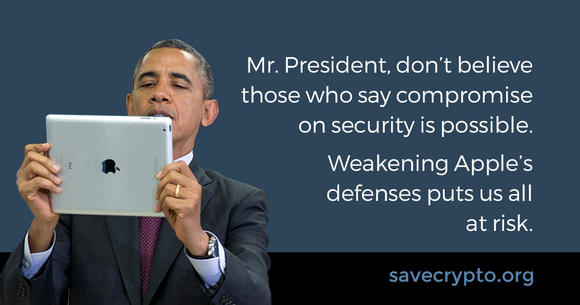
Over 100,000 people have called for President Obama to stand up for security in our devices through savecrypto.org. It’s time for the president to be accountable to them, and to all of us.
We ask our supporters to join this call by sharing this graphic with President Obama and the rest of the world.  SHARE ON TWITTER
President Obama on an iPad
In this fraught debate, we must let facts and reason prevail. We cannot compromise on our security or liberty. 
ACLU logo
Access Now logo
Electronic Frontier Foundation logo
David Greene talks to former national security official Richard Clarke about the fight between Apple and the FBI. The FBI wants an iPhone that was used by one of the San Bernardino shooters unlocked.

DAVID GREENE, HOST:
In the long debate over an iPhone, there has been a voice missing - President Obama's. It is not clear how he feels about the Justice Department demanding that Apple help unlock the phone belonging to one of the San Bernardino shooters. But over the weekend, Obama did say this.
(SOUNDBITE OF ARCHIVED RECORDING)
PRESIDENT BARACK OBAMA: If, technologically, it is possible to make an impenetrable device or system where the encryption is so strong that there's no key - there's no door at all - then how do we apprehend the child pornographer? How do we solve or disrupt a terrorist plot?
GREENE: Disrupting terrorist plots was Richard Clarke's mission for years. And we're adding his voice this morning in the ongoing debate over whether Apple should design a way for the government to break into that iPhone. Richard Clarke led counterterrorism efforts for two presidents - Bill Clinton and George W. Bush.
RICHARD CLARKE: For nine years, I was the senior counterterrorism official in the U.S. government. And I went to bed every night worrying about terrorist attacks. Had I done enough to stop a terrorist attack that might be out there that I don't know about? I know what the counterterrorism feels like because I was there. But I also operated within limits. And within the United States government, we've decided long ago that there are limits on what we're going to do in the war against terrorism. Under the Obama administration, for example, we've said we're not going to torture people. You know, we could, at the far extreme to make the FBI's job easier, put ankle bracelets on everybody so that we'd know where everybody was all the time. That's a ridiculous example, but my point is encryption and privacy are larger issues than fighting terrorism.
GREENE: But can you just explain why you would compare, you know, a company helping the government design a way to unlock an iPhone to something extreme as torture and ankle bracelets? I mean, that sounds like a very extreme jump.
CLARKE: No, the point I'm trying to make is there are limits. And what this is is a case where the federal government, using a 1789 law, is trying to compel speech. And courts have ruled in the past, appropriately, that the government cannot compel speech. What the FBI and the Justice Department are trying to do is to make code writers at Apple - to make them write code that they do not want to write that will make their systems less secure.
GREENE: And why do you say that's compelling speech, just so I understand that?
CLARKE: Well, they're compelling them to write code. And the courts have ruled in the past that computer code is speech.
GREENE: Some have said that while this seems like it could be a dangerous precedent, it's not because Apple has had to relent to pressure in the past and has been willing to do so. And I've been reading about, you know, last year when China - the Chinese government - requested data on a few thousand iPhones and Apple was willing to offer it. I mean, that sounds to some, I would imagine, like a scarier thing than helping the U.S. government unlock one iPhone.
CLARKE: Apple helps law enforcement organizations in the United States and Apple helps law enforcement organizations overseas when they have a duly authorized request for material that Apple has. Apple doesn't have this material. If it were in the Cloud, if the FBI and the San Bernardino County hadn't made a mistake on the way they treated this phone, this information would be in the iCloud and Apple would allow access to that because Apple has that information.
GREENE: What do you know about the debate within the Obama administration? It's been reported that there really is a fierce debate over how to handle this.
CLARKE: Well, I don't think it's a fierce debate. I think the Justice Department and the FBI are on their own here. You know, the secretary of defense has said how important encryption is when asked about this case. The National Security Agency director and three past National Security Agency directors, a former CIA director, a former Homeland Security secretary have all said that they're much more sympathetic with Apple in this case. You really have to understand that the FBI director is exaggerating the need for this and is trying to build it up as an emotional case, organizing the families of the victims and all of that. And it's Jim Comey and the attorney general is letting him get away with it.
GREENE: So if you were still inside the government right now as a counterterrorism official, could you have seen yourself being more sympathetic with the FBI in doing everything for you that it can to crack this case?
CLARKE: No, David. If I were in the job now, I would have simply told the FBI to call Fort Meade, the headquarters of the National Security Agency, and NSA would have solved this problem for them. They're not as interested in solving the problem as they are in getting a legal precedent.
GREENE: Wow, that sounds like quite a charge. You're suggesting they could have just gone to the NSA to crack this iPhone but they're presenting this case because they want to set a precedent to be able to do it in the future?
CLARKE: Every expert I know believes that NSA could crack this phone. They want the precedent that the government can compel a computer device manufacturer to allow the government in.
GREENE: Richard Clarke, thanks so much for talking to us. We appreciate it.
CLARKE: Thank you, David.
Copyright © 2016 NPR. All rights reserved. Visit our website terms of use and permissions pages at www.npr.org for further information.
NPR transcripts are created on a rush deadline by a contractor for NPR, and accuracy and availability may vary. This text may not be in its final form and may be updated or revised in the future. Please be aware that the authoritative record of NPR’s programming is the audio.

Viral image
Number of Americans killed by terrorism in the last decade: 24. Number of Americans killed by guns in the last decade: 280,024.
— Viral image on Thursday, October 1st, 2015 in a Facebook post

Fact-checking a comparison of gun deaths and terrorism deaths

A viral image compares the number of gun-related deaths and terrorism-caused deaths in the United States in the past decade. (Photo from NowThis)

In the wake of the Oct. 1 shooting at Umpqua Community College in Oregon, President Barack Obama tasked the media to put the number of gun violence-related deaths into perspective.
"Have news organizations tally up the number of Americans who've been killed through terrorist attacks in the last decade and the number of Americans who've been killed by gun violence, and post those side by side on your news reports," he said in his address on the shooting. "We spend over a trillion dollars, and pass countless laws, and devote entire agencies to preventing terrorist attacks on our soil, and rightfully so. And yet, we have a Congress that explicitly blocks us from even collecting data on how we could potentially reduce gun deaths. How can that be?" 
Obama's underlying point was to highlight the lack of resources and legislative action taken on gun violence. Some have questioned the merit of such a comparison -- for example, critics have pointed out that cigarettes kill more people than guns. We're not weighing in on that debate. Rather, we're looking just at the data. 
Multiple outlets obliged (though each came up with slightlydifferent numbers). Several readers asked us to check out one specific comparison widely shared on Facebook and Twitter. It was created by NowThis, a New York-based news company that produces content specifically for social media.
The image says that 24 Americans have been killed by terrorism in the last decade, while 280,024 Americans were killed by guns.
While NowThis’ numbers aren’t perfect, the overarching point is accurate. There have been far more deaths from gun violence than from terrorist attacks.
Walking through the math
Let’s start with the tally for terrorist-related deaths. NowThis senior editorial producer Versha Sharma told PolitiFact that the 24 figure refers to the number of U.S. citizens killed by terrorist attacks on U.S. soil, and does not include deaths abroad.
Sharma acknowledged that this could have been made clear in the graphic. But she maintained that it’s more apt to compare domestic gun deaths to domestic terrorism deaths. Counting terrorist attacks abroad, she said, would make it an apples to oranges comparison.
The number comes from the nonpartisan think tank the New America Foundation’s count of lethal jihadist attacks on U.S. soilfrom 2005 to 2015. It includes for example the four people killed during the Boston Marathon bombing in 2013 and the 13 deaths from the Fort Hood shooting in 2009.
To get to 280,024 gun deaths, NowThis compiled data from the Centers for Disease Control and Prevention’s National Vital Statistics System and the Mass Shooting Tracker, a crowd-sourced project that tallies deaths and injuries in mass shootings.
According to the CDC, the number of violent gun deaths between 2005 and 2013 (the latest year on record) was 279,976. That includes suicides, homicides, and police-related shootings. Mass Shooting Tracker counts 389 mass shooting gun deaths in 2014 and 375 so far in 2015.
There are, however, a few issues with these numbers.
For starters, a spokesperson for New America told us it would have been more accurate to include lives lost to both jihadist and non-jihadist extreme violence (47 deaths from 2005 to 2015) for a total count of 71 deaths from terrorist attacks on U.S. soil.
Secondly, Mass Shooting Tracker, as the name implies, only tracks deaths from mass shootings, defined by the group as when four more people are shot in an event. If we look at all gun-related deaths as the CDC does from the past two years, the numbers are much higher.
According the nonprofit project the Gun Violence Archive, there were 12,562 gun deaths in 2014 and 9,959 in 2015 thus far. That’s a grand total of 301,797 firearm-related deaths in the past decade, compared to 71 deaths from domestic acts of terrorism.
If we factor in terrorist attacks overseas, the comparison is still stark. From 2004 to 2014, 303 Americans were killed in terrorist attacks worldwide, according to State Department reports. During that same time frame, 320,523 Americans were killed because of gun violence. Here’s a breakdown:  
Our ruling
A viral image says the number of Americans killed by terrorism in the last decade is 24, while the number of Americans killed by guns in the last decade is 280,024.
NowThis, the creators of the image, told us they only counted lives lost to domestic jihadist attacks, though the image doesn’t specify that. If we look at deaths due to all extremist attacks on U.S. soil, the number goes up to 71. A more accurate count for gun deaths between 2005 and 2015 is 301,797.
Though the image’s numbers are slightly off, that doesn’t undercut the point: guns have claimed many more lives than terrorist attacks. We rate the claim Mostly True.
About this statement:
Published: Monday, October 5th, 2015 at 11:55 a.m.
Researched by: Linda Qiu
Edited by: Angie Drobnic Holan
Subjects: GunsTerrorism

Sources:

Phone and email interviews with Versha Sharma, senior editorial producer at NowThis, Oct. 2, 2015
Email interview with David Sterman, program associate at the New America Foundation, Oct. 2, 2015
Facebook, NowThis post, Oct. 1, 2015
Centers for Disease Control and Prevention,National Vital Statistics System search, accessed Oct. 2, 2015
U.S. Department of State, Terrorism Deaths, Injuries and Kidnappings of Private U.S. Citizens in 2010, accessed Oct. 2, 2015
U.S. Department of State, Terrorism Deaths, Injuries and Kidnappings of Private U.S. Citizens in 2009, accessed Oct. 2, 2015
U.S. Department of State, Terrorism Deaths, Injuries and Kidnappings of Private U.S. Citizens 2007, accessed Oct. 2, 2015
Federal Bureau of Investigation, Definitions of Terrorism in the U.S. Code, accessed Oct. 2, 2015