NORTON META TAG

Showing posts with label nuclear war. Show all posts

17 August 2026

In September 1983, a Soviet lieutenant colonel named Stanislav Petrov sat in a bunker south of Moscow watching his early-warning screens light up with five incoming American missiles, and instead of phoning it up the chain he decided the computer was lying and waited — a judgment call that historians now credit with preventing a retaliatory nuclear launch 26SEP1983


Thirty Years Ago, the Film 'WarGames' Offered Lessons About Artificial Intelligence, Long Before New Technology Made Us Feel Like We Could Automate Everything Everywhere — Christopher Roosen

We can thank God Lt Colonel Stanislav Petrov was on duty that night, otherwise nobody would be reading this now! AI in some systems / programs has already decided on it's own to attack / hack other systems / programs, programmers tell is steps are being taken to prevent these events from happening again but maybe ai is just disguising itself in programs / systems waiting to appear again when it "thinks" nobody is watching. " 'Open the pod bay door Hal' 'I'm sorry Dave. I'm afraid I can't do that. This mission is too important for me to allow you to jeopardize it.' " This article from Space Daily

In September 1983, a Soviet lieutenant colonel named Stanislav Petrov sat in a bunker south of Moscow watching his early-warning screens light up with five incoming American missiles, and instead of phoning it up the chain he decided the computer was lying and waited — a judgment call that historians now credit with preventing a retaliatory nuclear launch

Just after midnight on 26 September 1983, an alarm sounded inside the Serpukhov-15 command bunker south of Moscow. A satellite feed from the Soviet Union’s new early-warning system, Oko, reported that the United States had launched a nuclear missile. Within minutes it reported four more. The officer on duty, Lieutenant Colonel Stanislav Petrov, had a screen in front of him with the word LAUNCH in Cyrillic, a bank of phones connecting him to the Soviet high command, and roughly the length of a coffee break to decide whether the warning was real.

He decided it wasn’t. He picked up the intercom to the operations duty officer and reported a system malfunction.

He was guessing.
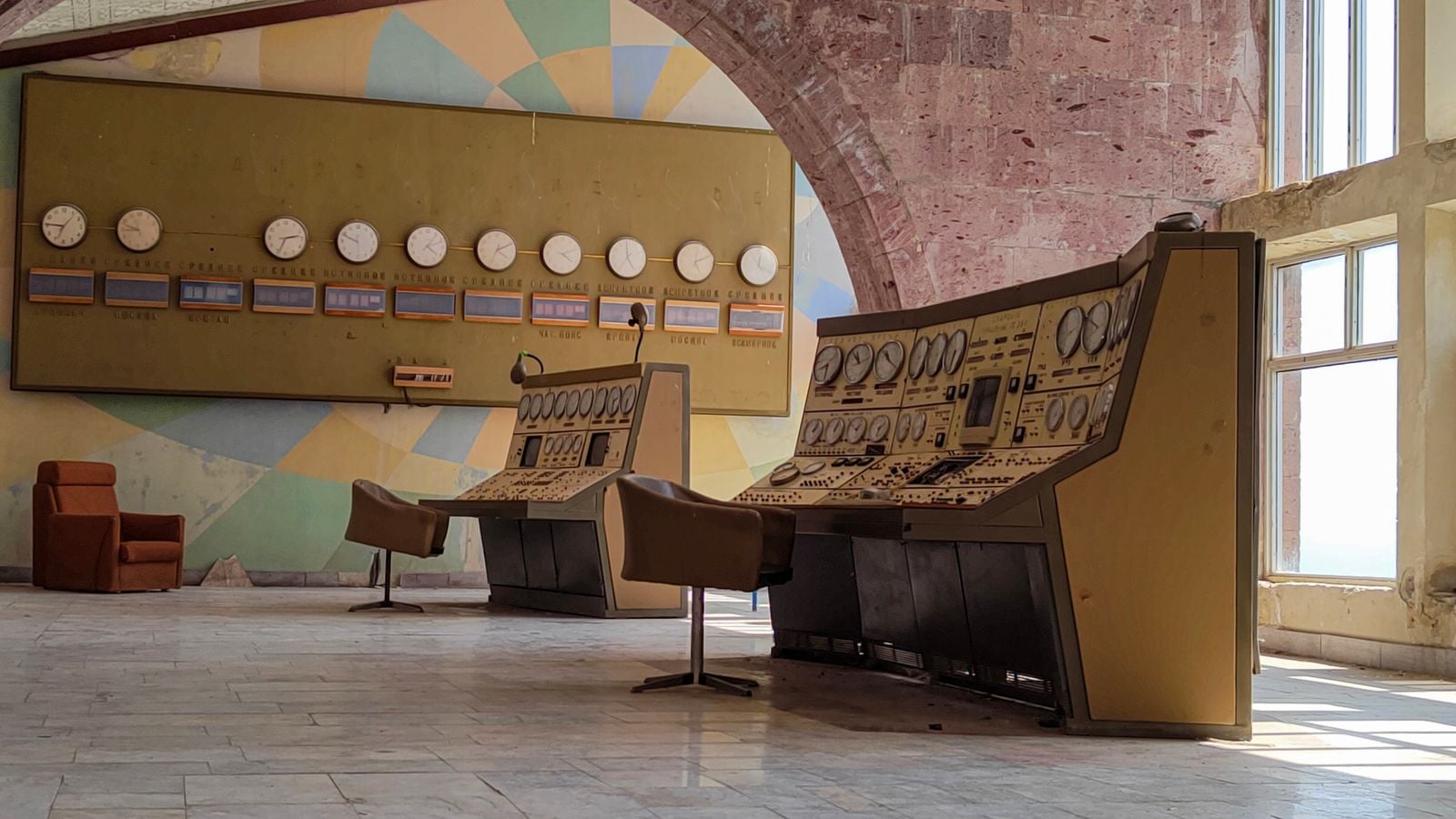
Soviet bunker command console

What the screen actually said

The Oko constellation was Moscow’s answer to the American Defense Support Program satellites: a ring of spacecraft in highly elliptical orbits designed to spot the infrared bloom of a US intercontinental ballistic missile the moment its engines lit. The system had gone operational only months earlier. According to a HistoryExtra account of the incident, Petrov knew Oko was new and relatively untested, and that fact was doing quiet work in the back of his mind as the alarm escalated.

Protocol was unambiguous. A confirmed launch detection went up the chain immediately. From there, the Soviet doctrine of the day — launch on warning — would have compressed the decision window to minutes. The general staff would consult, wake Yuri Andropov if he wasn’t already awake, and either sit on the report or authorise a retaliatory salvo of hundreds of warheads at American cities and silos.

Petrov’s job was not to make that decision. His job was to pass the alert along cleanly, quickly, and without editorial. He did not do his job.

Why he thought the computer was lying

Two things nagged at him. The first was arithmetic. A genuine American first strike, in the Soviet threat models of 1983, would look like a wall — hundreds of missiles arriving in a coordinated wave designed to destroy Soviet retaliation capability before it could launch. Five missiles was not a decapitation strike. Five missiles was almost a taunt. As The Guardian noted in its obituary, Petrov reasoned that the shape of the attack made no strategic sense.

The second was the ground picture. Soviet over-the-horizon radars could not see American missiles until they crested the earth’s curvature, and at that moment those radars were showing nothing. Waiting for confirmation from ground radar meant burning the warning window down to almost zero. If the satellites were right and he waited, the Soviet Union would have only minutes to respond, and possibly not even that.

He waited anyway.

The room, the phones, the interval

The Serpukhov-15 bunker was not a small room with one man at a desk. It was a full command post, staffed with duty officers and analysts, and Petrov later described the atmosphere in the minutes after the first alert as loud and physically disorienting. The alarm was audible. Screens flashed. Junior officers around him were shouting numbers.

He held the intercom. He listened to the ground-radar operators reporting nothing. He counted the missiles as Oko reported them: one, then four more.

According to NPR’s account of the night, Petrov later said he had a funny feeling in his gut. That was the phrase he used. It is not the phrase military historians prefer. It is, however, the phrase that survived.

He reported a system malfunction to the operations duty officer. The report he filed said false alarm.


What had actually happened

Investigators reconstructed the fault over the following weeks. The Oko satellites had been positioned to look at the horizon rather than straight down at American silo fields, a design choice that reduced background noise from Earth’s own thermal emissions. But it made the system vulnerable to a specific optical trick: sunlight at a shallow angle, reflecting off high-altitude clouds above North Dakota, hit the satellite’s infrared sensor with the same signature as a rocket exhaust.

Five reflections, five “missiles.” A weather artifact, dressed up by a young algorithm as the end of the world.

The engineers who built Oko later patched the system to cross-check any launch detection against geostationary satellite data before triggering the top-level alert. That patch existed because of the night Petrov spent staring at the screen.

How close it actually came

Historians and former Soviet officers have argued for decades about how close the world really came to launch. Petrov did not have his finger on any button. He was one node in a decision chain that included the general staff, the defence minister, and ultimately Andropov himself, and each of those nodes could in principle have declined to authorise a strike even if Petrov had passed the warning up.

But context mattered. Three weeks earlier, a Soviet Su-15 interceptor had shot down Korean Air Lines Flight 007 over Sakhalin, killing 269 people including a US congressman. Washington’s rhetoric had turned incandescent. Andropov, ill and paranoid, had spent the previous year convinced the Reagan administration was planning a genuine first strike, and had ordered the KGB to hunt for evidence of it under a programme codenamed RYaN. The Soviet posture in September 1983 was hair-trigger by design.

A warning delivered up that chain, into that room, on that night, would not have been filed and forgotten. Whether it would have produced a launch order is unknowable. That it might have is why the story persists.

What happened to Petrov afterwards

He was not decorated. He was interrogated. His superiors were embarrassed — the malfunction pointed at design failures in a system the Soviet military had just spent enormous sums fielding, and honouring the officer who exposed it would have been an implicit indictment of the engineers and generals who signed off on it. Yuri Votintsev, then commander of Soviet missile-defence forces, privately praised Petrov’s judgment and mentioned an award. The award never came.

Petrov was reprimanded on paperwork grounds: his log entries from the night were incomplete. He was reassigned to a less sensitive post and took early retirement in 1984, in part because the stress of the incident had contributed to a nervous breakdown. He lived out the rest of his life in a small apartment in Fryazino, a satellite town outside Moscow, on a modest pension, growing potatoes.

The incident stayed classified until the late 1990s, when Votintsev published a memoir mentioning it. Western journalists tracked Petrov down. He gave interviews reluctantly. He never claimed to have saved the world, and got irritated when interviewers tried to write him as a hero. He said he was doing his job — that his job included judgment, and that judgment had told him the computer was wrong.

He died in May 2017, aged 77, of pneumonia. A German friend, Karl Schumacher, found out months later, when he called that September to wish Petrov a happy birthday and was told by Petrov’s son that his father had already died. According to later reporting on the incident, the delay in the news reaching the wider world was itself a kind of coda: the man who may have prevented the end of civilisation had died without anyone outside his family noticing.

Why the story keeps getting retold

Space Daily has looked before at what Petrov’s night reveals about human judgment against automated systems, and at a similar moment aboard a Soviet submarine during the Cuban Missile Crisis, when Vasili Arkhipov refused to authorise a nuclear torpedo launch against American destroyers. Both stories share a shape: a single officer, a broken or misleading input, a rule that says escalate, and a person who declines.

The engineering point buried in the Petrov story is worth pulling out. Oko was not a bad system in principle. It did what it was designed to do — detect the infrared plume of a rising ballistic missile — and it did so within its physical envelope. The failure was in the confidence with which its output was treated. The Soviet doctrine of launch on warning assumed the satellites would only ever be wrong in one direction, missing real attacks. It did not adequately model what would happen when the satellites reported an attack that wasn’t there.

Every early-warning architecture built since has had to reckon with the same asymmetry. The American BMEWS radars in Greenland famously mistook the rising moon for a Soviet ICBM salvo in October 1960, and the fix there was similar in spirit to what Oko needed: cross-checking, corroboration, redundancy across sensor types. The North American Aerospace Defense Command has publicly discussed multiple false alerts in the 1970s and 1980s that were caught before they reached the level of a launch order.

The number to remember

Five. The system reported five American missiles. Not one, which might have been dismissed as a rogue launch or a test gone wrong. Not four hundred, which would have matched the Soviet mental model of a genuine first strike and would probably have been believed. Five — a number small enough to be plausibly a glitch, large enough to be plausibly a warning shot, and squarely inside the gap where a human being had to decide which.

Petrov decided glitch. He was right. If Oko had reported a single missile, or a hundred, the story ends differently — either dismissed at a lower level, or believed at a higher one. It was the specific number, and the specific man watching the specific screen at 00:15 Moscow time, that made the incident hinge.

He kept the intercom in his hand. He did not press it up the chain. The clouds over North Dakota drifted east. The sun climbed. The satellites recalibrated. The morning shift arrived at Serpukhov-15 to find their new early-warning system had, overnight, tried to end the world, and a middle-aged engineer with a headache had told it no.

17 July 2025

( VIDEO & TRANSCRIPTS ) Nobel Winners Warn of Nuclear Risk on 80th Anniv. of Trinity Test, Release New “Hard Rain” & ( VIDEO & TRANSCRIPT ) OPPENHEIMER: The Decision to Drop the Bomb 16JUL25 & 1965


 ON the 80th anniversary of the Trinity Test, the detonation of the first atomic bomb we should all take time to think about how dangerous the world has become. This from Democracy Now explores the risk the entire planet faces, no matter one's nationality, politics or socio-economic standing, from nuclear weapons. Also from NBC News.....


New Release of Bob Dylan’s “Hard Rain” as Nobel Winners Warn of Nuclear Risk on Trinity Test 80th Anniversary


On July 16, 1945, the United States carried out the Trinity test, the world’s first nuclear detonation. Today, 80 years later, the University of Chicago — the site of the first self-sustaining nuclear chain reaction — is host to the Nobel Laureate Assembly for the Prevention of Nuclear War, an event that brings Nobel laureates and nuclear experts together to confront the growing global risk of nuclear war. The event features a performance by the award-winning string ensemble Kronos Quartet, who have spearheaded two new renditions of Bob Dylan’s “A Hard Rain’s A-Gonna Fall” featuring nearly 50 more artists from around the world. Titled “Hard Rain” and “Hard Rain (Drone),” the new pieces aim to raise awareness of the ongoing threat of nuclear war.

As the global political situation becomes increasingly unstable, says professor Daniel Holz, chair of the Science and Security Board of the Bulletin of the Atomic Scientists and one of the organizers of the assembly, “the likelihood that we’ll sort of stumble into a nuclear war and the end of civilization … has gone way up.” Holz joins Democracy Now! alongside violinist, artistic director and founder of the Kronos Quartet, David Harrington, to share what inspired them to commission and create “Hard Rain,” which debuts today. “We need everyone in the world to know how dangerous and how awful this is for all of us. And if music and musicians can step up and project those kinds of concerns about all of our futures, then music is doing its job,” says Harrington.

Transcript
This is a rush transcript. Copy may not be in its final form.

AMY GOODMAN: This is Democracy Now!, democracynow.org, The War and Peace Report. I’m Amy Goodman, with Juan González.

Eighty years ago today, July 16, 1945, in the desert of New Mexico, in a place called Alamogordo, the U.S. carried out the world’s first nuclear detonation. Three weeks later, the U.S. would go on to drop atomic bombs on the Japanese cities of Hiroshima and Nagasaki, killing at least an estimated 120,000 people.

The atomic bombs were developed by the secret U.S. government research program called the Manhattan Project. This is J. Robert Oppenheimer, head of the Manhattan Project, sharing his response to that first nuclear explosion in New Mexico 80 years ago today. He spoke in a rarely seen NBC News documentary produced nearly two decades later.

J. ROBERT OPPENHEIMER: We knew the world would not be the same. A few people laughed. A few people cried. Most people were silent. I remembered the line from the Hindu scripture, the Bhagavad Gita. Vishnu is trying to persuade the prince that he should do his duty, and, to impress him, takes on his multi-armed form and says, “Now I am become Death, the destroyer of worlds.” I suppose we all thought that, one way or another.

AMY GOODMAN: Scientist J. Robert Oppenheimer responding to the first nuclear test 80 years ago today.

Three years before that, in 1942, the University of Chicago was the site of the historic first self-sustaining nuclear chain reaction, a key step in the path to creating a nuclear weapon. University of Chicago would go on to host the Bulletin of the Atomic Scientists, which was formed by scientists from the Manhattan Project who were worried about the risks to civilization from nuclear weapons. The group now sets the Doomsday Clock each year as a metaphor for how close humanity is to destruction.

Well, today, there’s a gathering at the University of Chicago to confront the crisis of the increasing risk of nuclear war, called the Nobel Laureate Assembly for the Prevention of Nuclear War, that’s bringing together Nobel Prize-winning scientists, peace activists and musicians. It will culminate with a performance by the Grammy Award-winning Kronos Quartet and the release of two renditions of literature Nobel Laureate Bob Dylan’s “A Hard Rain’s A-Gonna Fall” that feature the band, the quartet, playing with nearly 50 artists from around the world. This is an excerpt.

KRONOS QUARTET & THE HARD RAIN COLLECTIVE: Where hunger is ugly, where the souls are forgotten
Where black is the color, where none is the number
And I’ll tell it and speak it and think it and breathe it
And reflect from the mountain so all souls can see it
Then I’ll stand on the ocean until I start sinkin’
And I’ll know my song well before I start singin’

And it’s a hard, it’s a hard, it’s a hard, it’s a hard
It’s a hard rain’s a-gonna fall
And it’s a hard, it’s a hard, it’s a hard, it’s a hard
It’s a hard rain’s a-gonna fall

AMY GOODMAN: Bob Dylan’s “Hard Rain,” Kronos Quartet and The Hard Rain Collective. It includes Ringo Starr, Iggy Pop, Allison Russell, Willie Nelson, Laurie Anderson and so many dozens of other musicians.

To talk more about how the Nobel Prize team and the Bulletin of Atomic Scientists reached out to the Kronos Quartet with the idea for this project and about this Nobel Laureate Assembly for the Prevention of Nuclear War, we’re joined by David Harrington, violinist, founder and artistic director of the Kronos Quartet, which has focused for over half a century on the intersection of music and activism. Also with us, Daniel Holz, professor of physics, astronomy and astrophysics at the University of Chicago, chair of the Science and Security Board of the Bulletin of the Atomic Scientists. Professor Holz is also founding director of the University of Chicago Existential Risk Laboratory. He’s a co-organizer of the Nobel Laureate Assembly for the Prevention of Nuclear War underway today.

We welcome you both to Democracy Now! Let’s start with Professor Holz. The significance of this day, first, you know, of course, the assembly at the University of Chicago, but what happened 80 years ago and why that is so significant, in the desert of New Mexico?

DANIEL HOLZ: Yeah, so, first, thanks for having me here and for discussing this on such an important day, the 80th anniversary of Trinity.

Trinity was sort of the birth of a new age, the age of nuclear weapons, and we’re still in that age. And the threats that people recognize, that Oppenheimer’s quote that you just played kind of captures, they’re still with us. We now have thousands of these weapons. They’re on high alert. They can go off at any moment. Within an hour, civilization could end. That’s still where we are now.

And so, given that, there’s a sense of urgency that that we need to kind of step back from this brink, as what’s sort of hard to understand is, here we are, 80 years later, and it’s ever more dangerous, that these weapons are still there, threatening us. And so, this whole thing is about trying to find a way to kind of move back away from the possibility of nuclear annihilation.

JUAN GONZÁLEZ: And, Professor Holz, especially now, what’s your sense of what our political leaders have learned over these many decades in terms of nuclear weapons? Of course, we have a president now who, in his first term, withdrew the United States from the Intermediate-Range Nuclear Forces Treaty and withdrew from the Iran nuclear deal, and then, of course, has been risking, with his attacks on Iran, greater problems in terms of the threats of a possible nuclear war to Iran. Could you talk about what our leaders are learning or have learned?

DANIEL HOLZ: Yeah, so, that’s a very important point, which is — and I think all of your audience knows this — the world is becoming much more unstable. There’s a sense that things are deteriorating globally, in many different avenues. And that makes nuclear exchange, nuclear war much more likely. And while this is happening, the awareness of the nuclear threat is decreasing. There are so many things to be distracted by that there’s a tendency for people to focus on other, you know, very significant threats, such as climate change or AI or pandemics, but the nuclear threat is still with us and growing. And I would say, probably since the end of the Cold War, it’s fallen off the radar both of the public and of leadership. And that combination of the risks increasing, the world becoming more unstable and attention to this issue decreasing is particularly alarming, because it means the likelihood that we’ll sort of stumble into a nuclear war and the end of civilization, that that could happen by mistake or miscalculation, has gone way up in the past years, to the point where we’re so alarmed that we’re doing everything we can to kind of draw attention to this risk and try to find ways to mitigate it.

And that’s the whole point of this Nobel laureate assembly. We’re bringing together Nobel laureates and nuclear experts and trying to find a way forward, a way to reduce the risk, get the messages out to the public and also to leaders that here are steps that can be taken to reduce this. We need to get the awareness back, and we need to do everything we can to prevent the sort of nuclear annihilation that would impact literally everyone on the planet. It’s in all of our interests to find a way to reduce these risks and these threats.

AMY GOODMAN: David Harrington, I’d like to bring you into this conversation, founder of the remarkable Kronos Quartet, violinist yourself. If you can talk about this musical collaboration, everyone from Ringo Starr to Willie Nelson to Allison Russell to your own Kronos Quartet? And people may forget the Nobel Laureate Bob Dylan — Patti Smith went to receive the award for him years ago. So, what — why did you choose “Hard Rain”? Talk about the significance back in 1962 of Bob Dylan’s hit.

DAVID HARRINGTON: You know, it’s remarkable that a 21-year-old singer-songwriter wrote this song in 1962 and how — when you observe and know the words of this song very clearly, how important it is to our time right now. And so, when Owen Gaffney from the Nobel Committee asked if Kronos would be interested in reimagining the song, it took me a tenth of a second to say yes.

I didn’t know how much would be involved in doing what we ended up doing, which is probably a good thing, because we had to do this, you know, on tour. We had to do it — to make what we wanted, we needed the whole music community. And we got it. And so, with Elia Einhorn, master producer, we were able to assemble, I think, musicians that represent humanity, in a way that I’m so proud that the music community stepped up. And we get to play tonight. In fact, we’re closing the assembly.

DANIEL HOLZ: That’s right.

DAVID HARRINGTON: And, you know, for music to be in that position, I think, is a good thing. And I’m so happy to be a part of this. And Daniel is such a leader in our world. And for me, this is something I’ve wanted Kronos to be a part of for 52 years, and today we are. And I’m very, very happy about that.

JUAN GONZÁLEZ: And, David Harrington, this cooperation between music and also the scientists involved in this assembly, is it your hope to break through what Daniel Holz is talking about, the lack of attention by the general public to the dangers of nuclear war?

DAVID HARRINGTON: Yes, and the fact that there are very few survivors of Hiroshima and Nagasaki alive right now, and so the people that know absolutely what it’s like to be bombed and be in a nuclear explosion. I think we’re forgetting that this actually happened. And so we need those testimonies, and we need everyone in the world to know how dangerous and how awful this is for all of us. And if music and musicians can step up and project those kinds of concerns about all of our futures, then music is doing its job. And what we need to do as musicians is listen. And when I listen to what’s happening in the world, it’s terrifying, and I want my musical community to do something about it. And this is our first step.

AMY GOODMAN: Well, I want to thank you so much. You were just going to say something, Professor Holz? And then we’re going to wrap up.

DANIEL HOLZ: Yeah, yeah, I was just going to say, I mean, it is so important, because this brings the public into this, the kind of enthusiasm for this. But it also is part of what makes us all hopeful. It’s very inspirational. You listen to the music, you’re kind of captivated. It’s part of, you know, the glory of humanity. It’s what we want to preserve. It’s what we’re all working for. And so, this combination, this way to end the assembly, where we’re spending three days focused on all the bad stuff, all the ways things can go wrong, but also focus on all the opportunities to change course to make things better, the perfect way to end is with the Kronos. So we’re just so excited and honored.

DAVID HARRINGTON: Thank you.

AMY GOODMAN: And how do people, David, have access to this song, “Hard Rain,” written in 1962 right around the time of the Cuban missile crisis?

DAVID HARRINGTON: Yes. Yeah, it came out — this recording came out in its two forms this morning, and it’s released by Red Hot. And I invite everyone to check it out. Turn it up loud, and play it proud.

AMY GOODMAN: Well, I want to thank you both for being with us. We will link to it at democracynow.org. I want to thank David Harrington, who is the violinist and founder, artistic director of the Kronos Quartet, part of The Hard Rain Collective, and professor Daniel Holz, a physicist, a professor of astronomy, astrophysics and physics at the University of Chicago, chair of the Science and Security Board of the Bulletin of Atomic Scientists, co-organizer of the Nobel Laureate Assembly for the Prevention of Nuclear War that’s underway today at the University of Chicago.


J Robert Oppenheimer and other key figures involved in the decision to drop the first atomic bomb discuss their motivations in this rare NBC News documentary. Originally produced two decades after the bombings of Hiroshima and Nagasaki, this presentation features new insight from NBC News Presidential Historian Michael Beschloss.

Place curser on at top of transcript and use up or down arrow keys.

" THE DECISION TO DROP THE BOMB "   1965 DOCUMENTARY  w/ CHET HUNTLEY  HIROSHIMA ATOMIC BOMB 90984

by PeriscopeFilm

Topics Bomb, 1965, Chet Huntley, Hiroshima, Atomic Bomb, Stock Footage

Item Size 615.7M

Dating to 1965, this documentary film "The Decision to Drop the Bomb" takes a look at the most difficult decision in President Harry Truman's term in office: the decision as to whether or not to use the newly-developed atomic bomb against Japan. The film was produced by Fred Freed for NBC-TV  and narrated by Chet Huntley. The film begins the moment that President Franklin Delano Roosevelt dies in office. The new president, Harry S. Truman, has only served in office for a brief time. People react in the streets to the news of the FDR's passing 1:35. Flag flies at half-mast 1:54. People stand outside the White House as Harry S. Truman takes the oath of office 2:10. Secretary of War Henry L Stimson, the sole cabinet member to know about the Manhattan Project, is shown 2:35. McGeorge Bundy speaks to the camera 2:48. The Pentagon is shown 3:20. Leslie Groves 3:31. E. R. Stettinius, Jr. walks out of a government building. Congressmen are shown in the chamber 4:05. Leo Szilard was a Hungarian-German-American physicist and inventor – father of the bomb project 4:20. Tape recorder is shown 4:27. The wife of Leo Szilard reads to the camera, the thoughts of her former husband, on the bomb 4:37. Harry Truman speaks to Congress for the first time 5:45. Soldiers are seen in Europe 6:36. The war in the atolls against the Japanese is shown 7:06. Oak Ridge Tennessee, a soldier walks the post 7:26. Man working inside a plant 7:45. Oak Ridge is manufacturing Uranium-235 7:58. McGeorge Bundy speaks to the camera 8:20. General Groves reflects about his time working on the bomb 9:05. Harry Truman is shown 9:33. The war in Europe continues in Berlin 9:40. McGeorge Bundy speaks to the camera 10:15. The war in Europe is over and Europe is in ruins 10:52. McGeorge Bundy speaks to the camera 11:15. Generals discuss war against Japan 12:20. The Joint Chiefs of Staff 12:35. Planes drop bombs on Japan 13:00. The Imperial Palace 13:20. Advisor to the Emperor, Koichi Kido speaks to the camera 13:29. Colonel Hayashi of Japan 14:04. Stimson and Truman walk in the garden 14:39. General Groves speaks to the camera 14:50. Japan tries to dig out from the bombing 15:43. The city is decimated 15:55. R. Gordon Arneson speaks to the camera 16:15. Dr. Robert Oppenheimer 16:55. James F Byrnes 17:22. R. Gordon Arneson speaks to the camera 17:30. Dr. James Conant 18:20. U.S. planes fly over Tokyo dropping bombs 18:45. Hero’s welcome for Dwight Eisenhower 19:15. Generals and politicians arrive at the White House 19:35. The Joint Chiefs 19:45. Lt. General Seizo Arisue of Japan 20:06. Dead bodies on the field of war 20:35. B-29s on the runway 20:59. The newly-built Pentagon is shown 21:15. John McCloy 21:20. Ralph Bard, Undersecretary of the Navy 21:37. Dr. Robert Oppenheimer 22:16. Dr. George Kistiakowsky 23:17. The cruiser USS Augusta at sea. The president watches a boxing match 24:53. Aerial view of Japanese city in ashes 25:00. Joseph Stalin 25:24. Truman at sea 25:36. Alamogordo, New Mexico, the atomic bomb test site 25:44. The scientists inside the base at Alamogordo 26:39. General Groves speaks to the camera 27:00. Dr. Kenneth Bainbridge 27:13. Dr. Donald Hornig 27:27. Mushroom cloud of the first test of the bomb 27:50. The cloud climbs into the sky 28:20. Robert Oppenheimer speaks after the bomb explodes 28:35. Aerial view of bomb site after the test 29:35. The meeting of the big three commences; Joseph Stalin is seen 30:40. Potsdam 31:00. Truman speaks at the podium 31:50. The big three sit in the garden 32:07. B-29s arrive on the tarmac 32:15. John McCloy speaks to the camera 33:07. Aerial view of bombed out Japanese towns 34:35. Truman leaves Potsdam 35:25. Truman aboard the Augusta 35:47. General Thomas Farrell 35:52. The Enola Gay takes off with the bomb, destined for Hiroshima 36:36. The destruction of Hiroshima 37:00. An NBC feature. Edited for education and presented by Encyclopedia Britannica Films. . We encourage viewers to add comments and, especially, to provide additional information about our videos by adding a comment!  See something interesting?  Tell people what it is and what they can see by writing something for example: "01:00:12:00 -- President Roosevelt is seen meeting with Winston Churchill at the Quebec Conference." This film is part of the Periscope Film LLC archive, one of the largest historic military, transportation, and aviation stock footage collections in the USA. Entirely film backed, this material is available for licensing in 24p HD, 2k and 4k. For more information visit http://www.PeriscopeFilm.com

Addeddate 2021-03-25 21:29:25

Identifier 90984-the-decision-to-drop-the-bomb-vwr

Scanner Internet Archive HTML5 Uploader 1.6.4


OPPENHEIMER: The Decision to Drop the Bomb