PRES OBAMA needs to follow through and bring up human rights in china when meeting with pres hu next week. While the U.S. record on human rights is not lilly white (considering our recent record on torture, Gitmo, Bradley Manning, Wikileaks, and Leonard Peltier to name a few) the increased repression of the Chinese, Tibetan and Uygur people, the repression of religious, political, social, environmental, labor and economic rights, the complete and total disregard for human rights by the regime in Beijing needs to be discussed honestly and openly. The prc needs to be told the lack of human rights by the government is unacceptable. Pres Obama also needs to tell the government of pres hu the U.S. supports human rights activist in the Chinese religious communities, that the U.S. supports Liu Xiaobo, 2010 Nobel Peace Prize recipient and all the signers of Charter 08, that the U.S. supports the growing organized labor movement in China. If the regime in Beijing is offended so be it, the free world has been grossly offended by the government of the prc for years.....
President Obama met for more than an hour Thursday at the White House with five advocates for greater civil liberties and human rights in China, just days before Chinese President Hu Jintao's arrival in Washington for a state visit.
The meeting - which lasted 75 minutes in the Roosevelt Room - was part of Obama's preparation for his meetings with the Chinese leader, two senior administration officials said.
It was the first time Obama has met with advocates for human rights in China at the White House.
In a September address at the U.N. General Assembly, the president emphasized the centrality of human rights in U.S. foreign policy. But the administration has been cautious in raising the issue publicly with China, which has traditionally reacted harshly to criticism of its rights record.
On Thursday, Obama questioned the advocates - three of whom were born in China - about how, in the words of one administration official, "the arbitrary exercise of power is felt in the everyday lives of the Chinese people." Obama recalled his own childhood in Indonesia, then governed by dictatorship.
"One thing he kept coming back to was, how does the omnipresence of the state, how does corruption, affect the lives of real people," the official said, speaking on condition of anonymity. "And he asked how we should use our leverage. Where should we use our leverage?"
"There was a lot of talk about how to reach into China to be heard," the official continued. "He was very, very interested in that."
While economic and security issues are likely to be the focus of much of Hu's visit, how Obama manages the topic of human rights will likely help define the summit and provide clues to how the president intends to speak about the contentious subject with China in the years ahead.
By hosting Hu, who arrives Wednesday, Obama will achieve the distinction of becoming the first U.S. president to host a head of state who is currently holding a Nobel Peace Prize laureate in prison.
The Chinese writer and democracy advocate Liu Xiaobo was awarded the prize in October, and it was presented to his empty chair in Oslo two months later. Obama, who won the prize the previous year, "welcomed" the Nobel Committee's decision to award the prize to Liu. China condemned it.
At their summit, Obama and Hu are expected to announce the resumption of the U.S.-China "human rights dialogue" after a roughly half-year hiatus. The forum allows U.S. officials to raise with the Chinese government concerns over specific political prisoners, among other issues.
But the subject also holds the most potential to disrupt a visit that Hu views as important to his legacy. He is scheduled to leave the presidency in 2012.
A second senior administration official who attended Thursday's meeting with the human rights advocates said Obama will speak about human rights in his public appearance with Hu and also bring up the issue during their private meetings.
The two will also take questions at a news conference, something U.S. officials insisted on.
"The president's style in talking about human rights is different than others have used," the official said. "His convictions come through strongly, but he is not interested in hectoring, or lecturing, or embarrassing them. He's interested in affecting how people think."
Administration officials said Obama also sought the human rights advocates' assessment of the rising nationalism expressed by young people in China, and what effect it might have on outside efforts to expand civil liberties inside the country.
The human rights advocates who attended the meeting with Obama were Andrew Nathan of Columbia University; Zha Jianying, a Chinese writer and expert on the country's youth culture; Paul Gewirtz, founder of the China Law Center at Yale University; Bette Bao Lord, a Chinese-born writer, democracy advocate and wife of former U.S. ambassador to China Winston Lord; and Li Xiarong, a Chinese human rights advocate since the 1980s now living in exile in the United States.
All have worked extensively inside China. Zha is also a signer of Charter 08, a petition for greater civil liberties and a constitutional democracy that Liu, the imprisoned Nobel laureate, helped write and circulate.
"The meeting was very pluralistic, many different opinions were shared," said the first official. "But the consensus was that human rights has to be on the agenda even if it is awkward. And it makes a difference when it is."

BUCKNACKT'S SORDID TAWDRY BLOG We should not be a journey to the grave with the intention of arriving safely in an attractive & well preserved body, but rather to skid in sideways, chocolate, bier or wein in hand, body thoroughly used up, totally worn out and screaming "WHOO-HOO, WHAT A RIDE!!!!!!"
Showing posts with label Xinjiang. Show all posts
Showing posts with label Xinjiang. Show all posts
14 January 2011

11 December 2010
For China's Absent Nobel Winner, A Lasting Reward 10DEZ10
Friday's presentation marked the first time in 74 years that the award was not handed over. Liu wasn't able to collect the prestigious $1.4 million award in Oslo because he is being held in a Chinese prison.
The 54-year-old writer and democracy activist (his name is pronounced LEE-o SHAo-boh) is serving an 11-year prison sentence on subversion charges for urging sweeping changes to Beijing's one-party communist political system. His wife is under house arrest.
Liu Xiaobo: At A Glance
A 54-year-old poet, literary critic and activist. A look at the human-rights efforts of the first Chinese citizen to receive a Nobel Prize.
1989: Left post at Columbia University in New York to return to China to take part in the pro-democracy movement; jailed for two years for his role.
1996: Publicly questioned China's one-party system and called for a dialogue between the government and the Dalai Lama of Tibet; spent three years in "re-education through labor" for his acts.
2004: Wrote essay criticizing the government's use of "subversion" charges to silence journalists and activists; in response, had his Internet and phone connections cut.
2008: Helped write "Charter 08," a document calling for "universal values" in China, including freedom, equality, democracy and constitutional rule; detained and later formally arrested and charged for "inciting subversion of state power."
2009: Sentenced to 11 years in prison.
2010: Continues to write from jail. An article he wrote for the South China Morning Post in February contains the statement, "Opposition is not equivalent to subversion."
Sources: The Nobel Prize; The PEN American Center
1996: Publicly questioned China's one-party system and called for a dialogue between the government and the Dalai Lama of Tibet; spent three years in "re-education through labor" for his acts.
2004: Wrote essay criticizing the government's use of "subversion" charges to silence journalists and activists; in response, had his Internet and phone connections cut.
2008: Helped write "Charter 08," a document calling for "universal values" in China, including freedom, equality, democracy and constitutional rule; detained and later formally arrested and charged for "inciting subversion of state power."
2009: Sentenced to 11 years in prison.
2010: Continues to write from jail. An article he wrote for the South China Morning Post in February contains the statement, "Opposition is not equivalent to subversion."
Sources: The Nobel Prize; The PEN American Center
Some 1,000 guests, including ambassadors, royalty and other VIPs took their seats in Oslo's modernist City Hall for the two-hour ceremony, among them U.S. House Speaker Nancy Pelosi and U.S. Ambassador Barry White. About 100 Chinese dissidents in exile and some activists from Hong Kong were also attending.
Chinese dissident Wan Yanhai, the only one on a list of 140 activists in China invited by Liu's wife to attend the ceremony, said the jubilation felt by many at Liu's honor will be tinged with sadness.
"I believe many people will cry, because everything he has done did not do any harm to the country and the people in the world. He just fulfilled his responsibility," Wan told The Associated Press. "But he suffered a lot of pain for his speeches, journals and advocacy of rights."
Training A Lens On China
But there's nothing like a Nobel Peace Prize to focus the world's attention on human-rights abuses The award represents an ongoing public relations headache for China over its human-rights record, while potentially turning Liu into a symbol with likely resonance well beyond this week's events.
The Nobel citation calls Liu the "foremost symbol" of the human-rights struggle in China. By giving him the prize — Liu was named the winner in October — the Norwegian Nobel Committee made its own words come true, focusing international attention on his case and potentially elevating him to a status akin to 1991 Nobel Peace Prize winner Aung San Suu Kyi of Myanmar.
Suu Kyi's release from house arrest last month leaves Liu as the sole Nobel Peace Prize winner currently serving time in prison. He becomes the first winner not to be allowed to collect his award since Nazi Germany precluded pacifist Carl von Ossietzky from going in 1935.

Odd Andersen/AFP/Getty Images A man walks in front of a poster of Chinese dissident and Nobel Peace Prize laureate Liu Xiaobo at an exhibition in Oslo. Liu remains in a Chinese prison, and the ceremony has infuriated China's authoritarian government, while presenting it with public relations problems over its human-rights record.
"For those fighting for change in China, the award becomes a symbol of the fact that although China has brought huge economic gains to its population — probably the greatest poverty alleviation in world history — it still has a long way to go when it comes to exercising fundamental human rights," Patrick says.
The country detained hundreds of other dissidents and warned other countries of potential repercussions if they sent representatives to the ceremony in Norway. China also blocked access to the websites of the BBC, Norway's NRK and other news organizations ahead of the ceremony.
Liu In Context
Before being selected for the Nobel Peace Prize, Liu was not especially well-known.
Liu took part in a hunger strike during the 1989 pro-democracy protests in Beijing's Tiananmen Square. Liu has dedicated his award to his fellow protesters.
Read the statement Liu Xiaobo delivered in a Chinese court in 2009 before he was sentenced to 11 years in prison for subversion. In his absence from the Nobel award ceremony Friday, actress Liv Ullman read the speech.
Liu Xiaobo: I Have No Enemies Dec. 10, 2010
Liu was sentenced to prison for 11 years last December on subversion charges.
The award has brought him greater fame — within China, as well as on the international scene.
"The Chinese people are going to be interested about what got Mr. Liu locked up — his writings and particularly Charter 08," says Phelim Kine, an Asia researcher for Human Rights Watch. "Over time, against the government's wishes, Mr. Liu, within China, will have an increasingly high profile."
Kine predicts that Liu's writings "are going to go viral." That remains to be seen. China has kept close control of political discourse on the Internet, through its so-called Great Firewall.
"The Chinese have reacted very harshly to this award," notes Bonnie Glaser, an expert on Chinese foreign and security policy at the Center for Strategic and International Studies in Washington, D.C. "What they care about primarily is the implications domestically. They don't want to hear the Chinese people commenting favorably in the blogosphere or on Twitter about Liu Xiaobo."
Another Dalai Lama?
Glaser is skeptical that Liu will be able to achieve enough lasting prominence and importance within China to be a threat to its regime. But it's clear that the Nobel — and China's response — have brought Liu and the Chinese dissident movement to greater prominence on the international stage.

Odd Andersen/AFP/Getty Images Protesters in Oslo demonstrate outside the Chinese Embassy demanding the release of Liu Xiaobo, the Chinese dissident in jail in China and honored Friday with this year's Nobel Peace Prize.
The question looking ahead is whether Liu's status as a Nobel laureate will continue to grant him a continuing platform as a powerful symbol, as had been the case for earlier dissidents such as Lech Walesa of Poland and Andrei Sakharov of the old Soviet Union.
Over the years, China has sought — without great success — to isolate the Dalai Lama, the spiritual leader of Tibet, who was awarded the prize in 1989.
Foreign leaders visiting China will now frequently, if not inevitably, be asked questions about Liu by their own traveling press corps.
"China really craves soft power — respect for what the country stands for," says Kine, the Human Rights Watch researcher. "For the Chinese government, this is and will continue to be a running sore."
Attempting Coercive Diplomacy
But the prominent role of cash-flush China in the global economy has, so far, made it seemingly immune to the pressures of international public opinion.
"The possibility exists that Liu could become somebody that is seen by various interest groups around the world for advancing human rights in China," says Glaser, the CSIS scholar.
"But I think the Chinese government will work very hard to prevent that from happening," she continues. "There is already considerable pressure being put on companies, not just from Norway, who are actively supporting the award to Liu Xiaobo."
China continues to call Liu a criminal, and its Foreign Ministry spokesman said any country who sent representatives to the ceremony in Oslo were "clowns."
Beijing put pressure on foreign diplomats to avoid the ceremony. China and some 18 other countries — including Russia, Iran, Venezuela and Cuba — declined to attend.
At least 45 of 65 embassies in Oslo accepted invitations.
"My sense is that the Chinese are coming off as extraordinarily heavy-handed and that their effort at trying to extract promises from countries that they actually won't send participants to Oslo is really counterproductive in terms of their global image," says Patrick, who served a six-month stint as a researcher with the Nobel Peace Committee in 1993.
"It illustrates so starkly that the Chinese government is, frankly, afraid of their own people," he says, "as opposed to being a responsible global power that can stand a little internal criticism of its policies."
Material from The Associated Press was used in this report.
10 December 2010
Liu Xiaobo Nobel Peace Prize Ceremony Goes Ahead With Empty Chair 10DEZ10
THE prc shows the world it is still a repressive totalitarian regime, one the world hypocritically condemns for the government's refusal to allow Liu Xiaobo or a family member or representative to be in Oslo to accept the Nobel Peace Prize while investing heavily in china and so in fact funding the prc's human rights violations in china proper, Tibet, Xinjiang and their support of repression, genocide and war crimes and crimes against humanity in Darfur, Burma / myanmar, and n korea. The American government's hypocrisy is especially glaring because of the attacks against Wikileaks for the release of diplomatic cables exposing U.S. manipulation, deception and propaganda campaigns and questional actions around the world.

OSLO, Norway — With his Nobel Peace Prize diploma and medal placed in his empty chair, imprisoned Chinese dissident Liu Xiaobo was given a standing ovation at the award ceremony Friday as dignitaries demanded his release.
It was the first time in 74 years the prestigious $1.4 million award was not handed over, because Liu is serving an 11-year sentence in China on subversion charges for urging sweeping changes to Beijing's one-party communist political system.
China was infuriated when the 54-year-old literary critic won, describing the award as an attack on its political and legal system. Authorities have placed Liu's supporters, including his wife, Liu Xia, under house arrest to prevent anyone from picking up his prize.
In China, both CNN and BBC TV channels went black at 8 p.m. local time for nearly an hour, exactly when the Oslo ceremony took place. Security outside Liu's Beijing apartment was heavy and several dozen journalists were herded by police to a cordoned-off area.
In his speech, Norwegian Nobel Committee Chairman Thorbjorn Jagland called for Liu's release, receiving an unusual standing ovation at the international gathering.
"He has not done anything wrong. He must be released," Jagland said. He noted that neither Liu nor his closest relatives were able to attend the ceremony.
"This fact alone shows that the award was necessary and appropriate," Jagland said.
Liu's Nobel diploma and medal were placed on the empty chair marking his absence.
Norwegian actress Liv Ullman read Liu's final statement, "I Have No Enemies," which he delivered in a Chinese court in 2009 before he was jailed.
The Chinese Foreign Ministry described the award as a "political farce" and said it reflected Cold War mentality and infringed upon China's judicial sovereignty.
"(It) does not represent the wish of the majority of the people in the world, particularly that of the developing countries," ministry spokeswoman Jiang Yu said in Beijing.
In Washington, President Barack Obama said he regretted that Liu and his wife were not allowed to go to the ceremony as he and first lady Michelle Obama did when he won the peace prize last year.
"Liu Xiaobo is far more deserving of this award than I was," he said.
Also Friday, a group of Nobel laureates, including former South African President F.W. de Klerk, Nazi death camp survivor and author Elie Wiesel and Northern Ireland politician John Hume, offered to mediate with the Chinese government for Liu's early release.
The last time a Nobel Peace Prize was not handed out was in 1936, when Adolf Hitler prevented German pacifist Carl von Ossietzky from accepting his award.
China had pressured foreign diplomats to stay away from the Nobel ceremony, with 17 other countries joining their boycott, including Russia, Pakistan, Iran, Venezuela and Cuba. At least 46 of the 65 countries with embassies in Oslo accepted invitations. Serbia, which previously said it would stay away, announced Thursday it would now attend.
Some 1,000 guests, including ambassadors, royalty and other VIPs sat solemnly in atrium hall of Oslo's modernist City Hall for the ceremony, applauding occasionally during the speeches.
U.S. House Speaker Nancy Pelosi, who attended with U.S. Ambassador Barry White, told The Associated Press that it was "an honor" for her to be there.
"It is really a joy of my official life. For decades we have worked for human rights in China and Liu Xiaobo has been a hero to all of us," she said.
About 100 Chinese dissidents in exile and some activists from Hong Kong also attended. Chinese dissident Wan Yanhai, the only one on a list of 140 activists in China invited by Liu's wife to attend the ceremony, said the jubilation felt by many at Liu's honor will be tinged with sadness.
"I believe many people will cry, because everything he has done did not do any harm to the country and the people in the world. He just fulfilled his responsibility," Wan told AP. "But he suffered a lot of pain for his speeches, journals and advocacy of rights."
Wan managed to travel to Oslo because he fled to the United States in May after Chinese authorities increased their harassment of his AIDS advocacy group.
Before the ceremony, 2,000 schoolchildren gathered outside city hall in a display of appreciation for Liu. Some handed letters to Jagland, hoping he could convey their greetings to the jailed laureate.
Jagland said awarding the prize to Liu was not "a prize against China," and he urged Beijing that as a world power it "should become used to being debated and criticized."
Outside Parliament, the Norwegian-Chinese Association held a pro-China rally with a handful of people proclaiming the committee had made a mistake in awarding the prize to Liu.
China's furious assault on Liu's award has reached proportions last seen during the Soviet and Nazi regimes. But even Cold War dissidents Andrei Sakharov of the Soviet Union and Lech Walesa of Poland were able to have their wives collect the prizes for them. Myanmar democracy activist Aung San Suu Kyi's award was accepted by her 18-year-old son in 1991.
The Kremlin forced writer Boris Pasternak of the Soviet Union to decline his 1958 literature prize. French writer Jean-Paul Sartre declined the 1964 literature prize because he had consistently declined all official honors.
In 1973, North Vietnamese negotiator Le Duc Tho was awarded the peace prize jointly with U.S. Secretary of State Henry Kissinger but said he could not accept it, citing continued fighting in Vietnam as his reason.
In the Swedish capital of Stockholm, the other Nobel laureates were being honored in a separate ceremony Friday. Winners in literature, physics, chemistry and economics were receiving their awards from Sweden's King Carl XVI Gustaf.
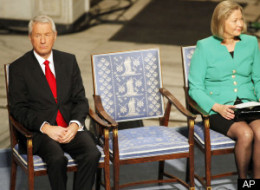
OSLO, Norway — With his Nobel Peace Prize diploma and medal placed in his empty chair, imprisoned Chinese dissident Liu Xiaobo was given a standing ovation at the award ceremony Friday as dignitaries demanded his release.
It was the first time in 74 years the prestigious $1.4 million award was not handed over, because Liu is serving an 11-year sentence in China on subversion charges for urging sweeping changes to Beijing's one-party communist political system.
China was infuriated when the 54-year-old literary critic won, describing the award as an attack on its political and legal system. Authorities have placed Liu's supporters, including his wife, Liu Xia, under house arrest to prevent anyone from picking up his prize.
In China, both CNN and BBC TV channels went black at 8 p.m. local time for nearly an hour, exactly when the Oslo ceremony took place. Security outside Liu's Beijing apartment was heavy and several dozen journalists were herded by police to a cordoned-off area.
In his speech, Norwegian Nobel Committee Chairman Thorbjorn Jagland called for Liu's release, receiving an unusual standing ovation at the international gathering.
"He has not done anything wrong. He must be released," Jagland said. He noted that neither Liu nor his closest relatives were able to attend the ceremony.
"This fact alone shows that the award was necessary and appropriate," Jagland said.
Liu's Nobel diploma and medal were placed on the empty chair marking his absence.
Norwegian actress Liv Ullman read Liu's final statement, "I Have No Enemies," which he delivered in a Chinese court in 2009 before he was jailed.
The Chinese Foreign Ministry described the award as a "political farce" and said it reflected Cold War mentality and infringed upon China's judicial sovereignty.
"(It) does not represent the wish of the majority of the people in the world, particularly that of the developing countries," ministry spokeswoman Jiang Yu said in Beijing.
In Washington, President Barack Obama said he regretted that Liu and his wife were not allowed to go to the ceremony as he and first lady Michelle Obama did when he won the peace prize last year.
"Liu Xiaobo is far more deserving of this award than I was," he said.
Also Friday, a group of Nobel laureates, including former South African President F.W. de Klerk, Nazi death camp survivor and author Elie Wiesel and Northern Ireland politician John Hume, offered to mediate with the Chinese government for Liu's early release.
The last time a Nobel Peace Prize was not handed out was in 1936, when Adolf Hitler prevented German pacifist Carl von Ossietzky from accepting his award.
China had pressured foreign diplomats to stay away from the Nobel ceremony, with 17 other countries joining their boycott, including Russia, Pakistan, Iran, Venezuela and Cuba. At least 46 of the 65 countries with embassies in Oslo accepted invitations. Serbia, which previously said it would stay away, announced Thursday it would now attend.
Some 1,000 guests, including ambassadors, royalty and other VIPs sat solemnly in atrium hall of Oslo's modernist City Hall for the ceremony, applauding occasionally during the speeches.
U.S. House Speaker Nancy Pelosi, who attended with U.S. Ambassador Barry White, told The Associated Press that it was "an honor" for her to be there.
"It is really a joy of my official life. For decades we have worked for human rights in China and Liu Xiaobo has been a hero to all of us," she said.
About 100 Chinese dissidents in exile and some activists from Hong Kong also attended. Chinese dissident Wan Yanhai, the only one on a list of 140 activists in China invited by Liu's wife to attend the ceremony, said the jubilation felt by many at Liu's honor will be tinged with sadness.
"I believe many people will cry, because everything he has done did not do any harm to the country and the people in the world. He just fulfilled his responsibility," Wan told AP. "But he suffered a lot of pain for his speeches, journals and advocacy of rights."
Wan managed to travel to Oslo because he fled to the United States in May after Chinese authorities increased their harassment of his AIDS advocacy group.
Before the ceremony, 2,000 schoolchildren gathered outside city hall in a display of appreciation for Liu. Some handed letters to Jagland, hoping he could convey their greetings to the jailed laureate.
Jagland said awarding the prize to Liu was not "a prize against China," and he urged Beijing that as a world power it "should become used to being debated and criticized."
Outside Parliament, the Norwegian-Chinese Association held a pro-China rally with a handful of people proclaiming the committee had made a mistake in awarding the prize to Liu.
China's furious assault on Liu's award has reached proportions last seen during the Soviet and Nazi regimes. But even Cold War dissidents Andrei Sakharov of the Soviet Union and Lech Walesa of Poland were able to have their wives collect the prizes for them. Myanmar democracy activist Aung San Suu Kyi's award was accepted by her 18-year-old son in 1991.
The Kremlin forced writer Boris Pasternak of the Soviet Union to decline his 1958 literature prize. French writer Jean-Paul Sartre declined the 1964 literature prize because he had consistently declined all official honors.
In 1973, North Vietnamese negotiator Le Duc Tho was awarded the peace prize jointly with U.S. Secretary of State Henry Kissinger but said he could not accept it, citing continued fighting in Vietnam as his reason.
In the Swedish capital of Stockholm, the other Nobel laureates were being honored in a separate ceremony Friday. Winners in literature, physics, chemistry and economics were receiving their awards from Sweden's King Carl XVI Gustaf.
Subscribe to:
Posts (Atom)