NORTON META TAG

25 June 2026

POLITIFACT WEEKLY: Andrew Jackson, meet PolitiFact, This week: Who would pay for Iran’s reconstruction? … Ossoff clips Mike Collins’ words about Trump, Epstein files … Susan Collins defends Kavanaugh vote with Maine’s post-Roe policy … AI, scams, sustainability: What fact-checkers discussed in Lithuania last week … Photo ID to enter the Obama library? That’s just for local discount 25JUN26


Thank you for being a member. We couldn't do this without you.
Refer a friendRefer a friend
Share PolitiFactShare PolitiFact
(AP and PolitiFact illustration)

11 times US presidents shaded reality as they shaped US history

A few months ago, our team met in person and over Zoom to brainstorm story ideas about the nation’s 250th anniversary. We wanted to deepen readers’ understanding of the factually lacking history that built to our current moment.

One thought experiment excited me from the start: What if PolitiFact, founded in 2007, had been around to cover presidential rhetoric from the very start? What big moments from 1776 would we have called out?

Chief Correspondent Louis Jacobson consulted numerous historians to compile a list of 11 presidential falsehoods or omissions that had significant consequences in U.S. history. 

Sometimes a president repeated inaccurate information from his staff. Sometimes the truth wasn’t clear at the time he spoke, or he gave it the most positive spin he could. Sometimes the president didn’t say anything per se, but rather left an inaccurate impression by omission. And sometimes the truth hung on "what the definition of ‘is’ is."

RELATEDWhat we learned from our deep dive into presidential deception 

With that in mind, here’s a chronological list of presidential falsehoods that had an impact on the nation’s 250-year history, and its psyche. 

Note: This is a thought experiment; reasonable people can disagree about what deserves mention. If you think we missed one or got it right, email truthometer@politifact.com.

Jackson and the treaty that produced the Trail of Tears

One of the nation’s darkest moments came when Andrew Jackson signed the Treaty of New Echota in 1835 knowing that the signatories represented a minority of Cherokees rather than the tribe’s official leadership. This led to the Trail of Tears, in which thousands of Native Americans died while being forced to migrate westward off their historical lands. By one estimate, 4,000 Cherokees died, nearly one-fifth of their population

In discussing the treaty with the public, Jackson failed to mention the full context of who had signed it, making the portrayal "deceptive," said Sean Wilentz, a Princeton University historian. 

The official Cherokee chief, John Ross, called the treaty signers "a spurious delegation" who agreed to a "pretended treaty" by "false and fraudulent representations." Ross’ letter called out Jackson and the lawmakers who allowed it to be enacted.

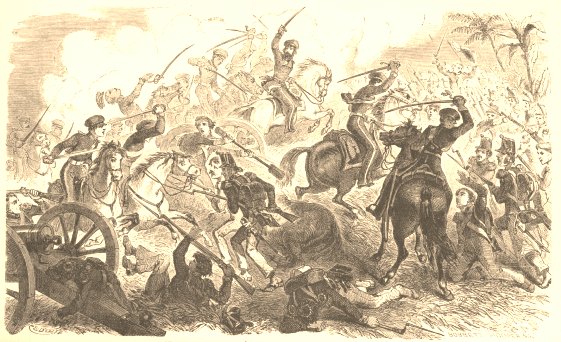
A portrayal of the Battle of Resaca de la Palma, Texas, in May 1846. (Public domain)

Polk’s justification for war with Mexico 

In 1846, James K. Polk said that in a series of incidents that killed or injured dozens of American soldiers, Mexico had "shed the blood of our fellow-citizens on our own soil." This became the pretext for the Mexican-American War, which was fought from April 1846 to February 1848. The U.S. won the war, acquiring 500,000 square miles from the Rio Grande to the Pacific Ocean; more than 10,000 U.S. troops died, the vast majority from illness.

The path to war began months before the fighting, when Polk ordered Gen. Zachary Taylor (who would succeed him as president) to "station his men on the banks of the Rio Grande in an area under dispute between the­ still-independent state of Texas and Mexico," Eric Alterman, a Brooklyn College historian and professor of English and journalism, wrote in "Lying in State," one of two books he’s written on presidential falsehoods. The casualties in this area became the spark for the war.

Despite knowing that the land was disputed, Polk framed it as blood shed on U.S. soil, justifying a military attack. Polk "would eventually go so far as to admit that the battle had taken place on ‘disputed’ rather than American soil," Alterman wrote, but that was after the war concluded.

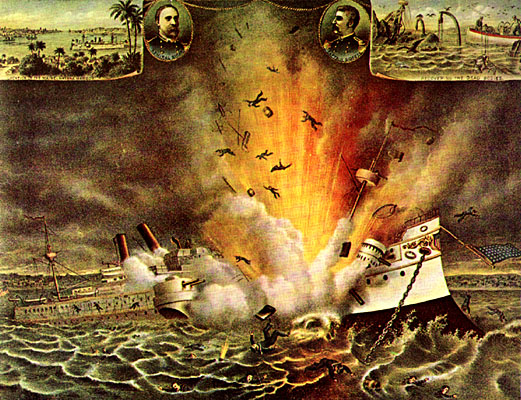
Explosion of the U.S.S. Maine, which triggered the Spanish-American War in 1898. (Public domain)

McKinley, the sinking of the Maine and war with Spain

In 1898, the USS Maine exploded in Cuba, killing 261 crew members. Pushed by a war-hungry media, William McKinley leveraged the incident into the Spanish-American War, even though historians generally believe the explosion was an accident, not an act of sabotage.

"The destruction of the Maine, by whatever exterior cause, is a patent and impressive proof of a state of things in Cuba that is intolerable," McKinley wrote to Congress in seeking a declaration of war. "That condition is thus shown to be such that the Spanish government can not assure safety and security to a vessel of the American Navy in the harbor of Havana on a mission of peace, and rightfully there."

Even though "it’s hard to locate an obvious lie among his explanations for the need for war in Cuba," Alterman said, "McKinley caved into the hysteria manufactured by an increasingly irresponsible press."

Truman and the bombing of Hiroshima

In 1945, Harry Truman announced the United States’ deployment of the world’s first atomic bomb by saying it was "dropped on Hiroshima, a military base." It was a seminal moment for the world on the brink of the nuclear age, and it wasn’t the whole story of who would be affected. 

Precise comparisons of military and civilian deaths are not available, but there’s broad agreement that most of the 66,000 deaths and 69,000 injuries were civilians, not troops.

Paul Finkelman, an Albany Law School emeritus professor of legal history, said it’s not clear how much Truman knew about the target, which was chosen by Army Chief of Staff George Marshall and Secretary of War Henry Stimson. Hiroshima was the command center for southern Japan, which made it "a significant military target," Finkelman said.

Even if Truman did know, Finkelman said, "No country at war tells the rest of the world all the reasons for a particular target."

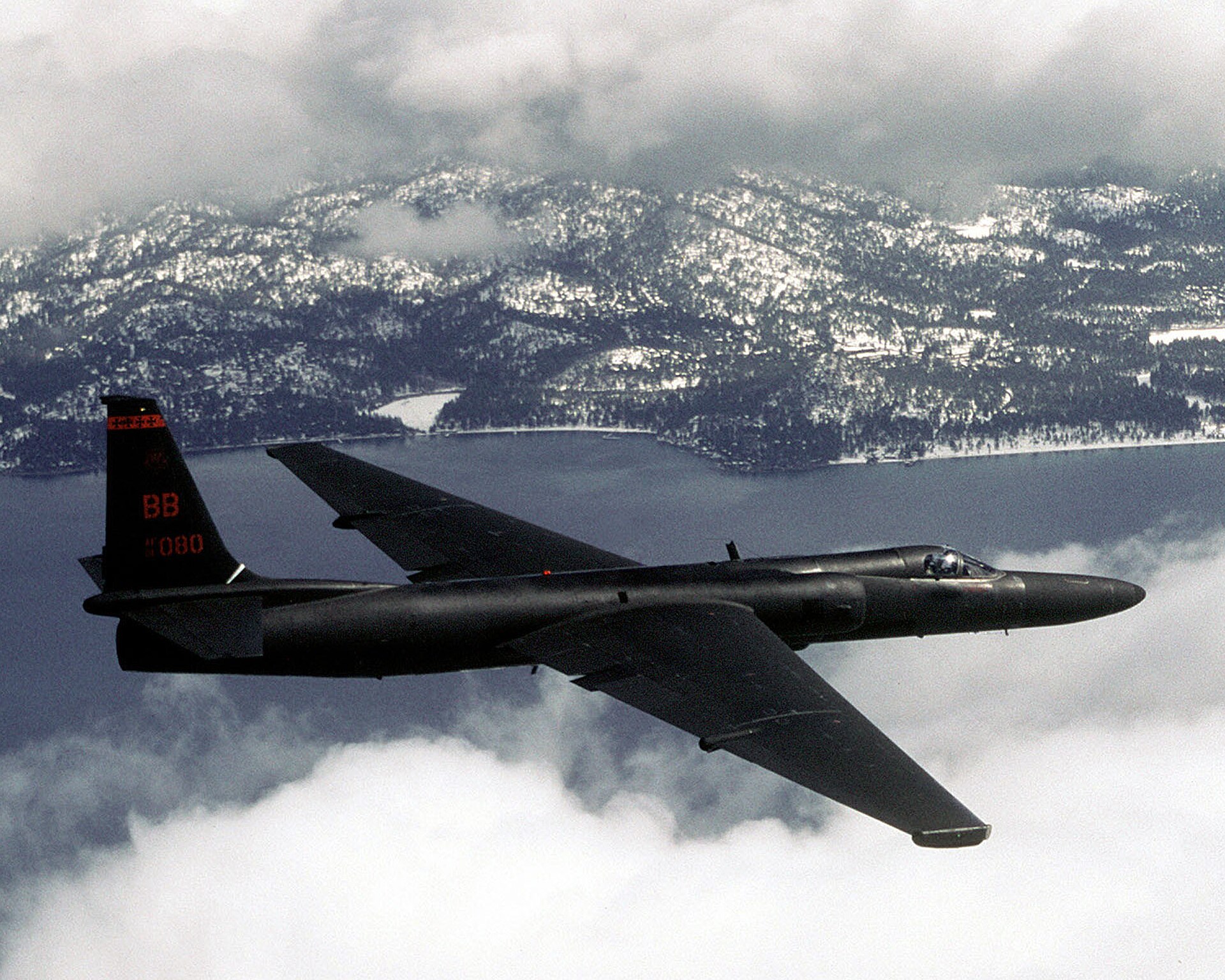
A U-2 reconnaissance aircraft in flight; this was the type of plane shot down over the Soviet Union in 1960. (U.S. Air Force)

Eisenhower and the downed spy plane

In 1960, Dwight D. Eisenhower said a U.S. spy plane shot down over Russia had been a weather research plane. Eisenhower had assumed the pilot had died and the plane had been destroyed, which he thought would make his remark harmless.

Within days, the Soviet Union produced the American pilot, initiating an international incident and exposing Eisenhower’s knowing falsehood. 

Eisenhower regretted the incident, telling his secretary, "I would like to resign."

How Johnson got the U.S. deeper into Vietnam

In 1964, Lyndon B. Johnson used a series of events in the Gulf of Tonkin to get Congress to approve a more extensive military conflict in Vietnam. 

U.S. destroyers had reported an attack by North Vietnamese vessels, but evidence eventually emerged that there had not been an enemy attack.

Retired Naval Cmdr. Pat Paterson, a National Defense University professor, has written that documentary evidence about the Gulf of Tonkin incident makes it clear that "high government officials distorted facts and deceived the American public about events that led to full U.S. involvement in the Vietnam War."

Johnson continued to be less than frank with the American public about the war as it went on. 

"Private briefings painted a grim picture, and when he escalated the war, he deliberately downplayed what he was doing," said John J. Pitney, a Claremont McKenna College politics professor.

Nixon’s defenses about his role in Watergate

About 10 weeks after the Watergate break-in, Richard Nixon told reporters, "No one in the White House staff, no one in this administration, presently employed, was involved in this very bizarre incident." 

More than a year later, as the scandal was swelling, Nixon uttered the phrase that will indelibly be linked to him: "I am not a crook." 

Subsequent events, including his resignation in the face of impeachment, demonstrated that White House staff were clearly involved in the break-in and that Nixon might have been tried criminally had he not been pardoned.

Reagan and the Iran-Contra Affair

In 1986, Ronald Reagan addressed the nation amid questions about the Iran-Contra Affair, in which the U.S. sold arms to Iran and used the proceeds to support a rebel group in Nicaragua, contrary to U.S. law.

"We did not — repeat — did not trade weapons or anything else for hostages," Reagan said. 

The following year, he changed his story. Reagan said in an Oval Office address, "A few months ago I told the American people I did not trade arms for hostages. My heart and my best intentions still tell me that's true, but the facts and the evidence tell me it is not." 

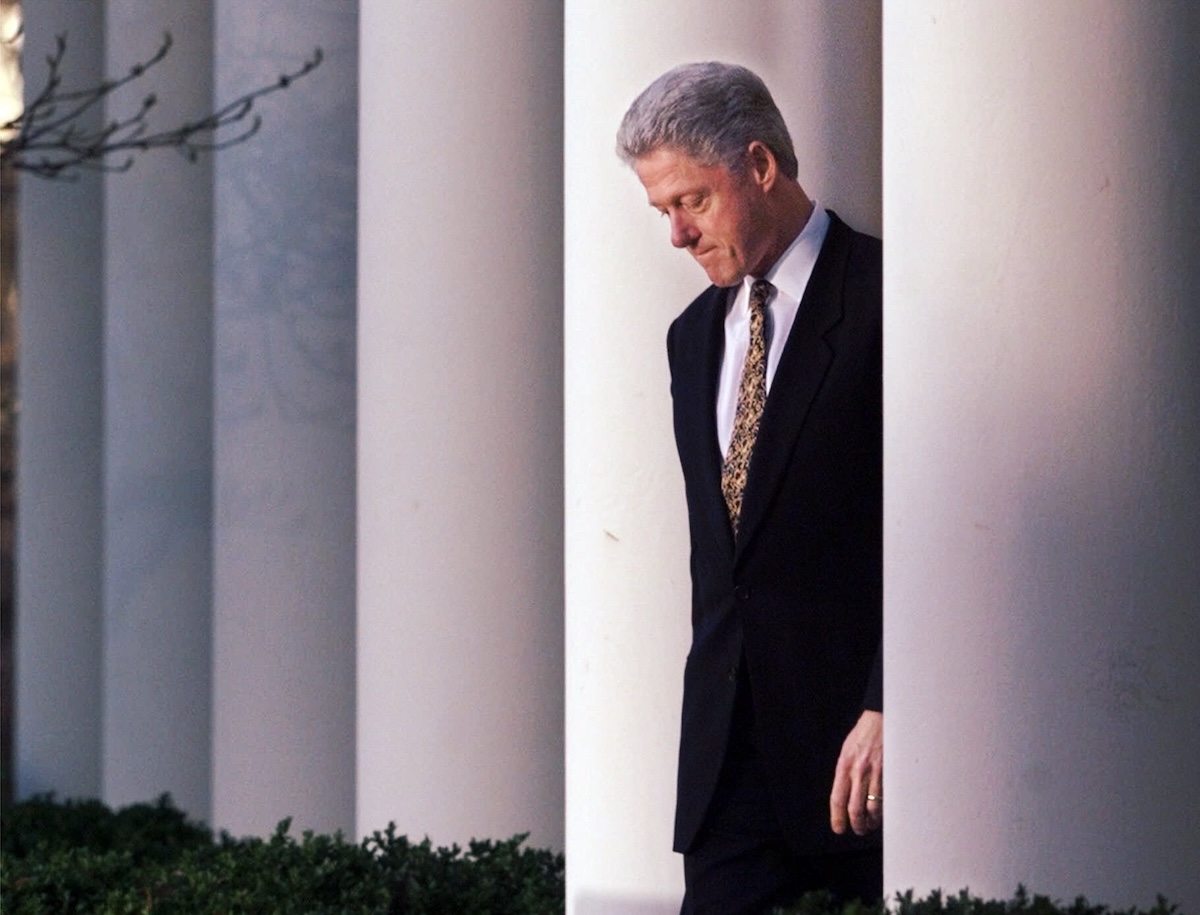
President Bill Clinton walks to the podium to deliver a short statement on impeachment on Dec. 11, 1998. (AP)

Clinton’s denial that he had sex with Monica Lewinsky 

As Bill Clinton was fending off allegations that he had a relationship with a former White House intern, Monica Lewinsky, he addressed reporters in January 1998. Clinton said, "I did not have sexual relations with that woman, Miss Lewinsky." 

The truth of that statement hung on hairsplitting whether oral sex counts as "sexual relations" and "what the meaning of ‘is’ is" (as he told a grand jury). 

Clinton later acknowledged he’d been intimate with Lewinsky. The American public was in a forgiving mood — voters punished congressional Republicans for trying to impeach him in the 1998 midterm elections. Political scientists say the episode contributed to public cynicism in the longer term, and Clinton’s post-presidential reputation has suffered from the scandal.

Bush’s misleading statements about Iraq

For about a year after the 9/11 attacks, George W. Bush built the case for waging war against Iraq on its ability to deploy weapons of mass destruction. 

In a 2002 speech in Cincinnati, for instance, Bush said, "The evidence indicates that Iraq is reconstituting its nuclear weapons program. … Satellite photographs reveal that Iraq is rebuilding facilities at sites that have been part of his nuclear program in the past." 

Bush added that Iraqi leader Saddam Hussein "could have a nuclear weapon in less than a year" and that "facing clear evidence of peril, we cannot wait for the final proof, the smoking gun that could come in the form of a mushroom cloud."

When U.S. troops entered Iraq, they didn’t find evidence to support such claims. 

George Mason University historian James Pfiffner has analyzed the evidence and concluded that Bush "misled the country in important ways, potentially undermining the trust of the citizenry." However, Pfiffner also concluded that Bush based his comments on misleading evidence from intelligence officials, who "may have been under unusual pressure to support the administration’s goals."

Donald Trump’s ‘rigged’ election allegations

Trump has told an unusually large number of falsehoods in office, but the most pervasive — and historians say, problematic — is that he won the 2020 presidential election over Joe Biden. He first claimed this on election night, and has repeated it, or the related claim that the election was "rigged," on many other occasions. It also led to the Jan. 6 Capitol attack.

RELATEDPolitiFact’s fact-checks of Barack Obama

RELATEDPolitiFact’s fact-checks of Joe Biden

RELATEDPolitiFact’s fact-checks of Donald TrumpOur Sources

James Pfiffner, "The Contemporary Presidency: Presidential Lies" (Presidential Studies Quarterly), 1999

James Pfiffner, "Trump’s lies corrode democracy," April 13, 2018

James Pfiffner, "The Lies of Donald Trump: A Taxonomy," 2019

James Pfiffner, "The Character Factor: How We Judge America's Presidents," 2004

James Pfiffner, "Did President Bush Mislead the Country in His Arguments for War with Iraq?" (Presidential Studies Quarterly), 2004

Eric Alterman, "Lying in State: Why Presidents Lie -- And Why Trump Is Worse," 2020

Eric Alterman, "When Presidents Lie: A History of Official Deception and Its Consequences," 2004

David Greenberg, "Are Clinton and Trump the Biggest Liars Ever to Run for President? A short history of White House fabulists," July-August 2016

David Greenberg, "The Perils of Calling Trump a Liar," Jan. 28, 2017

National Park Service, "What Happened on the Trail of Tears?" accessed June 8, 2026

National Park Service, "Chief John Ross Protests the Treaty of New Echota," accessed June 8, 2026

University of Virginia Miller Center, "May 11, 1846: War Message to Congress," accessed June 8, 2026

Britannica.com, "Mexican-American War," accessed June 8, 2026

William McKinley, "Message to Congress Requesting a Declaration of War With Spain," April 11, 1898

Truman Library, "Statement by the President Announcing the Use of the A-Bomb at Hiroshima," Aug. 6, 1945

National Park Service, "Eisenhower and the U-2 Spy Plane Incident," accessed June 8, 2026

State Department, "Paper Prepared in the Department of Defense, Washington," Sept. 25, 1964

Pat Paterson, "The Truth About Tonkin" (U.S. Naval Institute), February 2008 

American Public Media, "Lyndon B. Johnson: The Vietnam Dilemma," accessed June 8, 2026

American Presidency Project, "The President's News Conference," Aug. 29, 1972

YouTube, clip of Richard Nixon’s "I am not a crook" comment," Nov. 17, 1973 

Reagan Library, "Address to the Nation on the Iran Arms and Contra Aid Controversy," Nov. 13, 1986

PBS, President Reagan’s speech from the Oval Office on the Iran Arms and Contra Aid Controversy, March 4, 1987

C-SPAN, President Clinton’s remarks about Monica Lewinsky, Jan. 26, 1998

Slate, "Bill Clinton and the Meaning of ‘Is,’" Sept 13, 1998

Gallup, "Retrospective Approval of JFK Rises to 90%; Trump at 46%," July 17, 2023

Washington Post, "Jimmy Carter would not tell a lie. Did his honesty doom his presidency?" Jan 5, 2025

PolitiFact, "Amid Russia’s invasion of Ukraine, a look back at yellow journalism and the Spanish-American War," April 27, 2022

PolitiFact, "What PolitiFact learned in 1,000 fact-checks of Donald Trump," Feb. 1, 2024

PolitiFact, "Trump falsely and prematurely claims 2020 presidential victory," Nov. 4, 2020

PolitiFact, "The 2021 Lie of the Year: Lies about the Jan. 6 Capitol attack and its significance," Dec. 15, 2021

Email interview with David Greenberg, Rutgers University historian, April 28, 2026

Email interview with Eric Alterman, Brooklyn College historian and professor of English and journalism, June 3, 2026

Email interview with Sean Wilentz, Princeton University historian, June 3, 2026

Email interview with Paul Finkelman, emeritus professor of legal history at Albany Law School, May 29, 2026

Email interview with John J. Pitney, politics professor at Claremont McKenna College, June 1, 2026

Email interview with Steven Smith, Arizona State University political scientist, May 28, 2026

Email interview with James Pfiffner, emeritus professor at George Mason University, May 29, 2026

ShareShare
TweetTweet
ForwardForward

Fact-checks of the week

  • Ossoff invokes Epstein. An ad by Georgia Sen. Jon Ossoff says his Republican opponent, U.S. Rep. Mike Collins, covered for President Donald Trump and other powerful men when he voted against releasing the federal government’s files on deceased sex offender Jeffrey Epstein. Collins "even admitted Trump was in the files," the June 17 ad said. It includes a clip of Collins saying: "Yeah, I’m sure he’s in there," taken from leaked audio of Collins in 2025, when less was known about the files’ contents. But the ad omits what Collins said next, leaving a nefarious impression. Collins said, "Yeah, I’m sure he’s in there. Because he was the one telling the FBI about it. He’s the one that kicked the guy out of Mar-a-Lago and then called the FBI. Yeah, yeah, he’s in there." We rated the misleading attack Mostly False

  • Abortion in Maine. U.S. Sen. Susan Collins, R-Maine, said she doesn’t regret her 2018 vote for Supreme Court Justice Brett Kavanaugh, part of the court’s majority that overturned Roe v. Wade. "Obviously, I'm disappointed in that decision, which turned abortion issues back to the states," Collins said June 12. "It has not had an impact on the state of Maine in that Maine actually expanded its law." We rated this Mostly True. In response to the ruling, Maine’s state lawmakers and Democratic Gov. Janet Mills scrambled to protect abortion access and spent years strengthening its laws. Abortion providers pointed to other effects, however, such as a bomb threat at the state capitol while lawmakers were considering an abortion-related bill, and fear and confusion among the public immediately after the ruling.

  • Obama tickets. Sen. Marsha Blackburn, R-Tenn., marked the opening of the Obama Presidential Center in Chicago with a dig about Democrats and voter ID. “Democrats are fine with requiring photo ID to enter the Obama Presidential Center, but not to vote in U.S. elections," Blackburn wrote, sharing a screenshot of the center’s website. Blackburn misrepresented the website’s instructions, which are limited to Illinois residents seeking discounted tickets. We rated her statement False.

You're a current PolitiFact donor. Thank you so much for supporting our work! 
Sponsored: 
“The Business of Journalism in the Age of AI” — a new monthly webinar series from the University of Maryland’s nationally renowned Philip Merrill College of Journalism and Robert H. Smith School of Business — explores how the business model of journalism can become more sustainable and how to thrive in the age of AI.

All webinars are Fridays from 12-1 p.m. Sign up for any number of sessions. ENROLL TODAY!

Who will pay for Iran's reconstruction fund? It's unclear.

As Trump and the Iranian government reached a written agreement to end the war, Democrats honed in on a section that appeared to promise hundreds of billions of U.S. dollars to Iran.

"With $300 billion, we could end homelessness, fund cancer research for 40 years, and give every child free pre-K for over 7 years," Sen. Amy Klobuchar, D-Minn., said in an X post. "Instead, Trump is sending it to Iran."

Trump dismissed such concerns. “There is no 300 Billion Dollar payment to Iran by the U.S.,” he said in a June 18 Truth Social post.

A memorandum of understanding between the U.S. and Iran, obtained by multiple news outlets from anonymous sources, reads, “The United States of America undertakes with regional partners to develop a definitive, mutually agreed plan with at least U.S.D. 300 billion for the reconstruction and economic development of the Islamic Republic of Iran.” 

The Trump administration has since acknowledged a fund but said no taxpayer money will go toward it. When a reporter asked Vice President JD Vance on June 18 who would fund the $300 billion, Vance said, "There is a great desire from the Arab world and from outside the Arab world to actually get involved in Iran if they behave properly." 

Negotiations are ongoing. Read the story.

— Loreben Tuquero

Does Musk pay the same in federal taxes as someone making $184,500? 

Elon Musk’s historic milestone as the world’s first trillionaire renewed calls from some politicians to address wealth inequality and raise taxes on the richest Americans. 

“Today, Elon Musk, a trillionaire, pays the same amount into Social Security as someone making $184,500,” Sen. Bernie Sanders, I-Vt., said in a June 12 X post.

Sanders’ statement accurately reflects a real feature of Social Security taxes: The federal government stops collecting the tax after a person’s wages reach a certain amount. In 2026, that cap is $184,500. 

But we can’t know how much wage-based income Musk will receive this year; increases in Musk’s net worth are often caused by increasing stock value, rather than compensation. Such unrealized gains aren’t subject to Social Security taxes.

We rated Sanders’ statement Mostly True

— Caleb McCullough

A new bombshell has entered the villa: fact-checkers

In the June 16 episode of "Love Island USA," Mackenzie "Kenzie" Annis told her then-partner, Caleb McDaniel, that 20/30 vision "means that what (other) people have to be at 20 feet to see, I can see at 30 feet." 

Snuggled up in "Soul Ties," a secluded section of the villa where intimate conversations often occur, Caleb shared that he had "fighter pilot vision" because of his 20/13 vision score. With no way to verify the information through external sources, Caleb dropped the topic after Kenzie asserted that a higher second number in a vision score means better vision.

Our reporting found that Kenzie swapped the meaning of the two numbers in the vision score. Her 20/30 vision means that she must be 20 feet away from an object to clearly see what the average viewer needs 30 feet of distance to see. With that kind of vision, you may miss an islander’s head turning at the new bombshell. 

Read: “Love Island USA” fact-check: Is 20/30 vision better than 20/13 vision?

— Gracey Abernethy

Those AI ads attacking Talarico are part of a changing political advertising scene 

In an online ad viewed millions of times, Texas U.S. Senate candidate James Talarico appears to be wearing a dress in the style of Julie Andrews in “The Sound of Music” and singing about transgender children.

"Boys in white dresses with blue satin sashes, girls dosed with hormones 'til they grow mustaches, changing the gender of all your offspring, these are a few of my favorite things," the Talarico character sings in the style of “My Favorite Things.” 

Citizens for Sanity, a conservative nonprofit group, released this ad and five others mocking Talarico with AI-generated content over several days. It’s part of a changing scene in political advertising, and experts worry about an inundated public trying to make sense of what’s real. 

Texas bans political deepfakes 30 days before an election; breaking the law would be a Class A misdemeanor. “A lot of the damage is already going to have been done at that point,” said Zelly Martin, a University of Tampa assistant professor of communication."

Worried about AI in political advertising? Read the story. 

— Loreben Tuquero

Quick links to GlobalFact 2026 reports 

PolitiFact Chief Correspondent Louis Jacobson covered the GlobalFact 2026 assembly of fact-checkers in Vilnius, Lithuania, for Poynter and the International Fact-Checking Network. Here’s a rundown:

Have questions or ideas for our coverage? Send me an email.

Thanks for reading!

Katie Sanders
PolitiFact Editor-in-Chief
Send this link to your friends so they can sign up for this email!Send this link to your friends so they can sign up for this email!
Copyright © 2026 PolitiFact, All rights reserved.
You are receiving this email because you opted in at our website, attended one of our events, or communicated with us.

Our mailing address is:
PolitiFact
801 3rd St S 33701
St. Petersburg, FL 33701

Add us to your address book

No comments:

Post a Comment