

|
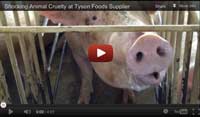

The Humane Society just released an undercover video of extraordinarily cruel treatment of animals at a pig supplier for Tyson Foods, the largest meat producer in the U.S.
The video is shocking. Baby pigs are being kicked around like soccer balls. Sick mother pigs are being beaten. And sows are being locked in “gestation crates” – cages so small the animal can barely move, and can’t even turn around…for their entire lives.
There is no reason to treat animals this cruelly.
Sign our petition to Tyson telling the company to immediately stop allowing gestation crate confinement in its supply chain.
After the video was released online, a massive public outcry caused Tyson to pull the plug -- temporarily -- on this one factory farm’s contract. But the reality is animal mistreatment is systemic in Tyson’s supply chain, and gestation crate confinement creates a culture of callousness toward animals. This callousness will only end when this practice does.
Burger King, McDonald's, Wendy's, and Safeway have all committed to eliminating gestation crates from their supply chains. But Tyson doesn't just condone this cruelty, which scientific evidence proves causes extreme animal suffering -- it defends it.
It shouldn’t take intrepid animal welfare activists going undercover to document mistreatment. Tyson should be making every effort to root animal mistreatment out of its supply chain. And with so much momentum building around this issue now, we have a huge opportunity to make the second-largest meat producer in the world stop this abuse for good.
Sign the petition to Tyson Foods demanding the company eliminate cruel gestation crates from its supply chain.
Thanks for standing up for the pigs,
--Emma, Taren, Kaytee and the rest of us
------------------------------
Background Information
What is a gestation crate?
Gestation crates are metal stalls measuring approximately 0.7 m (2 ft) by 2m (7 ft)—barely larger than a sow. This crate is specifically designed to severely restrict a sow’s movement and thwart her natural behaviours. A breeding sow spends most of her reproductive life (normally 3-5 years) in such a gestation crate. She endures a continuous cycle of impregnation and birth (beginning at seven months of age) producing more than 20 piglets per year, 15 percent of whom will die by the age of 2-3 weeks. The piglets who survive are taken away from her and crowded into pens with metal bars and concrete floors, destined for the same life as their mother or the dinner plate. After about three litters, she is spent, deemed “no longer profitable” and sent to the slaughterhouse.
Do gestation crates cause animal suffering?
Yes. The horrors of gestation crates are well documented, and include joint damage, leg weakness, decreased muscle mass, weakened bones, overgrown hooves, lameness, impaired mobility, obesity, abrasions, urinary tract infections, chronic stress, depression, frustration, aggression, abnormal neurotic behaviour, cardiovascular problems and diseases such as Salmonellosis, epidemic transmissible gastroenteritis, bratislava and respiratory disease.
In addition to being subjected to suffering, pigs are fed massive doses of antibiotics to keep them alive in these conditions, but many pigs will still die from infection.
Undercover investigations show that pigs forced to live in gestation crates develop infected sores and abscesses, live in their own filth, and are abused at the hands of factory farm owners. Pigs bite at the bars of their crates and try to push their crate doors up – demonstrating their deep frustration. Many pigs are abused, and dead pigs have been found in crates and pens.
Are gestation crates banned anywhere?
Growing public awareness about the cruelty of gestation crates has led numerous companies to eliminate them -- notably McDonald’s, Burger King, and Wendy's. National governments have begun to ban the crates. The European Union and eight U.S. states -- including California, Ohio, and Michigan -- have bans. Despite progress, 70% of the U.S. pork industry still confines pigs in these crates.
Citations and further reading:
Undercover Investigation Documents Pig Abuse at Tyson Supplier, Humane Society of the United States, May 8, 2012.
REPORT: Undercover Exposés at Two of the Nation’s Largest Pork Producers, The Humane Society of the United States
Pigs Prove to Be Smart, if Not Vain, The New York Times, November 9, 2009.
Gestation Crates in Canada, Humane Society International/Canada, 2010.
Undercover at Smithfield’s Foods, a short video on gestation crates.


 SumOfUs is a world-wide movement of people like you, working together to
hold corporations accountable for their actions and forge a new,
sustainable path for our global economy. You can follow us on Twitter, and like us on Facebook.


