NORTON META TAG

Showing posts with label rural America. Show all posts

16 October 2024

SOME POSITIVE OBSERVATIONS FROM SEN BERNIE SANDERS WHILE CAMPAIGNING FOR KAMALA HARRIS & TIM WALZ 15OKT24


 THANK GOD for Sen Bernie Sanders and the work he is doing  for the Harris-Walz campaign! PLEASE volunteer for the campaign or donate whatever you can to the campaign and talk to your family and friends about voting for Kamala Harris & Tim Walz and the rest of the Democratic candidates on your ballot on 5 NOVEMBER 2024!!!

I spent the last few days on the campaign trail for Kamala, Tim, and progressive candidates in the Midwest. It was a helluva trip. In four days we visited Illinois, Iowa, Minnesota, Wisconsin and Michigan. A lot of large crowds and good energy.

Some observations.

On Friday, October 11 we began our campaign swing with a stop in Belvedere, Illinois before a fired up, standing room only crowd of UAW union workers. I was there with UAW President Shawn Fain, one of the outstanding progressive union leaders in America. As you’ll remember, last year the UAW went on strike against the Big 3 automakers and won an excellent contract. Now, Stellantis, one of the Big 3, is trying to renege on the commitment they made in that contract to re-open their plant in Belvedere and put thousands of their employees back to work. Our message at that meeting to Stellantis was simple. End corporate greed. Keep your promise. Re-open the plant.

Belvidere, IllinoisBelvidere, Illinois

Later in the afternoon we flew into Dubuque, Iowa for another rally with union workers. In Dubuque, the John Deere company is continuing to lay off workers as they transfer production lines from the United States to Mexico where they hire workers at one-sixth of the wages they pay here. Like Stellantis, John Deere is making strong profits and giving their CEO a huge compensation package. Our demand to John Deere was straightforward. Stop outsourcing good paying American jobs.

Dubuque, IowaDubuque, Iowa

We finished the day with an evening get-out-the vote rally in St. Paul, Minnesota. The many hundreds of people there were quite clear and quite loud. We’re not going back! Kamala for President.

St. Paul, MinnesotaSt. Paul, Minnesota

On Saturday we did two very well-attended rallies in rural Wisconsin. The day event was in Superior and the evening event was in Baraboo. My message at both events was: (a) we cannot have a pathological liar as President. Donald Trump is unfit to lead the country. That’s not just my opinion. That’s what Republicans Mike Pence, Dick Cheney, and Mitt Romney believe. (b) The progressive agenda is not radical. It’s what the American people overwhelmingly want. We must fight to create an economy and government that works for all, and not just the billionaire class.

Superior, WisconsinSuperior, Wisconsin

Baraboo, WisconsinBaraboo, Wisconsin

On Sunday we continued our campaigning in rural areas. This time in Michigan. We started the day in Traverse City and ended with a large rally in Marquette. The folks at these rallies, young, old, and in-between, understand that the issues in this campaign are crystal clear. Women must be able to control their own bodies, not politicians. Climate change is real, not a “hoax.” Health care is a human right, not a privilege. We need to address the housing crisis which exists in virtually every area of the country.
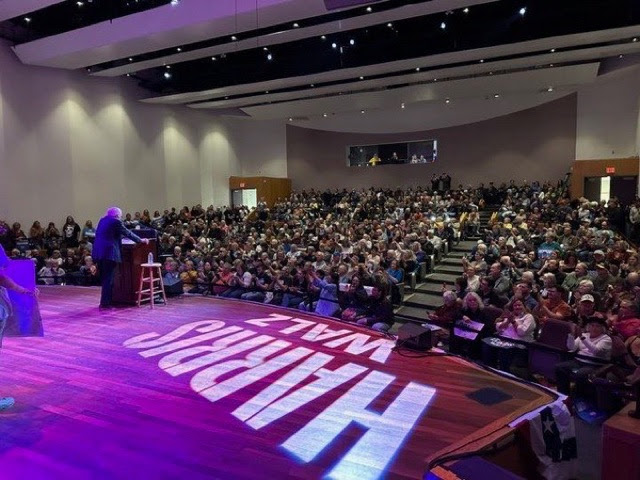
Traverse City, MichiganTraverse City, Michigan

Marquette, MichiganMarquette, Michigan

On Monday we ended our campaign swing with a couple of events in Milwaukee. First, I spoke at an Alliance for Retired Americans event. While we don’t discuss it much, many seniors in America are struggling. In fact, 25 percent of seniors are trying to survive on $15,000 or less. They can’t afford prescription drugs, health care or other basic necessities. Sadly, the U.S. has the highest rate of senior poverty of almost any wealthy nation. The seniors there were appreciative that Kamala intends to expand Medicare to cover home health care, hearing aids, and vision care.

The last event of this trip was with former Lt. Governor Mandela Barnes and the Working Families Party of Wisconsin. The Working Families Party is doing an outstanding job in Wisconsin and around the country in organizing the working poor - Black, White, Latino, Asian - to stand up for their rights. What we heard at this meeting was distressing, but not surprising. We heard from low-income workers unable to afford to go to a doctor or get the dental care they need. People working 2 or 3 jobs at $14 an hour. Seniors in debt, and unable to pay it off because of high interest rates. Not a happy situation in the wealthiest country on earth.

On Monday night I was on a plane back to Burlington.

Thank you all for making these campaign events possible. Let’s continue to work hard and do everything we can to elect Kamala and Tim and create the kind of country we know we can become.

In solidarity,

Bernie


👋 Before you go... 👋

Bernie recently wrote a best-selling book entitled, "It’s OK To Be Angry About Capitalism." It’s a good book. It’s an important book. It deals with issues that too few people are discussing. And if you make a contribution of ANY amount today, we'll send you a copy, and use the proceeds to continue campaigning across the country ahead of November's elections.

Please use this link to make a contribution — $27 or whatever you can afford today — and we'll get you a copy of Bernie's new book It's Ok To Be Angry About Capitalism.

GET THE BOOK


Paid for by Friends of Bernie Sanders

(not the billionaires)

PO BOX 391, Burlington, VT 05402

You can  sign up to receive fewer emails. We hope you'll stay, because emails are such an important part of how we organize and how we raise money. In fact, there is no single greater source for our campaign's fundraising than emails like this one. And that's important, because no one person, not even Bernie Sanders, can take on the billionaire class alone.

Before you go about the rest of your day, help power our fight against the billionaire class by making a contribution today.


25 October 2014

Why anyone in the South would continue to vote Republican after seeing this Map defies logic & The Easiest & Hardest Places to Live in America 19OKT&26JUN14


I am a Pennsylvania Yankee living in Virginia (NOVA / Metro D.C.) and this is about as far South as I could live. There is a voluntary ignorance grounded in racism that I just can't stand among the electorate that is pathetic. These people keep electing gop / tea-bagger extremest that work against the best interest of those who elect them, denying them fair wages, workers rights and the social safety net programs so many of them need while making the rich richer. The picture above is a perfect depiction of many of these people in the deep South and rural South (as well as many of the rural areas of the North, including the part of PA I am from). This from +Daily Kos shows the results of their votes. Also from +The New York Times & +New York Magazine .....
Sun Oct 19, 2014 at 10:12 PM PDT

Why anyone in the South would continue to vote Republican after seeing this Map defies logic

Why any ostensibly rational person living in Kentucky, Tennessee, the Carolinas, Georgia, Alabama, Mississippi, or Louisiana who saw this map, and still would think their states' Republican leaders' policies were delivering the economic growth their region so sorely needs is beyond comprehension.
                           Where Are the Hardest Places to Live in the U.S.?
http://youtu.be/Z83EgFcLcW4
                            
The toughest places to live in America Almost every county in the U.S. has its share of haves and have-nots. But there are some regions where it's just plain harder for Americans to thrive, places where the poor far outnumber those living in middle-class comfort.
Ten counties in America stand out as the most challenging places to live, based on a survey of six criteria including median household income, disability rate and life expectancy, according to an analysis by The New York Times.
The county with the dubious distinction of being the worst of all is Clay County, Kentucky, where residents can expect to die six years earlier than the average American.
The other four counties ranked at the bottom of the survey include four counties in the rural south: Humphreys County, Mississippi; East Carroll Parish, Louisiana; Jefferson County, Georgia; and Lee County, Arkansas. The findings highlight an often overlooked issue in the debate about income inequality -- the stubbornness of rural poverty. In the U.S., the number of poor rural residents outnumber those in the cities, with 14 percent of rural Americans living below the poverty line, compared with 12 percent in urban areas, according to the International Fund for Agricultural Development's Rural Poverty Portal.
Of course you'd never get an inkling of any of this from watching Fox Noise. The right's hired boobs like to characterize America's urban areas as teeming with desperately poor people.
Of course, Appalachia and the South aren't the only parts of the country where people struggle, The Times' study found. Pockets of economic and social hardship extend from Maine to Alaska.
Why the South is the worst place to live in the U.S. — in 10 charts
INTERACTIVE MAP CLICK TO CHECK YOUR COUNTY
By Roberto A. Ferdman
Meanwhile, there are a number of states — all of them in the South — you might want to avoid. Mississippi, which scored lower than any other state, barely broke 50. Arkansas and Alabama, which tied for second to last, each scored 51.3. West Virginia, which was fourth to last, scored 52.2. And Tennessee, which was fifth to last, scored 52.9.
The South, which performed the worst of any region in the country, is home to eight of the poorest performing states. Only Virginia was in the top 25. And just barely — it placed 22nd.
The average person's life is harder in the South and in Appalachia. The economic safety net in these states is bare bones and have gaping gaps that let many their citizens fall through into the economic margins. The South's and Appalachia's craven political leaderships that grovel before wealthy interests are the main reason why the region consistently lags behind the other states across a range of measures.

Originally posted to Lefty Coaster on Sun Oct 19, 2014 at 10:12 PM PDT.

Also republished by New Jersey Kossacks, Subversive Agitation Team Action Network, and Team DFH.

 Where Are the Hardest Places to Live in the U.S.?

Annie Lowrey writes in the Times Magazine this week about the troubles of Clay County, Ky., which by several measures is the hardest place in America to live.
The Upshot came to this conclusion by looking at six data points for each county in the United States: education (percentage of residents with at least a bachelor’s degree), median household income, unemployment rate, disability rate, life expectancy and obesity. We then averaged each county’s relative rank in these categories to create an overall ranking.
(We tried to include other factors, including income mobility and measures of environmental quality, but we were not able to find data sets covering all counties in the United States.)
The 10 lowest counties in the country, by this ranking, include a cluster of six in the Appalachian Mountains of eastern Kentucky (Breathitt, Clay, Jackson, Lee, Leslie and Magoffin), along with four others in various parts of the rural South: Humphreys County, Miss.; East Carroll Parish, La.; Jefferson County, Ga.; and Lee County, Ark.
Slide Show
Slide Show|12 Photos

The Hardest Place to Live in America

CreditLuke Sharrett for The New York Times
We used disability — the percentage of the population collecting federal disability benefits but not also collecting Social Security retirement benefits — as a proxy for the number of working-age people who don’t have jobs but are not counted as unemployed. Appalachian Kentucky scores especially badly on this count; in four counties in the region, more than 10 percent of the total population is on disability, a phenomenon seen nowhere else except nearby McDowell County, W.Va.
Remove disability from the equation, though, and eastern Kentucky would still fare badly in the overall rankings. The same is true for most of the other six factors.
The exception is education. If you exclude educational attainment, or lack of it, in measuring disadvantage, five counties in Mississippi and one in Louisiana rank lower than anywhere in Kentucky. This suggests that while more people in the lower Mississippi River basin have a college degree than do their counterparts in Appalachian Kentucky, that education hasn’t improved other aspects of their well-being.
As Ms. Lowrey writes, this combination of problems is an overwhelmingly rural phenomenon. Not a single major urban county ranks in the bottom 20 percent or so on this scale, and when you do get to one — Wayne County, Mich., which includes Detroit — there are some significant differences. While Wayne County’s unemployment rate (11.7 percent) is almost as high as Clay County’s, and its life expectancy (75.1 years) and obesity rate (41.3 percent) are also similar, almost three times as many residents (20.8 percent) have at least a bachelor’s degree, and median household income ($41,504) is almost twice as high.
Wayne County may not make for the best comparison — in addition to Detroit, it includes the Grosse Pointes and some other wealthy suburbs that could be pulling its rankings up. But St. Louis, another struggling city, stands alone as a jurisdiction for statistical purposes and ranks even higher over all, slightly, with better education and lower unemployment making up for a median household income ($34,384) that is lower than Wayne County’s but still quite a bit higher than Clay County’s $22,296.
At the other end of the scale, the different variations on our formula consistently yielded the same result. Six of the top 10 counties in the United States are in the suburbs of Washington (especially on the Virginia side of the Potomac River), but the top ranking of all goes to Los Alamos County, N.M., home of Los Alamos National Laboratory, which does much of the scientific work underpinning the U.S. nuclear arsenal. The lab directly employs one out of every five county residents and has a budget of $2.1 billion; only a fraction of that is spent within the county, but that’s still an enormous economic engine for a county of just 18,000 people.
Here are some specific comparisons: Only 7.4 percent of Clay County residents have at least a bachelor’s degree, while 63.2 percent do in Los Alamos. The median household income in Los Alamos County is $106,426, almost five times what the median Clay County household earns. In Clay County, 12.7 percent of residents are unemployed, and 11.7 percent are on disability; the corresponding figures in Los Alamos County are 3.5 percent and 0.3 percent. Los Alamos County’s obesity rate is 22.8 percent, while Clay County’s is 45.5 percent. And Los Alamos County residents live 11 years longer, on average — 82.4 years vs. 71.4 years in Clay County.
Clay and Los Alamos Counties are part of the same country. But they are truly different worlds.

19 March 2011

House votes to defund NPR 18MAR11

PLEASE click the header or links to sign the petition to the U.S. Senate to reject the legislation from the House defunding NPR and PBS. Even Glenn Beck has spoken out in defense of NPR (see my earlier post GLENN BECK BLAST ANTI-NPR VIDEO 16MAR11). This service is vital to the nation, providing educational TV for children at home and schools, entertainment for families and unbiased, in-depth news reporting in all sections of the nation (see my earlier post WHY THE (HOUSE) REPUBLICANS HATE NPR 18MAR11). We will become a less informed and more polarized country if NPR and PBS loose government funding. Please sign the petition and share with family, friends and co-workers....
Yesterday, (17MAR11) House Republicans passed an "emergency" bill that would ban any federal money from going to NPR.
This is it: our last chance to save public broadcasting, after more than a decade of fending off Republican attacks. More than 600,000 people have already signed the petition, and we're aiming for 750,000 to show the Senate how much support public broadcasting has.
Can you help us reach our goal by sharing the petition on Facebook right now?


Thanks for all you do.
–Daniel, Amy, Adam, Wes, and the rest of the team
P.S. You can also just forward the email below asking people to sign:
The Republicans in the House of Representatives just passed what they called "emergency" legislation to zero out funding for NPR. We're on the verge of losing this fight, after more than a decade.
We need to tell Republicans that cutting off funding was unacceptable last time they were in charge, and it's unacceptable now.
I've signed the petition to save NPR and PBS. Can you join me at the link below?

Thanks!
Want to support our work? We're entirely funded by our 5 million members—no corporate contributions, no big checks from CEOs. And our tiny staff ensures that small contributions go a long way. Chip in here.

18 March 2011

Why the Republicans Hate NPR 18MAR11

IT is no surprise, but it is a sad comment that the tea-baggers and gop in the house have wasted so much time and energy on this issue instead of the economy.
I remember the first time I tuned into NPR. It was several decades ago, and it was as though a tropical breeze was flowing from the radio. Real, serious news coverage -- and no commercials. Wow, what a refreshing change from most of commercial radio.
The network became a huge success.
Thirty-three million people listen each day to NPR affiliate stations, and some 27 million tune into at least one program distributed by National Public Radio.
NPR's long-form news shows -- that actually explore issues in all of their depth and complexity -- are very popular with huge segments of the American public. And they are available to everyone. The network is especially popular with baby boomers and Americans with higher levels of education. But it is has ardent fans in every part of the population and every section of the country. In fact, 99% of Americans have access to an NPR affiliate.
I would bet that the majority of cab drivers in America spend much of their time listening to NPR. And you can hear it coming out of barber shops, stores, homes and cars in pretty much every community.
The vast majority of its funding now comes from private donations, but the federally-financed Corporation for Public Broadcasting still provides a small portion of NPR's support -- and about 10% of the funding for 414 local public radio stations.
Yesterday, Republicans in the House passed a bill -- with no Democratic support -- to cut off funding for NPR altogether and to restrict local public radio stations from using federal funds from buying programing from NPR.

The Miami Herald quoted Patrick Butler, president of the Public Media Association that represents public television stations and NPR, as saying:
The only result would be the loss of thousands of jobs in this industry, the closing or severe restriction of hundreds of local stations serving small-town and rural America which depend on federal funds for 30 (percent) to 100 percent of their annual budgets, including program acquisition, and the loss of vital information for millions of Americans.
Why do the radical Republicans in the House hate NPR?

First, they hate any successful public sector -- non-corporate venture. It flies in the face of radical conservative belief that the "private sector" always does things better.
NPR was established by a public corporation to provide a vital service that was simply not being made available by privately-owned radio stations. Long-form, serious news coverage was considered "commercially unviable." Now it turns out that the public sector created one of the most popular -- and high caliber news organizations in the world.
Rather than reconsider their belief that the public sector can never do anything as well as private corporations, their first reaction is to kill the successful ventures that disprove rightwing ideological orthodoxy. Dyed in the wool right wing zealots still haven't gotten over the fact that the community-owed Green Bay Packers won the Super Bowl this year.
Second, the Republicans hate the idea that NPR is drawing listeners from stations owned by corporations like Clear Channel. They are all about "competition" until private corporations have to compete with public sector ventures that can provide superior services for less money and don't have to pay millions in profits to satisfy their corporate task masters.
The Republicans were all about "competition" until private insurance companies were called upon to compete with a Public Health Insurance Option; then they did the bidding of their own corporate sponsors and prevented the public from having the right to choose.
But, you say, the private radio stations don't get "public subsidies." That's right, by setting up public radio, the people of America provided an option to listeners that relied upon a small number of tax dollars, so it would not have to be dependent on constant commercials -- and on the tyranny of the corporate bottom line.
NPR is all about maximizing the quality of the news coverage for its own sake. The founders of NPR bet that there was a huge audience for that kind of commercial-free, serious journalism that could enhance the level of knowledge and information available to everyday Americans. They were right.
At its heart, NPR is an educational institution. It was born out of the same philosophy that brought America public education for everyone. Thomas Jefferson and America's other founders believed in public education because it leads to a more highly-educated and prosperous country -- a more informed electorate and a more vital democracy. It was a decision that -- probably more than any other -- led America to become the most prosperous country on earth, and its longest-lasting democracy.
By providing serious, intelligent discussion of news and public affairs from every point of view, NPR does exactly the same thing. It massively contributes to our common well-being -- whether or not you choose to listen to it, you benefit by living in a more informed society -- and a more prosperous country.
The same right wing Republicans who want to privatize public schools, want to kill off NPR.
Third, Republicans want to kill NPR because it presents high quality, unbiased, factually accurate news. These qualities do not sit well with people who want the Rupert Murdoch's and Fox News's of the world to control what the public has the right to hear. They think unbiased news coverage is subversive.
Many of these Republicans don't believe that listeners -- particularly young listeners -- should be exposed to subversive subjects like science -- evolution and such. And they sure as heck don't want to give economists forums to release studies drawing uncomfortable conclusions such as the Moody Econometrics study by Marc Zandi that shows that the Republicans' budget plan would cost 700,000 Americans their jobs.
Many of these Republicans apparently believe that "fair and balanced" news actually sounds like Fox. When you're that far out in right field I guess you actually think that NPR has a "left" bias.
Fourth, the Republicans in the House wanted to attack NPR to throw some red meat to the Tea Party portion of its base.
What the heck, if you refuse to do anything about jobs -- the subject that most Americans really care about -- give them side-shows and circuses. Go after the "Chablis and brie" set that they characterize as the average NPR listener.
Trouble is, there are a world of people of every type, everywhere, that are devoted to NPR. The Republicans might think they are whipping up enthusiasm among their base by their attack on NPR. In fact they are once again ignoring one of the foremost rules of politics: you really make people mad when you take away something they value.
There are an awful lot of people out in Mountain Home, Arkansas and Killeen, Texas who listen to NPR. NPR listeners don't all live on the lower East Side of Manhattan or in Malibu. And the ones who would really suffer if the Republicans were successful are, as Patrick Butler pointed out, from small town America where there aren't as many donors to fuel those pledge-drives.
The Republican ploy to defund NPR may be just Jim Dandy with their Fox News-watching base. But with swing voters -- not so much. It will be one more tactic that blows up -- right in their faces.
Oh, about those jobs that the voters wanted last November. One more week has passed without the Republicans lifting a finger to create one job in America. Instead they busied themselves passing legislation to destroy several thousand more broadcasting jobs at the NPR affiliate near you.
Robert Creamer is a long-time political organizer and strategist, and author of the book: Stand Up Straight: How Progressives Can Win, available on Amazon.com.