NORTON META TAG

Showing posts with label pres yanukovych. Show all posts

22 February 2014

Ukraine’s parliament votes to oust president; former prime minister is freed from jail & To get why so many people hate Viktor Yanukovych, take a tour of his ridiculously luxurious mansion 22FEB14

THE people of Ukraine have won the first part of this battle for their freedom and democracy. To believe the fight freedom and democracy, for the future of Ukraine is over is naive. Ousted pres viktor yanukovych is still in the country, hiding in the Russian speaking parting of the country, no doubt fanning the flames of separatism, and may be successful in luring vladmir putin to send Russian troops to "liberate" the eastern and southern parts of the country and set up yanukovych as a puppet dictator there until until they are able to force the world to accept anschluss (
подключение, підключення) of Russian speaking Ukraine with the Russian "federation". When have we see this before? Do Austria and Sudetenland ring any bells? If the Ukrainians resist and fight a Russian invasion will NATO, the EU and the UN intervene? The Russian intervention in Georgia was negotiated to a ceasefire by the EU with Russian troops still occupying parts of South Ossetia and Abkhaza (20% of Georgian territory) http://en.wikipedia.org/wiki/2008_South_Ossetia_war . yanukovych and putin are just biding their time. The Sochi Winter Olympics will be over Sunday, we should not be surprised to see Russian troops enter eastern and southern Ukraine within the next two weeks to defend the Russian speaking population there. Once Russia gets part of the Ukraine back the clock with start ticking for Belarus. Estonia, Latvia and Lithuania, beware...

KIEV, Ukraine — In a single climactic day, the political order of Ukraine was overturned, more or less peacefully, when the Ukrainian parliament voted Saturday evening to dismiss President Viktor Yanukovych from office and to free jailed opposition leader Yulia Tymoshenko, who went directly from a prison hospital bed to a stage at Independence Square to address an audience of tens of thousands.
“A day for the history books,” tweeted Geoffrey Pyatt, U.S. ambassador to Ukraine.
Gallery

Anatoliy Zhalobaha, 33, killed in Kiev, carried with him from Lviv the anger of many in his country’s west.
The parliament plans to quickly name a prime minister and cabinet to act as a caretaker government before elections scheduled for May. Still unknown is whether a defiant Yanukovych and a bitterly divided Ukraine will accept the parliament’s decrees. Leaders of the ousted government, especially those from Ukraine’s east and south, said they would oppose the new measures.
Just hours after parliament voted to oust the president, his arch rival Tymoshenko, a key figure in Ukraine’s 2004 Orange Revolution, was released from prison after serving 30 months.
Tymoshenko, suffering from a back injury, was rolled onstage in pink wheelchair. She gave an emotional, forceful speech, honoring the 88 Ukrainians killed in street fighting and by riot police since Tuesday.
The opposition leader, who still has her trademark blond braids, said that Ukraine would not be truly free until "everyone bears a responsibility for what they have done," a clear reference to the president and his ousted interior minister, who controlled the riot police that used live ammunition against protesters. "If we don't prosecute, we should be ashamed.”
She told the crowd, “You changed everything -- not the politicians, not the diplomats, you changed the world,” and called the ousted government “a dictatorship.”
Tymoshenko, a former two-term prime minister, was sentenced to seven years in prison in a 2011 trial charging her with abuse of power and embezzlement over her role in a deal to purchase natural gas from Russia. Her supporters and many Western countries said was trial and conviction were politically motivated.
In an emergency session, the Ukraine parliament voted 380 to 0 on Saturday to remove Yanukovych from office, saying he was guilty of gross human rights violations and dereliction of duty. Many of Yanukovych’s allies were absent or abstained from voting.
Then the parliament, now dominated by opposition politicians, declared that early presidential elections would be held on May 25.
Thousands filled Independence Square in the capital, which is still ringed by barricades erected by protesters and “self-defense” militias. The militia members kept order and continued to march in military columns, brandishing home-made metal shields, with wooden clubs and axes over their shoulders.
Tymoshenko, who blinked back tears several times, promised, "I am coming back to work. I won't waste a minute to make sure you are happy on your own land.”
She ran for president in 2010, but lost to Yanukovych, and most people here assume Tymoshenko would run in the May contest.
Yanukovych, his exact whereabouts unknown since Friday evening, appeared on television Saturday afternoon in a pre-recorded interview to say, “I am not planning to leave the country. I am the legitimate president and I am not going to resign.”
He called the opposition politicians in parliament “bandits,” their actions “illegal,” and described the protesters as “hooligans.”
“What we witness now resembles Nazi occupation,” Yanukovych said. “My car was shot at. But I am not afraid for my life, I am afraid for my country.”
Yanukovych said Russian President Vladimir Putin told him that he spoken with President Obama and promised, “we will negotiate,” he said.
But the White House released a statement that praised the “constructive work” done by the Ukrainian parliament and urged “the prompt formation of a broad, technocratic government of national unity.”
The statement also applauded Tymoshenko’s release from prison, saying “We wish her a speedy recovery as she seeks the appropriate medical treatment that she has long needed and sought.” It did not mention Yanukovych.
“We have been monitoring the situation very closely,” said a senior state department official who spoke on the condition of anonymity because conditions remained so fluid. “What the United States and our European partners have been advocating for consistently this week is a de-escalation of violence, constitutional change, a coalition government, and early elections. The developments we are seeing on the ground are ... moving us closer to those goals.”
Russia's Foreign Ministry said in a statement that the opposition leaders in Ukraine were "pushing new demands, submitting itself to armed extremists and looters whose actions pose a direct threat to the sovereignty and constitutional order of Ukraine," according to Interfax news agency.
Ukrainians awoke Saturday morning to rumors and reports that Yanukovych had fled the country, though he is now believed to have returned to his home base in the east of the country.
The new speaker of the parliament, Oleksandr Turchynov, told his fellow deputies Saturday that Yanukovych had attempted to flee the country.
"He tried to get on a plane that was bound for the Russian Federation but was stopped by border guards. At the moment he's hiding somewhere in the Donetsk region," Turchynov said, according to Russia’s Interfax news agency. The Donetsk region is eastern Ukraine, which is where Yanukovych’s Russian-speaking political base lives.
Police surrendered the center of Kiev to protesters who had commandeered water cannon trucks and personnel carriers from retreating security forces, and claimed full control of the city.
The self-defense militia, composed of hardcore protesters wearing military surplus helmets and mismatched body armor, were enlisted to guard government buildings and direct traffic. The city was peaceful.
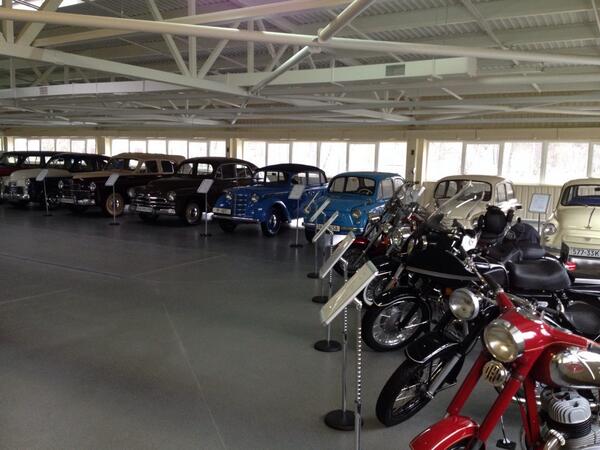
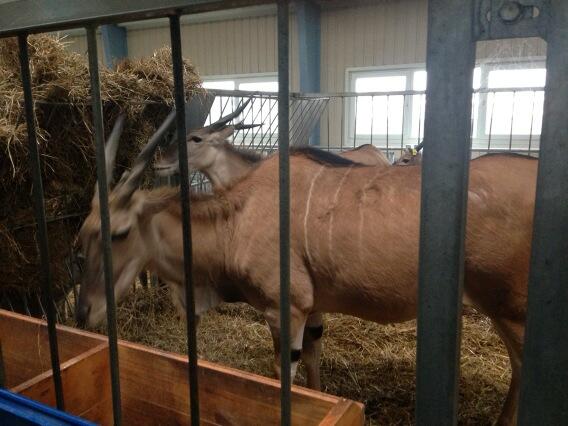
Tens of thousands of ordinary Ukrainians poured onto the grounds of Yanukovych’s abandoned presidential compound, 12 miles from downtown Kiev, to gawk at the manicured lawns, small zoo, golf course, botanical gardens and classic car collection.
Museum officials were working with militias to guard the presidential mansion and inventory possessions and art works they say were likely borrowed or stolen by Yanukovych from state museums and institutions.
“Who knows what he has stashed in there,” said Ihor Lihovy, a consultant for the Ukrainian national committee for the preservation of national treasures. “We have been told he was hoarded masterpieces. It is a scandal.”
Yanukovych built his mansion and its outbuildings after he was elected president in 2010. None of the Ukrainian public or media had seen inside the compound until Saturday. An elderly pensioner with a mouth full of metal teeth shouted, “What a thief!” as he took in the marble statuary.
The crowds were orderly and polite. There was no looting, few were allowed to enter the houses or outbuildings, and opposition protesters even warned visitors to keep off the grass.
A group of young people, however, somehow found their way into Yanukovych’s clubhouse and brought out golf balls and clubs and whacked a few drives down the long fairways.

Anne Gearan contributed to this report from Washington. 

To get why so many people hate Viktor Yanukovych, take a tour of his ridiculously luxurious mansion

Ukrainian President Viktor Yanukovych attends the signing of an agreement to end the Ukrainian crisis in Kiev, Ukraine, Friday, Feb. 21, 2014. Ukraine’s opposition leaders signed a deal Friday with the president and European mediators for early elections and a new government in hopes of ending a deadly political crisis. Russian officials immediately criticized the deal and protesters angry over police violence showed no sign of abandoning their camp in central Kiev. (AP Photo/Andrei Mosienko, Presidential Press Service, Pool)
Ukrainian President Viktor Yanukovych attends the signing of an agreement to end the crisis in Kiev on Friday.  Andrei Mosienko, AP/Presidential Press Service/Pool)
Ukraine's ongoing crisis is about many things: geopolitics, economics, linguistics, ethnicity, to name a few.
But for many people, the problem is much simpler. It's all about President Viktor Yanukovych, who is widely believed to have used his position as the country's leader to enrich himself and his inner circle, collectively known in Ukraine as "the family."
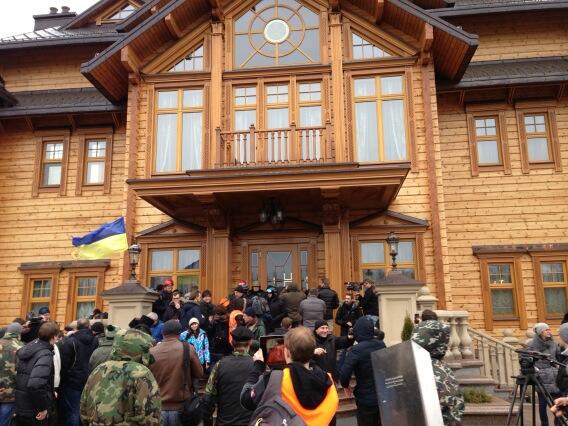
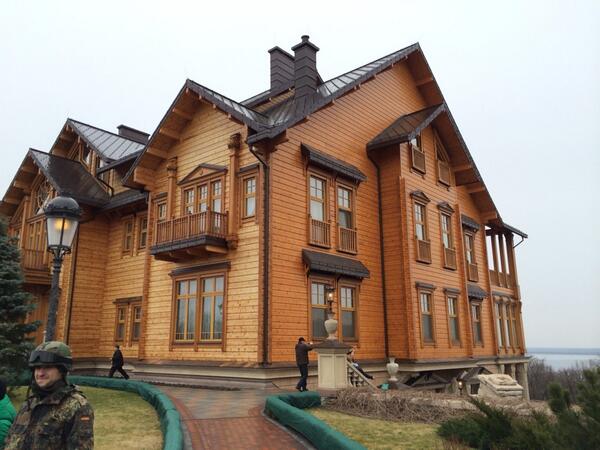
To get an idea of why Yanukovych is so loathed by many in Ukraine, take a quick tour of his mansion in Mezhyhirya, some 12 miles outside Kiev. Now that Yanukovych has fled the capital, thousands of people, including reporters and curious bystanders, have made their way to the residence.
Here's some of what they found:
View image on Twitter
Shot of the main building in the area. Kind of tasteful if not for the kitsch all around it
View image on Twitter

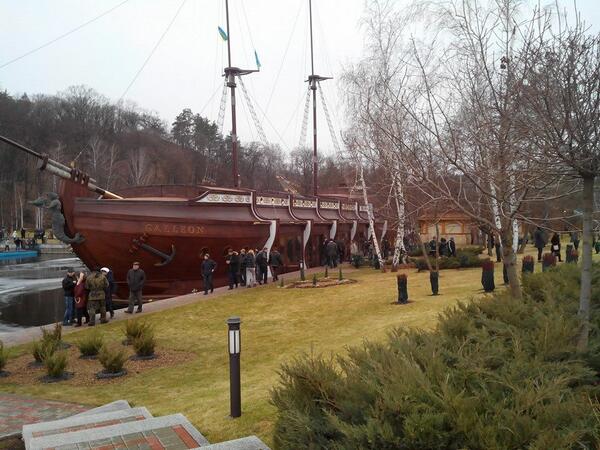
"Tasteful" galleon on Yanukovych's man-made lake RT @KonstantinBznv:pic.twitter.com/Eoy9mFe0HI
View image on Twitter
Yanukovych's purported car collection. MT @Andriyak: А Віктор Федорович - нехилий любитель авто і мото екзотики!!!
View image on Twitter
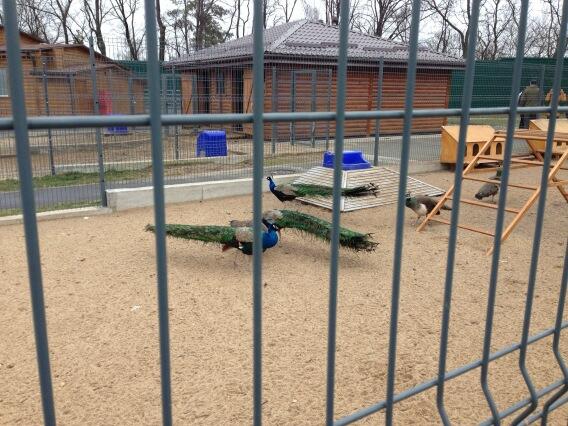
The private zoo. Peacocks of course
View image on Twitter
Every President needs one of these
Yanukovych's residence in Mezhyhirya had long been held up as an example of the Ukrainian elite's corruption and waste: It has been estimated to have cost $100 million to build. For most Ukrainians, however, this is the first time they've been able to see it up close.
In any country, a president who owned a zoo or a galleon might be viewed cynically. In a country with a per capita GDP of $7,300, such indulgences might be unforgivable.
 

The bitterness behind the upheaval in Ukraine

The bitterness behind the upheaval in Ukraine  http://www.washingtonpost.com/world/europe/ukraines-yanukovych-missing-as-protesters-take-control-of-presidential-residence-in-kiev/2014/02/22/802f7c6c-9bd2-11e3-ad71-e03637a299c0_story.html?tid=pm_pop

http://www.washingtonpost.com/blogs/worldviews/wp/2014/02/22/to-get-why-so-many-people-hate-viktor-yanukovych-take-a-tour-of-his-ridiculously-luxurious-mansion/?tid=pm_world_pop 


20 February 2014

Despite truce, more fighting reported in Kiev (Photos & Video) 20FEB14

THERE is too much blood on yanukovych's hands for him to remain in power. Ukraine will not know peace until he leaves office on his own or is removed by the people.
UKRAINE may be spinning out of control, blame lies directly with the corrupt and inept government of pres yanukovych and his decision to turn his back on the European Union and offer his country as an indentured servant to vladamir putin. After his politically engineered coup d'etat allowing putin to rule Russia with an iron fist in a style similar to stalin (though he probably see's his rule more czar like) there is no doubt he would like to restore the Russian empire to it's former, soviet "glory". Ukraine is seen as a vital part of that empire, and probably the only thing that has kept Russian tanks and troops out of the country to save yanukovych are the ongoing Sochi 2014 Winter Olympics. The democratic forces in Ukraine have to move fast, they only have a few days for yanukovych to leave office. How is his choice. He should resign and move to Russia. But he can be removed by the people, and they could exile him or remove him like mussolini, gaddafi, or ceausecau were. Something has to happen before the end of the games this week to keep putin out of Ukraine. More at Is Ukraine on the verge of spinning out of control? & UPDATE: Ukraine’s government and opposition call for truce & Examining the diplomatic push and pull over Ukraine 18&19&7FEB14 http://bucknacktssordidtawdryblog.blogspot.com/2014/02/is-ukraine-on-verge-of-spinning-out-of.html
Written by Will Englund
Updated: Thursday, February 20, 7:14 AM
KIEV, Ukraine — Hours after a truce was declared between Ukrainian government forces and opposition protesters, fighting broke out once again Thursday morning in the streets around Kiev’s Independence Square.
Police and demonstrators traded molotov cocktails, and gunshots could be heard. On the hill south of the square, the protest movement’s epicenter also known as the Maidan, the parliament and cabinet buildings were evacuated.
Although the fighting Thursday morning fell short of developing into a full-scale battle, the Health Ministry confirmed five deaths in clashes near government offices. Videos indicated that some protesters have sniper rifles; police were shown shooting automatic weapons. Unofficial reports put the death toll considerably higher.
The Associated Press reported that 18 bodies were laid out on the edge of the protest encampment. Interior Ministry spokesman Serhiy Burlakov told the agency that one policeman was killed and 28 suffered gunshot wounds on Thursday.
Witnesses said they saw 10 bodies at a medical station on Independence Square.
The Kyiv Post reported that about 50 Interior Ministry troops were captured by demonstrators and were taken to the post office, which the opposition controls.
Vitali Klitschko, a former heavyweight boxing champion who has emerged as a leading opposition figure, called on parliament to convene Thursday afternoon to find a resolution to the crisis. The Russian Foreign Ministry, meanwhile, demanded that opposition leaders put a stop to violence the violence.
Russia’s Interfax news agency said a group of legislators from the ruling Party of Regions seconded Klitschko’s call for parliament to meet at 3 p.m. The newly appointed mayor of Kiev quit the Party of Regions Thursday.
A truce reached late Wednesday between President Viktor Yanukovych and three main opposition political leaders has not been formally renounced, but the fighting demonstrated how neither side appears to have control over its armed contingents.
The development came as U.S. and European leaders condemned the violence and the United States said it was imposing visa sanctions on 20 Ukrainian officials. Russia, meanwhile, condemned the opposition.
The pressure on Ukraine — internal and external — has only increased, and the two sides are so far apart that reconciliation appears impossible. They are now faced with the challenge of getting the country back on track even without reconciling politically.
The hostility between Yanukovych and the political opposition is deep and intense, and now has been paid for in blood. Regional differences are flaring, with governors in the east near the Russian border denouncing the protesters and demanding a crackdown, while in the west, cities are declaring virtual autonomy from the central government. Opposition leaders, for their part, are leading a movement that includes hard-line militants who are not keen on political compromise.
Abroad, the Western nations and Russia blamed each other for supporting one of the two sides in Ukraine’s long-running political crisis.
The country, which has experienced regular bouts of political turmoil since the downfall of the Soviet Union two decades ago — but never the sort of violence seen Tuesday — appears to be at a point of fracture.
That may now be extending to the government itself.
As fires continued to burn Wednesday on the Maidan, forming a buffer of flame and thick greasy smoke between protesters and police, the state security service announced that it was launching an “anti-terrorist operation.” A little while later, the Defense Ministry said it might join in.
It appeared as though a serious escalation was in the works. But then Yanukovych fired his chief military commander Wednesday evening.
Col. Gen. Volodymyr Zamana was quoted a month ago as saying that the armed forces should never be used against Ukrainian civilians, and this may have been the reason for his ouster.
The Ukrainian army is not as well-funded or powerful a force as the Interior Ministry. Nonetheless, it wields heavy weaponry that the opposition fears may come into play.
U.S. military leaders have been unable for the past several days to reach their Ukrainian counterparts to warn them against getting involved in the crisis, a senior U.S. official said Wednesday night, and this is a matter of some concern.
Ukraine’s military has joined with NATO in Iraq and Afghanistan and has particularly close relations with the Polish military. But Poland has been Yanukovych’s most vocal critic, and that may leave him uncertain of his own army’s loyalty in a fight portrayed as East vs. West.
Later in the evening, the security service said that although it was making preparations for an anti-terrorist operation, it had not put one into effect, according to the Interfax news agency.
All this has left Ukrainians wondering whether a crackdown is coming and, if so, how effective it might be given the conflicting pressures on the beleaguered country.
Small but violent protests Wednesday left several people wounded and one reported dead in the Black Sea port of Odessa and in the western city of Khmelnytskyy.
In the east — in Donetsk, Yanukovych’s home town, and Kharkov — governors talked tough about defeating the protests.
But the city of Lviv in western Ukraine effectively declared itself autonomous of the central government. In nearby Ivano-Frankivsk, the local commander of the security forces pledged not to carry out or give any illegal orders.
Obama warns both sides
The Russian Foreign Ministry, which backs Yanukovych, said Tuesday’s violence was an attempted coup by the opposition, and Foreign Minister Sergei Lavrov called on Western countries to use their influence with the opposition to force it into negotiations with the government.
The White House and the European Union strongly criticized Yanukovych earlier Wednesday, blaming him for the violence.
“I want to be very clear as we work through these next several days in Ukraine that we’re going to be watching closely and we expect the Ukrainian government to show restraint, to not resort to violence in dealing with peaceful protesters,” Obama said. “We’ve also said we expect peaceful protesters to remain peaceful, and we’ll be monitoring very closely the situation, recognizing that with our European partners and the international community there will be consequences if people step over the line.”
E.U. Commission President José Manuel Barroso expressed “shock and utter dismay” Wednesday over the “violence and use of excessive force,” which he blamed on Ukraine’s “political leadership.” He said he expects the E.U. to agree on “targeted measures against those responsible.”
The Swedish foreign minister, Carl Bildt, said Yanukovych “has blood on his hands.”
Bildt said Ukraine would have been on its way to a better future by now, with a trade agreement with the E.U., were it not for threats from Moscow.
The foreign ministers of Poland, Germany and France intend to travel here Thursday to hold talks about the crisis and then to Brussels for an E.U. meeting to consider targeted sanctions against Ukrainian officials.
Authorities said that 800 people have been injured, and that of the 26 killed, 10 were Interior Ministry troops.
There have been guarded expressions of unease within the ruling Party of Regions over the violence. Ukraine is without a prime minister a month after Mykola Azarov was forced from office. Rinat Akhmetov, an oligarch once very close to Yanu­kovych, has called for an end to violence by both sides.
If an “anti-terrorist” campaign begins, it is not clear what it will entail or how effectively it can be carried out. Government officials say hard-line protesters have stolen 1,500 firearms during the three months of demonstrations and have used them against police.
A special operation would presumably give the security service the authority to seize people and property without court orders for a specified period.
Vice President Biden has warned Yanukovych several times — most recently on Tuesday — against declaring a state of emergency.
The Defense Ministry denied that armored units were moving to Kiev. Paratroop battalions have been deployed to guard Defense Ministry sites, but not to take part in an attack on protesters, officials said.
Focus on rightists
Yanukovych, echoing the Russians, has said that the top political leaders of the opposition must disassociate themselves from the right-wingers among the protesters who have done most of the fighting with police.
Helmeted young militants of the group that calls itself Pravy Sektor have without question complicated the role of more moderate political leaders and, in important ways, have helped set the opposition agenda. Opposition politicians have been careful not to have a falling-out with their most committed wing.
In a joint statement, the three main opposition parties said they were not responsible for Tuesday’s deadly violence.
“We have never called and never will call people to pick up arms,” it said. “This is our principled stance. The death of any person is a personal tragedy for each one of us.”
Kiev explodes into chaos