NORTON META TAG

Showing posts with label rep andy harris r MD. Show all posts

04 February 2012

'Gasland' Journalists Arrested At Hearing By Order Of House Republicans (UPDATES) 1FEB12

SO much for repiglican / tea-bagger congressional transparency, but really, did any of use expect any less?
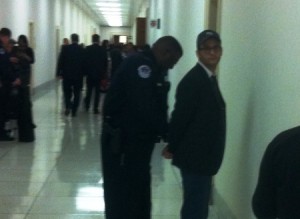
This image, taken by a Democratic source, shows Josh Fox being arrested by Capitol Hill police. 

WASHINGTON -- In a stunning break with First Amendment policy, House Republicans directed Capitol Hill police to detain a highly regarded documentary crew that was attempting to film a Wednesday hearing on a controversial natural gas procurement practice. Initial reports from sources suggested that an ABC News camera was also prevented from taping the hearing; ABC has since denied that they sent a crew to the hearing.
Josh Fox, director of the Academy Award-nominated documentary "Gasland" was taken into custody by Capitol Hill police this morning, along with his crew, after Republicans objected to their presence, according to Democratic sources present at the hearing. The meeting of the House Subcommittee on Energy and Environment had been taking place in room 2318 of the Rayburn building.
HuffPost has obtained exclusive video of the arrest of Josh Fox. Rep. Brad Miller (D-N.C.), the ranking Democrat on the subcommittee, can be heard at the end of the clip asking Republican Chairman Andy Harris (R-Md.) to halt the arrest and permit Fox to film the public hearing. Harris denies Miller's request as Fox is escorted out of the hearing in handcuffs.
WATCH Capitol Hill Police Arrest a Journalist for Filming a Public Hearing: (story continues below, click the link to watch the video of Josh Fox's arrest)
http://www.huffingtonpost.com/2012/02/01/house-republicans-order-j_n_1246971.html?utm_source=Triggermail&utm_medium=email&utm_term=Daily%20Brief&utm_campaign=daily_brief
"Gasland" received strong critical acclaim and takes a critical eye toward the practice of hydraulic fracturing, or "fracking," a process in which several tons of highly pressurized water and chemicals are injected into the ground, allowing valuable natural gas to escape. The practice is decried by ecological experts for destroying ecosystems and polluting groundwater. The energy industry keeps the actual content of fracking chemicals secret.
Fox had hoped to film Wednesday's hearing for a follow-up to "Gasland." Fox told HuffPost later Wednesday evening, "We did get his staff on the phone, they never returned the phone call," referring to staffers for Chairman Harris. "This is not transparency. This is a lockout and it's bad. It's the people's House, after all. We went through the proper channels to arrange to tape this hearing. We have taped congressional hearings before and we've been turned down before, but I disagree with the policy. Anyone who says they're a journalist is a journalist. It's called the First Amendment. It's the freedom of the press, and that is fundamental to our core identity as the United States of America."
Hearings are open to the public, and any citizen can attend. Regulations only govern the use of cameras. Even under an extreme adherence to the rules, Fox's camera could have been confiscated or disabled without subjecting him to arrest. And while Fox did not have formal Capitol Hill credentials, such formalities are rarely enforced against high-profile journalists. Temporary passes are easy to obtain, and if Republicans had objected on procedural grounds, they could have simply sent the crew to the front desk, rather than ordering police to arrest journalists. The right to a free press is protected by the First Amendment to the U.S. Constitution. Documentary crews are almost never denied access to public meetings of elected government officials.
UPDATE: 12:09 p.m. -- Capitol Police public information officer Sergeant Kimberly Schneider provided the following statement to HuffPost on the morning's events:
"At approximately 10:30 a.m. today, United States Capitol Police arrested Joshua Fox of Milanville, Pa. in room 2318 of the Rayburn House office building. He is charged with unlawful entry, and he is currently being processed at United States Capitol Police headquarters."
UPDATE: 2:27 p.m. -- Fox apparently had applied for credentialing the day before the hearing but had been unable to obtain official permission to film. He had asked a credentialed film crew to tape the proceedings on his behalf but was informed that this was not permitted.
Nevertheless, turning away journalists is extremely rare on Capitol Hill. The rules requiring pre-approval for film crews are designed to prevent hearings from being disrupted by hordes of camera operators. That was not the case for this hearing. Only two cameras requested entrance to the event, which was not crowded.
Subcommittee Chairman Andy Harris (R-Md.) was unavailable for comment, but several Democrats on the committee voiced outrage with the GOP's press blackout.
"I was chair of the Subcommittee for four years, and we frequently had people show up the day of a hearing to film," Rep. Brad Miller (D-N.C.) told HuffPost. "We asked for their name, but they were told if they would not disrupt the hearing, they were free to record. A couple of times staff said, 'You're getting in the way, don't stand there,' but other than that, I do not ever recall anything like this. We certainly never turned anyone away for not providing 24 hours' notice."
"It's an outrageous violation of the First Amendment," Rep. Zoe Lofgren (D-Calif.) told HuffPost. "Here we've got an Academy Award-nominated filmmaker, and it's an important subject and the subject that he did his prior film on for HBO. And they put him in handcuffs and hauled him out of there. This is stunning."

"I found it ironic that there was not a flood of cameras there," noted Rep. Paul Tonko (D-N.Y.). "There was the one camera and then before that, the ABC camera ... if you have a camera there to bring the issue home to the public, that's a good thing."
The hearing was already being filmed by C-SPAN. Josh Fox had only sought to obtain higher-quality video by bringing their own cameras to the event. Democrats attempted to suspend the rules governing camerawork to allow Fox and ABC to film the hearing, but Republicans, who hold a majority on all House committees and subcommittees, voted down the motion. Democrats then sought to postpone the hearing to allow for filming at a later date, a motion which Republicans also overruled.
UPDATE: 3:45 p.m. -- Republican staffers told Democrats that a crew for ABC News had also been denied access to the event, but ABC News told HuffPost that their organization did not have any journalists assigned to cover the hearing. It is not clear what caused the confusion.
"We definitely did not have a crew on the Hill this morning to cover this hearing," an ABC News spokeswoman told HuffPost. "The individual who was turned away absolutely did not have ABC news credentials."
UPDATE: 4:45 p.m. -- Rep. Jerry Nadler (D-N.Y.) told HuffPost, “I have served in the House of Representatives since 1992, and I had the privilege of chairing the Subcommittee on the Constitution, Civil Rights, and Civil Liberties. In all that time, I cannot recall a chair of any committee or subcommittee having ever ordered the removal of a person who was filming a committee proceeding and not being disruptive, whether or not that person was accredited. It is a matter of routine that all sorts of people photograph and record our proceedings. Most of them are not accredited. I cannot recall anyone questioning their right to be there."
Arthur Spitzer, legal director of the ACLU in Washington, explained that "congressional committees routinely allow professional journalists to record hearings even when they don't have official press credentials, and excluding a journalist because he doesn't share the political views of the committee chair is outrageous. The Supreme Court has explained many times that censorship based on viewpoint is the clearest kind of First Amendment violation, and that seems to be what happened here."
Josh Fox, meanwhile, has issued the following statement to the press:
I was arrested today for exercising my First Amendment rights to freedom of the press on Capitol Hill. I was not expecting to be arrested for practicing journalism. Today's hearing in the House Energy and Environment subcommittee was called to examine EPAs findings that hydraulic fracturing fluids had contaminated groundwater in the town of Pavillion, Wyoming. I have a long history with the town of Pavillion and its residents who have maintained since 2008 that fracking has contaminated their water supply. I featured the stories of residents John Fenton, Louis Meeks and Jeff Locker in GASLAND and I have continued to document the catastrophic water contamination in Pavillion for the upcoming sequel GASLAND 2. It would seem that the Republican leadership was using this hearing to attack the three year Region 8 EPA investigation involving hundreds of samples and extensive water testing which ruled that Pavillion's groundwater was a health hazard, contaminated by benzene at 50x the safe level and numerous other contaminants associated with gas drilling. Most importantly, EPA stated in this case that fracking was the likely cause. As a filmmaker and journalist I have covered hundreds of public hearings, including Congressional hearings. It is my understanding that public speech is allowed to be filmed. Congress should be no exception. No one on Capitol Hill should regard themselves exempt from the Constitution. The First Amendment to the Constitution states explicitly "Congress shall make no law...that infringes on the Freedom of the Press". Which means that no subcommittee rule or regulation should prohibit a respectful journalist or citizen from recording a public hearing.
This was an act of civil disobedience, yes done in an impromptu fashion, but at the moment when they told me to turn off the cameras, I could not. I know my rights and I felt it was imperative to exercise them.
When I was led out of the hearing room in handcuffs, John Boehner's pledge of transparency in congress was taken out with me.
The people of Pavillion deserve better. The thousands across the US who have documented cases of water contamination in fracking areas deserve their own hearing on Capitol hill. They deserve the chance to testify in before Congress. The truth that fracking contaminates groundwater is out, and no amount of intimidation tactics --either outright challenges to science or the arrest of journalists --will put the genie back in the bottle. Such a brazen attempt to discredit and silence the EPA, the citizens of Pavillion and documentary filmmaking will ultimately fail and it is an affront to the health and integrity of Americans.
Lastly, in defense of my profession, I will state that many many Americans get their news from independent documentaries. The hill should immediately move to make hearings and meetings accessible to independent journalists and not further obstruct the truth from being reported in the vivid and in depth manner that is only achievable through long form documentary filmmaking.
I will be thinking on this event further and will post further thoughts and developments.
I have been charged with "unlawful entry" and my court date is February 15.
Josh Fox
Washington D.C.
2/1/12
This is a developing story. Check back with HuffPost for more.

29 January 2011

Ayn Rand Railed Against Government Benefits, But Grabbed Social Security and Medicare When She Needed Them 29JAN11

AYN RAND, SOCIOPATH, hypocritical darling of greedy right wing politicians, the gop  and tea-baggers benefited from the very social safety net programs she felt the poor, working class and middle class Americans have no right to....and these hypocrites carry on her legacy by working to destroy Social Security, Medicare, Medicaid, the Affordable Care Act while keeping their own government subsidized health care and pension systems because they feel they are entitled to them. From AlterNet....... 
 
Ayn Rand was not only a schlock novelist, she was also the progenitor of a sweeping “moral philosophy” that justifies the privilege of the wealthy and demonizes not only the slothful, undeserving poor but the lackluster middle-classes as well.
Her books provided wide-ranging parables of "parasites," "looters" and "moochers" using the levers of government to steal the fruits of her heroes' labor. In the real world, however, Rand herself received Social Security payments and Medicare benefits under the name of Ann O'Connor (her husband was Frank O'Connor).
As Michael Ford of Xavier University's Center for the Study of the American Dream wrote, “In the end, Miss Rand was a hypocrite but she could never be faulted for failing to act in her own self-interest.”
Her ideas about government intervention in some idealized pristine marketplace serve as the basis for so much of the conservative rhetoric we see today. “The reason I got involved in public service, by and large, if I had to credit one thinker, one person, it would be Ayn Rand,” said Paul Ryan, the GOP's young budget star at a D.C. event honoring the author. On another occasion, he proclaimed, “Rand makes the best case for the morality of democratic capitalism.”
“Morally and economically,” wrote Rand in a 1972 newsletter, “the welfare state creates an ever accelerating downward pull.”
Journalist Patia Stephens wrote of Rand:
[She] called altruism a “basic evil” and referred to those who perpetuate the system of taxation and redistribution as “looters” and “moochers.” She wrote in her book “The Virtue of Selfishness” that accepting any government controls is “delivering oneself into gradual enslavement.”
Rand also believed that the scientific consensus on the dangers of tobacco was a hoax. By 1974, the two-pack-a-day smoker, then 69, required surgery for lung cancer. And it was at that moment of vulnerability that she succumbed to the lure of collectivism.
Evva Joan Pryor, who had been a social worker in New York in the 1970s, was interviewed in 1998 by Scott McConnell, who was then the director of communications for the Ayn Rand Institute. In his book, 100 Voices: An Oral History of Ayn Rand, McConnell basically portrays Rand as first standing on principle, but then being mugged by reality. Stephens points to this exchange between McConnell and Pryor.
“She was coming to a point in her life where she was going to receive the very thing she didn’t like, which was Medicare and Social Security,” Pryor told McConnell. “I remember telling her that this was going to be difficult. For me to do my job she had to recognize that there were exceptions to her theory. So that started our political discussions. From there on – with gusto – we argued all the time.
The initial argument was on greed,” Pryor continued. “She had to see that there was such a thing as greed in this world. Doctors could cost an awful lot more money than books earn, and she could be totally wiped out by medical bills if she didn’t watch it. Since she had worked her entire life, and had paid into Social Security, she had a right to it. She didn’t feel that an individual should take help.”
Rand had paid into the system, so why not take the benefits? It's true, but according to Stephens, some of Rand's fellow travelers remained true to their principles.
Rand is one of three women the Cato Institute calls founders of American libertarianism. The other two, Rose Wilder Lane and Isabel “Pat” Paterson, both rejected Social Security benefits on principle. Lane, with whom Rand corresponded for several years, once quit an editorial job in order to avoid paying Social Security taxes. The Cato Institute says Lane considered Social Security a “Ponzi fraud” and “told friends that it would be immoral of her to take part in a system that would predictably collapse so catastrophically.” Lane died in 1968.
Paterson would end up dying a pauper. Rand went a different way.
But at least she put up a fight before succumbing to the imperatives of the real world – one in which people get sick, and old, and many who are perfectly decent and hardworking don't end up being independently wealthy.
The degree to which Ayn Rand has become a touchstone for the modern conservative movement is striking. She was a sexual libertine, and, according to writer Mark Ames, she modeled her heroic characters on one of the most despicable sociopaths of her time.
http://www.alternet.org/books/145819/ayn_rand,_hugely_popular_author_and_inspiration_to_right-wing_leaders,_was_a_big_admirer_of_serial_killers
"One reason most countries don't find the time to embrace Ayn Rand's thinking is that she is a textbook sociopath. In her notebooks Ayn Rand worshiped a notorious serial murderer-dismemberer, and used this killer as an early model for the type of "ideal man" she promoted in her more famous books. These ideas were later picked up on and put into play by major right-wing figures of the past half decade, including the key architects of America's most recent economic catastrophe -- former Fed Chair Alan Greenspan and SEC Commissioner Chris Cox -- along with other notable right-wing Republicans such as Supreme Court Justice Clarence Thomas, Rush Limbaugh and South Carolina Gov. Mark Sanford.
The loudest of all the Republicans, right-wing attack-dog pundits and the Teabagger mobs fighting to kill health care reform and eviscerate "entitlement programs" increasingly hold up Ayn Rand as their guru. Sales of her books have soared in the past couple of years; one poll ranked Atlas Shrugged as the second most influential book of the 20th century, after the Bible.
The best way to get to the bottom of Ayn Rand's beliefs is to take a look at how she developed the superhero of her novel, Atlas Shrugged, John Galt. Back in the late 1920s, as Ayn Rand was working out her philosophy, she became enthralled by a real-life American serial killer, William Edward Hickman, whose gruesome, sadistic dismemberment of 12-year-old girl named Marion Parker in 1927 shocked the nation. Rand filled her early notebooks with worshipful praise of Hickman. According to biographer Jennifer Burns, author of Goddess of the Market, Rand was so smitten with Hickman that she modeled her first literary creation -- Danny Renahan, the protagonist of her unfinished first novel, The Little Street -- on him.
What did Rand admire so much about Hickman? His sociopathic qualities: "Other people do not exist for him, and he does not see why they should," she wrote, gushing that Hickman had "no regard whatsoever for all that society holds sacred, and with a consciousness all his own. He has the true, innate psychology of a Superman. He can never realize and feel 'other people.'"
This echoes almost word for word Rand's later description of her character Howard Roark, the hero of her novel The Fountainhead: "He was born without the ability to consider others." (The Fountainhead is Supreme Court Justice Clarence Thomas' favorite book -- he even requires his clerks to read it.)"
Ames’ conclusion is important for understanding today’s political economy. “Whenever you hear politicians or Tea Partiers dividing up the world between ‘producers’ and ‘collectivism,’” he wrote, “just know that those ideas and words more likely than not are derived from the deranged mind of a serial-killer groupie....And when you see them taking their razor blades to the last remaining programs protecting the middle class from total abject destitution—Social Security, Medicare and Medicaid—and bragging about how they are slashing these programs for ‘moral’ reasons, just remember Rand’s morality and who inspired her.”
Now we know that Rand was also just as hypocritical as the Tea Party freshman who railed against “government health care” to get elected and then whined that he had to wait a month before getting his own Cadillac plan courtesy of the taxpayers.
But, as I note in my book, The Fifteen Biggest Lies About the Economy, that's par for the course. A central rule of the U.S. political economy is that people are attracted to the idea of “limited government” in the abstract—and certainly don’t want the government intruding in their homes—but they really, really like living in a society with adequately funded public services.
That's just as true for an icon of modern conservatism as it is for a poor mother getting public health care for her kids.

19 January 2011

BOHICA! House Votes For Repeal Of Health Care Law from NPR & WASHINGTON POST 19JAN11

THE mainstream media, NPR & Washington Post included, is missing a major point in this story, the glaring hypocrisy of the representatives who voted to repeal the Affordable Health Care Act while keeping their insurance that is subsidized by the taxpayers at a cost of approximately $700 a month per policy. They feel they are entitled to government subsidized health care but nobody else is. They have the same lack of morality as the executives of the banks, financial institutions and companies who feel they are entitled to obscene bonuses after their companies were bailed out by the taxpayers. The gop/tea-bagger controlled House will make sure America does get one medical procedure, though it will be with greater frequency than recommended by the AMA......know what it is? Here's a hint....BOHICA!!!! BYOL (bring your own lube).....

The new Republican-controlled House voted Wednesday 245-189 to repeal the historic health care overhaul legislation signed last March by President Obama, but the measure appears destined to prove largely symbolic.
Top Democrats in the Senate, including Majority Leader Harry Reid, who characterized the House action as "partisan grandstanding," say they will block efforts to take up the bill.
And Obama, while signaling a willingness to work on aspects of the sweeping bill where compromise may be possible, has pledged to veto any effort to repeal the centerpiece of his domestic agenda.
Republicans lack the votes in the Senate to override a presidential veto.
But the up-or-down repeal vote fulfills a campaign promise many Republican candidates made last fall, and sets into motion a larger GOP strategy to use the power levers they control to chip away at aspects of the bill over the next two years.
During repeal debate that began Tuesday, and wound down late Wednesday afternoon, Republican Rep. Greg Walden of Oregon said that his party will come up with a "replacement bill."
Other House GOP leaders on the issue, including Rep. Steve King of Iowa, say the party will also use its muscle in the appropriations process to pull funding that would implement aspects of the bill, including enforcing the legislation's requirement that citizens have private or employer-provided health insurance.
Republican leaders say they don't have a deadline for producing new health care legislation — the "replace" part of their campaign promise of "repeal and replace."
But four House committees will be charged tomorrow with coming up with proposed changes to the existing bill. And more than two dozen states have joined a Florida lawsuit challenging the constitutionality of the health care law.
Largely Respectful Debate, Except …
The seven hours of floor debate struck a largely respectful tone, with one glaring detour: Democratic Rep. Steve Cohen of Tennessee late Tuesday compared Republican arguments to Nazi propaganda and "blood libel." The term was recently invoked, to much criticism, by former GOP vice presidential candidate Sarah Palin in a statement critical of the media's coverage of her in the wake of the recent shootings in Arizona that critically injured Rep. Gabrielle Giffords (D-AZ) and killed six people.
The health care measure, a hot-button political issue for more than 18 months and the first bill considered under House Republican control in the new Congress, is officially titled the "Repealing the Job-Killing Health Care Law Act."
Before the Tucson massacre, the impending repeal debate appeared likely to be stridently partisan — a replay, perhaps, of last year's debate, when terms like "death panels" were casually employed. But, as was the case Tuesday when the bill came to the floor, the language remained - with an exception or two - largely focused on well-worn talking points Wednesday.
House Speaker John Boehner, noting that Obama has indicated that the health care bill needs work, said:  "If we agree that this law needs improving, why would we keep it on the books?"
Obama in a statement this week said that while "we can't go backward," he is "willing and eager" to work with members of both parties to "improve the Affordable Care Act."
Democratic House Leader Nancy Pelosi, who was House Speaker when the bill passed, defended popular aspects of the bill that have already gone into effect, including barring insurance companies from denying coverage to people with pre-existing conditions, to allowing adult children up to age 26 to remain on their parents' policies.
"Repeal would be devastating to so many Americans," Pelosi said.
House Republicans have already indicated that they are unlikely to strip the pre-existing condition rule from any plan going forward.
But they also warned opponents not to underestimate their determination or their willingness to use parliamentary maneuvers to deny the Obama administration funds needed to carry out the law.
"Repeal doesn't mean we aren't for health care reform, quite the contrary," said Rep. Phil Roe (R-TN), an obstetrician-gynecologist. "This bill does increase the number of people who are insured. But it does nothing to decrease the costs."
That, he predicted, will make Obama's expansion of coverage unsustainable.
Both Parties Seize Opportunity To Make Case
Many Democrats were defiant during the debate. "We are not interested in taking down, repealing and destroying," said Rep. Xavier Becerra (D-CA).
They also held an informal hearing Tuesday featuring actual people who are benefiting from some of the parts of the law that have already taken effect.
Republicans are "re-litigating, regurgitating and re-arguing" a debate that was settled last year, said Rep. Rob Andrews (D-NJ). Repeal is "the wrong bill at the wrong time," he added.
Republicans argued that the law gives the federal government too much power, particularly the requirement that nearly every American either have health insurance or else pay a penalty.
"If this law is constitutional, if Congress has such broad power, our limited federal government will have become limitless," said Michigan freshman Republican Rep. Justin Amash.
The GOP's Health Care Priorities
The House is scheduled to vote Thursday to instruct several major committees to draft health care legislation that reflects Republican priorities, including limits on medical malpractice awards and stricter language barring taxpayer funding for abortions. But an earlier GOP bill that offered a competing vision to the Democrats' only covered a fraction of the people reached by Obama's law.
No matter, Republicans say. A modest, step-by-step approach may turn out to be more sustainable in the long run than a major new government program whose costs and consequences are still unclear.
The fate of the repeal-and-replace effort hinges on the quality of the replacement legislation and the care that Republicans put into drafting it, said Rep. Chris Gibson (R-NY), a freshman. If it meets the needs and concerns of the public, Gibson said, he believes Democrats in the Senate may be persuaded to give it serious consideration.
Easier said than done, Democrats say. For example, Republicans say they also want to help people with pre-existing medical conditions find affordable coverage. But many experts say that won't be possible unless there is some kind of requirement that healthy people get into the insurance pool as well, thereby helping to keep premiums down.
"They're going to have to deal with that," said Maryland Rep. Steny Hoyer, the No. 2 Democrat.
But while the legislative battle is likely to end in a draw, at least for now, the battle for public opinion rages on. A new CNN poll provides more ammunition for both sides. For Republicans, it finds that half of those polled think the law should be repealed. But Democrats will take heart in the fact that nearly 80 percent of Americans favor at least some aspect of the health law.
Contributing: Julie Rovner; Liz Halloran; The Associated Press
House votes to repeal health-care law

By Felicia Sonmez and David A. Fahrenthold
Washington Post Staff Writers
Wednesday, January 19, 2011; 6:33 PM


The House on Wednesday evening passed a bill that would repeal the national health care overhaul, approving the measure on a largely party-line vote.
The repeal bill passed 245 to 189, with three Democrats - Reps. Mike Ross (Ark.), Dan Boren (Okla.) and Mike McIntyre (N.C.) - joining Republicans in backing the measure. The three were among the four Democrats who voted earlier this month to advance the measure. Rep. Gabrielle Giffords (D-Ariz.), who remains in serious condition following this month's mass shooting in Tucson, was the only lawmaker not voting.
The bill's passage came after Democrats unsuccessfully staged an eleventh-hour vote in an effort to derail the Republican-sponsored measure.
The Democratic move, which would have made the repeal effort ineffective unless a majority of lawmakers gave up their federal health care benefits within 30 days of the bill's passage, fell short in the GOP-led House.
While the repeal passed the House, ultimately, it is expected to fail.
To actually repeal the law, Republicans would need the approval of the Democrat-controlled Senate and President Obama, unless they have enough votes to override his veto. They are not likely to get that approval.
That made Wednesday's debate look like a dress rehearsal for an entirely different discussion: not whether the bill should be repealed, but how it might be changed.
House Speaker John Boehner (R-Ohio) said in his remarks on the House floor that repeal would prevent more than $770 billion in tax hikes, reduce spending by $540 billion and protect more than 7 million seniors from losing or being denied coverage through Medicare Advantage.
"Repeal means paving the way for better solutions that will lower the cost without destroying jobs or bankrupting our government, and repeal means keeping a promise," Boehner said. "This is what we said what we'd do. We listened to the people; we made a commitment to them, a pledge to make their priorities, our priorities."
House Minority Leader Nancy Pelosi (D-Calif.) defended the law by citing some of the stories of seven Americans who gave testimony on Tuesday at a hearing called by House Democrats. "Nothing speaks more eloquently to the success of health care reform than the success of their own personal stories," she said.
"We don't want them to think that in order for them to have the same kind of access to health care that we do, we should say to them, 'Run for Congress,'" Pelosi said.
Throughout Wednesday's debate, some Republicans said that elements of the current law - such as a ban on denying coverage for for pre-existing conditions, or the ability for parents to keep young adult children on their insurance - might be included in a replacement bill they want to write.
"We will address, with a replacement bill, pre-existing conditions," said Rep. Greg Walden (R-Ore.). But Walden said Republicans wanted to to keep out of the replacement bill other elements of the overhaul law, which he said included an increase in the overall cost of healthcare.
"We can do better than this, given a chance," Walden said.
Democrats also said they would be willing to change elements of the law.
"This is political theater. It's a charade," Rep. Eliot Engel (D-N.Y.) said of the repeal proposal. He continued: "I'm willing to change the bill. But repealing it is the absolutely wrong way of doing it."
The two sides still seemed a long way from actual compromise. Republicans have not said exactly how they would replace the current bill with one that provided these benefits with lower costs. And Democrats seem unwilling to budge on some elements most unpopular with Republicans, like the requirement that all individuals buy health insurance.
The tone of Wednesday's debate was far more muted than the first debate over the healthcare overhaul--there were fewer mentions of "job-killing," or comparisons of the bill to socialism.
But, as the day went on, both sides slipped in bitter jabs at the other. Freshman Rep. Morgan Griffith (R-Va.), compared his state's fight against the health-care overhaul to the American Revolution.
"We did not accept the chains of George III, nor will we accept the chains of Obamacare," Griffith said.
After him, Rep. Anthony Weiner (D-N.Y.) said Republicans were telling untruths about the healthcare legislation. He said that, if anyone watching on television was playing a drinking game that required them to drink when a Republican bent the truth, they needed to get a designated driver.
Weiner said the Republicans' tactics should be called the "'We don't really mean it' strategy."
The night before, Rep. Steve Cohen (D-Tenn.) had compared the Republican tactics on this issue to ones used by the Nazis.
"They say it's a government takeover of health care, a big lie just like Goebbels," Cohen said. "You say it enough, you repeat the lie, you repeat the lie, and eventually, people believe it. Like blood libel. That's the same kind of thing.
"The Germans said enough about the Jews and people believed it--believed it and you have the Holocaust," Cohen said.
Rep. Michele Bachmann (R-Minn.) on Wednesday called the health care overhaul "the crown jewel of socialism." And a handful of members of both parties used heated rhetoric in charging that the health care overhaul would "kill jobs" -- or that its repeal would result in "killing Americans."
Wednesday's floor debate was a chance for both sides to try out the arguments they are likely to use in this year's longer debate, as Congress considers changing or eliminating the healthcare legislation one piece at a time.
Republicans largely used their floor remarks to tie the health care law to the economy, arguing that the health care overhaul will do away with fiscal discipline through increased spending and higher taxes, cost the country jobs and create economic uncertainty.
Some lawmakers went further, arguing that the law itself is unconstitutional, would overextend the reach of government and would allow for taxpayer-funded abortions, even though Democrats say that is not the case.
Rep. Mike Pence (R-Ind.), a prominent conservative who is mulling a bid for president or governor, said that with Wednesday's vote, House Republicans "are going to stand with the American people and vote to repeal their government takeover of health care lock, stock and barrel."
"Now I know the other side and some liberals in the media don't like us using that term -- government takeover of health care -- but let me break it down for you: When you mandate that every American purchase health insurance whether they want it or need it or not ... and you throw in public funding of abortion against the wishes of the overwhelming majority of the American people, that's a government takeover of health care and the American people know it," Pence said in his floor remarks.
In the battle of constituent anecdotes, Republicans told stories about small businessmen worried about the bill's costs. Democrats, on the other hand, talked about patients: people who would get help paying for pre-natal care, or the treatment of cancer or other diseases.
At one point, Reps. Louise Slaughter (D-N.Y.) and Marsha Blackburn (R-Tenn.) sparred over how women would be affected by a repeal of the health care law.
"Thanks to the new law, women do not have to worry anymore about being treated as second-class citizens or about being discriminated against for being a woman," Slaughter said, arguing that the health care law made it illegal for insurance companies to charge women higher premiums and would require that insurers provide coverage for victims of domestic violence.
Blackburn shot back that the health care overhaul would make it "more difficult for women under the age of 50 and over the age of 75 to get mammograms."
"One of our primary concerns with this legislation was the way in which women would be adversely impacted," Blackburn said, adding that "we need this bill off the books."

18 January 2011

Ron Paul: GOP ‘Could Be’ Hypocrites For Using Gov Health Care For Themselves, Repealing It For Public 18JAN11

SHOWING THEMSELVES FOR WHAT THEY ARE, HYPOCRITICAL, GREEDY, SELF-SERVING AND CONTROLLED BY CORPORATE INTEREST AND THE WEALTHY THAT PAID FOR THEIR CONGRESSIONAL SEATS, THESE REPUBLICORP MINIONS WILL DO THEIR BEST TO DESTROY HEALTH CARE REFORM (THE AFFORDABLE CARE ACT), THROWING THE REST OF US TO SUFFER FROM THE WHIMS OF THE PROFIT DRIVEN INSURANCE COMPANIES AS LONG AS CONGRESS GETS TO KEEP THEIR TAXPAYER SUBSIDIZED HEALTH INSURANCE. WHY? BECAUSE, JUST LIKE THE EXECUTIVES OF TARP RESCUED BANKS, FINANCIAL INSTITUTIONS AND CORPORATIONS WHO ARE STILL GETTING HUGE BONUSES WHILE THE NATION WALLOWS IN RECESSION, THEY FEEL THEY ARE ENTITLED TO IT.  THIS FROM THINK PROGRESS....
Rep. Andy Harris (R-MD), who campaigned on a pledge to repeal health reform, gained notoriety shortly after being elected when he complained about a delay in receiving his government-sponsored health care benefits as a member of Congress. While repeal efforts have unified most Republicans, Harris’ comments sparked a debate within the GOP caucus over charges of hypocrisy. Several new Republican lawmakers have turned down their government-sponsored plans, but the vast majority have chosen to accept taxpayer money to help pay for their own health benefits and coverage for their staff.
Speaking to ThinkProgress shortly after the swearing-in ceremony for Speaker John Boehner (R-OH), Rep. Ron Paul (R-TX) explained to us that — although he supports repealing health reform — he hasn’t evaluated his own package of taxpayer-subsidized health benefits for himself and his staff. At first, Paul said he wasn’t sure of the size of the taxpayer subsidy. Asked if he thought it was hypocritical for members of Congress to accept government subsidized and regulated health plans while repealing similar benefits for everyone else, Paul replied blithely, “[c]ould be”:
KEYES: Do you think you’ll be voting for it when it comes up, voting for repeal?
PAUL: I would.
KEYES: Do you think you’ll also be giving up government-sponsored health care for yourself?
PAUL: I would hope so. [...] Well, I will be voting against all of this stuff, but whether I’m going to be changing my policies or not, I have Blue Cross Blue Shield. I pay a fee every month for it.
KEYES: But the government, the members of Congress and their staff are all subsidized by taxpayers, government subsidies.
PAUL: I don’t know how much the subsidy is — [...]
FANG: Do you think it’s hypocritical to take government subsidized and regulated health care as a member of Congress but repeal it for everyone else?
PAUL: Could be.
Watch it:


Members of Congress on average receive a $700 a month taxpayer subsidy for their health insurance plan, which they can choose through a highly regulated exchange offered by the government. The federal exchange establishes a minimum benefit plan, which bars discrimination based on preexisting conditions and other insurance industry abuses, and provides a menu of private sector plans to choose from. Congressional staff members receive the same plan as members. The federal system mirrors the reforms enacted by Democrats and President Obama, which end health insurance abuses by regulating coverage through an exchange, while offering subsidies to individuals and small businesses to make coverage more affordable.
Few Republicans have been as candid as Paul. For instance, Rep. Robert Hurt (R-VA) tried to tell ThinkProgress that his congressional health benefits don’t qualify as any special privilege. “It’s a policy that’s issued by Anthem and it’s a policy that any — it’s open to the public,” Hurt claimed. However, millions of Americans, unlike Hurt and other members of Congress, can be denied health coverage because of what insurance companies deem as “preexisting conditions.” And other than government employees and veterans, few Americans enjoy the type of taxpayer subsidies given to members of Congress like Hurt and Paul.

06 January 2011

DEFEND THE AFFORDABLE CARE ACT from HEALTH CARE FOR AMERICA NOW 5JAN11

A CALL TO ACTION TO DEFEND HEALTH CARE REFORM PASSED BY CONGRESS LAST YEAR, to sign the petition click the links or header, and share with family and friends. Check out the article about the hypocritical House members who want to repeal the Affordable Care Act but aren't willing to forgo their own government subsidized health care below and the entire earlier post on this blog REP STEVE KING (R IA) WON'T GIVE UP GOVERNMENT HEALTH CARE DESPITE BASHING REFORM 5JAN11
It’s here. The first day of the 112th Congress with its Republican majority bought and paid for by Wall Street-run corporations and their shill groups like the U.S. Chamber of Commerce. It comes as no surprise that one of the Republicans’ first items is to repeal the Affordable Care Act (ACA) and all the benefits and consumer protections that are making a real difference in the lives of millions of Americans right now .1 What are they replacing it with? NOTHING.

Click here to automatically sign the petition that says: "Republicans in Congress shouldn't give our health care back to the insurance companies and sentence more than 30000 Americans a year to death because they can't afford health insurance."

Everyone already knows that the Republican Party is a wholly-owned subsidiary of the health insurance industry2 and other profit-hungry corporations. In case there was any doubt, the Republicans have hired insurance and health care industry lobbyists for key positions on committees and members’ staffs.3 So far, two health care industry lobbyists have joined the powerful House Energy & Commerce Committee, which has jurisdiction over health care legislation. One of them was named staff director. In addition, a top lobbyist from the medical device industry has joined Boehner’s staff as policy director.4

Click here to automatically sign our petition.  When you cut through the political hyperbole the GOP’s search-and-destroy mission is serious business. Thankfully we have a strong Democratic caucus in the House and a majority in the Senate to fight back.  The repeal vote in the House scheduled for next week is part of an all-out assault on the new law in the Congress

After a century of legislative and political combat over health care, working families and small businesses and ended the insurance companies’ stranglehold on our health care. Naturally, Boehner wants to roll back the new health care law and let the health insurance companies resume their reign of terror. That’s why Boehner and his band of corporate shills, including House Majority Leader Eric Cantor5, Senate Minority Leader Mitch McConnell6 and a raft of presidential wannabes7, have made repealing the health care law the top priority for 2011 for the Republican Party.

Click and automatically sign our petition.  Now is the time for us to send this Congress a message.  We will not go back.  We will not let them play partisan political games with our rights as consumers or with the lives of our families.

In Solidarity,

Melinda Gibson
Health Care for America Now


1. http://www.healthcare.gov
2. http://thinkprogress.org/2010/02/24/anthony-weiner-subsidiary/
3. http://tpmdc.talkingpointsmemo.com/2010/12/gop-turns-to-k-st-to-unravel-health-care-law.php
4. http://www2.nationaljournal.com/member/daily/boehner-taps-top-lobbyist-to-be-policy-director-20101209
5. http://www.cbsnews.com/video/watch/?id=7016891n
6. http://politicalticker.blogs.cnn.com/2010/03/21/key-health-care-opponent-ambushed-with-cash/
7. http://www.huffingtonpost.com/2010/12/28/elections-2012-_n_801856.html

Rep Steve King (R IA) Won't Give Up Government Health Care, Despite Bashing Reform & Rep.-Elect Walsh Joins Just Four Other Republicans In Forgoing Government Health Care For Themselves 5JAN11

TYPICAL of political hypocrisy, especially among the gop and tea-baggers, Rep steve king (r IA) will keep his federally subsidized health insurance.....he has his, why should he care about the rest of the country? Bet he votes for repealing health care reform too....
Rep. Steve King (R-Iowa), a fervent opponent of last year's health care law, said Tuesday that he had no plans to give up his own federally subsidized health plan, despite saying that others "standing on this principle" deserved some praise.
"I don't intend to pull off of it, but I give [incoming Rep. Joe Walsh (R-Ill.)] a lot of credit for that," King said on CNN. "I went to Chicago to help him in the campaign, and I give him a lot of credit for standing on this principle."
Earlier Tuesday, Walsh reiterated his intention to forgo his congressional health care plan because he saw it as a conflict of interest in his battle against the Democratic health care law.
"My wife and I now are going to have to go through the struggles that a lot of Americans go through, trying to find insurance in the individual market and having to deal with problems of preexisting conditions," Walsh said.
ThinkProgress reports that Walsh is one of five representatives who opposed the law and have decided to reject their own government plans. In doing so, they have accepted a challenge from Democrats, who last year asked Republicans to "walk that walk" on turning down the type of "affordable health care" they say the overhaul bill makes more available to Americans.

05 January 2011

Rep Steve King (R IA) Won't Give Up Government Health Care, Despite Bashing Reform & Rep.-Elect Walsh Joins Just Four Other Republicans In Forgoing Government Health Care For Themselves 5JAN11

TYPICAL of political hypocrisy, especially among the gop and tea-baggers, Rep steve king (r IA) will keep his federally subsidized health insurance.....he has his, why should he care about the rest of the country? Bet he votes for repealing health care reform too....
Rep. Steve King (R-Iowa), a fervent opponent of last year's health care law, said Tuesday that he had no plans to give up his own federally subsidized health plan, despite saying that others "standing on this principle" deserved some praise.
"I don't intend to pull off of it, but I give [incoming Rep. Joe Walsh (R-Ill.)] a lot of credit for that," King said on CNN. "I went to Chicago to help him in the campaign, and I give him a lot of credit for standing on this principle."
Earlier Tuesday, Walsh reiterated his intention to forgo his congressional health care plan because he saw it as a conflict of interest in his battle against the Democratic health care law.
"My wife and I now are going to have to go through the struggles that a lot of Americans go through, trying to find insurance in the individual market and having to deal with problems of preexisting conditions," Walsh said.
ThinkProgress reports that Walsh is one of five representatives who opposed the law and have decided to reject their own government plans. In doing so, they have accepted a challenge from Democrats, who last year asked Republicans to "walk that walk" on turning down the type of "affordable health care" they say the overhaul bill makes more available to Americans.
WATCH (via ThinkProgress):

Rep.-Elect Walsh Joins Just Four Other Republicans In Forgoing Government Health Care For Themselves

Responding to Rep.-elect Andy Harris’ (R-MD) hypocritical demand for government-sponsored health coverage last month, Rep. Joe Crowley (D-NY) circulated a letter among his colleagues calling on Harris and other members of Congress who want to repeal President Obama’s health care law to forgo their own government health care plans. At least four GOP congressmen have already announced they will turn down their congressional benefits, and a recent poll found that a majority Americans “think incoming Congressmen who campaigned against the health care bill should put their money where their mouth is and decline government provided health care now that they’re in office.” In an interview with the New York Times published yesterday, Rep.-elect Joe Walsh (R-IL) has said he too will forgo government health coverage:
And get this: he’s turned down the usual congressional health care, pension and retirement packages.
“I don’t think congressmen should get pensions or cushy health care plans,” he said. His wife is not exhilarated with the latter decision; she has a pre-existing medical condition and is now forced to hunt for a plan.
Walsh’s decision to forgo government coverage is noteworthy because it is extremely unusual. Of the eighty-plus incoming Republican congressmen, all of whom ran campaigns railing against the Affordable Care Act, and the hundreds of incumbent GOP lawmakers, ThinkProgress has been able to identify only five who are willing to put their money where their mouth is and turn down government health care for themselves. This translates to just 2 percent of the 242 GOP House members of the 112th Congress. Moreover, those who have turned down their congressional health plans are either covered by other government programs, such as veterans benefits, or are wealthy, like Walsh, and can afford to pay for their own coverage.
Walsh’s wife, however, may have a hard time finding coverage no matter what she’s willing to pay due to her preexisting condition. If only Congress has passed some sort of law barring insurance companies from discriminating against people with preexisting conditions…
http://thinkprogress.org/2010/12/27/walsh-gov-health-care/

Two More Republicans Who Ran Against Health Reform Opt-Out Of Federal Health Benefits

Last month, responding to Rep.-elect Andy Harris’ (R-MD) hypocritical demand for government-sponsored benefits, Rep. Joe Crowley (D-NY) began circulating a letter among his Democratic colleagues calling on Harris and other members of Congress who want to repeal the new health care law to forego their own government health care plans. Two incoming Republican freshmen — Rep.-elect Mike Kelly (PA) and Rep.-elect Bobby Schilling (IL) — agreed to the deal immediately and now two others, Reps. Tim Walberg (MI) and Bill Johnson (OH) have also pledged to opt out of the federal employees’ health program:
– TIM WALBERG (R-MI): “Walberg didn’t take the federal plan during his first term in Congress, either. Walberg receives free health-care stemming from his 16-years in the state legislature.”
– BILL JOHNSON (R-OH): “This is one substantial way I can show that my commitment to the people of eastern and southern Ohio is to help them, not to gain exclusive benefits for myself,” he said, in a news release issued by his office. Johnson is not be going to be without health insurance coverage, however. He has health insurance available to him as a retired U.S. Air Force officer.
In reality, these two congressmen are still receiving health benefits from the government. Walberg is drawing on state benefits, while Johnson will be dependent on the military system, which is funded with federal taxes. Kelly and Schilling, meanwhile, will receive employer-sponsored coverage through their businesses. Meanwhile, the Wonk Room argues that if Republicans were really serious about “listening to the people who sent us here” — as they argued after the midterm elections — they would all opt out of their government-sponsored insurance plans.
http://thinkprogress.org/2010/12/08/reject-fehbp/

02 December 2010

Republicans Could Save $2.4 Million A Year By Forgoing Their Health Care 23NOV10

ALL SENATORS AND HOUSE MEMBERS WHO RAN FOR OFFICE OPPOSING THE HEALTH CARE REFORM BILL THAT WAS PASSED EARLIER THIS YEAR SHOULD NOT SIGN UP FOR THE TAXPAYER SUBSIDIZED GOVERNMENT HEALTH CARE OFFERED TO ALL FEDERAL EMPLOYEES. BUT YOU KNOW THESE HYPOCRITES WILL AND WILL TRY TO DESTROY THE REFORM THAT MAKES AFFORDABLE HEALTH CARE AVAILABLE TO MILLIONS OF POOR, WORKING CLASS AND MIDDLE CLASS AMERICANS.


WASHINGTON -- Some progressive organizations have been making a push in recent days for incoming congressional Republicans to drop their government-sponsored health care on the grounds that keeping the plans would be hypocritical.
The incident started after incoming Rep. Andy Harris (R-Md.) complained loudly during freshmen orientation that his coverage wouldn't start immediately upon taking office. It took a new turn when Rep. Mike Kelly (R-Penn) and Bobby Schilling (R-Ill.) both said they would, in fact, forgo the coverage. It escalated even further when White House Press Secretary Robert Gibbs called out Harris for the "irony," and the municipal workers union AFSCME applied a similar charge to the whole GOP shortly thereafter.
"These Republicans want to repeal health reform, putting the insurance companies back in charge and putting affordable coverage out of reach of millions of Americans," said AFSCME President Gerald W. McEntee. "If they enroll in the taxpayer-funded health care system provided to members of Congress, they deserve to be denounced as hypocrites."
There is an apparent double standard with respect to lawmakers trying to reduce health care for American workers while taking a subsidy for health care for themselves. And in a Public Policy Poll released on Tuesday, a full 53 percent of respondents (and 58 percent of Republicans) said that if a congressman is opposed to the president's health care reform law, he or she should decline to participate in government-sponsored health care.
But another cudgel sits there on the sidelines waiting to be used by trouble-making Democrats. If the incoming Republican Congress is so concerned about the use of taxpayer funds, it could start by foregoing taxpayer-funded health care. How much money that would save is impossible to pinpoint with great accuracy. But it's possible to make some reliable estimates.
According to the Los Angeles Times, "the plan most favored by federal workers is Blue Cross Blue Shield, which covers a family for about $1,030 a month." Of that total, "taxpayers kick in $700." So far there are 242 Republicans set to be seated in the incoming House of Representatives (that could only go higher) and 47 Republicans in the Senate. The taxpayer bill for insuring all those members over the course of a single year comes to just over $2.4 million ($700 X 12 months X 289 members).
Chump change? Yes, it is. That said, chump change seems to always at the heart of the most provocative political battles. During the 2008 presidential campaign, Sen. John McCain (R-Ariz.) made a big issue over the fact that $1 million was being appropriated for a Woodstock museum in upstate New York.
UPDATE: Pete Sepp, the Executive Vice President of National Taxpayers Union -- one of the ultimate penny-pinching organizations in the D.C. area -- calls opting out of health care a "symbolic and not insignificant" gesture for congressional Republicans.
"If lawmakers are looking for ways to say that they feel solidarity with the American people this might be one way to do it," said Sepp. "And, again, if you are looking at dollar amounts that's equivalent or a little more of equivalent to [congressmembers] taking a pay cut of about five percent. And, again, we have heard a lot of pledges to reduce the overall budget of Congress by ten percent. So opting out of health care coverage is one place to start."