NORTON META TAG

Showing posts with label insurance ceo pay. Show all posts

24 March 2017

GOP health-care bill: House Republican leaders abruptly pull their rewrite of the nation’s health-care law 24MAR17

stock photo of aca - Affordable Care Act Button A white button with red stripes and stars with words ACA isolated on a white background - JPG
VICTORY!!!! The repiglican leadership of the US House, rep fotze paul ryan r WI and the administration of (NOT MY) president drumpf/trump-pence have pulled their no health care bill, there will not be a vote, Obamacare stands! The republicans were not only defeated by the tea-baggers and freedom caucus and right wing extremest in their own party, they were also defeated by the American people who overwhelmingly disapproved of the drumpf/trump-pence-ryan plan. EVEN my representative, fotze barbara comstock r tb VA (10th cong dist) finally announced she would vote NO on the bill. Rest assured, her decision is political, she is looking at her re-election campaign in 2018, not care and compassion for her constituents. From +The Hill and the +Washington Post .....


Poll: Just 17 percent of voters back ObamaCare repeal plan

BY PAULINA FIROZI - 

Poll: Just 17 percent of voters back ObamaCare repeal plan
A majority of American voters oppose the Republicans' plan to repeal and replace ObamaCare, while very few voters support it, a new poll finds.
A poll published Thursday by Quinnipiac University found that 56 percent of voters disapprove of the GOP healthcare plan, while just 17 percent support it.
Even among Republicans, only 41 percent support the American Health Care Act, while 24 percent oppose it. And 58 percent of Democratic voters disapprove of the plan.
Republicans are scrambling to shore up support for the repeal-and-replace bill ahead of an expected House vote later Thursday. President Trump is meeting with members of the conservative Freedom Caucus, who are seeking a number of changes to the bill in exchange for their support.
But centrist Republicans are fleeing from the bill as it changes to fit the conservatives' desires, complicating efforts to get the bill passed in the House.
The poll found that 46 percent of voters say they will be less likely to vote for their Congressional representative if they vote to approve the GOP health insurance plan.
The Quinnipiac University poll was conducted from March 16 to 21 and surveyed 1,056 voters. The margin of error is 3 percentage points.
  

House Republican leaders abruptly pulled a Republican rewrite of the nation’s health-care system from consideration on Friday, a dramatic acknowledgment that they are so far unable to repeal the Affordable Care Act.
“We just pulled it,” President Trump told the Washington Post in a telephone interview.
The decision came a day after Trump delivered an ultimatum to lawmakers — and represented multiple failures for the new president and House Speaker Paul D. Ryan (R-Wis.).
The decision means the Affordable Care Act remains in place, at least for now, and a major GOP campaign promise goes unfulfilled. It also casts doubt on the GOP’s ability to govern and to advance other high-stakes agenda items, including tax reform and infrastructure spending. Ryan is still without a signature achievement as speaker — and the defeat undermines Trump’s image as a skilled dealmaker willing to strike compromises to push his agenda forward.
“I don’t blame Paul,” Trump said, referring to Ryan.
Rep. Bradley Byrne (R-Ala.), who planned to vote for the legislation, said that Friday would have been the “first big vote in the presidency of Donald Trump. I think it’s a statement, not just about him and the administration, but about the Republican Party and where we’re headed.”
“So much about political power is about perception. And if the perception is that you can’t get your first big initiative done, then that hurts the perceptions down the road about your ability to get other big things done,” Byrne said in an interview before the decision.
The decision came hours after Ryan visited the White House to warn Trump that despite days of intense negotiations and sales pitches to skeptical members, the legislation lacked the votes to pass.
Trump had personally lobbied 120 lawmakers, either in person or on the phone, White House press secretary Sean Spicer reminded reporters on Friday. The president had “left everything on the field,” Spicer said.
Spicer said that no matter what happens, the White House did not think that defeat would slow other parts of Trump’s agenda including tax reform and immigration reform.
Vice President Pence, White House Chief of Staff Reince Priebus and Health and Human Services Secretary Tom Price also made a last-ditch attempt to win over members of the hard-line House Freedom Caucus, huddling with them at midday at the Capitol Hill Club, a GOP social hall next door to the headquarters of the Republican National Committee. All three exited the meeting quickly without taking questions.
In one stunning defection Friday, House Appropriations Committee Chairman Rodney Frelinghuysen (R-N.J.) announced at midday that the health care bill is “currently unacceptable” and that changes made late Thursday to placate conservatives “raise serious coverage and cost issues.”
Another moderate, Rep. David Joyce (R-Ohio) — who had met with Trump on Wednesday night — said he would vote against the bill. So did Rep. Barbara Comstock (R-Va.), a longtime Ryan friend and ally who represents a competitive Northern Virginia congressional district.
Rep. Paul Gosar (R-Ariz.), a Freedom Caucus member, was one of six Republicans who voted against a procedural resolution bringing the bill to the floor on Friday morning.
“You know what? I came here to do health care right,” said Gosar, a dentist. “This is one chance we that can get one-sixth of our GDP done right. It starts with here.”
At the heart of the argument made by GOP leaders to skeptical members: Keeping the Affordable Care Act is a worse outcome than passing a potentially flawed replacement.
“You want to score a touchdown, but sometimes, on the fourth down, you kick a field goal,” said Rep. Joe Barton (R-Tex.), the longest-serving member of Congress in the Freedom Caucus. “The choice is yes or no. I’m not going to vote no and keep Obamacare. That’d be a stupid damn vote.”
At the White House on Friday morning, Trump projected confidence as he answered shouted questions following an announcement of a presidential permit for the Keystone XL pipeline, a revived project that the president said would create jobs.
Asked by a reporter what he would do if the bill fails, Trump — seated at his Oval Office desk — shrugged and said: “We’ll see what happens.”
Trump also said he didn’t feel the process had been rushed and that Ryan should remain as speaker if the bill fails.
On Twitter, Trump said that “After seven horrible years of ObamaCare (skyrocketing premiums & deductibles, bad healthcare), this is finally your chance for a great plan!”
With 237 House Republicans, party leaders can afford only 21 or 22 defections, depending on how many Democrats are present on Friday. If the measure fails, it would be a defeat for Trump in his first effort to help pass major legislation. An unsuccessful vote could also jeopardize other items on his wish list, including a tax overhaul and infrastructure spending.
No matter what happens in the House, the ultimate fate of the legislation hinges on the Senate, where new uncertainty emerged about the timing of a vote despite earlier guidance that Senate Majority Leader Mitch McConnell (R-Ky.) planned to push for a vote next week.
The Congressional Budget Office warned senators on Friday that recalculating the rewritten House bill could take a week or more to produce, said several officials familiar with the discussions, who were not authorized to speak publicly about the matter.
That was expected to upend McConnell’s plan to finish their work and send the legislation to the White House for Trump’s signature before a two-week Easter recess, according to three people briefed on the matter.
Senate budget rules require that party leaders provide an official estimate of how much the legislation would cost and how it would change the deficit before scheduling a vote.
McConnell’s aides didn’t immediately return requests for comment.
Republicans have a 52-to-48 advantage in the Senate, but at least a dozen Republicans are on the fence about the legislation, because many of them want to maintain some of the current law’s more generous spending components.
When formal debate on the bill began on Friday morning, top leaders used a procedural vote to gauge last-minute support. House Majority Whip Steve Scalise (R-La.) was seen conferring with Rep. Christopher Smith (R-N.J.), a key holdout. House Ways and Means Committee Chairman Kevin Brady (R-Tex.) sat in the row behind them cajoling Rep. Patrick Meehan (R-Pa.), another moderate who has yet to announce what he plans to do.
Rep. Mark Meadows (R-N.C.), who chairs the Freedom Caucus, did not respond to requests for comment on Friday about his plans.
Rep. Ken Buck (R-Colo), a caucus member who said before the election that minor losses in the House Republican ranks would increase conservative clout, said he remained undecided.
“I’m examining life experiences,” he said. Asked to explain what he meant, he said he was joking.
Rep. Peter King (R-N.Y.), a moderate who had expressed qualms as recently as Tuesday, when he was singled out by Trump inside a private meeting of House Republicans, said he had all but decided to vote for the bill.
“I’m not one they should worry about,” he said.
Rep. Louie Gohmert (R-Tex.), one of Trump’s most ardent congressional supporters, said he remained opposed to the legislation because it made more political sense to keep current law than to start rewriting it.
“A no vote means we save Donald Trump from a Democratic majority in 2019,” Gohmert said. “If this passes, then Obamacare stays.”
Republican leaders on Thursday introduced several tweaks intended to appeal to skeptics on either ideological flank. The amendment looks to appease moderates by adding $15 billion to a flexible fund for states to pay for maternity, mental health and substance abuse programs under Medicaid. That money adds to an existing $85 billion pot of money created by leaders earlier in the week.
The amendment attempted to appease conservatives by allowing states to determine the minimum standards for health insurance plans. It would allow insurers to drop basic coverage, like maternity care and preventative screenings, in order to cut premium rates.
Several members from both groups said the new additions were helpful but did not go far enough to win their votes. Moderate Rep. Leonard Lance (R-N.J.) told reporters Friday that he worries the bill still does not give states enough flexibility.
“I think there’s trouble with a significant number,” he said.
With Republicans in total control of the chamber, House Democrats could do little but clash and shout. A rare early-morning meeting of the Rules Committee held to set the rules of debate and add the amendment to the legislation quickly became tense.
“You never intended for there to be a health plan of consequence for this nation,” said Rep. Alcee Hastings (D-Fla.), raising his voice as he spoke.
He added: “What we will have done is helped rich people. And we will not have helped poor people.”
Rep. Greg Walden (R-Ore.), chairman of the House Energy and Commerce Committee and one of the bill’s architects, forcefully rejected Hastings’s claim during testimony before the rules panel, saying he was “offended” by the remark. He tried tempering the tone of his exchange with Hastings, who wouldn’t oblige
“I’m mad as hell about what you all are doing!” the Democrat exclaimed.
Later, Rep. Joe Crowley (D-N.Y.) told reporters that some Republicans were likely “ashamed” by a process that had been defined by “back-room deals,” turning an old Republican attack back onto the majority.
“For what? To keep a seven-year old campaign promise?” said Crowley. “So Trump doesn’t send a mean tweet about you? That’s not leadership; that’s politics.”
Sean Sullivan, David Nakamura, David Weigel, John Wagner and Paul Kane contributed to this report.
Mike DeBonis covers Congress and national politics for The Washington Post. He previously covered D.C. politics and government from 2007 to 2015.
  Follow @mikedebonis
Robert Costa is a national political reporter at The Washington Post.
  Follow @costareports
Ed O’Keefe is a congressional reporter who has covered congressional and presidential politics since 2008. He previously covered federal agencies, the federal workforce and spent a brief time covering the war in Iraq. Follow @edatpost.
  Follow @edatpost

PUT UP OR SHUT UP TIME IN THE HOUSE:& CBO releases new score for ObamaCare repeal bill 23MAR17


(NOT MY) president drumpf/trump has issued an ultimatum to the repiglicans in the US House, pass drumpf/trump-ryancare or move on and Obamacare stays. As the +Washington Post reports "PUT UP OR SHUT UP TIME IN THE HOUSE". It will be very interesting how this plays out, especially with the latest CBO / Congressional Budget Office report on the amended repiglican health care plan from +The Hill .....


-- The Republican health-care overhaul faces its greatest test today, as President Trump and House Speaker Paul D. Ryan (R-Wis.) work feverishly to persuade enough Republican lawmakers to back the measure and push it to a floor vote. Mike DeBonis, Juliet Eilperin and David Weigel have the latest on the fluid process: “Late Wednesday, the White House and House leaders were still scrambling to grow support, and signaled at the 11th hour a willingness to rework the measure to mollify conservatives. On Thursday morning House leaders postponed a 9 a.m. meeting of the entire GOP Conference, signaling that negotiations were still underway. After insisting for weeks that the changes sought by hard-right members would render the bill unable to pass the Senate, White House officials and GOP House leaders appeared to shift their thinking — and opponents agreed to keep working on a deal with the goal of holding a floor vote in the House by Thursday night.”
Rep. Mark Meadows (R-N.C.), chairman of the conservative House Freedom Caucus, said he had taken personal calls Wednesday from Trump seeking a resolution, although he said no formal offer had been extended by the White House. “We are working very diligently tonight to try and get there,” Meadows said Wednesday.
-- The Koch political network has created a seven-figure fund to back up conservative lawmakers who vote against the bill. It will go toward paid TV, direct mail and grassroots engagement. “The bill as it stands today is Obamacare 2.0,” said James Davis, executive vice president of Freedom Partners. Leaders of the network describe this as following through on their promises to stand with champions of the causes they care about most, even if it means getting crosswise with the Speaker. “We want to make certain that lawmakers understand the policy consequences of voting for a law that keeps Obamacare intact,” said Tim Phillips, the president of Americans for Prosperity.
-- The Rules Committee adjourned at 11:35 p.m. last night after a party line vote to waive key rules of the House so that the Speaker can keep making tweaks until the last minute. The procedural move they used is known inside Congress as “martial law.” Because changes are being made, there is no updated score from the Congressional Budget Office. That means lawmakers will be forced to vote on something before they know how many people will lose coverage or what impact it will have on the deficit. (David Weigel documents some of the things Republicans are doing this week that they attacked Democrats for seven years ago.)
-- Trump has put all his chips on the table. “There is no Plan B,” Sean Spicer said with characteristic bluster during his daily briefing, describing the president as “the closer.” “There is Plan A and Plan A. We’re going to get this done.”
The president is meeting with members of the Freedom Caucus at 11:30 a.m. in the cabinet room. Vice President Pence huddled with the same members in his EEOB office less than 24 hours ago. Yesterday, Trump himself huddled with 18 House Republicans at the White House. As far as we know, those sessions only flipped one conservative from “no” to “yes”: Steve King, who is not a member of the Freedom Caucus. The Iowa congressman said he was swayed by “a firm, firm commitment” from Mitch McConnell to make the Senate vote on an amendment “to strike out the mandates that are written into Obamacare.”
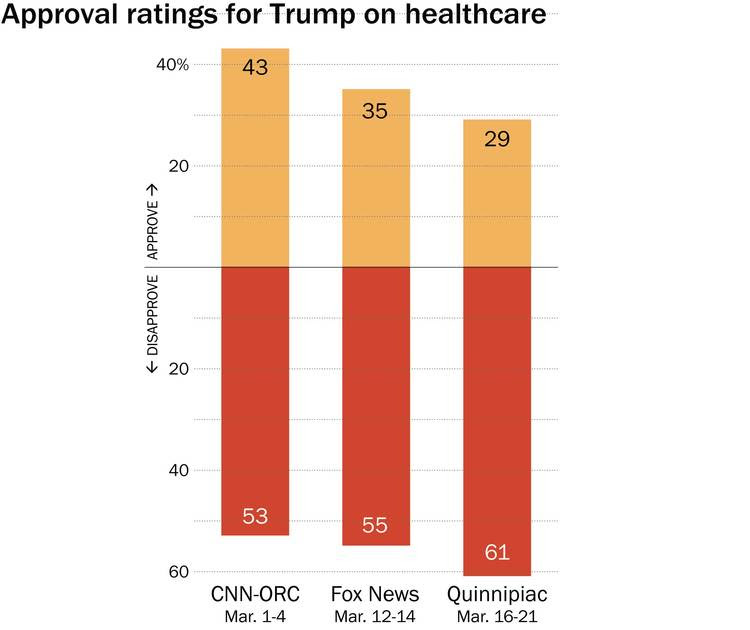
-- Public support for Trump’s approach to health care continues to sink, which will make it harder for him to use the bully pulpit. A new Quinnipiac University poll, which gives the president a 37 percent approval ratings, shows that just 29 percent of Americans approve of how he’s handling this issue. 

Compare that to a CNN poll early this month and a Fox News poll that was in the field 10 days ago. That’s not a promising trajectory:

COUNTING THE VOTES:
-- The magic number today is 22. Because a Democrat will be absent from the House today, GOP leaders can afford 22 defections. A Freedom Caucus spokeswoman said yesterday afternoon that “more than 25” members of the group oppose the bill, though that was before any deal was made. (Amber Phillips is keep a running whip count for us here.)
-- The more Ryan and Trump give to the Freedom Caucus, the more problems they may have with the middle. Four GOP moderates came out against the bill yesterday: Reps. Charlie Dent (Pa.), Frank A. LoBiondo (N.J.), Daniel Donovan (N.Y.) and David Young (Iowa). Ryan met with a dozen members of the moderate Tuesday Group in his office last night to stop more bleeding. He outlined what he might give to the Freedom Caucus and asked how they’d react.
-- Several deals have already been cut to win over lawmakers, including special goodies for Illinois and Upstate New York. GOP Rep. Daniel Donovan, who represents New York City, cited this in opposing the bill. In an op-ed for the Staten Island Advance, he said that change “gives our district short shrift.”
-- With those moderate defections, Ryan must figure out a way to get the far right of his conference. But many Freedom Caucus members have already drawn red lines that make it almost impossible to come around. Rep. Mo Brooks (Ala.) said, even after changes were made to satisfy conservatives, that the bill remains “the largest Republican welfare bill in the history of the Republican Party.” Rep. Thomas Massie (Ky.), a close ally of Rand Paul, called the bill a “stinking pile of garbage” that was written by “the insurance lobby.”
-- The risk of forcing a vote: Ryan may be forcing his biggest loyalists to walk the plank for a Pyrrhic victory. If he twists arms to get this through his chamber but then it dies in the Senate, some Republicans may lose their seats in 2018 for nothing. He could be doing what Nancy Pelosi did in 2009 when she forced Democrats to vote for cap-and-trade despite all political tea leaves that said it was a bad idea.
A good illustration of this dynamic is Barbara Comstock, who represents an affluent northern Virginia district that Hillary Clinton carried and is staying mum about how she’ll vote today. She’ll almost certainly give up her vote if Ryan needs it to get across the finish line, but she also knows the ways it that could hurt her reelection hopes next year. A savvy political operative who was heavily involved in the Clinton wars of the 1990s, it is a good bet Comstock has nightmares of the commercials that could be run against her.
-- Over the past three days, there have been several damning reports about the bill that make it hard to convince those who remain undecided. Phil Bump flags three examples:
  • Most of key tax benefits goes to millionaires. The Center on Budget and Policy Priorities, using data from the Tax Policy Center, reports that repealing two taxes that are part of the Affordable Care Act would offer no benefit at all to people making less than $200,000 a year — and would offer the bulk of its benefits, 79 percent of the total cut, to millionaires.
  • Fewer people would have insurance under the AHCA than if Obamacare were simply repealed. The New York Times’s Margot Sanger-Katz looked at the CBO’s analysis and realized something surprising: The estimated 24 million fewer people who would have insurance under the AHCA by 2026 is actually one million people higher than if Obamacare were simply repealed.
  • Deductibles will likely increase by 60 percent. The Kaiser Family Foundation’s Drew Altman calculated that average deductibles from the AHCA would be $1,550 higher than under Obamacare because people will receive smaller subsidies and therefore increasingly choose lower-cost health-care plans that have higher deductible rates.
-- Meanwhile, leading conservative intellectuals are not giving Ryan the cover he needs to change the terms of the debate:
  • “Whatever replaces Obamacare will look a lot like Obamacare,” George F. Will says in his column for this morning’s paper. “‘Mend it, don’t end it’ was President Bill Clinton’s rhetorical straddle regarding affirmative action. Republican efforts to ‘repeal and replace’ the Affordable Care Act (Obamacare) look increasingly like ‘mend it, don’t end it.’”
  • “Nothing good will come of the Obamacare repeal-and-replace debate,” writes National Review Editor Rich Lowry“If anything resembling the current bill passes and is signed into law, Republicans will spend years trying to fix it and live it down. If the bill fails, the rest of Trump's legislative agenda may sink with it.”
-- A sign of the truth-challenged times we live in. From ProPublica’s Charles Ornstein: “As the debate to repeal the law heats up in Congress, constituents are flooding their representatives with notes of support or concern, and the lawmakers are responding, sometimes with form letters that are misleading. A review of more than 200 such letters … found dozens of errors and mischaracterizations about the ACA and its proposed replacement. The legislators have cited wrong statistics, conflated health care terms and made statements that don’t stand up to verification. It’s not clear if this is intentional or if the lawmakers and their staffs don’t understand the current law or the proposals to alter it.”
-- Even if this passes the House today, the bill in its current form will be dead on arrival in the Senate. At least a dozen senators have expressed skepticism, and Trump can afford only two defections. (Sean Sullivan and Kelsey Snell have more on the state of play in the upper chamber.)

CBO releases new score for ObamaCare repeal bill


BY PETER SULLIVAN - 
The Congressional Budget Office (CBO) on Thursday released a new score for a revised plan to repeal and replace ObamaCare that Republican leaders are struggling to pass in the House. 
The CBO found that this version of the healthcare plan contains significantly less deficit reduction than the original but would lead to essentially the same levels of coverage losses and premium increases. 
The legislation would reduce the deficit by $150 billion over 10 years, down from $337 billion in the original legislation, the report said. The plan would still result in 24 million more people being uninsured in 2026, a finding that has been a rallying cry for Democrats.
Premiums would still initially rise by 15 percent to 20 percent before eventually becoming 10 percent lower, the CBO said.
GOP leaders had pledged that they would wait for the CBO's new score before holding a floor vote on the legislation. That vote could happen as early as Friday.
The CBO's score, however, does not reflect last-minute changes that could be made to win over conservatives, including repeal of ObamaCare's minimum coverage requirements. That change would be significant, but it is possible House Republicans could bring up the vote without that revised score. 
The revised analysis takes into account a range of changes Republicans made to the bill. The main reason the deficit reduction is now lower is that Republicans moved up repeal of ObamaCare's taxes by one year, something conservatives had requested.
The revised bill also turns Medicaid funding into block grants for states and gives states the option of creating work requirements for Medicaid recipients. Another change slightly increases a cap on Medicaid spending.
GOP leaders are scrambling to shore up the 215 votes likely needed to pass the ObamaCare repeal bill. A vote on the bill for Thursday was postponed after efforts to strike a deal with conservatives came up empty.
Democrats are fighting to protect ObamaCare and rooting for Republicans to fail. They seized on the new CBO analysis.
"The CBO has reconfirmed tonight that the Republican plan will cause millions of Americans to lose their coverage and out-of-pocket costs to skyrocket, while subjecting middle-aged Americans to an age tax. They do all this to give $1 trillion in tax cuts to corporations and the wealthy, but they may not stop there," said Rep. John Yarmuth (Ky.), the ranking Democrat on the House Budget Committee.
"It is astounding and appalling that Republicans in Congress are negotiating with the health and well-being of American families. They have no moral compass."
Updated at 5:42 p.m.

23 March 2017

House leaders postpone vote on their health-care plan 23MAR17


LOL just because (NOT MY) president drumpf/trump has to be raging! The White House staff better keep all electronic devices away from the Orange Menace so he doesn't send out any tweets that will guarantee defeat. Here is real question that none of the house repiglicans can answer, you have voted multiple times the past 6-7 years to repeal Obamacare but are just now finalizing the replacement? What have you been doing, besides not governing, all those years? From the +Washington Post.....

House leaders postpone vote on their health-care plan
  
House leaders postponed a vote Thursday on their plan to overhaul the nation’s health care system, as they and President Trump struggled to meet demands of conservative lawmakers who said they could not support the bill.
House Republicans planned to meet behind closed doors later Thursday to figure out their next steps. Leaders have told the rank and file to be available Friday in the event a vote can be scheduled then.
White House Deputy Press Secretary Sarah Huckabee Sanders confirmed the delay but said that she expected debate on the bill to begin Thursday night, with the expectation of a vote early Friday.
“We’re very confident that the bill will pass tomorrow morning,” she sid.
Earlier Thursday, conservative House Republicans had rebuffed an offer by Trump on Thursday to strip a key set of mandates from the nation’s current health-care law, raising doubts about whether House Speaker Paul D. Ryan (R-Wis.) had the votes.
Trump met at the White House with the most conservative House Republicans, hoping to close a deal that would help ensure passage of the party’s health-care plan by shifting it even further to the right. But the session ended with no clear resolution, and some lawmakers said they needed more concessions before they would back the bill.
Rep. Justin Amash (R-Mich.), asked whether the White House had made its final negotiating offer, said that if that’s the case, “They’re not going to pass the bill.”
Talks continued, however, and White House press secretary Sean Spicer said he still anticipated a vote on the measure by day’s end. Asked whether there was an alternative plan to the current bill, Spicer replied: “No. it’s going to pass. So that’s it.”
The chairman of the conservative Freedom Caucus, Rep. Mark Meadows (R-N.C.), also said that resolution could “possibly” be resolved Thursday. His spokesman, Ben Williamson, later tweeted that Meadows “remains hopeful and will continue working” to reach a deal.
That appears to have changed, according to several lawmakers who confirmed the delay.
The session came after more than a day of almost nonstop negotiations, as Trump and Ryan have worked to mollify members of the conservative House Freedom Caucus while simultaneously trying to minimize defections by GOP moderates.
As of midafternoon Thursday, 37 House Republicans — mainly Freedom Caucus members — had announced their opposition to the bill, known as the American Health Care Act.
How health care amendments appease GOP moderates and hard-liners
Trump will also meet Thursday with members of the moderate “Tuesday Group,” Spicer said. On Wednesday, four Republican moderates — Reps. Charlie Dent (Pa.), Frank A. LoBiondo (N.J.), Daniel Donovan (N.Y.) and David Young (Iowa) — announced their opposition, increasing pressure on leaders to win over conservatives.
GOP leaders appeared to be making some headway in bringing the measure to the floor for a vote Thursday. The price for doing so, however, may be striking popular provisions in former president Barack Obama’s Affordable Care Act that could make it even more difficult to pass legislation in the Senate. This high-wire balancing act, in which Republicans are catering to conservatives in the House with the knowledge that they still must woo moderates to get legislation to Trump’s desk, could not only reshape the nation’s health-care system but could also have uncertain electoral repercussions for the new majority.
But with failure not a viable option, Ryan and Trump have been working furiously to win over the large voting bloc of conservatives who control the House bill’s fate. Conservative lawmakers have asked to eliminate much of the measure’s Title I, which not only mandates which benefits participating insurers must cover — such as mental health treatment, wellness visits, and maternity and newborn care — but also bars companies from setting insurance rates based on a person’s sex, medical condition, genetic condition or other factors.
The only existing mandates conservatives are open to preserving are ones that bar insurers from denying coverage based on preexisting conditions and allow children to stay on their parents’ plans until age 26.
Passage of the bill would represent a major political victory for both the White House and House leaders, although the ultimate fate of the legislation hinges on the Senate. There are at least a dozen skeptics of the bill among Senate Republicans, who maintain a slim 52-to-48 advantage, and many of them want to maintain some of the current law’s more generous spending components.
If Republicans fail this initial test of their ability to govern, Trump and Capitol Hill Republicans may face a harder time advancing high-priority initiatives on infrastructure, tax reform and immigration. They might also find themselves navigating strained relationships among themselves.
White House officials expressed optimism Thursday that a deal remained within reach. Cliff Sims, director of White House message strategy, tweeted a photo of the president walking in to meet with Freedom Caucus members, along with the line, “Lengthy standing ovation from the Freedom Caucus when @POTUS walked into the Cabinet Room just now. Big momentum toward #RepealAndReplace.”
GOP leaders can afford only 22 defections, given that one Democrat was expected to be absent Thursday. A Freedom Caucus spokeswoman said that “more than 25” members of the group oppose the bill.
The flurry of activity Thursday represented a profound shift from GOP leaders’ previous strategy, under which they insisted that the changes sought by hard-right members would render the bill unable to pass the Senate.
Thursday is the seventh anniversary of the Affordable Care Act, and Republican leaders are eager to mark it with a historic vote demonstrating that its evisceration has begun. In a sign of how high the stakes are for both parties, Obama issued a statement noting that more than 20 million Americans have gained coverage since he signed the law, while the rise in health-care costs has slowed.
“So the reality is clear: America is stronger because of the Affordable Care Act,” Obama said, adding that Republicans are welcome to work with Democrats to improve the law. “But we should start from the baseline that any changes will make our health care system better, not worse for hard-working Americans. That should always be our priority.”
House Democrats have urged their GOP counterparts to slow down. Just before 11:35 p.m. Wednesday, the House Rules Committee voted along party lines to waive a rule prohibiting the panel from forwarding a bill to the floor for same-day consideration. The move, colloquially known as “martial law” in the House, will allow GOP leaders to make further changes to the legislation and still hold a final vote Thursday.
Democrats questioned why lawmakers would move it to the floor when the Congressional Budget Office had not issued a new analysis of the bill. The additional effects on coverage and federal spending of the provisions still being negotiated Wednesday were also unknowns.
“You’re going to own this, just like we owned the Affordable Care Act,” Rep. Alcee L. Hastings (D-Fla.) warned shortly before the panel adjourned for the night. “You’ll rue the day that you did it this way.”
Republicans’ current strategy is based on a new interpretation of Senate rules had raised the possibility that acceding to the Freedom Caucus’s request might not threaten Senate consideration of the whole bill. But both aides said the provision could still be stripped out once the bill reaches the Senate.
Democratic Senate aides insisted that would be the case. “What the proponents aren’t telling conservative House Republicans is that the plan to repeal essential health benefits will almost certainly not be permissible under Senate reconciliation rules,” said Matt House, a spokesman for Senate Minority Leader Charles E. Schumer (D-N.Y.).
In fact, the new negotiations late Wednesday raised the possibility that the challenge would only grow at the other end of the Capitol. Republicans can afford to lose the votes of only two senators, assuming Pence would step in to cast a vote for the health-care rewrite in the case of a tie.
An additional potential hurdle facing the bill is the updated analysis still to come from the Congressional Budget Office, which will reflect changes to the measure that were issued Monday. That analysis could be rendered inaccurate if further changes are made before the vote.
Complications stemming from the bill’s last-minute tweaks appeared to add yet another political headache Wednesday, as veterans groups discovered that the latest draft might make them ineligible for a tax credit. A change made to ensure that the measure would comply with Senate rules created a separate consequence — that individuals would qualify for the bill’s tax credits only if they “are not eligible” for other types of coverage, including those provided by the Veterans Health Administration.
In an email, House Ways and Means Committee spokeswoman Lauren Aronson said the issue would be fixed in subsequent legislation. “This amendment makes no change to veterans’ health care. In working with the administration and the Veteran Affairs Committee, we will continue to ensure that America’s veterans have access to the best care available.”
In another example of last-minute changes, Illinois’ GOP delegation announced late Wednesday night that Centers for Medicare and Medicaid Services Director Seema Verma had assured them that “Illinois will have the opportunity to accurately report its 2016 Medicaid payment information to CMS.” The state “has long been disadvantaged by below- average Medicaid reimbursements,” the lawmakers said, and this adjustment will ensure that the state would receive more federal funds when the government shifts to allocating Medicaid dollars on a per capita basis under the bill.
Many recent changes made to the bill were aimed at placating conservatives, including giving states the option to take a fixed Medicaid block grant and to impose work requirements on childless, able-bodied adults covered under the program. Others responded to broader concerns about the sufficiency of the tax credits offered to help Americans purchase insurance.
One revision was more narrowly targeted — added at the behest of Republicans from Upstate New York who wanted to end their state’s practice of commandeering local tax revenue to fund state Medicaid benefits.
That concerned Donovan, who said a day after meeting with Trump in the Oval Office that he would oppose the bill.
In an op-ed for the Staten Island Advance, he said the change “gives our district short shrift” and also said the GOP bill would disproportionately harm older Americans.
Abby Phillip, Lisa Rein, Kelsey Snell and John Wagner contributed to this report.
Mike DeBonis covers Congress and national politics for The Washington Post. He previously covered D.C. politics and government from 2007 to 2015.
  Follow @mikedebonis
Juliet Eilperin is The Washington Post's senior national affairs correspondent, covering how the new administration is transforming a range of U.S. policies and the federal government itself. She is the author of two books—one on sharks, and another on Congress, not to be confused with each other—and has worked for the Post since 1998.
  Follow @eilperin
David Weigel is a national political correspondent covering the 2016 election and ideological movements.
  Follow @daveweigel