NORTON META TAG

Showing posts with label ftpr fascist traitor pig republican donald drumpf/trump. Show all posts

02 September 2025

VIDEO: PETIE LOLA HEGSETH GETS SHAMED IN D.C. BY AMERICAN PATRIOTS & Hegseth Puts Up Painting of Confederate General With a Chilling Detail at West Point 29AUG25


SEC of Defense neo-nazi fascist fotze petie lola hegseth gets SHAMED in D.C. by true American patriots for kow-towing to NOT MY pres drumpf / trump, NOT MY vp vance, the turd reich cabinet and the fascist heritage foundation's project 2025 plan to impose an authoritarian theocratic oligarchy on our country by deploying troops in our nation's capital. Poor petie, but he has to understand he is getting the lack of respect he has earned and deserves. SHAME SHAME PETIE LOLA HEGSETH, EVERYBODY KNOWS YOUR NAME!!! The article is from The Daily Beast which also offers Hegseth Puts Up Confederate Memorial That Whitewashes Slavery & Trump Restores Military Bases to ‘Racist’ Confederate Names. They are two racist, bigoted, neo-nazi, fascist pig fotzen.....

RE-INTERGRATING LEE

The move is part of the Trump administration’s broader effort to honor people who fought for the Confederacy.

Defense chief Pete Hegseth is restoring to West Point Military Academy a giant painting of rebel Gen. Robert E. Lee that shows him wearing his gray Confederate uniform and accompanied by a slave guiding his horse.

The painting was originally hung in the storied academy’s library in 1952—at the height of racial segregation, voter suppression, and Jim Crow laws in the South—as part of an effort to rehabilitate the disgraced general’s image, The New York Times reported.

Its return is part of a broader effort by President Donald Trump’s administration to reintroduce Confederate symbols, restore monuments that whitewash the evils of slavery, and remove references to slavery from national museums and parks.

Lee had a long history with West Point, attending from 1825 to 1829 and graduating at the top of his class. He later returned as the academy’s superintendent from 1852 to 1855.

His family was shocked when, after more than 30 years of service, he resigned from the U.S. Army in 1861 to fight on the side of the Confederacy.
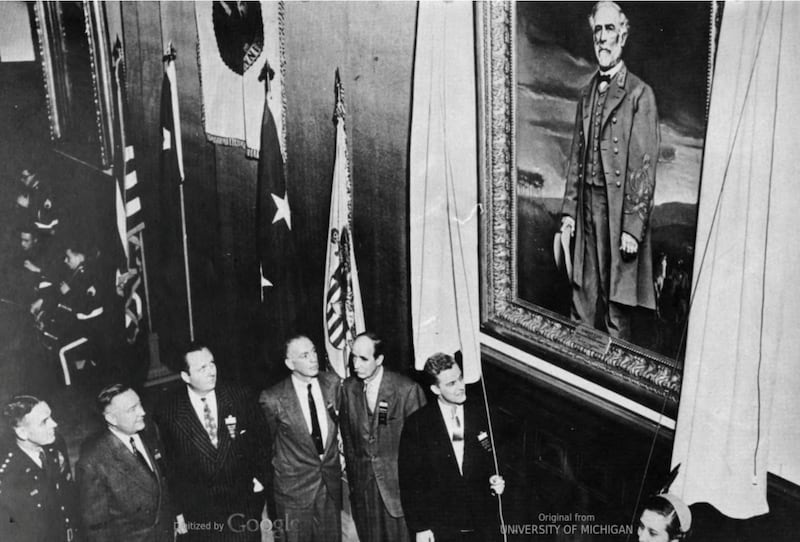
Gen. Maxwell Taylor and other dignitaries and guests at the unveiling of the portrait of Robert E. Lee at West Point's library on January 19, 1952
A 20-foot portrait of Gen. Robert E. Lee in his Confederate uniform, accompanied by a slave, was unveiled in 1952 at the height of segregation.The Sesquicentennial of the United States Military Academy via West Point Modern War Institute

When Congress passed a law in 2020 creating a commission to remove Confederate names and symbols from military institutions—including bases and academies—his likeness was all over West Point, and at least five roads and buildings were named in his honor.

The commission decided that portraits of Lee in his blue Army uniform could stay up, but ordered the removal of the portrait that shows him in Confederate gray and accompanied by his slave. The commission also recommended renaming the areas bearing his name.

It’s not clear how Hegseth could bring the Confederate portrait back out of storage without breaking the law, the Times reported.

“At West Point, the United States Military Academy is prepared to restore historical names, artifacts, and assets to their original form and place,” Army communications director Rebecca Hodson told the paper. “Under this administration, we honor our history and learn from it — we don’t erase it.”

The Daily Beast has reached out to the White House and the Department of Defense for comment.

Already before its removal in 2022, the academy’s diverse, 21st-century officer corps and alumni had begun pushing back against Lee’s sanitized image, which emerged as a result of a process called “Reconciliation,” West Point’s Modern War Institute wrote in 2020.

After the Confederates surrendered in November 1865, the federal government spent more than a decade pursuing a policy of Reconstruction to reunify the nation and transform the South’s slave-based society into something more equitable.

The Reconstruction effort, however, ended in 1877 and was replaced by a policy called “Reconciliation” that, in the words of the Modern War Institute, “downplayed the Confederacy’s treason,” “papered over the issue of slavery,” and “ignored the underrepresented black officers of the U.S. army.”

The federal government also withdrew troops from the South, allowing the former Confederate states to impose racial segregation, deny Black people the right to vote, and terrorize Black communities.

Lee’s Confederate portrait was donated to the West Point Library in honor of the 100th anniversary of his taking the helm of the academy.

During the unveiling, Gen. Maxwell Taylor declared that, “Few fair-minded men can feel today that the issues which divided the North and South in 1861 have any real meaning to our present generation,” The Modern War Institute reported.

The Army had only decided to pursue full desegregation a month earlier. Emmett Till’s murder, Rosa Parks’ arrest, the 16th Street Baptist Church bombing, Freedom Summer, the Selma to Montgomery March, and the assassination of Martin Luther King Jr. were all still years away.

Lee personally owned several families of slaves at various points in his life. After his father-in-law died, he managed hundreds of enslaved people belonging to his wife’s family and personally ordered their whippings on occasion, according to the National Parks Service.

In 1856, he wrote to his wife that slavery was a “moral and political evil,” but that it was a “greater evil to the white man than to the black race,” because “the painful discipline” of slaves fell to white people. This discipline was “necessary for their instruction as a race,” he wrote.

When his home state of Virginia seceded from the Union, he decided to resign from the U.S. Army after 30 years of service and joined the insurrection—despite having received a request to command Union troops, the National Parks Service reported.

He agonized over the decision, according to the NPS, but ultimately chose to fight for the Confederacy despite claiming to oppose both slavery and secession.

During the war, his Virginia estate was seized and later turned into Arlington National Cemetery to honor fallen Union soldiers. Lee nevertheless said that his “duty demanded” that he fight for the Confederacy, and that he would do it all over again.

The resurrection of his Confederate portrait comes after the Trump administration has brought back Army bases named after Confederate soldiers, restored a statue of a Confederate general, re-erected a monument devoted to the idea that the Civil War was a noble “lost cause” that enslaved Black people supported.

29 August 2024

First rioter to enter U.S. Capitol in Jan. 6 insurrection is sentenced 28AUG24


 JUSTICE continues to be meted out, I myself think the sentences should be longer but am satisfied those who chose to commit treason against America are at least being held accountable.  From the Washington Post.....

First rioter to enter U.S. Capitol in Jan. 6 insurrection is sentenced

Authorities assert Michael Sparks was among the group that confronted Capitol Police Officer Eugene Goodman.
Peter Hermann covers crime for The Washington Post. He previously worked for the Baltimore Sun for 22 years, covering a Baltimore suburb and then the Baltimore Police Department. Twitter

August 28, 2024 at 12:36 p.m. EDT

A Kentucky man who authorities assert was the first rioter to breach the U.S. Capitol during the Jan. 6, 2021, insurrection and “helped light the fire” to try to overturn the election of Joe Biden as president was sentenced Tuesday to more than four years in prison.

Michael Sparks, 47, was convicted in March of two felonies and several misdemeanors for his role. In court papers, the U.S. attorney’s office in D.C. described the factory worker as one of the most concerning and angriest members of the hundreds who stormed the Capitol, saying he “led the violent mob … in an effort to disrupt the peaceful transition of power.”

U.S. District Judge Timothy J. Kelly sentenced Sparks to four years and four months in prison, slightly less than the four years and seven months prosecutors had sought. The felonies the jury convicted him on were obstruction of an official proceeding and civil disorder. Court documents show Sparks has been freed on personal recognizance since his arrest in Kentucky in January 2021.

Michael Sparks, left, and Kevin Seefried, center, confront U.S. Capitol Police on Jan. 6, 2021. (Manuel Balce Ceneta/AP)

Prosecutors said Sparks was part of a group of rioters — including one clutching a Confederate flag and another holding a sharpened spear — who came close to Vice President Mike Pence as Pence was being hustled out of the building for safety. The group confronted U.S. Capitol Police Officer Eugene Goodman, who diverted them away from an area Pence had just passed through. Rioters had earlier chanted “Hang Mike Pence!” after his refusal to heed President Donald Trump’s demand that he head off the electoral college count.

Sparks, prosecutors said in court papers, pointed his finger at Goodman — the officer’s hand on his holstered service weapon and threatening to shoot — screaming, “This is our America! This is our America,” while wearing black gloves imprinted with the image of a skeleton.

Sparks’s attorney, Scott T. Wendelsdorf with the federal public defender service in Louisville, argued in a sentencing memorandum filed in court that his client followed the mob but did not lead them and that he was among the more peaceful of the group of demonstrators.

Wendelsdorf noted that it was a member of the Proud Boys, whose leader is serving 22 years in prison for seditious conspiracy for leading the riot, who used a stolen police riot shield to break a window on the Capitol’s west side. It was that window that Sparks climbed through as authorities said another rioter was simultaneously breaking an adjacent window with a two-by-four beam.

Surveillance video shows Michael Sparks inside the U.S. Capitol after he entered through a shattered window on Jan. 6, 2021. (Criminal Complaint filed with the U.S. District Court for The District of Columbia)

The defense attorney argued in court papers that assertions that his client was the “first to enter the building” are “technically true in a timeline sense,” but that Sparks “did not lead the crowd into the building or cause the breach through which he and others entered. Actually, there were eight different points of access that day separately and independently exploited by the protesters.”

Wendelsdorf argued that once inside, Sparks was “among the less culpable offenders in the Capitol breach.” He said his client articulated his political views, including to Goodman, and then “literally quit the protest and walked away” when “it became evident to him that Vice President Pence was not, in fact, going to declare Trump president as Trump had assured his followers that he would.”

The attorney disputed an account from prosecutors that Sparks and others “chased” Goodman, saying they followed as Goodman led them away from a corridor that led to the Senate chamber and to an area where additional police officers were stationed. Wendelsdorf wrote that Sparks never threatened Goodman, that Sparks protected him from being attacked by another protester and that in early accounts to the FBI Goodman did not describe Sparks as a threat.

Sparks was driven to anger and extremes through social media and religious fervor, according to an account of his actions published in The Washington Post a month after the insurrection. That article notes that in his booking photo, he wore a T-shirt inscribed with “Armor of God” and quotes from a Bible verse about standing “against the devil’s schemes.”

Prosecutors said in their sentencing memorandum that Sparks entered the Capitol despite warnings from people behind him not to, and that his actions “acted like a green light for everybody behind him. … One might say Sparks helped light the fire that day using preparation and planning — including his protective body armor — to steel himself against officers attempting to hold back the mob.”

Prosecutors said Sparks and others entered the Capitol one floor above where Pence and senators were in session. In a criminal complaint, the FBI said a video published by The Post shows Sparks with a group of protesters inside the Capitol.

The group with Sparks encountered the lone Goodman at the bottom of a staircase, “standing in a doorway, trying to fend off a mob of armed rioters from further penetrating the building,” according to the sentencing memorandum filed by prosecutors.

Goodman testified their chants were deafening as they demanded, “Where they counting the f------ votes? Where they counting them votes at?” the sentencing memo states.

Prosecutors said that the group, with Sparks, advanced even after Goodman threatened to shoot and ultimately chased him up the stairs. “Sparks not only refused to leave, he shouted back at the police. Pointing at Goodman, Sparks shouted: ‘No, we’re here for you. We’re here for you guys,’” prosecutors wrote.

Once police had gained some control, prosecutors said Sparks, “likely realizing that he could not breach this last police line, turned around and left the building. At this time, 2:26 p.m., the Vice President had just been evacuated — passing through a hallway just yards away from the place Sparks was occupying.”