BUCKNACKT'S SORDID TAWDRY BLOG
We should not be a journey to the grave with the intention of arriving safely in an attractive & well preserved body, but rather to skid in sideways, chocolate, bier or wein in hand, body thoroughly used up, totally worn out and screaming "WHOO-HOO, WHAT A RIDE!!!!!!"
The Ji Di was designed to push through polar sea ice.(U.S. Coast Guard Courtesy Photo)
THIS an interesting and informative report on the bold and blatant poking and probing by China of the territorial integrity of free nations in the Southern Pacific / Indo-Pacific and the diplomatic and military response of these nations and the alliances among them. So far the response is not impressive, and if these nations allow NOT MY pres drumpf/trump to determine and lead the response to China's aggression, well, just look at his illegal and immoral war with Iran for a preview of their near future. drumpf's/trump's "art of the deal" will be on public display this September as he licks Ji's ass at the White House. It will be interesting to see if the free nations of the Southern Pacific / Indo-Pacific unite to defy and defend against China or if they fold and become vassal states of the PRC. This from ABC / Australian Broadcasting Corporation.....
In the final days of May, a Chinese research vessel ventured 74 kilometres into Palau's waters and reportedly spent 14 hours moving slowly through the island nation's maritime zone.
With a bow built to push through a metre of Arctic sea ice, the 89-metre icebreaker Ji Di might have looked out of place in the warm waters of the North Pacific.
Exactly what it was doing remains unclear to Palau's President Surangel Whipps Jr.
"Their research vessels come into our EEZ (Exclusive Economic Zone) uninvited and do whatever they want," he said.
"What are they looking for, and what is the ultimate intention?"
Launched in 2024, the Ji Di was designed for environmental monitoring and surveying to respond to climate change, according to Chinese state media.
Its fleet of unmanned drones and underwater vehicles can map the sea floor and collect data on everything from undersea minerals, ocean currents and marine ecosystems.
Ji Di
Research vessel
China
Ministry of Natural Resources
89.95 m
15 knots
14,000 NM
60
Name:
Type of vessel:
Flag:
Owner:
Length:
Speed:
Range:
Crew:
Source: ccs.org.cn
ABC News: Jarrod Fankhauser
But security experts fear the vessel and dozens of others like it might also be gathering intelligence for a military purpose, one that could aid Beijing in the event of a future conflict over Taiwan.
Exactly what it was doing remains unclear to Palau's President Surangel Whipps Jr.
"Their research vessels come into our EEZ (Exclusive Economic Zone) uninvited and do whatever they want," he said.
"What are they looking for, and what is the ultimate intention?"
Launched in 2024, the Ji Di was designed for environmental monitoring and surveying to respond to climate change, according to Chinese state media.
Its fleet of unmanned drones and underwater vehicles can map the sea floor and collect data on everything from undersea minerals, ocean currents and marine ecosystems.
Ji Di
Research vessel
China
Ministry of Natural Resources
89.95 m
15 knots
14,000 NM
60
Name:
Type of vessel:
Flag:
Owner:
Length:
Speed:
Range:
Crew:
Source: ccs.org.cn
ABC News: Jarrod Fankhauser
But security experts fear the vessel and dozens of others like it might also be gathering intelligence for a military purpose, one that could aid Beijing in the event of a future conflict over Taiwan.
Exactly what it was doing remains unclear to Palau's President Surangel Whipps Jr.
"Their research vessels come into our EEZ (Exclusive Economic Zone) uninvited and do whatever they want," he said.
"What are they looking for, and what is the ultimate intention?"
Launched in 2024, the Ji Di was designed for environmental monitoring and surveying to respond to climate change, according to Chinese state media.
Its fleet of unmanned drones and underwater vehicles can map the sea floor and collect data on everything from undersea minerals, ocean currents and marine ecosystems.
Ji Di
Research vessel
China
Ministry of Natural Resources
89.95 m
15 knots
14,000 NM
60
Name:
Type of vessel:
Flag:
Owner:
Length:
Speed:
Range:
Crew:
Source: ccs.org.cn
ABC News: Jarrod Fankhauser
But security experts fear the vessel and dozens of others like it might also be gathering intelligence for a military purpose, one that could aid Beijing in the event of a future conflict over Taiwan.
The Ji Di travelled roughly 74 kilometres into Palau's EEZ between May 30 and 31.(Micronesia Security Monitor)
Hidden agenda
The Ji Di's incursion was not an isolated incident for Palau.
Similar incidents were reported in 2018, 2024 and 2025, while in 2023 a Chinese vessel allegedly operated near Palau's fibre-optic cable.
The most recent incursion, according to Mr Whipps, came in July, shortly after China launched a ballistic missile from a submarine that flew over multiple Pacific islands.
The ABC was unable to independently confirm the incursion.
"They're surveying over the top of our fibre-optic cable, and they have gear in the water, so for us it's a security concern," Mr Whipps said.
Sixteen Chinese research vessels have been deployed into the north Pacific this year, according to the Pacific Centre of Island Security, a think tank that tracks vessels and geopolitical activity in the region.
Jennifer Parker, an adjunct professor of defence and security at the University of Western Australia, said while some vessels would be used for "pure science", the scale and location of China's activities also suggested they could be gathering intelligence to conduct submarine and anti-submarine warfare against the United States.
"If you look at where Hawaii and Guam are, where US subs are based, and how they would operate across the Western Pacific, you can see why waters around Palau are important," she said.
In 2024, an investigation by the Center for Strategic and International Studies into 64 Chinese research vessels found 80 per cent demonstrated suspicious behaviour or had organisational links suggesting involvement in advancing Beijing's geopolitical agenda.
The study said China had developed the largest fleet of civilian research vessels in the world, heavily concentrating its surveys in the South China Sea and western Pacific Ocean.
Science or spying?
The dual-use nature of research vessels can make their true purpose difficult to discern, because mapping the sea floor can serve both scientific and military objectives.
A 2025 study published in the journal Frontiers in Political Science noted that "unlike other countries, China doesn't distinguish between ships operating for naval survey, scientific research, or commercial purposes".
But the director of the Pacific Centre for Island Security, Leland Bettis, said there were clues in the vessels' patterns.
Mr Bettis said the Ji Di was tracked in May following a pattern suggesting it was mapping the ocean floor near Guam along a corridor likely used by US submarines.
"It's doing a lawnmower pattern, which is typical of oceanographic survey work," he said.
"The fact it's doing the lawn-mowing positioning directly off of Guam where US submarines are based underscores the potential for some of the dual use capabilities."
Leland Bettis said the Ji Di's "lawnmower" movement pattern is typical of oceanographic survey work. (Micronesia Security Monitor)
A recent Lowy Institute report into China's military said two of the main priorities of the People's Liberation Army were developing the forces needed to invade Taiwan and deterring or defeating a US intervention.
As a hub for military operations in the Pacific, Guam is home to multiple US nuclear submarines likely to be used as a staging area if the US intervened in a Taiwan conflict.
Mr Bettis said Chinese research vessels could be trying to track the "signatures" of US submarines or even planting listening devices.
"Increasingly we've seen the use of drones and other submersibles that float around or [are] managed by an operator to collect information," he said.
Ms Parker, who is also a former Australian anti-submarine warfare officer, said understanding the sea floor was critical for operating and hunting submarines.
She said detailed mapping helped submarines navigate terrain like underwater mountains and trenches.
The shape and depth of the seabed, along with ocean temperature, also affect how sound travels through the water column.
"The primary way you detect subs is through sound: passive by listening or active by putting sound in the water and getting it to bounce back," she said.
Playing by its own rules
Marine scientific research in another country's EEZ without permission is a breach of international law, said Ms Parker.
But Palau's options to stop China entering its territorial waters are limited.
In a diplomatic complaint to China, Palau said the incursion showed a disregard for its sovereignty and the "rules-based order" nations are supposed to follow.
Ms Parker said China had been operating under its own rules in its efforts to map vast expanses of the Pacific and Indian Oceans.
"It is uncommon to see countries conducting survey operations in another country's EEZ without permission, and the only country I can think of that does this at scale is China," she said.
China, meanwhile, has defended the activities of its vessels in the Pacific, saying in July an alleged incursion near the Japanese island Okinawa was "legitimate, lawful and beyond reproach".
The ABC reached out to the Chinese embassy for comment.
Ms Parker said as China continued to project power across the Indo-Pacific, research vessels would likely become a more common sight.
"China has been doing this more across the Pacific and Indian Ocean, including in places just north of Papua New Guinea, so I think we'll see more of this," she said.
This could be a story about NOT MY pres drumpf / trump, NOT MY vp vance, their neo-nazi cabinet, the fascist gop / greed over people-republican party and project 2025. Just another authoritarian theocratic oligarchy.....Hongmen are just part of the plethora of ccp associated entities that are a serious threat to the United States, but then again so is the drumpf / trump-vance government, the gop / greed over people-republican party and project 2025. From the Washington Post.....
In December, a man considered by U.S. officials to be among Asia’s most powerful crime bosses gathered friends and allies in the Chinese casino city of Macao. Videos from the event show Wan Kuok Koi belting out Cantonese songs and smiling broadly for the cameras, seemingly unbothered by investigations across multiple countries into his alleged role in large-scale scams, fraud and money laundering.
The 69-year-old Wan — widely known by his nickname, “Broken Tooth” — presided over the celebration as chairman of the World Hongmen History and Culture Association, which describes itself as an ethnic Chinese fraternal organization devoted to promoting Chinese culture abroad. According to the U.S. Treasury, however, the association serves as a front for the 14K triad, one of China’s largest organized crime groups with involvement in“drug trafficking, illegal gambling, racketeering, human trafficking, and a range of other criminal activities.”
In 2020, the Treasury imposed sanctions on Wan, the association and several related entities, saying they were part of a “powerful business network” that had been involved in illicit activity across the Asia Pacific since 2018, and barred U.S. residents and entities from any transactions with them.
A Washington Post investigation has found that the Hongmen association is not just an alleged criminal front. It is entwined with the Chinese Communist Party (CCP) in ways that have not been previously reported. And its network, which has continued to expand despite sanctions,has routinely supported Beijing’s political objectives in Southeast Asia, the Pacific and Africa, even as it is investigated in at least four countries for alleged fraud, bribery, online scams, money laundering and other crimes.
Wan’s deputies, several of whose roles are being identified for the first time, have expanded Hongmen’s footprint in the past five years largely unimpeded, The Post found, sometimes evading criminal charges by escaping to China and to jurisdictions where China has deep influence.
The Post investigation drew on hundreds of photos and videos of Hongmen leaders, along with court records, police documents, business filings, and interviews with over four dozen government and law enforcement officials from seven countries, as well as Hongmen members, crime analysts and individuals close to the CCP.
It discovered that at the same time the Hongmen association has been implicated in criminal activity, it has spread Chinese government propaganda, promoted unification with Taiwan, brokered projects for the Belt and Road Initiative (BRI) — China’s $1 trillion infrastructure project to build global influence — and provided security for Chinese officials overseas as part of a stated mission to contribute to “the great rejuvenation of the Chinese nation.”
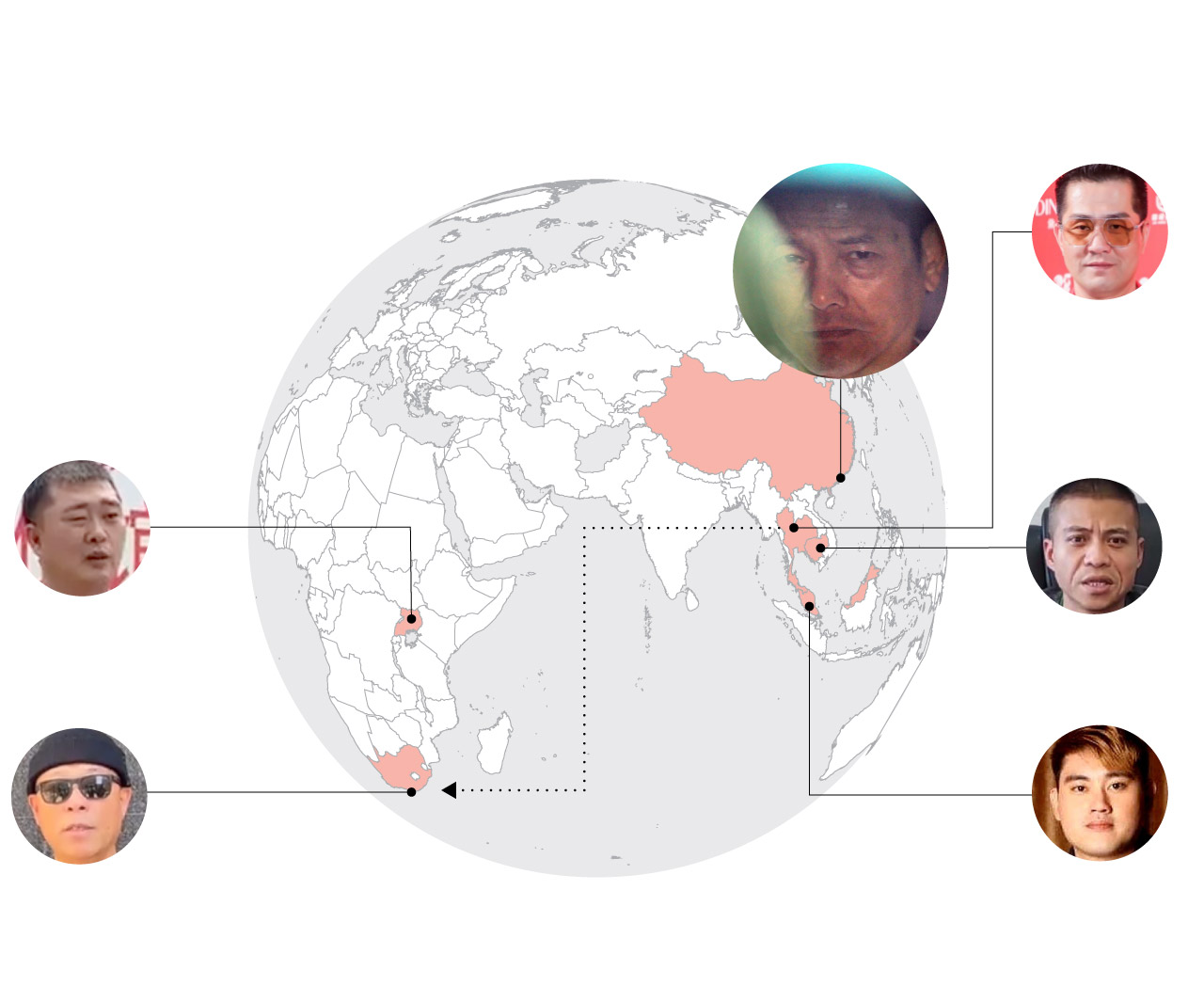
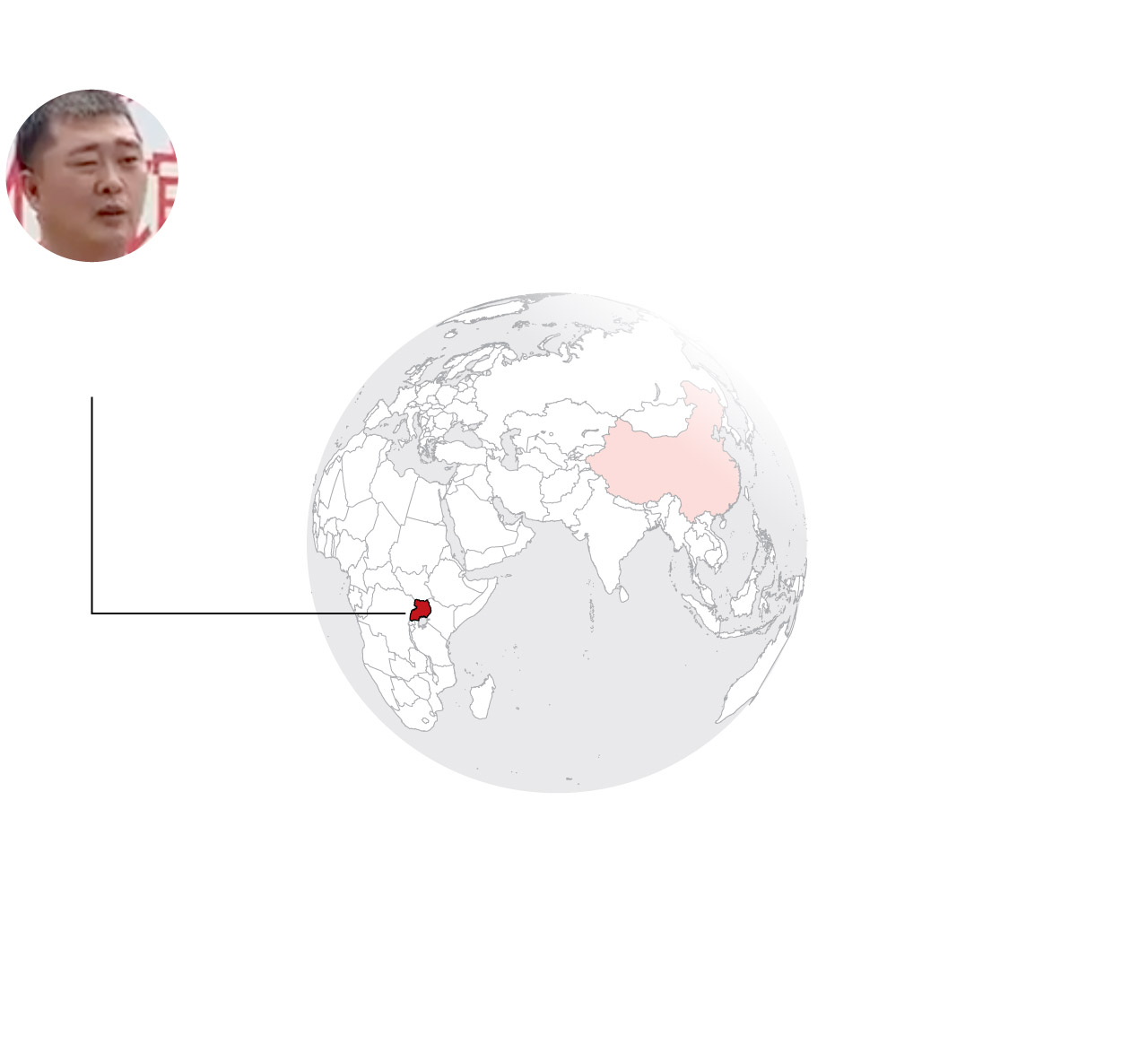
China Hongmen map and actors
Current and former World Hongmen leaders
Wan Kuok Koi
尹國駒
Main figures and areas of activity of the World Hongmen History and Culture Association. None of the leadership responded to requests for comment.
Bai Zhaohui
⽩兆辉
CHINA
Macao
THAILAND
CAMBODIA
MALAYSIA
Ye Baochun
叶报春
UGANDA
Cai Zhiqin
蔡智钦
SOUTH AFRICA
Bai moved
from Thailand
to South Africa.
Lu Liran
卢⽴然
Nicky Liow
廖顺喜
In virtually every country where it operates, Hongmen members have forged ties to elites that have been strategically helpful for China, diplomats and analysts say.
And in at least one country, Uganda, Hongmen members set up a Chinese overseas police center — a type of facility that rights groups and U.S. officials say is part of Beijing’s espionage operations. At the opening of the center in 2023, the Chinese ambassador, Zhang Lizhong, standing by the Hongmen chapter leader in Uganda, described it as an effort to “protect the safety and legitimate rights and interests of Chinese investors and Chinese citizens.”
Chinese leader Xi Jinping’s bid to expand China’s influence has made increasing use of Chinese people living and working abroad — a “United Front” strategy that Xi has called the country’s “magic weapon.” This includes selectively exploiting ties to criminals that proclaim loyalty to the CCP, The Post found, letting them thrive as long as their illicit activities remain offshore and do not threaten domestic stability.
A Chinese casino mogul, Zhao Wei, has been running a special economic zone in Southeast Asia that has become a flourishing hub of trafficking, money laundering and other illicit businesses, according to watchdog groups. Despite appeals to authorities in Beijing from organizations like the International Crisis Group to rein in his activity, Zhao has been able to travel freely to and from China and maintain close ties to Chinese officials, watchdog groups said. A representative of Zhao declined to make him available for comment.
There is similarly “extremely compelling” evidence tying the Hongmen association to Beijing,including photos of Wan receiving an award for patriotism from CCP entities, said Martin Thorley, a senior analyst focused on China at the Global Initiative Against Transnational Organized Crime (GI-TOC), a Geneva-based watchdog group.
“This is beyond clandestine diplomacy,” Thorley said. “This is crime that is really deeply entrenched in state machinery.”
An endorsement
After the U.S. sanctions, online scam centers linked to Hongmen in Myanmar, Cambodia and Laos continued to expand, defrauding tens of thousands of victims with fake investment and marriage schemes, investigators say. The centers are increasingly steering away from targeting Chinese citizens to avoid Beijing’s wrath, as they focus on people from other parts of the world, including the United States, according to U.S. and U.N. officials.
The Hongmen network is under active investigation by law enforcement in Malaysia for alleged involvement in financial crimes, including fraud, bribery, stock manipulation and money laundering, and in an espionage case in the Philippines, according to officials who confirmed probes that have not been previously reported.
At least two other nations — Thailand and Palau — had already opened investigations into Hongmen for allegedly running online gambling, scam centers and other illicit businesses within their territory.
In Palau, a close U.S. partner, Wan was added in 2019 to the nation’s “undesirable alien” list and banned from the Pacific island country. That followed an attempt by Wan to secure land next to two U.S. radar sites on a main southern island, which raised concerns in Washington, officials in Palau said. But individuals linked to Wan “remain active on the island and have continued to expand their influence in Palau and elsewhere in the Pacific,” the U.N. Office on Drugs and Crime (UNODC) said in an April report.
In the past year, online-scamming, human-trafficking and money-laundering operations similar to those that Hongmen members have been accused of carrying out in Asia have also surfaced in Africa, with Uganda emerging as a major source for trafficking victims and South Africa growing as a hub for financial crime, investigators say.
“There have been increasing indications of major Asian criminal networks establishing connections and operations on the continent and exploiting similar vulnerabilities to those present in Southeast Asia,” UNODC said. Hongmen, in particular, has been “increasing activity in Uganda and other African countries,” the office said.
Ugandan and South African officials did not respond to requests for comment.
“There’s a growing Venn diagram between [Chinese] authorities and Chinese organized crime groups overseas, where there’s clear knowledge of each other’s activities, a kind of co-awareness and cooperation,” said a former official in the U.S. State Department’s Bureau of International Narcotics and Law Enforcement Affairs who, like some others, spoke on the condition of anonymity to discuss sensitive information or because of security concerns.
The Chinese Foreign Ministry did not respond to a list of detailed questions. Neither did the Chinese embassies in Cambodia, Uganda and South Africa, countries where the Hongmen association has active chapters, The Post found. The Chinese Embassy in D.C. declined to comment.
Messages, calls, emails and letters to over a dozen Hongmen-related businesses and organizations, including its registered corporations in Cambodia, were not answered.
Responding to the U.S. sanctions in 2020, Wan said, “The World Hongmen History and Culture Association has always abided by laws and regulations, and never under the guise of China’s Belt and Road Initiative engaged in any illegal behavior.” Following the sanctions, Chinese authorities publicly distanced themselves from Wan, calling allegations that he had ties to the CCP “lies” and “unscrupulous attacks” on China.
But an examination of public and visual records undercuts that assertion and showsthat despite the well-known criminal associations of Wan, contact has continued between him, Hongmen, and state and provincial entities in China, including as recently as this year:
From 2015 to 2020, Wan identified himself and was identified in a newspaper owned by the Chinese government as a member of the Chinese People’s Political Consultative Conference (CPPCC), an advisory body for the party. Months after China’s Foreign Ministry said in 2020 that he was not a CPPCC member, Wan was pictured at a ceremony in Beijing receiving an award for patriotism from the “Overseas United Working Committee,”an entity that sits under the CPPCC and has ties to the People’s Liberation Army.
Chinese state media has itself documented Wan’s travels across Southeast Asia and the Pacific to negotiate government initiatives. In 2020, Wan met the president of Papua New Guinea alongside retired Chinese Senior Col. Li Yingming. Following the U.S. sanctions,Wan deepened his cooperation with a Chinese company, Ronghong Group, which works under a state-supported initiative to spread traditional Chinese medicine; he was listed last year as a consultant for the company.
Wan spent extended time last year in a special economic zone in Laos that Chinese authorities helped create to boost investment from China. In March, Wan met publicly with officials of China’s southern province of Hainan to discuss cooperation with Hongmen — including joint work, with “Laos as the base,” on the “regionalization” of the Chinese yuan to displace the U.S. dollar, according to official statements.
On April 17, during an official state visit by Xi to Cambodia, Hongmen members there participated in a closed-door “special discussion” on the security of overseas Chinese with Cambodia’s deputy defense minister and an organization affiliated with the CCP, according to photos and statements from the association.
The CCP makes “precise, deliberate” decisions on whom it associates with, and Wan is “arguably the most notorious criminal on the continent who has also been very publicly sanctioned by the U.S.,” said Thorley, the GI-TOC analyst. “For them to have given him an award … it’s as clear-cut as it gets,” Thorley added. “It was an endorsement.”
A network across the Global South
Before he was a patriot, Wan was a kingpin.
At the height of his influence in the 1990s, he had a $50 million stake at a Macao casino and command of 10,000 triad members, according to Portuguese prosecutors. (Macao was a Portuguese colony before it was returned to China in 1999.)
Starting in late 1999, Wan served 14 years in a high-security prison in Macaofor gambling, loan-sharking and attempted murder — a period in which the political landscape for Chinese organized crime changed significantly. The CCP moved to force triads out of China and, at the same time, began to co-opt non-state actors such as diaspora groups to further its goals overseas.
Before his release in December 2012, Wan was contacted by Beijing’s Liaison Office in Macao and persuaded to “ensure peaceful coexistence between triad societies in Macao and to promote cross-straits links” between Taiwan and China, said Martin Purbrick, an expert in Chinese organized crime and former Hong Kong police officer who commissioned intelligence reports on Wan’s activities at the time.
The Hongmen association probably emerged from these discussions, Purbrick said.
Hongmen scrolly ONE: step1
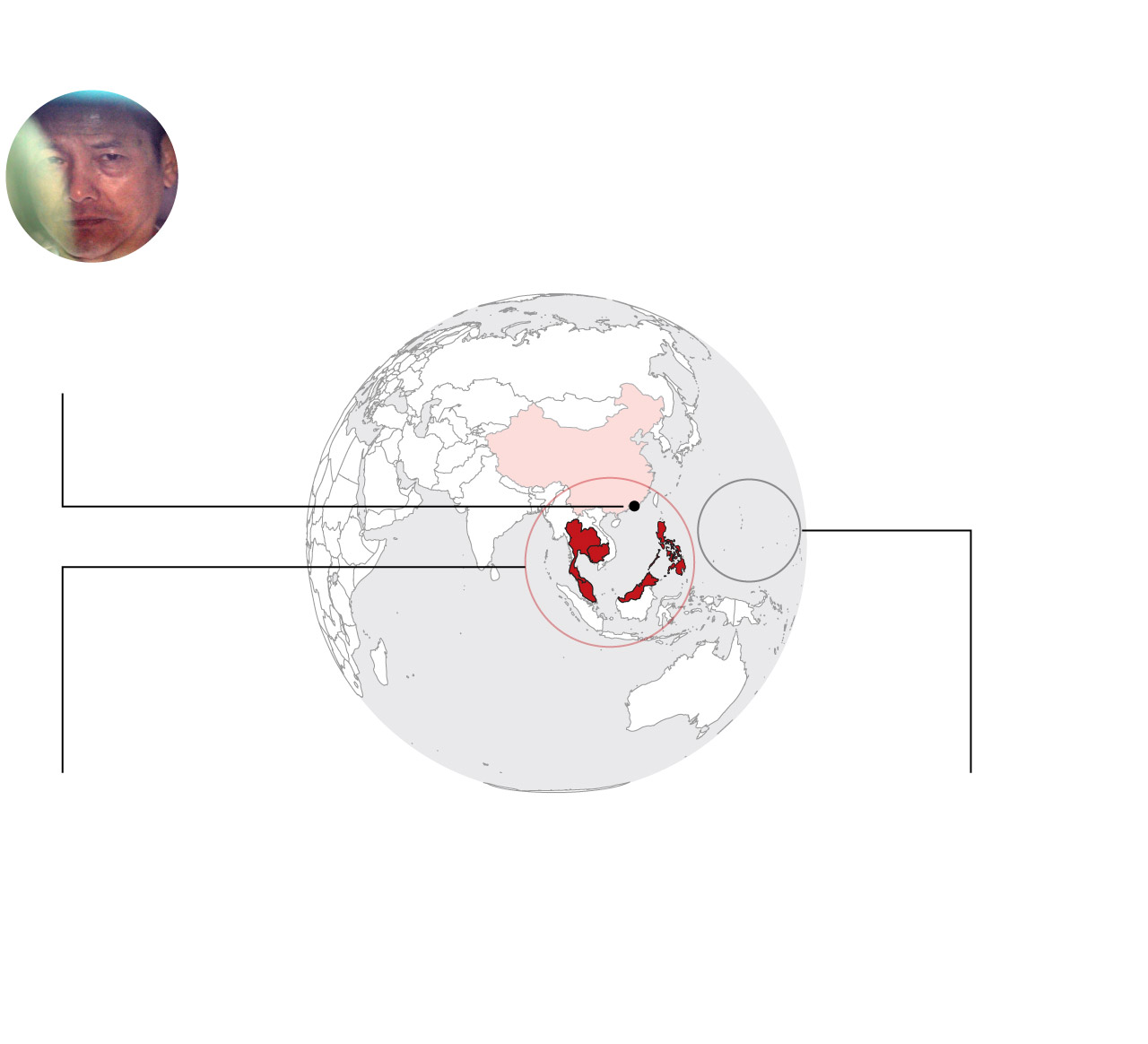
2012-2018: The reinvention of Wan
Wan served 14 years in a high-security prison in Macao for his triad activity.
After his release in 2012, he rebranded himself as a patriot.
CHINA
Macao
PACIFIC
ISLANDS
He launched a cryptocurrency called Hongbi inCambodia, the Philippines, Thailand and Malaysia...
...while also traveling to the Pacific Islands to promote the Belt and Road Initiative.
Hongmen scrolly ONE: step2
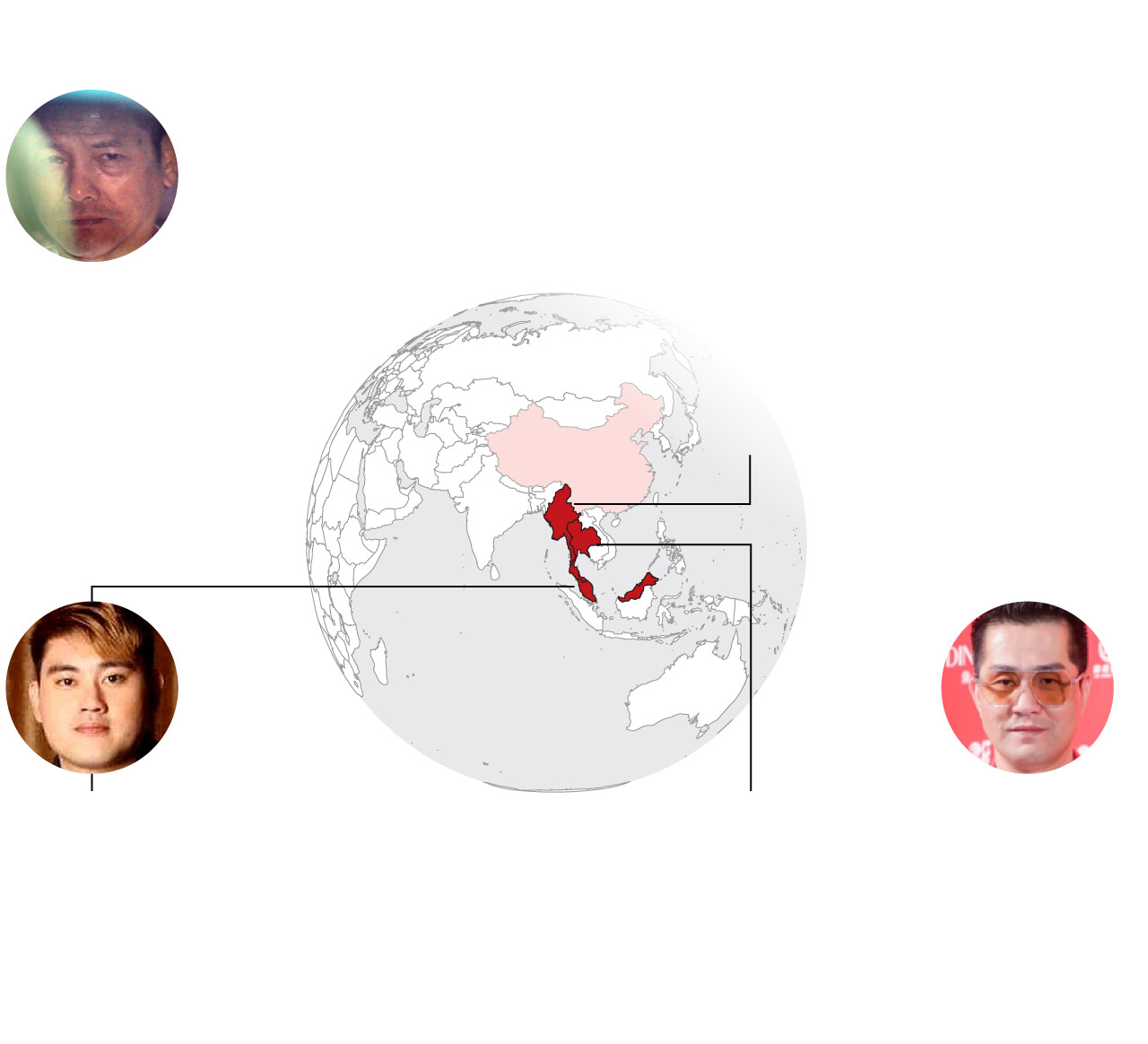
2019-2022: Entrenchment in Asia
Wan appointed leaders to Hongmen chapters across the Asia-Pacific:
In Myanmar,Wan courted investors for a development that turned into a center for online scams and human trafficking, say U.S. officials.
CHINA
MYANMAR
THAILAND
MALAYSIA
In Malaysia, Liow helped Wan carry out scams that profit Hongmen, according to Malaysian investigators.
In Thailand,Bai led illicit ventures until a warrant was issued for his arrest by Thai authorities.
In 2018, months after Malaysia’s then-Prime Minister Mahathir Mohamad canceled or paused billions of dollars’ worth of Chinese BRI projects,a Malaysian businessman closely affiliated with the Chinese Embassy, Tan Choon Hwa, helped Wan lead a group of Chinese investors to the capital, Kuala Lumpur, to meet legislators and cabinet officials, as well as Mahathir, according to Malaysian legislators and individuals close to the CCP. Photos and witness accounts also show that Wan’s delegation included a Chinese chair of a CCP-linked entity, the Malaysia One Belt One Road Committee.
Tan did not respond to queries on Wan. Mahathir said he did not recall meeting Wan.
In 2019, Wan attended a commemoration of Macao’s “return to the motherland” alongside CCP leaders, and in 2020, during Hong Kong’s pro-democracy protests, he filmed a video in support of the Beijing-backed National Security Law. As the world reeled from the covid-19 pandemic, Wan placed advertisements in Chinese-language newspapers in Malaysia applauding China’s response.
In 2023, Wan co-hosted an event in Macao to promote investment in Chinese traditional medicine — which the CCP has identified as a BRI priority — appearing alongside a former party leader from Tibet, photos from the event show.
Unlike Chinese triads, which focused on controlling territory, the Hongmen association formed as a “constellation of business structures,” which allowed it to expand rapidly across parts of the Global South hungry for investment, said Nathan Paul Southern, a researcher at the Eyewitness Project, an independent group investigating illicit industries.
Business records show that an early business entity called the Shijie Hongmen Investment Co. was registered in Cambodia in 2018 under the name Xu Ran Ran, who was Wan’s wife, according to law enforcement in Palau and Malaysia. Calls and messages to Xu’s number were not answered.
Other Hongmen companies and chapters were set up in at least eight other countries over a span of three years, public records show, as Wan brought old contacts and new allies into the organization, many of them Chinese nationals with criminal histories, according to public records reviewed by The Post. Of five Hongmen deputies identified by The Post, at least two have been convicted of various criminal offenses, records show.
The association’s first big initiative was a Hongmen-branded cryptocurrency, Hongbi, which was traded on a Hong Kong-based exchange. Documents published by All In Group, a Hong Kong company that partnered with Hongmen, listed a member of the All-China Federation of Returned Overseas Chinese, an arm of the CCP, as a consultant for the project. Hongmen, pitch documents stated, would use blockchain technology to “unite brothers” and facilitate Beijing’s Belt and Road Initiative.
After Hongbi’s launch, however, the price surged and then plunged before the cryptocurrency was no longer traded at all, a pattern indicating “a possibility of the crypto’s use in a money laundering and/or so-called ‘pump and dump’ investor fraud scheme,” UNODC said in a 2024 report on financial crime that named Wan and Hongmen. Messages sent to a listed contact of the All In Group were not returned and the company appears defunct.
Leong, a Hongmen member in Malaysia who asked to be identified only by his surname to avoid reprisals, said most buyers of the Hongbi coin ended up losing money. But the Hongmen association — and Wan specifically — came away richer, Leong said.
Under investigation
After Hongbi, Wan worked with contacts in Genting Highlands, Malaysia’s casino hub, and with local groups to run online scams, manipulate stocks and carry out other schemes, the proceeds of which were funneled to Hongmen-related bank accounts, Malaysian investigators say.
He also courted financiers in Malaysia for a Chinese development project in Myawaddy, Myanmar, that became a center for online scam centers and human trafficking, according to the U.S. Treasury and UNODC, and brought Chinese Malaysian criminal actors closer into the orbit of the CCP, say Hongmen members.
“Wan injected millions of dollars into the local casino industry and is believed to be a key player behind the proliferation of Myawaddy cyberfraud compounds,” UNODC said in a report on underground casinos. “He is also understood to be involved in several related projects in Cambodia and elsewhere in Southeast Asia and the Pacific.”
In 2021, Malaysian authorities charged Nicky Liow, a Hongmen vice president, with being a member of an organized crime group. But after a drawn-out legal process, Liow was acquitted without public announcement, court documents obtained by The Post show. Liow’s lawyer, Rajpal Singh, did not respond to a list of detailed questions.
Malaysian officials pointed to a lack of cooperation from Chinese authorities in the Liow investigation. “It was a failure,” a senior police official in Kuala Lumpur said about the case. The problem for the prosecution, he explained, was that the nexus of power behind Liow’s operations lay abroad, principally in China.
When Beijing began clamping down on scam operations abroad that targeted Chinese citizens, Wan publicly denied ties to the Myanmar development, called Dongmei Zone, and to other scam hubs in Southeast Asia. “It is all lies. I have never been involved in these heartless activities,” he said in a 2024 video shared on Hongmen channels. “In the last years of my life, all I want to do is serve my country.”
Last September, Malaysian police notified Chinese authorities that they were continuing their investigation to look more closely at Wan and his alleged involvement in fraud, bribery and money laundering in the country, according to people aware of the correspondence who described its contents to The Post.
This came just as investigators in the neighboring Philippines opened a separate probe into Wan and Hongmen, in part for their connections to Alice Guo, a disgraced Philippine mayor currently in police custody on suspicion of spying for China and carrying out online scamming, money laundering, and other crimes at facilities in the country, said a senior Philippine official.
A Malaysian academic who served until last year as a member of the China Overseas Friendship Association under the CCP said Chinese authorities tolerate Hongmen involvement in criminal activities in exchange for being able to rely on the group to carry out “influence operations” in key countries.
“What the party wants is to unite groups like Hongmen and others in Thailand, in Cambodia, in Malaysia — unite them to serve the party agenda,” he said.
Inroads into Africa
As it comes under scrutiny in parts of Asia, Hongmen has turned to expanding its operations farther afield, in Africa.
In March 2023, Thai police raided the Hongmen office in Bangkok in response to public videos of Bai Zhaohui, Hongmen’s overseas president, boasting about illicit ventures in the country,and to tips that Bai was operating the Hongmen association without required permits. In the videos, since scrubbed from the internet but saved by Thai authorities and reviewed by The Post, Bai doesn’t specify his activities but tells followers to do “whatever business” makes him money, which Thai police said they believed referred to illicit activity.
Court records in China show that a man matching the name, birth date and birth province of Bai was arrested at least six times and served a prison term from 2016 to 2020 for rape. By the time Thai authorities caught wind of his activities, however, Bai had slipped away.
Two months after Thai police issued a warrant for his arrest on grounds that he was operating businesses and organizations without requisite permits, Bai surfaced in South Africa, where he registered a company called Huichuang Group in Cape Town, business records show. He returned to Beijing for a conference on Africa the following month and in 2024 appeared again in Beijing for a gala with CCP officials.
Dressed in his signature white suit, he introduced himself to a television interviewer as chief executive of a firm with plans to provide security for Chinese businesses in Africa. “Us Chinese abroad,” Bai said, “have to take care of one another.”
Surachate Hakparn, a former Thai police general who led the investigation into Bai, said his officers have communicated all they know about Bai and Hongmen to Beijing. “The Chinese authorities have a lot of information,” Surachate said.
The fate of the investigation, he added, was now up to them.
Messages sent to various social media accounts that posted self-recorded videos and livestreams of Bai were not answered. Neither were inquiries sent to his company’s address listed in business registration documents.
In venturing into South Africa, Bai joined a growing Hongmen network that has ambitions to build influence on the continent.
Hongmen scrolly TWO: step3
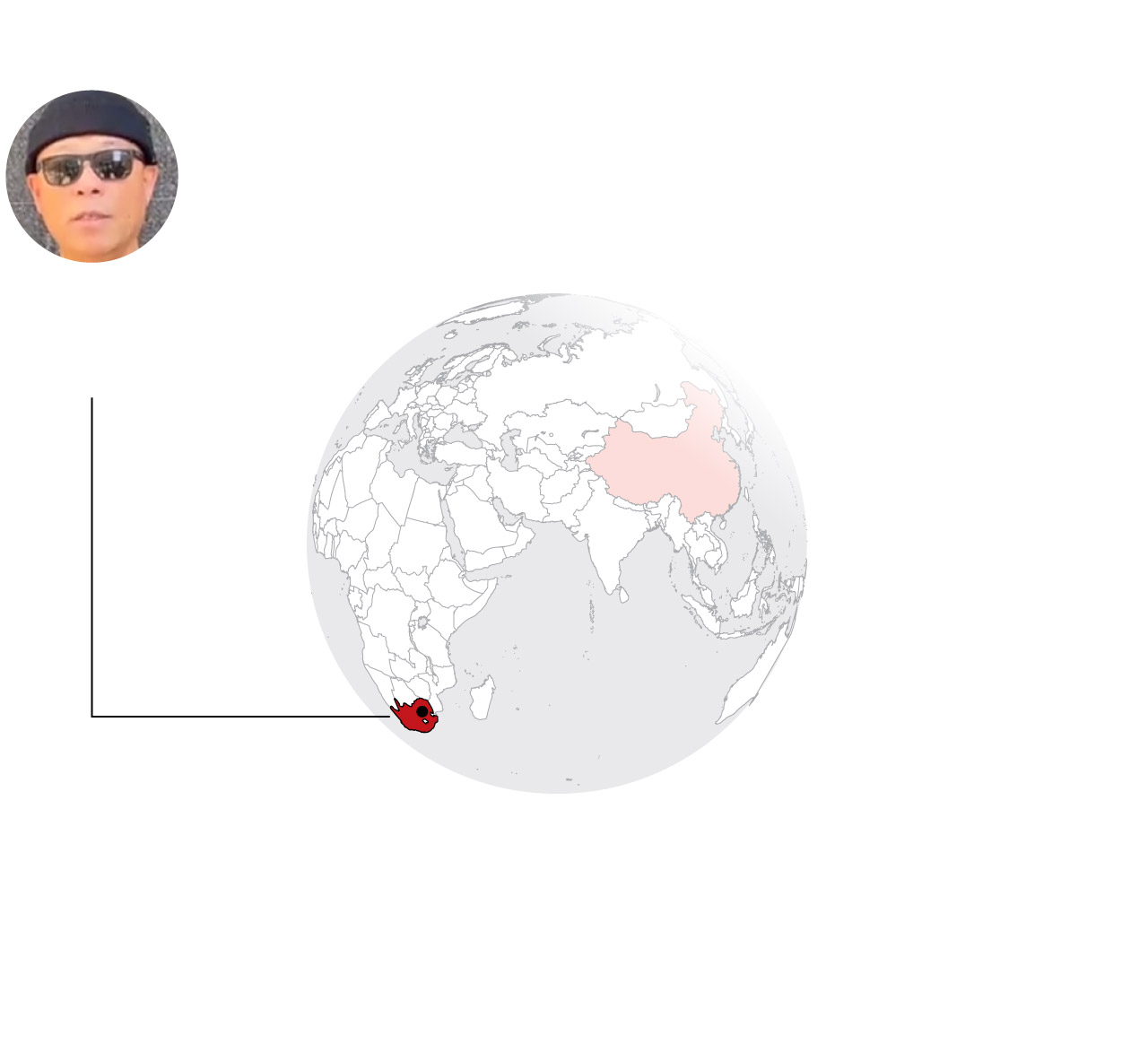
2023: Encroachment into Africa
Lu Liran, Hongmen leader in Johannesburg, South Africa
He was charged in 2011 with a near-fatal assault on a Chinese national in Johannesburg, according to South African police.
CHINA
Johannesburg
SOUTH AFRICA
In 2023, he hosted CCP officials from the city of Luzhou in meetings with South African politicians, photos show.
He ran a private security service escorting Chinese businesses and officials.
Hongmen scrolly TWO: step4
2023: Encroachment into Africa
Ye Baochun, Hongmen leader in Kampala, Uganda
Ye heads the quasi-governmental Chinese Union of Uganda and has been described as a “consular assistance officer” by the Chinese Embassy.
CHINA
UGANDA
In 2023, he established the China-Uganda Security and Overseas Chinese Cooperation Center, which rights groups say could be used to aid Chinese espionage. ...
... Similar police centers have been used to surveil diaspora communities and intimidate Chinese critics abroad, according to rights groups.
A glitzy opening
The only authority able to rein in the association is the CCP, say Thorley and other researchers.
Beijing in recent years has enforced a global crackdown on scammers targeting Chinese nationals, rescuing thousands of victims and hauling perpetrators back to China. The Hongmen network, however, has been left relatively untouched even as it continues to be involved in scamming operations in Southeast Asia that have targeted victims from across the world, including Americans, according to U.S. officials, U.N. investigators, and research organizations like the U.S. Institute of Peace and the Eyewitness Project.
In Cambodia, at the same time the Chinese Embassy has repatriated Chinese criminals by the planeload, Hongmen has registered new businesses and opened retail storefronts, public records show. This is because Hongmen leaders, with their close ties to the Cambodian elite, have become key figures in China’s relationship with the country, a staunch supporter on contentious issues such as the treatment of Muslim Uyghurs in China’s Xinjiang region, say Western diplomats in Cambodia.
Cambodia’s Foreign Ministry did not respond to requests for comment.
Hongmen held a glitzy opening last July for a retail store in Phnom Penh, which was attended by Cambodian politicians, generals and celebrities,photos and videos show. Hongmen documents and business registration records show that a Chinese national and association vice president, Cai Zhiqin, was last year named director of newly incorporated businesses in Cambodia to manufacture and distribute Hongmen-branded merchandise. Neither Cai nor his listed businesses responded to requests for comment.
One recent afternoon, a Post reporter visited the Hongmen store, located in a Chinese enclave dotted with casinos and cryptocurrency exchanges. The store appeared to be more a projection of power than a functioning business. Inside a gleaming gold storefront monitored by guards, a video featuring Wan played on a loop. There were no other customers.
An employee, who declined to give her name, said the store was a hub for the Hongmen association. Members come from all over Southeast Asia and beyond and hold meetings on the second floor, the employee said. What about all the merchandise on display? Was it for sale? The employee shook her head at the stacks of Hongmen-branded cigarettes, cigars, beer, whiskey, tea, water, watches and T-shirts. None of it was for sale.
Smiling, the employee explained, “It’s just for show.”
About this story
Graphics by Álvaro Valiño. Graphics editing by Adrián Blanco Ramos. Photos by Ian Teh. Photo editing by Jennifer Samuel. Video editing by Zoeann Murphy. Text editing by Peter Finn. Copy editing by Martha Murdock.
Michael E. Miller in Ngerulmud, Palau; Beauregard Tromp in Johannesburg; Vincent Tan in Kuala Lumpur; and Wilawan Watcharasakwej in Bangkok contributed to this report.
Rebecca TanRebecca Tan is the Southeast Asia Bureau Chief, with occasional stints elsewhere. She was a Livingston Award finalist for her reporting on conflict in Myanmar and was previously part of the team that won the Pulitzer Prize in public service for coverage of the Jan. 6 attack on the U.S. Capitol.
Pei-Lin WuPei-Lin Wu joined The Washington Post’s China Bureau in 2021.