BUCKNACKT'S SORDID TAWDRY BLOG
We should not be a journey to the grave with the intention of arriving safely in an attractive & well preserved body, but rather to skid in sideways, chocolate, bier or wein in hand, body thoroughly used up, totally worn out and screaming "WHOO-HOO, WHAT A RIDE!!!!!!"
NORTON META TAG
Showing posts with label wells fargo/wells fraudgo. Show all posts
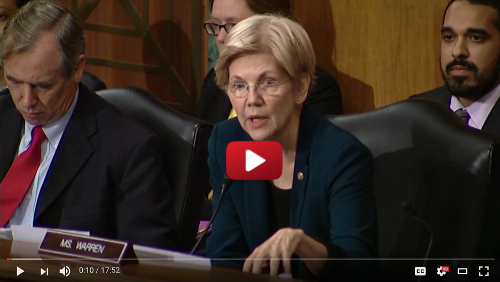
THIS is a huge victory for the American financial consumer and against the bank-financial cabal on wall street. But it isn't over. john stumpf resigned (watch Sen Warren grill stumpf) as ceo of wells fraudgo/fargo and lost his $41 million severance package. He still has the profits he made from the fraud committed while ceo, and he has yet to be criminally charged. +Senator Elizabeth Warren D MA is pushing for the last two to happen. It is because of her the CFPB has the power and authority to regulate, investigate and punish the greed of the financial wall street powers that be. They are not to big to be challenged and held accountable by the CFPB. Now it is time for the Dept of Justice and the Securities and Exchange Commission to take action. This is followed by a report from +The Huffington Post on Sen Warren challenging sec chair mary jo white on her lack of regulation of investment and financial institutions. Watch the video from the Young Turks explaining why wall street hates Sen Elizabeth Warren. We need to keep Sen Warren in the Senate, please consider donating to her re-election campaign, and to other +BoldProgressives endorsed senate candidates (I did). With Hillary Clinton as president and the US Senate returned to the Democratic Party we can work together to keep America great and even make it greater for all Americans.
BIG UPDATE: Wells Fargo CEO/bankster grilled by Elizabeth Warren suddenly quits! (Next stop jail?)
And Sen. Warren isn't finished with him yet!
CNBC reports: Warren renewed her assertion that Stumpf should be criminally investigated. She has previously said that change would only come to Wall Street if executives faced a real threat of jail time.
VIDEO: Elizabeth Warren just gave Wells Fargo's CEO a lesson he won't soon forget. Now she's pushing for a criminal investigation.
Rachel Maddow said last night that Warren roasted the CEO on a spit and called Warren a "force of nature when it comes to watchdogging big business and Wall Street."
Yesterday, the CEO of Wells Fargo sat in front of the Senate Banking Committee and tried to blame low-level employees making $12 an hour for one of the most widespread frauds we've ever seen.
Elizabeth Warren wasn't having any of it.
She told him what prosecutors should have said months ago:he should resign, give back his bonuses, and face criminal charges.
This is why we elected Senator Warren -- to stand up to Wall Street fraudsters. Now she's pushing for criminal investigations, and with all the press coverage she's getting after yesterday's hearing there's real momentum.
John Stumpf, the CEO of Wells Fargo, is the #1 highest paid bank CEO in the country. And yet he claims that only low-level employees should be held accountable for a scam his company was running for at least 5 years, affecting millions of accounts.
Here's what happened: Wells Fargo created over two million bogus bank and credit card accounts using their customers’ personal information without their knowledge. When customers started getting hit with overdraft fees and late charges on accounts they didn't even know existed, Wells Fargo saw their profits soar.
The Los Angeles Times first uncovered the scam in 2013, but government investigators have found that it continued right up until this year.
As a result of the scandal, Wells Fargo has fired over 5,000 low level employees -- and not one single member of senior leadership.
Senator Warren is pushing hard for the SEC and Justice Department to prosecute the executives who oversaw and profited from Wells Fargo's fraud.
Thanks for being a bold progressive. And for supporting this bold progressive who does us proud -- Senator Elizabeth Warren.
-- Keith Rouda, PCCC organizer
Want to support the Warren wing? Senator Elizabeth Warren says, "When PCCC members donate millions in small-dollar donations and make millions of phone calls for progressive candidates, leaders in Washington, they take notice." Chip in $3 here.
Zach CarterSenior Political Economy Reporter, The Huffington Post
GARY CAMERON / REUTERS
WASHINGTON ― Sen. Elizabeth Warren (D-Mass.) on Friday asked President Barack Obama to replace the government’s top securities regulator for “brazen conduct” that “hurts investors, undermines administration policy, and willfully misinterprets congressional mandates.”
Warren is taking aim at Securities and Exchange Chair Mary Jo White, a former prosecutor and corporate lawyer who has long supported limiting corporate disclosures to investors. White is an Obama appointee who identifies as a political independent and often sides with a Republican commissioner. She has been in Warren’s crosshairs for years.
For years, White has scuttled a rule Congress ordered the SEC to write that would require companies to detail their political spending. By delaying the rule, White gave Republican lawmakers an opportunity to delay it even further by including language in must-pass government funding bills to put off the disclosures. Whitepublicly criticized another rule mandated by Congress that would have required the companies to disclose their use of conflict minerals ― natural resources that are mined to fund brutal violence in the Democratic Republic of the Congo. A federal court eventually negated the law, citing White’s speech against it.
In her Friday letter to President Obama calling for White’s dismissal, Warren noted that the SEC has neglected to write 19 regulations required by the 2010 Dodd-Frank law.
“She has failed to complete disclosure mandates Congress enacted in the wake of the 2008 financial meltdown, while simultaneously devoting the SEC’s limited discretionary resources to a far-reaching, anti-disclosure initiative cooked up by big business lobbyists seeking to reduce the amount of information public companies must make available to their investors,” Warren wrote.
It would be very unusual for the president to remove the SEC Chairman. SEC Commissioners are appointed with the approval of the United States Senate. But under an obscure regulation, the president has the authority to designate which of the five SEC Commissioners serve as the Chairman. There are currently only three SEC Commissioners, due in part to Republican obstruction of Obama appointees. White’s term ends in 2019, but removing her as chair and naming Democratic Commissioner Kara Stein in her place would allow another leader to set the agency’s agenda.
Warren railed against White in a June congressional hearing, saying she was “more disappointed than ever” over the SEC’s efforts to scale back corporate disclosures. White insisted the disclosures unnecessarily burden companies.
“I’ve never heard of the idea that investors want less information than they’re getting,” Warren said. “Let’s be honest about this. I cannot find and you have not produced a single investor who has complained to the SEC about getting too much information.”
The spat came amid a review of possible updates, released in April, to SEC rules that would require businesses to disclose financial risk posed by global warming, or government crackdowns on corporate profits stashed in offshore tax havens.
“More than a million people, including countless investors and former SEC commissioners, are pushing the agency to require publicly traded companies to disclose their political contributions,” Warren added.
At the same hearing, Sen. Charles Schumer (D-N.Y.) piled on criticism of the SEC for failing to require companies to disclose their political contributions.
“You’re hurting America,” Schumer told White. “Your priorities are out of line with what corporate America needs and America needs, and I hope when you go to bed late at night, you would think about that.”
Warren over the summer pilloried the SEC for failing to finalize rules and waivers, and for settling cases without obtaining guilty pleas. She also criticized links between the companies White oversees, and both the law firm where she once worked, and the one her husband currently runs.
Warren’s push for White’s ouster comes on the heels of her victory against Wells Fargo, embroiled in a scandal over widespread fraud. During a congressional hearing last month, Warren speared now-retired CEO John Stumpf. She called for him to resign and be “criminally investigated.” Days later, the bank’s board forced Stumpf to forfeit $41 million in unvested stock and give up his $2.8 million annual salary. He resigned on Wednesday.
Warren, who has served as an outspoken surrogate for Democrat Hillary Clinton’s presidential campaign, appears to be staking out her place in a future administration. Last month, Warren ― who has repeatedly attacked Republican nominee Donald Trump on Twitter in recent months ― signaled she would try to stop any appointment of big bank executives to Clinton’s cabinet.
“We believe Sen. Elizabeth Warren is succeeding in establishing herself as the chief financial policymaker in a potential Clinton White House,” Jaret Seiberg, managing director at the financial research firm Cowen Group, wrote in an investor memo last month. “She has threatened to stop Clinton nominees with ties to BlackRock and other firms. And she is using the bully pulpit to shape the debate over the Wells Fargo cross-selling controversy.”
Leaked emails show just how much Wall Street can’t stand Elizabeth Warren. Cenk Uygur, host of The Young Turks, breaks it down. Tell us what you think in the comment section below. CLICK HERE to become a Wolf PAC member http://www.tytnetwork.com/wpmember
“WALL STREET DONORS have used their financial relationship with the Democratic Party to complain bitterly about Sen. Elizabeth Warren’s, D-Mass., influence over the direction of the party, a new fundraising document reveals. At one point, the Democratic lawmaker in charge of raising cash for House Democrats attempted to reassure donors by pointing to a news story claiming that Warren does not speak for the party.
The document, a fundraising summary compiled by the Democratic Congressional Campaign Committee, provides a window into the relationship between the Democrats and major interest group donors. The party held meetings with donors such as Goldman Sachs and General Electric and carefully compiled their concerns, even when they whined about core progressive goals. It’s an awesome example of how money greases the wheels of Washington, D.C.
The notes were compiled on behalf of Rep. Ben Ray Luján, D-N.M., the chair of the DCCC, providing a summary of his fundraising meetings with various corporate and union donors. The DCCC did not respond to a request for comment.”
With just over a month until Election Day, The New York Times has dropped a bombshell report that suggests Republican presidential nominee Donald Trump may have avoided paying ... Read More →
Donald Trump has threatened to sue The New York Times for publishing leaked pages from his tax returns, and the paper’s executive editor, Dean Baquet, said he would do so ... Read More →
donald drumpf and the republicans hate the CFPB / Consumer Financial Protection Bureau, created by +Senator Elizabeth Warren D MA to protect American consumers from the greed of the bank-financial wall street cabal, the people who created the 2008 recession. The CFPB brought the wells fargo fraud story to light, fined wells fargo $185 million for their criminal activity and Sen Warren has been at the forefront of the US Senate Banking Committee's investigation on wells fraudgo. If donald drumpf is elected president and the republicans retain control of the Senate they will destroy the CFPB, leaving wells fraudgo and the rest of the bank-financial wall street cabal to pillage the American people and economy. Check out this video of Sen Warren during the Senate Banking Committee's hearings on wells fargo's criminal activities followed by her questioning at the Senate Banking Committee's hearings on Consumer Finance Regulations by the CFPB. Videos from Sen Warren's YouTube site and the articles from +Mother Jones and +BoldProgressives .....
Senator Elizabeth Warren's two round of questions for Wells Fargo CEO John Stumpf at the September 20, 2016 Senate Banking Committee hearing entitled: "An Examination of Wells Fargo’s Unauthorized Accounts and the Regulatory Response." For more information on the hearing, click here:http://www.banking.senate.gov/public/...
Senator Elizabeth Warren's Q&A of Leonard Chanin at an April 5, 2016 Senate Banking Committee hearing titled, "Assessing the Effects of Consumer Finance Regulations."
The Senate Banking Committee conducted a hearing Tuesday about the massive scandal currently engulfing Wells Fargo. The word "fraud" was used repeatedly by senators on both sides of the aisle when describing the bank's creation of millions of unauthorized bank and credit card accounts for existing customers.
Fallout from the account scandal continues to pile up. The bank is also facing an investigation by the House Financial Services Committee, subpoenas from the Department of Justice, and at least one potential class-action lawsuit.
First up at Tuesday's Senate hearing was Wells Fargo CEO John Stumpf, who was grilled by the committee for almost three hours.
Massachusetts Sen. Elizabeth Warren—a longtime advocate for more stringent regulation of Wall Street—tore into Stumpf, describingthe unauthorized accounts as a "massive, yearslong scam." She asked Stumpf what he has done to take responsibility for his bank's actions. "You have said repeatedly, 'I am accountable,'" she said. "But what have you done to actually hold yourself accountable? Have you resigned?"
Stumpf avoided answering the question directly, prompting Warren to repeat her question, her voice rising, at least three times.
Warren proceeded to pummel Stumpf with more questions. "Have you returned one nickel of the money you earned while this scam was going on?" she asked. Stumpf evaded the question several times. (Stumpf said earlier in the hearing that he earned $19.3 million last year.) Finally, an exasperated Warren said, "I'll take that as a 'no.'"
She then asked if he'd fired any members of his senior management. Stumpf initially began by describing the firing of regional branch managers, but Warren stopped him, emphasizing that her question was not about low-level leadership but about the people at the top. Again, Stumpf's answer was no.
When Warren asked Stumpf if he knew how much the value of his bank's stock had gone up over the time that the unauthorized accounts were created and maintained, Stumpf replied the information was in the public record. "You're right, it is all in the public records," Warren said, "because I looked it up." She continued: "While this scam was going on, you personally held an average of 6.75 million shares of Wells stock." The share price went up by about $30 in that time frame, Warren pointed out, "which comes out to more than $200 million in gains, all for you personally."
Warren ended her speech by calling on Stumpf to resign and for both the Department of Justice and the Securities and Exchange Commission to investigate the CEO. Here's an excerpt of her speech:
You know, here's what really gets me about this, Mr. Stumpf. If one of your tellers took a handful of $20 bills out of the cash drawer, they'd probably be looking at criminal charges for theft. They could end up in prison. But you squeezed your employees to the breaking point so they would cheat customers and you could drive up the value of your stock and put hundreds of millions of dollars in your own pocket. And when it all blew up, you kept your job, you kept your multimillion-dollar bonuses, and you went on television to blame thousands of $12-an-hour employees who were just trying to meet cross-sell quotas that made you rich. This is about accountability. You should resign. You should give back the money that you took while this scam was going on, and you should be criminally investigated.
You can watch Warren's full questioning above.
HANNAH LEVINTOVA
Hannah Levintova is a reporter in Mother Jones' DC bureau. You can email her at hlevintova[at]motherjones[dot]com. For more of her stories, click here.
Yesterday, the CEO of Wells Fargo sat in front of the Senate Banking Committee and tried to blame low-level employees making $12 an hour for one of the most widespread frauds we’ve ever seen.
Elizabeth Warren wasn’t having any of it.
She told him what prosecutors should have said months ago: he should resign, give back his bonuses, and face criminal charges.
This is why we elected Senator Warren—to stand up to Wall Street fraudsters. Now she's pushing for criminal investigations, and with all the press coverage she's getting after yesterday's hearing there's real momentum.
John Stumpf, the CEO of Wells Fargo, is the #1 highest paid bank CEO in the country. And yet he claims that only low-level employees should be held accountable for a scam his company was running for at least 5 years, affecting millions of accounts.
Here’s what happened: Wells Fargo created over two million bogus bank and credit card accounts using their customers’ personal information without their knowledge. When customers started getting hit with overdraft fees and late charges on accounts they didn't even know existed, Wells Fargo saw their profits soar.
The Los Angeles Times first uncovered the scam in 2013, but government investigators have found that it continued right up until this year.
As a result of the scandal, Wells Fargo has fired over 5,000 low level employees -- and not one single member of senior leadership.
Senator Warren is pushing hard for the SEC and Justice Department to prosecute the executives who oversaw and profited from Wells Fargo's fraud.
Thanks for being a bold progressive. And for supporting this bold progressive who does us proud -- Senator Elizabeth Warren.
-- Keith Rouda, PCCC organizer
Want to support the Warren wing? Senator Elizabeth Warren says, "When PCCC members donate millions in small-dollar donations and make millions of phone calls for progressive candidates, leaders in Washington, they take notice." Chip in $3 here.
Wells Fargo CEO John Stumpf is in the hot seat. Last week his bank was fined $185 million in penalties after employees subject to aggressive sales goals opened two million accounts without customers' knowledge, "often racking up fees or other charges," according to the Consumer Financial Protection Bureau. (Photo by Justin Sullivan/Getty Images)
Wells Fargo CEO John Stumpf started the year off on something of a throne. In January, the investment research firm Morningstar named him "CEO of the Year" for 2015, noting that he "guided the bank through a difficult period in the industry and shunned activities that put profits ahead of customers."
Fast forward nine months, and Stumpf is on the hot seat instead. Last week, his bank was fined $185 million in penalties after employees, in effect, put money before customers. Subject to aggressive sales goals, some two million accounts opened by Wells Fargo workers may have been unauthorized, created without customers' knowledge and "often racking up fees or other charges," according to the Consumer Financial Protection Bureau.
Federal prosecutors have reportedly launched an investigation into the company's sales tactics. The bank's stock has dropped 9 percent since the news hit. And Stumpf has been called to Capitol Hillto testify before the Senate Banking Committee, which is surely eager to hear him explain how Wells Fargo had fired 5,300 employees over a period of five years while the executive who ran the community banking unit has amassed compensation in vested stock, options and retirement benefits that, according to an analysis from Bloomberg, was valued at $90 million this past week.
The past week of devastating headlines for the nation’s now second largest bank by market value -- in more bad news, it lost that crown to J.P. Morgan this week --could deal a major blow to Wells Fargo’s reputation, say communications advisers and management professors. In the Wells Fargo scandal, they see a case study that illustrates the perils of aggressive sales goals — risky enough, in Wells Fargo's case, that the bank said it would eliminate them altogether starting Jan. 1. They point to the damage in trust that could be done to a brand that has sought to distinguish itself for its not-like-Wall-Street ways. And they question executives' initial comments about the company’s culture, which seemed to isolate bad actors from the corporate whole and shift the blame to low-level employees.
"There are not 5,000 bad apples," said Maurice Schweitzer, a professor at the University of Pennsylvania's Wharton School who studies ethical decision-making. "It was as if whole-scale divisions of people were put under unrealistic expectations, [and] told to turn in numbers."
Since news of the penalties erupted last week, Wells Fargo has taken out full-page ads in major newspapers including The Washington Post expressing its regret and taking "full responsibility." It said it has refunded customers' fees for unauthorized accounts. And it said it has improved its communication, training and compliance, adding steps to confirm account openings, and eliminating the product sales goals in retail banking.
Yet experts in corporate reputation management questioned comments made by the bank's executives since news of the scandal hit. At a financial services conference in New York Tuesday, Wells Fargo CFO John Shrewsberry appeared to blame employees for the unauthorized accounts, saying "it was really more at the lower end of the performance scale, where people apparently were making bad choices to hang on to their job," according to CNBC. A Wall Street Journal article on Tuesday included a headline that said Stumpf "lays blame with bad employees," quoting him as saying "there was no incentive to do bad things" and that the bad behavior "in no way reflects our culture." Stumpf, the Journal explained, "initially wouldn’t comment on who was ultimately responsible for the practices and sales-driven culture."
The report noted that Stumpf later said, through a spokesperson, that "I feel accountable and our leadership team feels accountable," remarks he echoed in an interview with The Washington Post and with CNBC's Jim Cramer. In the CNBC interview, Stumpf again said the unauthorized accounts were not representative of the company's culture, but started out the interview by apologizing.
"To the extent that we don't get it right 100 percent of the time," Stumpf said, " 'cause that's our goal -- if we don't make that plan, I'm responsible. I'm accountable."
Melissa Arnoff, who leads the corporate reputation practice at the communications firm Levick, graded Wells Fargo's response as "starting off poorly, but getting better. The fact that [the CEO] waited so long to say anything at all -- and then the first thing [Stumpf] said is 'it's the employees fault?' Obviously, yes, it is the employees who created the accounts. But there's something wrong with the internal system if this went on for five years and involved at least 5,300 employees."
Others pointed out the problems of trying to distance the company's overall culture from those who created the phony accounts. Irving Schenkler, a professor of management communication at New York University, said that if the finger is pointed too sharply at lower-level workers, it "could cause unintended consequences or backlash," sparking disgruntled employees to come forward or current workers to lose trust in leadership. "It could breed cynicism," he said.
Richele Messick, a spokesperson for Wells Fargo, said in an email that the company has made "substantial investments in additional monitoring and controls" and said that "we have made fundamental changes to help ensure team members are not being pressured to sell products, customers are receiving the right solutions for their financial needs, our customer-focused culture is upheld at all times and that customer satisfaction is high." In a follow-up phone call, she said "we have shared that we have been making changes to our processes, our controls, our training, our incentives for several years."
Meanwhile, Anthony Johndrow, CEO of a reputation management advisory firm in New York, said that for banks like Wells Fargo, a reputation hit like the current scandal could be particularly damaging. The so-called "reputation gap" between how customers of a bank view the company and how non-customers view it is much wider than in other industries. Since the financial crisis, customers have gone from disliking banks in general but liking their own bank to hating the banks and being just okay with their own banker, he says. That makes the risk of losing the faith and trust of their own customers that much more serious.
"When you have a massive scandal like this, which basically puts Wells Fargo in the role of villain of their customers," he said, "you've really threatened that strength they have with their customers."
One part of Wells Fargo's response that got better reviews was its decision to do away with its product-based sales goals. "Wow," said Lisa Ordóñez, a professor of management at the University of Arizona who studies goal-setting. At Wells Fargo, bank employees were pushed to "cross-sell" different types of accounts to customers, with goals of reaching as many as eight accounts per account holder, according to a complaint filed by the Los Angeles City Attorney. The complaint also said daily sales for each branch and each sales employee were "reported and discussed by Wells Fargo's district managers four times a day."
An investigation by the Los Angeles Times into the sales practices back in 2013 reported that branch managers had to commit to 120 percent of daily numbers and tellers had to come up with at least 100 sales of financial services per quarter. Aggressive sales goals are frequently cited in anonymous employee reviews on Glassdoor.com, a career web site.
One question, of course, is what will replace it. Decades of research have shown that it's effective to set specific, challenging goals for employees. But the potential downsides -- unethical behavior, distorted appetites for risk -- get far less attention, Ordóñez says, pointing to several recent scandals at organizations where audacious goals were set. From Volkswagen (where the "diesel-gate" scandal came amid a push to become the world's largest automaker) to the Veterans Administration (where a 14-day scheduling goalwas said to lead to widespread cheating) to Wells Fargo, Ordóñez said, "there's just example after example after example. If you set tough goals, and you don't monitor them, frankly, you're asking for this kind of behavior."
Ordóñez has researched how multiple goals can wear people down over time, leading to greater unethical behavior. And she wrote a paper with Wharton's Schweitzer called "Goals Gone Wild" which argues that the "systematic harm caused by goal setting has been largely ignored."
In any company, Schweitzer says, "when everybody to your left and right is turning in numbers you can’t possibly reach without cheating, and everybody’s getting rewarded for it, and your leadership’s basically telling you to turn in those numbers -- it takes a very unusual person to blow the whistle or not fall into that pattern."
Of course, the next round of reviews for how Wells Fargo is managing its crisis will come next week, when Stumpf heads to Capitol Hill. While there, says Johndrow, he's likely to face the Catch-22 of responding to questions about what he knew and when. Saying he did know about the behavior would cause its own set of problems. Yet saying the opposite to a Senate committee, particularly for banks that have dealt with the "too big to fail" image for years, isn't much better. As Johndrow puts it: If Stumpf was "to say 'we're too big for me to be aware of this' -- it just doesn't work."