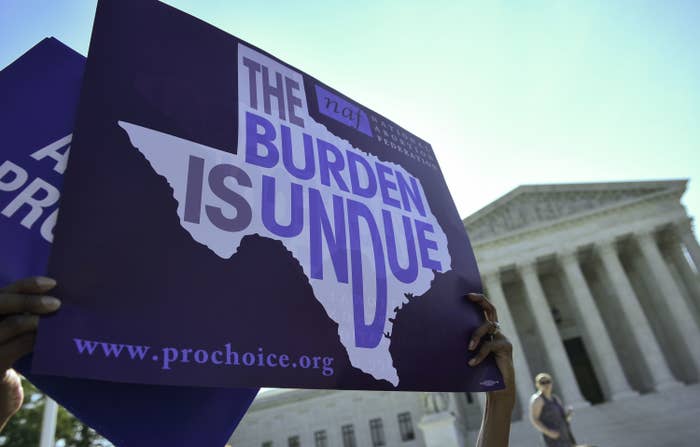
Two federal judges issued orders on requiring
Texas and Ohio to allow abortion clinics to stay open and keep providing services in the states Monday. Texas Attorney General Ken Paxton had ordered
a ban on abortions last week, saying it did not qualify as “essential” health care (except in cases of a threat to the life of the pregnant person), and any scheduled procedures to be postponed amid the
coronavirus outbreak in order to mitigate the spread of the virus and devote any medical resources to treating it. Ohio’s Department of Health had issued the same interpretation.
Planned Parenthood and the American Civil Liberties Union quickly
filed emergency lawsuits, arguing that the orders were unconstitutional and demanding they be halted and clinics in the state be allowed to continue their work. Judges granted their request for temporary restraining orders to keep clinics open in both states Monday evening.
In his decision, US District Court for the Western District of Texas Judge Lee Yeakel said that Texas’s order would cause “irreparable harm” to abortion clinics and their patients, and that this harm “outweighs” Texas’s reason for the order.
“Regarding a woman's right to a pre-fetal-viability abortion, the Supreme Court has spoken clearly. There can be no outright ban on such a procedure,” Yeakel wrote. “This court will not speculate on whether the Supreme Court included a silent ‘except-in-a-national-emergency clause’ in its previous writings on the issue.”
Yeakel said that only the Supreme Court can clarify if a ban on abortion can be applied during a national crisis, and that he will not try to predict what the Supreme Court will decide if the case against Texas’s ban reaches the justices. His temporary restraining order will prevent the ban from affecting clinics in Texas while the case moves forward and expires April 13 (though it could be extended).
The decisions in Texas and Ohio come hours after Planned Parenthood, alongside a coalition of abortion rights organizations, filed a series of lawsuits in three other states as well, seeking similar judgements preventing Oklahoma, Iowa, and Alabama from temporarily banning abortion as part of their plans to mitigate the
coronavirus pandemic.
Over the past week, all five states had issued similar interpretations of state executive orders, suspending all “nonessential medical procedures,” saying abortion services were not essential and, in some cases, threatening criminal action against medical workers who violated the order.
Planned Parenthood, the American Civil Liberties Union, and the Center for Reproductive Rights quickly joined together to respond, arguing that the conservative states with anti-abortion legislative histories were “taking advantage” of the coronavirus crisis to effectively ban abortion in their states, and that the orders were unconstitutional. Each of the lawsuits demand an “emergency stay” on the orders so that the clinics in those states can reopen or stay open and continue to provide abortion care. The groups were joined in the press conference by the American College of Obstetricians and Gynecologists (ACOG) and the Abortion Care Network.
“It's not surprising that the states that are now using the COVID crisis to stop people from getting abortion care are the very same states that have a history of passing laws to ban abortions or using sham rationale to shut down clinics,” Jennifer Dalven, the director of the Reproductive Freedom Project with the ACLU, said on a call with the press Monday.
Since the coronavirus reached the US and started spreading at breakneck speed — by Monday there were around 159,000 confirmed cases and nearly 3,000 deaths in the US,
according to the latest data compiled by Johns Hopkins — governors across the country have been issuing order after order to help enforce social distancing, prevent large gatherings, and limit the spread of the virus.
Over the past week, each of the governors in the five states ordered “nonessential” medical procedures to be postponed for several weeks, stating that this measure would help dedicate as many medical personnel and resources as possible toward treating the virus. Following this order, each of those states then specified that they considered abortion services “nonessential” and instructed Planned Parenthood and other abortion clinics in the states to shutter.
In Texas, which
issued its ban last Monday, state Attorney General Ken Paxton followed up on Gov. Greg Abbott’s order, specifying that any medical worker providing abortion care before the order’s expiration date of April 21 could be fined $1,000 or face jail time of up to 180 days. Paxton even ordered clinics to stop issuing medication abortion to patients, which can be provided outside of the clinic via telemedicine.
Ohio’s order caused much confusion among clinics and reproductive rights organizations. On March 17, Gov. Mike DeWine ordered the cancellation of all nonessential medical procedures, and shortly thereafter, Ohio’s deputy attorney general, Jonathan Fulkerson, sent
letters to several abortion clinics in the state, accusing them of being in violation of the order. The clinics’ lawyers quickly responded, assuring Fulkerson’s office that they were in compliance with the order and were taking all necessary precautions. After some back and forth, Ohio’s Department of Health eventually issued further guidance saying that the ban applied to abortion clinics.
Alabama, which passed a
near total ban on abortion over the summer that
was blocked in court, issued its own order calling for the close of abortion clinics Saturday night. The order threatened criminal penalties for doctors who violated it, but was vague about exactly what services or actions would violate the order.
This vagueness “puts doctors in a terrible position of being forced to risk their licenses and risk prosecution in order to provide care,” Dalven said.
Planned Parenthood quickly
filed a lawsuit in Texas on Thursday — the first of the five suits — arguing that the order was in violation of
Roe v. Wade. Each of the ensuing lawsuits used similar language and arguments.
The organizations have requested emergency rulings in each of the cases for Monday evening, but it is unclear when those rulings might actually occur.
Hundreds of patients seeking reproductive health care have already been affected by the orders, the coalition said. In Alabama, when the clinics had to call patients to cancel their abortion appointments by phone, many of the patients cried, Dalven said.
Many patients seeking abortions in Texas had been traveling to Oklahoma for care since the ban came down last week, but now that Oklahoma has issued a ban as well, many people are stuck and unsure of what to do, Nancy Northup, the head of the Center for Reproductive Rights (which is leading the Oklahoma lawsuit), said on the call.
“No one stopped needing sexual and reproductive health care in a public health crisis,” acting Planned Parenthood president Alexis McGill Johnson said during the press conference. “People still have sex. They still need birth control, STI testing and treatment, and access to safe and legal abortion.”
Each representative of the five groups joining and supporting the lawsuits argued that abortion is in fact essential health care, and that halting that care does not help to mitigate the spread of COVID-19.
“Stopping [patients] from getting an abortion doesn't lower the risk of transmitting the virus,” Dalven said. “It just forces people to stay pregnant and have children against their will.”
Planned Parenthood clinics around the country that remain open are taking extensive measures to mitigate the spread of COVID-19 at their clinics, Planned Parenthood assured press on the call. They are spacing out patients to limit the number of people in the office, encouraging telemedicine and medication abortion, and making sure their staff has protective equipment.
However, even in states that are not forcing clinics to close, the precautions are beginning to cause barriers to access, as some clinics stop taking new appointments or delay patients’ appointments in order to not overwhelm and crowd the clinics.
On Monday, California’s attorney general, Xavier Becerra,
sent a letter to the US Department of Health signed by 21 state attorneys general demanding increased access to telemedicine reproductive care. The attorneys general asked the Trump administration to remove the regulation of mifepristone — a drug used in medication abortion — so that it could be prescribed in a pharmacy like a normal drug, instead of requiring clinics to give it directly to patients, forcing them to come in and expose themselves and others to increased risk of COVID-19.